Best Legal Drafting Software in 2026: 7 Tools Compared

- Legal drafting software turns templates, precedents, and client data into consistent documents, with less copy-paste and fewer errors.
- Spellbook, Draftwise, and Luminance suit teams that want AI-assisted drafting and review tied to playbooks and precedent.
- Clio Draft suits law firms that want document automation, court forms, and questionnaires inside Clio's platform.
- Definely and Contractbook suit teams that draft and review complex contracts in Word or need simple contract creation and signing.
- Our pick for most legal teams is a tool that fits current workflows, keeps precedent controlled, and leaves final review with lawyers.
Quick comparison
| Product | Ideal for | Price from | Free version | |
|---|---|---|---|---|
 Spellbook | AI contract drafting and review | See website | Free trial | Visit |
 Clio Draft | Law firm document automation | See website | No | Visit |
 Draftwise | Precedent-driven drafting | See website | No | Visit |
 Definely | Complex contract review in Word | See website | Free trial | Visit |
 Luminance | Enterprise contract intelligence | See website | No | Visit |
 Contractbook | Simple contract creation | See website | Free trial | Visit |
 Ironclad | Contract lifecycle drafting | See website | No | Visit |
The best legal drafting software
Legal drafting is repetitive by nature: the same clauses, the same client details, the same forms, with small changes that matter a lot. Good drafting software turns approved language into reusable templates, pulls client and matter data automatically, and flags terms that drift from playbooks. The best tool depends on whether a team drafts mostly contracts, court documents, or firm-wide precedents.
We compared official product pages for legal drafting tools used in the US, looking at templates, AI drafting, review, precedent, integrations, and security. The list below covers AI contract suites, firm document automation, and contract lifecycle tools, so law firms and in-house teams can compare realistic options.
Spellbook
Ideal for: AI contract drafting and review
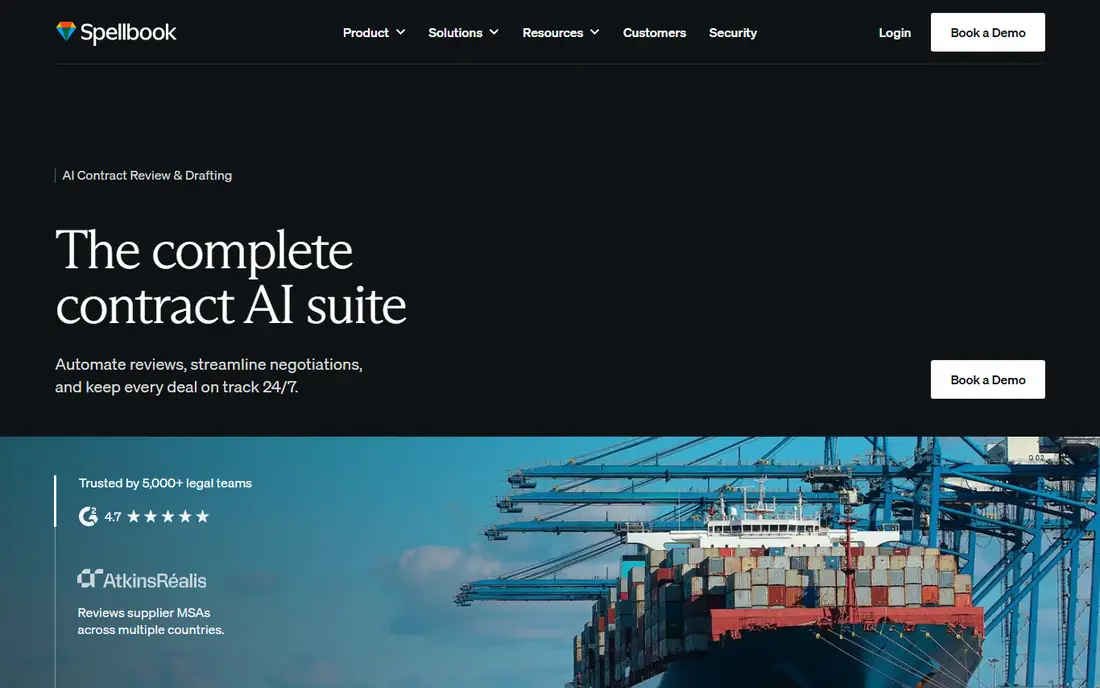
Spellbook is an AI contract review and drafting suite that helps legal teams review contracts, draft agreements, and keep positions consistent across deals. Its homepage highlights intake from email and Slack with first-pass review against standards, drafting of clauses, full agreements, and revisions from AI or precedents, tracked redlines, playbooks that enforce team standards, and a repository for signed contracts with renewal monitoring. Security features include zero data retention from LLM providers, SSO, MFA, encryption, and SOC 2 Type II.
The trade-off is focus and setup. Spellbook centers on contracts, so firms that mainly draft court filings should compare Clio Draft, and playbooks need design to deliver consistent results. Pricing varies by firm and company size. For contract-heavy teams that want drafting plus review in one suite, Spellbook is a leading pick.
- Draft, review, and playbook checks in one suite
- Drafts from precedents
- Strong security and privacy controls
- Pricing by team size
- Contract-focused, less court-form depth
- Needs playbook setup for best results
Clio Draft
Ideal for: Law firm document automation
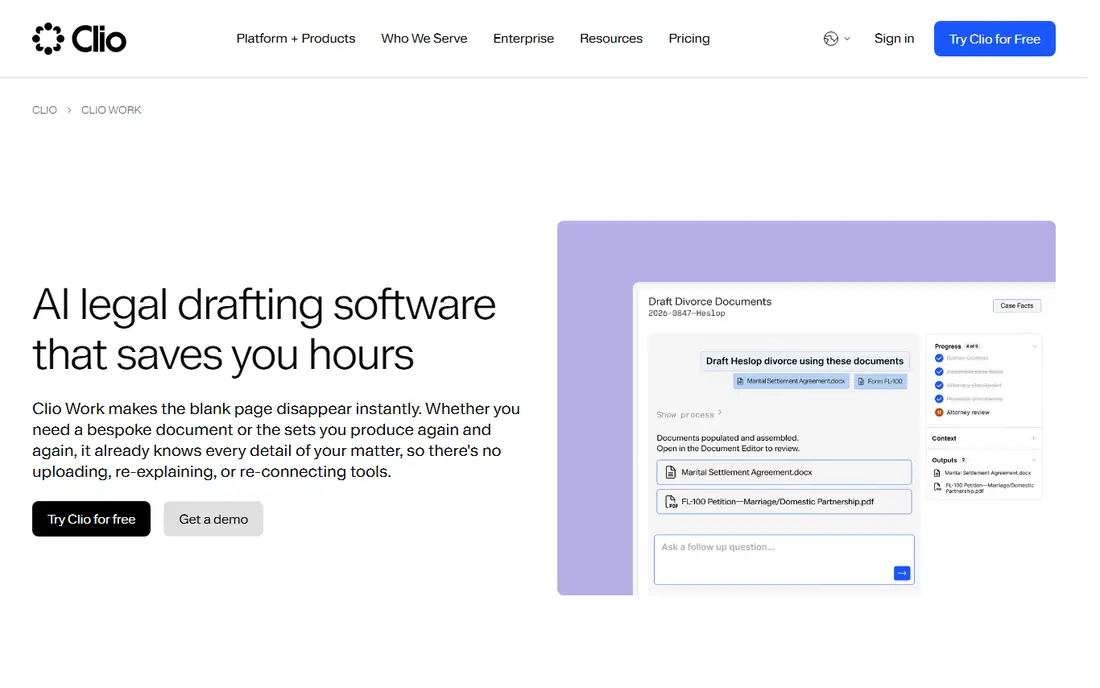
Clio Draft, formerly Lawyaw, is AI legal drafting software on Clio's platform that automates document work from client intake to drafting, with up-to-date court forms for each area. Its homepage highlights converting Word documents into reusable templates, firm-specific starter templates, populating whole document sets at once with automatic pronoun and clause agreement, online questionnaires that map to templates, and built-in e-signatures. Court forms cover all 50 states, plus state, county, and federal immigration forms.
The catch is ecosystem. Clio Draft works best with Clio Manage, where client and matter details flow into templates automatically, so firms outside Clio should weigh integration effort. Pricing is by demo and plan. For law firms that want document automation plus court forms, Clio Draft is a strong choice.
- AI template building from Word files
- Court forms for all 50 states
- Questionnaires and e-signatures
- Works best inside Clio's platform
- Pricing by demo
- Less contract-intelligence depth than Luminance
Draftwise
Ideal for: Precedent-driven drafting

Draftwise offers proprietary intelligence for law, helping firms draft, redline, and research directly from their own precedent and standards. Its homepage stresses drafting with the full insight of precedent, reviewing at firm standards, negotiating better outcomes, and a knowledge layer that structures firm data into a legal ontology. Security includes SOC 2 Type II and ISO 27001 certification, GDPR compliance, DMS permission mirroring, and a promise that firm data never trains public models.
The trade-off is scale. Draftwise suits larger firms with substantial precedent libraries, while smaller firms may get faster value from Spellbook or Clio Draft. Pricing is by demo and firm size. For precedent-rich firms that want drafting grounded in their own work, Draftwise is a top pick.
- Drafts and reviews from firm precedent
- Negotiation support
- Strong security with DMS permission mirroring
- Enterprise pricing
- Best for larger firms with rich precedent
- Implementation needs knowledge design
Definely
Ideal for: Complex contract review in Word
Definely provides structured review tools for complex contracts, helping lawyers surface and edit definitions, provisions, and cross-references without leaving the clause they are working on. Its homepage highlights faster review through collaboration, instant export of tracked changes, redlines, and comments into clean issue lists, and AI analysis that shows how changes affect clauses, definitions, and schedules. Integrations with Word, iManage, NetDocuments, and SharePoint keep review inside existing workflows.
The catch is scope. Definely excels at reviewing complex contracts in Word, while full drafting and lifecycle management suit Spellbook, Ironclad, or Contractbook better. Pricing is by team and trial terms should be checked. For lawyers who live in Word and review dense contracts, Definely is an excellent pick.
- Works inside Word with iManage, NetDocuments, and SharePoint
- Definitions and cross-references at hand
- Clean issue lists
- Review-focused, less full drafting suite
- Pricing by team
- Best for complex contracts, not simple forms
Luminance
Ideal for: Enterprise contract intelligence
Luminance is a contract intelligence platform that turns every contract into visible, actionable knowledge across legal, procurement, finance, sales, and executive teams. Its homepage stresses applying playbooks and precedent to every review, seeing portfolio-wide risk, querying supplier terms and renewals, surfacing auto-renewals and commitments, and moving deals forward with clearer guardrails. Security includes ISO 27001 and SOC 2 Type II, plus independent penetration testing.
The trade-off is enterprise weight. Luminance suits large enterprises with big contract portfolios, while small firms should compare Spellbook or Contractbook. Pricing is by demo and scope. For enterprises that want drafting plus portfolio intelligence, Luminance is a leading choice.
- Contract intelligence across legal, procurement, finance, and sales
- Playbooks and portfolio risk views
- Enterprise security
- Enterprise pricing
- Implementation for large portfolios
- Overkill for small firms
Contractbook
Ideal for: Simple contract creation
Contractbook is contract management software that helps teams draft, negotiate, and finalize contracts in one place, with customizable templates, version control, e-signatures, renewal reminders, and insights into deadlines and opportunities. Its homepage stresses ending copy-paste slowdowns, keeping negotiations moving with guardrails and latest versions, and avoiding missed renewals with assigned responsibilities. Security includes SOC 2 certification, SSO, and an API.
The catch is drafting depth. Contractbook suits business teams and smaller legal teams that want simple, reliable contract creation, while law firms needing precedent-driven AI drafting should compare Draftwise or Spellbook. Pricing is by plan with a free trial. For straightforward contract drafting and signing, Contractbook is a practical pick.
- Simple draft, negotiate, and sign workflow
- Customizable templates
- Renewal reminders and insights
- Less AI drafting depth than Spellbook or Draftwise
- Enterprise features vary by plan
- US legal content varies
Ironclad
Ideal for: Contract lifecycle drafting
Ironclad is a contract lifecycle management platform that covers drafting, negotiation, approval, signing, and repository work in one system, with AI-assisted drafting and workflow automation for in-house legal teams. Its strength for drafting is context: templates, clauses, and approvals live inside the same system that later tracks obligations and renewals, so drafted terms stay connected to outcomes. That lifecycle view suits companies with high contract volume and cross-team approvals.
The trade-off is enterprise scope. Ironclad pricing is by quote and implementation needs workflow design, so small firms may prefer Clio Draft or Contractbook. Court filing work also sits outside its core. For in-house teams that want drafting inside lifecycle management, Ironclad is a strong choice.
- Drafting inside full contract lifecycle
- Workflows, approvals, and repository
- Strong for in-house legal teams
- Enterprise pricing
- Implementation takes planning
- Less court-form focus than Clio Draft
How we picked these
We compared official product pages for legal drafting tools used in the US, looking at templates, AI drafting, review, precedent, integrations, and security. We favored tools that draft from controlled templates or precedent over generic AI writing tools, and we kept a range from firm document automation to enterprise contract intelligence. We also favored tools with current homepages and active development in 2026.
We did not test these tools on live matters, and we did not review private contracts. Pricing, trial terms, and feature scope can change, so check the vendor site and trial each tool with real document types before buying.
What to check before you choose
Start with your document mix. List the ten documents you draft most, from NDAs and MSAs to wills, pleadings, or vendor agreements, then test whether each tool handles their templates, data fields, and approval paths. A tool built for contracts will not fit court forms, and vice versa.
Next, check precedent and playbook control. Confirm who can edit templates, how changes are approved, and whether AI drafts stay inside approved language or invent terms. Lawyers should remain the final reviewers, with AI as a drafting aid, not a signer.
Finally, check security and data handling. Confirm encryption, access controls, DMS integration, and whether firm data trains models, since client confidentiality is central. Also confirm export formats, so documents remain usable in Word and PDF outside the platform.
Frequently asked questions
What is legal drafting software?
Legal drafting software turns templates, precedents, and client data into legal documents with less manual copying, plus review, approval, and signing workflows. It helps firms draft faster while keeping language consistent.
Can AI draft legal documents safely?
AI can speed first drafts and flag issues, but lawyers should review every draft for accuracy, jurisdiction, and client facts, since AI can invent terms or miss context. Choose tools with controlled templates, playbooks, and clear data handling.
Which legal drafting tool is best for law firms?
Clio Draft suits firms that need document automation and court forms, Spellbook suits contract-heavy firms, and Draftwise suits larger firms with rich precedent. The best pick depends on document mix and existing systems.
How is drafting software different from contract management?
Drafting software focuses on creating documents from templates and precedent, while contract management covers the full lifecycle including negotiation, signing, storage, and renewal tracking. Tools such as Ironclad and Contractbook cover both.
How much does legal drafting software cost?
Most tools price by user, team size, or plan, with trials or demos rather than public list prices. Ask for totals that include users, templates, integrations, and support before committing.