Comparing 7 LinkedIn Automation Tools in 2026

- 1
 Linked HelperPower users who want granular automation controlVisit
- 2
 WaalaxyFounders and small teams starting LinkedIn outreachVisit
- 3
 HeyReachAgencies and teams running numerous LinkedIn sendersVisit
- 4
 ExpandiTeams that want cloud outreach with the most solid safety setupVisit
- 5
 Dux-SoupTeams that want a veteran tool with a cloud upgrade pathVisit
- Top of the list is Linked Helper, which targets power users who want granular automation control.
- PhantomBuster fits growth teams that require data extraction beyond LinkedIn.
- Linked Helper is the lowest-priced starter here at $16.50/month.
- Only Waalaxy offers a free plan among these 7 tools.
- One limit worth knowing about HeyReach: no free plan and no published trial.
Direct answer
Our first pick is Linked Helper, best for power users who want granular automation control. For a different need, Waalaxy covers founders and small teams starting LinkedIn outreach and HeyReach covers agencies and teams running numerous LinkedIn senders. The full list of 7 tools follows, with prices and free plan facts.
Quick comparison
| Product | Ideal for | Price from | Free version | |
|---|---|---|---|---|
| Linked Helper | Power users who want granular automation control | $16.50/month (billed annually) | No | Visit |
| Waalaxy | Founders and small teams starting LinkedIn outreach | From $19/month | Yes | Visit |
| HeyReach | Agencies and teams running numerous LinkedIn senders | $79/sender/month | No | Visit |
| Expandi | Teams that want cloud outreach with the most solid safety setup | $99/seat/month | Free trial | Visit |
| Dux-Soup | Teams that want a veteran tool with a cloud upgrade path | $41.25/month (billed yearly) | No | Visit |
 LinkedIn Sales Navigator | Prospecting with LinkedIn's own data and zero account risk | $79.99/month (billed yearly) | Free trial | Visit |
 PhantomBuster | Growth teams that require data extraction beyond LinkedIn | From $56/month | No | Visit |
Our 7 LinkedIn automation tools
This Ainotely guide covers 7 LinkedIn automation tools. Each profile lists a starting price, free plan details, strengths and drawbacks, so you can drop poor fits quickly.
Linked Helper
Ideal for: Power users who want granular automation control
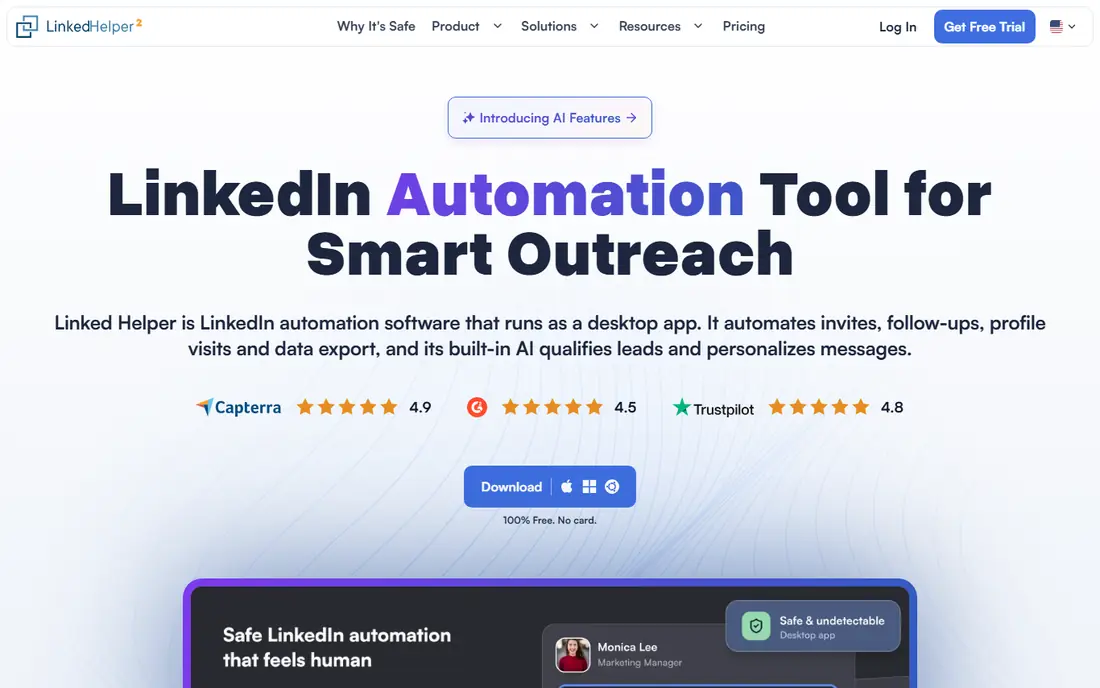
Linked Helper is aimed squarely at power users who want granular automation control. The desktop-app architecture injects no code into the LinkedIn page, which the company positions as safer by design.
Each account gets a dedicated proxy with built-in health checks. Beyond that, at $16.50 per month on annual billing, though, it is the cheapest deep-featured choice, and control freaks love it. Price to start with Linked Helper: $16.50/month. There is no free plan with Linked Helper.
Downsides: No cloud convenience.
- One proxy per account with health checks
- Desktop app with no code injected into LinkedIn
- Desktop software must run on your machine
Waalaxy
Ideal for: Founders and small teams starting LinkedIn outreach
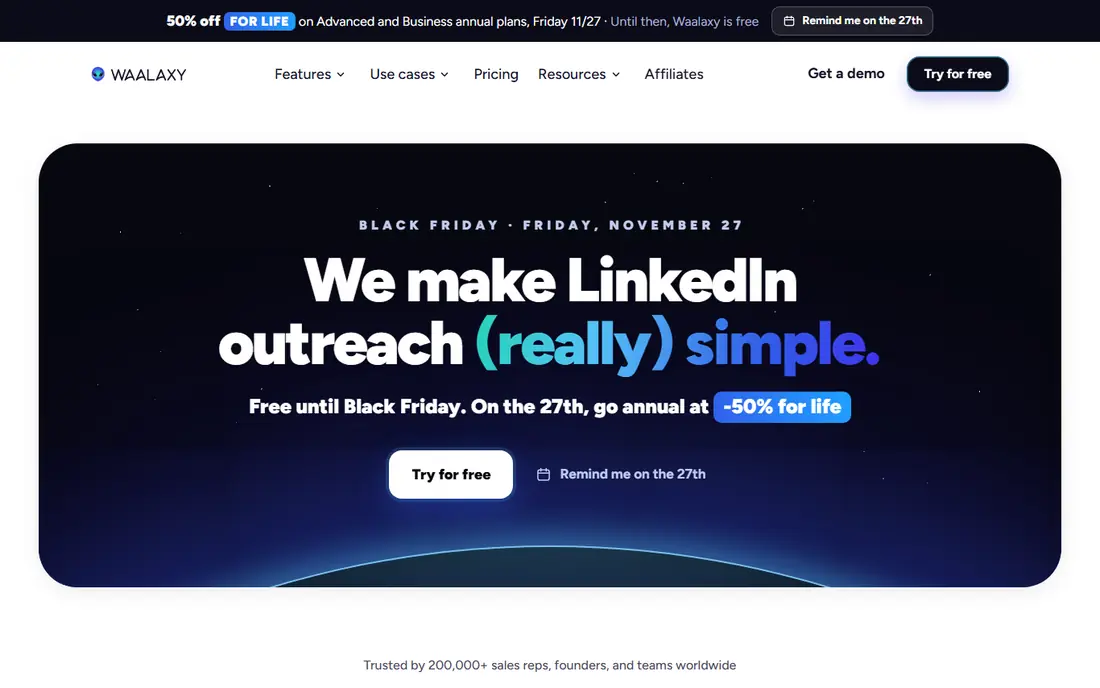
Waalaxy targets founders and small teams starting LinkedIn outreach. Prebuilt sequences include the typical plays, so a founder can launch outreach in an hour: find prospects from LinkedIn search or Sales Navigator, send connection requests and follow-ups across LinkedIn and email, and sync replies to HubSpot or Pipedrive.
Honest limits: The vendor notes it does not comply with LinkedIn's terms.
As a browser extension, Waalaxy carries more detection risk than cloud tools with dedicated IPs, and the company is upfront that it does not comply with LinkedIn's terms. Intent signals like post reactions, groups and events sharpen targeting without an external database. Waalaxy pricing: From $19/month. Waalaxy has a free plan.
- LinkedIn plus email multichannel in one tool
- Real free plan to start
- Advanced features need the $69 Business level
HeyReach
Ideal for: Agencies and teams running numerous LinkedIn senders
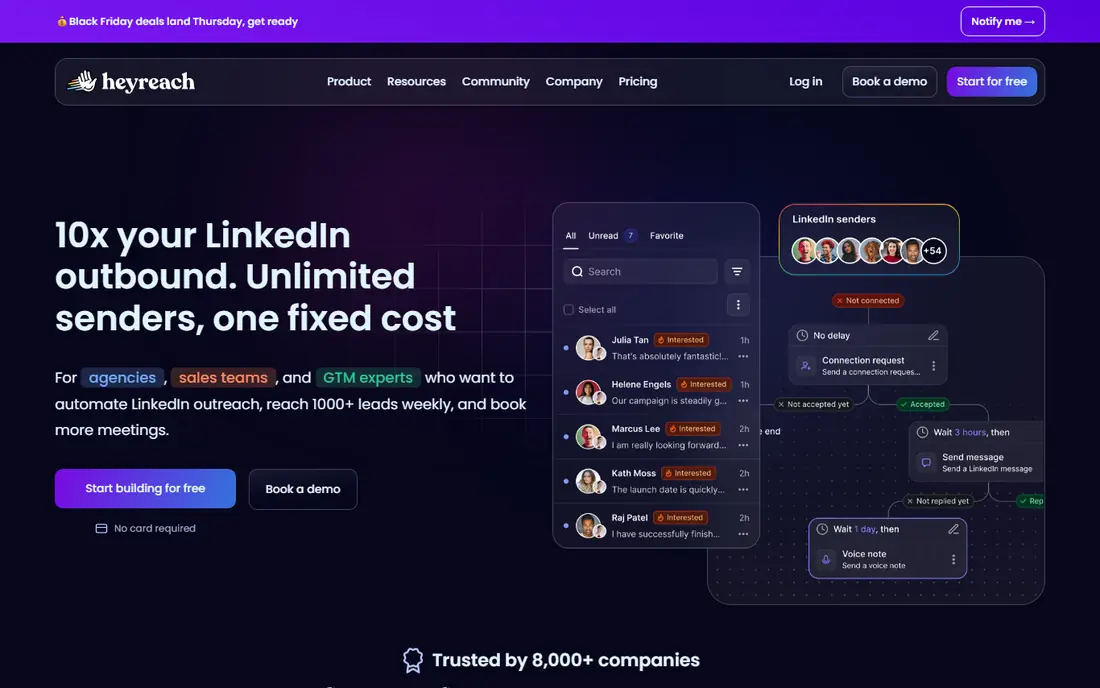
Choose HeyReach for agencies and teams running numerous LinkedIn senders. The main limit is fit. Solo users do not need sender rotation, and there is no free level to test casually.
For agencies and sales teams scaling LinkedIn outbound across plenty of profiles, it is purpose-built. HeyReach solves the agency problem: running outreach across dozens of LinkedIn accounts without logging in and out or tripping limits. Beyond that, AI agents can run outreach end to end with human approval. HeyReach cost at the entry level: $79/sender/month. HeyReach has no free tier.
Where it is weaker: No free plan and no published trial; overkill for one profile.
- Smartlead and HubSpot integrations
- Unlimited senders with automatic rotation for one fee structure
- Aimed at multi-account users
Expandi
Ideal for: Teams that want cloud outreach with the most solid safety setup
Expandi was built for teams that want cloud outreach with the most solid safety setup. Expandi is the cloud-based standard for LinkedIn outreach. From a buyer's view, campaigns run on Expandi's servers with a dedicated IP per account, automatic warm-up and fine-tuned daily limits, which is the architecture most resistant to LinkedIn restrictions.
Teams that prioritize safety and scale accept both. From a buyer's view, a 7-day free trial opens every feature with no card required. Also, at $99 a seat a month, a ten-person SDR team pays real money, and like every external tool, Expandi operates outside LinkedIn's terms of service. What you pay to start with Expandi: $99/seat/month. As for free access: Free trial.
Trade-offs to know: Some advanced campaign types need learning time; only a 7-day trial.
- A/B testing and campaign priority management
- Dedicated country-based IP per account with automatic warm-up
- $99 a seat brings up for large teams
Dux-Soup
Ideal for: Teams that want a veteran tool with a cloud upgrade path
Dux-Soup targets teams that want a veteran tool with a cloud upgrade path. Dux-Soup has been automating LinkedIn since before most competitors existed, and 300,000-plus customers provide it the longest track record here. Team plans add delegation, shared campaigns and per-day billing for adding or removing seats.
Limits to weigh: Pricing per seat layers on up for teams.
More specifically, safety engineering is the pitch: pauses, delays, breaks, auto-snooze at daily limits and scheduled working hours keep activity human-paced. The main limit is modernity. At $41.25 a seat on annual billing for the cloud level, it is a solid middle ground between budget extensions and premium cloud tools. On cost, Dux-Soup starts like this: $41.25/month. Dux-Soup has no free tier.
- Trusted by 300,000+ customers
- Unlimited campaigns with AI personalization
- Classic version is browser-dependent
LinkedIn Sales Navigator
Ideal for: Prospecting with LinkedIn's own data and zero account risk
Where LinkedIn Sales Navigator fits: prospecting with LinkedIn's own data and zero account risk. If your strategy is high-touch manual outreach to a tight account list, Sales Navigator alone may be enough.
Trade-offs to know: $79.99 per month is just for search.
LinkedIn Sales Navigator pricing: $79.99/month. Free access: Free trial.
- Live job-change and account alerts
- Zero automation risk since it is LinkedIn's own product
- No outreach automation at all
PhantomBuster
Ideal for: Growth teams that require data extraction beyond LinkedIn
PhantomBuster serves growth teams that require data extraction beyond LinkedIn. PhantomBuster plays a different game. Rather than LinkedIn sequences, it gives you prebuilt automations ("Phantoms") that extract and enrich data across LinkedIn, Twitter, Instagram, Facebook and more: profile scraping, company employee lists, post engagement, job-change monitoring and AI-powered list building.
What to check first: Outreach features are lighter than dedicated tools.
Upsides: not just LinkedIn.
Multi-step flows burn through execution quotas, and plans run $56 to $352 per month. Worth adding: the output feeds everything else. In practice, enriched lists with verified emails flow into your CRM, your cold email tool or your LinkedIn automation product of choice. For everyday use, the honest limits are sequencing and cost. The starting price for PhantomBuster: From $56/month. PhantomBuster has no free plan.
- 1,000+ enrichment data points
- Live intent signals like job changes
- Multi-step sequences consume execution time quick
How we built this list
Ainotely looked at what each vendor publishes: pricing, plan limits, feature coverage for LinkedIn automation tools and stated drawbacks. No hands-on testing is claimed. Where a vendor does not publish a price, the entry says quote. Where a price depends on seats or billing term, the entry says so. The ranking is editorial: typical fit first, then clear pricing, then free access. If your needs are unusual, read the profiles rather than relying on position.
A buyer's checklist
- Prices are a starting point; Linked Helper shows $16.50/month to start, so verify what your seat count would cost.
- Test the free plan from Waalaxy against your real workload before relying on it.
- Take the trial from Expandi and LinkedIn Sales Navigator and push a live task through it before you pay.
- Read the limits listed for Linked Helper first: desktop software must run on your machine.
- Let daily users try PhantomBuster on real work; their feedback beats any feature checklist.
- Confirm you can export your data from Waalaxy, so leaving later does not mean losing records.
Frequently asked questions
Do I need Sales Navigator to use these tools?
Sales Navigator's advanced search builds better prospect lists, and most automation tools import its lead lists straight. Waalaxy and Linked Helper can work from regular LinkedIn search, with less targeting precision.
What are LinkedIn's connection request limits?
LinkedIn lets roughly 100 to 200 connection requests per week for most accounts, with a lower practical safe zone around 20 to 25 per day on warmed accounts. New or restricted accounts should start much lower.
Which options for LinkedIn automation tools have a free plan?
Waalaxy is the only tool in this list with a free plan. Free plans usually cap users, projects or features, so check the limits on the vendor page. Several others offer a trial instead.
Is Linked Helper the right pick for everyone comparing LinkedIn automation tools?
No single tool suits every team. Linked Helper comes first because it fits power users who want granular automation control, while Waalaxy suits founders and small teams starting LinkedIn outreach and HeyReach suits agencies and teams running many LinkedIn senders. Match the tool to your own size, budget and workflow before deciding.
Can I try these options before paying?
Often, yes. Waalaxy has a free plan and Expandi and LinkedIn Sales Navigator offer a free trial. Use your own data and a real task during the test, and check what the free tier or trial limits before you rely on it.
How are the tools for LinkedIn automation tools ordered?
Linked Helper sits first and PhantomBuster last because the order follows typical fit for LinkedIn automation tools, then price clarity and free access. It is a judgement call, so read each profile for fit and limits.