Best LLM SEO Analysis Software in 2026: 8 Tools Compared

- 1
 ProfoundAI search visibilityVisit
- 2
 Athena (AthenaHQ)AI brand trackingVisit
- 3
 Peec AIAI search analyticsVisit
- 4
 Semrush AI ToolkitSEO plus AI searchVisit
- 5
 Ahrefs Brand RadarBrand and AI mentionsVisit
- Profound, Athena and Peec AI are leading tools for tracking how AI chatbots mention and cite your brand.
- Traditional SEO tools like Semrush and Ahrefs now add AI search features, so check what your current tool already covers.
- LLM SEO is new and fast changing, so metrics, citation tracking and pricing vary widely between tools.
- AI visibility depends on content quality, authority and structured data, not just a tracking dashboard.
- Free trials are useful, but most LLM SEO tools are paid and aimed at agencies and larger brands.
Quick comparison
| Product | Ideal for | Price from | Free version | |
|---|---|---|---|---|
| Profound | AI search visibility | See website | Free trial | Visit |
| Athena (AthenaHQ) | AI brand tracking | See website | Free trial | Visit |
| Peec AI | AI search analytics | See website | Free trial | Visit |
| Semrush AI Toolkit | SEO plus AI search | See website | Yes | Visit |
| Ahrefs Brand Radar | Brand and AI mentions | See website | Yes | Visit |
 Otterly.AI | AI search monitoring | See website | Free trial | Visit |
 Scrunch AI | AI search optimisation | See website | Free trial | Visit |
 Goodie AI | AI visibility tracking | See website | Free trial | Visit |
The best LLM SEO analysis software
LLM SEO analysis software, also called AI search optimisation or generative engine optimisation, tracks how large language models and AI search tools like ChatGPT, Perplexity and Google AI Overviews mention, cite and recommend your brand. We compared official feature pages, pricing and public reviews to find tools that still offer AI search tracking in October 2026. This is a new category, so features and pricing change quickly, and we mark See website where no clear starting price is published.
Profound
Ideal for: AI search visibility

Profound is one of the leading AI search visibility platforms, tracking how your brand appears in AI answers, which sources are cited and what conversations drive mentions. It covers major AI tools, analyses citation patterns and helps teams understand why a competitor is cited more often. That insight is valuable for brands that already see AI search traffic and want to improve it.
Pricing is aimed at agencies and larger brands, with trials for evaluation, so small businesses may find Profound expensive. Metrics in this category are still evolving, since AI answers change with each prompt, so use Profound for trends and citation patterns, not single answer snapshots.
- Tracks AI search visibility across chatbots
- Citation analysis
- Conversation insights
- Enterprise pricing for many teams
- New category, so metrics evolving
- Setup needs prompts
Athena (AthenaHQ)
Ideal for: AI brand tracking

AthenaHQ, often called Athena, tracks brand mentions, share of voice and sentiment across AI search and chatbot platforms, with competitor comparisons that show where your brand wins or loses in AI answers. That brand lens suits marketing teams that already track brand health and want to add AI visibility to their reporting. Its dashboards are designed for regular monitoring, not one off checks.
Pricing is quoted and aimed at brands and agencies, so small businesses should request a trial and a clear quote before committing. As a newer tool, Athena's features change frequently, which is normal in this fast moving category, but it means you should test current features rather than relying on older reviews.
- Brand tracking across AI platforms
- Share of voice
- Competitor comparison
- Pricing quoted
- Newer tool, so features changing
- Small business pricing unclear
Peec AI
Ideal for: AI search analytics
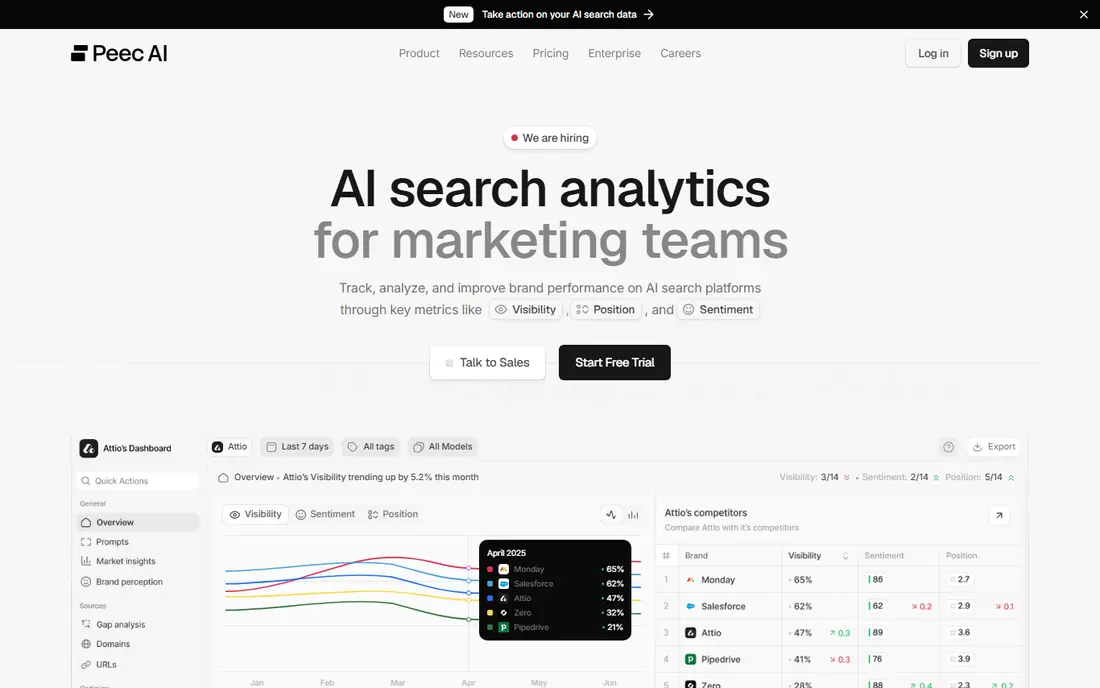
Peec AI offers AI search analytics with prompt tracking, brand visibility scores and recommendations for improving citations and mentions. Its dashboards are clean and easy to read, which helps teams that need to report AI visibility to stakeholders without a deep technical background. Peec AI also tracks how AI answers change over time for key prompts.
Pricing is aimed at teams and agencies, with trials available, and coverage may be stronger for European markets in some reports, so check coverage for your region. For a straightforward AI search analytics tool with actionable recommendations, Peec AI is a strong contender.
- AI search analytics and recommendations
- Prompt tracking
- Clean dashboards
- Pricing for larger teams
- European focus in some coverage
- Newer category
Semrush AI Toolkit
Ideal for: SEO plus AI search
Semrush's AI Toolkit adds AI search visibility tracking to its existing SEO platform, which suits teams already using Semrush for keywords, audits and rank tracking. That integration means AI visibility sits alongside traditional SEO data, so you can compare AI mentions with search rankings, backlinks and content performance in one place. For SEO teams, that context is valuable.
AI depth is thinner than dedicated tools like Profound, since Semrush's AI features are an add on to a broader platform. If you already pay for Semrush, test its AI Toolkit first before buying a separate AI tool, since it may cover your basic AI tracking needs.
- Adds AI search tracking to existing SEO tools
- Large keyword and site data
- Familiar for SEO teams
- AI features are an add on
- Depth less than dedicated AI tools
- Pricing by plan
Ahrefs Brand Radar
Ideal for: Brand and AI mentions
Ahrefs Brand Radar tracks brand mentions across the web, including AI related mentions, and integrates with Ahrefs' backlink, keyword and site audit data. That integration helps SEO teams see how brand mentions, links and AI visibility relate, and Ahrefs' large web index gives broad coverage. For teams already on Ahrefs, Brand Radar is a natural addition.
AI specific features are still evolving, and depth is less than dedicated LLM SEO tools, so brands that need detailed citation analysis should compare Ahrefs with Profound or Athena. If your main need is brand mentions plus SEO data in one tool, Ahrefs Brand Radar is efficient and familiar.
- Brand mention tracking
- Integrates with Ahrefs SEO data
- Large web index
- AI search depth less than dedicated tools
- Features evolving
- Pricing by plan
Otterly.AI
Ideal for: AI search monitoring
Otterly.AI monitors how brands appear in AI search results, tracking prompts, citations and visibility across major AI platforms. Its setup is simple, with prompt lists and brand tracking that small teams can start quickly, and its reports focus on practical changes in AI visibility over time. That simplicity suits agencies and brands that want monitoring without enterprise complexity.
As a smaller company in a new category, Otterly.AI's coverage varies by AI tool and region, so test it for your key prompts before committing. Pricing is aimed at teams, with trials available, and it is a good mid market option between free SEO add ons and enterprise AI platforms.
- Monitors AI search results
- Brand and prompt tracking
- Simple setup
- Smaller company
- Pricing for teams
- Coverage varies by AI tool
Scrunch AI
Ideal for: AI search optimisation
Scrunch AI focuses on optimising for AI search, not just tracking it, with recommendations for content gaps, citation opportunities and structured data that may improve AI mentions. That optimisation lens suits agencies and brands that want action steps, not just dashboards, and its tools help prioritise which pages and topics to improve first. Agency features support managing multiple clients.
Pricing is quoted, and optimisation advice in this new field is still evolving, since AI ranking factors are less understood than traditional SEO. Treat Scrunch AI's recommendations as hypotheses to test, measure changes over time, and combine them with solid traditional SEO, rather than following every suggestion blindly.
- AI search optimisation recommendations
- Content gap analysis
- Agency friendly
- Pricing quoted
- Newer tool
- Optimisation advice still evolving
Goodie AI
Ideal for: AI visibility tracking
Goodie AI tracks AI visibility, prompts and citations across major AI platforms, with simple reporting designed for marketing teams that need to show AI performance to stakeholders. Its focus on clear visibility scores and citation sources helps teams understand where their brand appears in AI answers and where competitors are cited instead. That clarity is useful in a category where metrics can feel abstract.
As a newer tool, Goodie AI's coverage and metrics are still evolving, and pricing is aimed at teams with trials for evaluation. For a straightforward AI visibility tracker without enterprise complexity, Goodie AI is worth a trial alongside Profound and Peec AI.
- AI visibility tracking
- Prompt and citation analysis
- Simple reporting
- Newer tool
- Pricing for teams
- Coverage and metrics evolving
How we picked these
We compared official feature pages, pricing pages and public reviews, and we only included tools that still offer LLM or AI search tracking in October 2026. We favoured tools that track multiple AI platforms, analyse citations and offer prompt level insights, and we distinguished between dedicated AI platforms and traditional SEO tools with AI add ons, since that difference decides depth and price.
How to improve LLM SEO visibility
Focus first on traditional SEO fundamentals, since AI tools cite authoritative, well structured and clearly written content. Create comprehensive pages that answer questions directly, use clear headings, structured data and citations to reputable sources, and build authority through quality backlinks and brand mentions. AI models favour content that is accurate, up to date and easy to quote, so update key pages regularly and avoid thin or misleading content.
Track a small set of prompts that matter to your business, such as best product in your category or how to solve a common problem, and monitor how AI answers change over time. Use a tracking tool for trends, not single answers, since AI responses vary by prompt wording and model version. Test content changes, measure citation changes over weeks, and combine AI visibility work with traditional SEO, since the two reinforce each other.
Frequently asked questions
What is LLM SEO analysis software?
LLM SEO software tracks how AI chatbots and AI search tools mention, cite and recommend your brand in answers, helping you understand AI visibility. It is also called AI search optimisation or generative engine optimisation.
Which LLM SEO tool is best?
Profound is a leading dedicated platform, Athena and Peec AI offer strong brand tracking, and Semrush and Ahrefs add AI features to existing SEO tools. Choose a dedicated tool for depth, or an SEO add on if you already use Semrush or Ahrefs.
Is LLM SEO different from traditional SEO?
Yes, traditional SEO optimises for search rankings and clicks, while LLM SEO optimises for mentions and citations in AI answers, which may not include a click. Both need quality content, authority and structured data, so they work together.
Can small businesses use LLM SEO tools?
Yes, through trials and SEO tool add ons, but dedicated platforms are often priced for agencies and larger brands. Small businesses should start with Semrush or Ahrefs AI features and basic prompt tracking before buying a dedicated tool.
How do I know if AI search mentions my brand?
Use an LLM SEO tool to track prompts related to your category, or manually ask major AI chatbots about your brand and category and note citations. Tracking tools automate this and show trends over time.