Local Marketing Software: 9 Options Side by Side (2026)

- 1
 UberallGlobal brands managing locations across countriesVisit
- 2
 SynupAgencies that resell local SEO under their own brandVisit
- 3
 Semrush LocalMarketing teams already paying for SemrushVisit
- 4
 ReputationMulti-location brands tying reputation to revenueVisit
- 5
 BrightLocalAgencies and SMBs that live on client reportsVisit
- Uberall sits first on this list: global brands managing locations across countries.
- For the cheapest start, look at BrightLocal: $31/month.
- Uberall, Birdeye and the 7 others all need a premium plan or a trial, since no free plan is listed.
- Before buying Semrush Local, weigh this: needs a Semrush subscription.
Direct answer
Our first pick is Uberall, best for global brands managing locations across countries. Synup fits agencies that resell local SEO under their own brand; Semrush Local fits marketing teams already paying for Semrush. All 9 tools are compared below on price, free plan and limits.
Quick comparison
| Product | Ideal for | Price from | Free version | |
|---|---|---|---|---|
| Uberall | Global brands managing locations across countries | See website | No | Visit |
| Synup | Agencies that resell local SEO under their own brand | See website | Free trial | Visit |
| Semrush Local | Marketing teams already paying for Semrush | See website | No | Visit |
| Reputation | Multi-location brands tying reputation to revenue | See website | No | Visit |
| BrightLocal | Agencies and SMBs that live on client reports | $31/month | No | Visit |
 SOCi | Franchises running local search, social, and reviews together | See website | No | Visit |
 TruLata | Local service firms that want marketing run and leads tracked in one place | From $400/mo (Starter; Launch $650, Growth $1,200; month to month) | Not stated | Visit |
 Yext | Enterprise brands needing maximum listing coverage | See website | No | Visit |
 Birdeye | Brands drowning in reviews across locations | See website | No | Visit |
9 options for local marketing software in detail
Ainotely compared 9 tools for local marketing software. The goal is a practical shortlist: published prices, free plan facts, best-fit use cases and honest limits for every entry.
Uberall
Ideal for: Global brands managing locations across countries
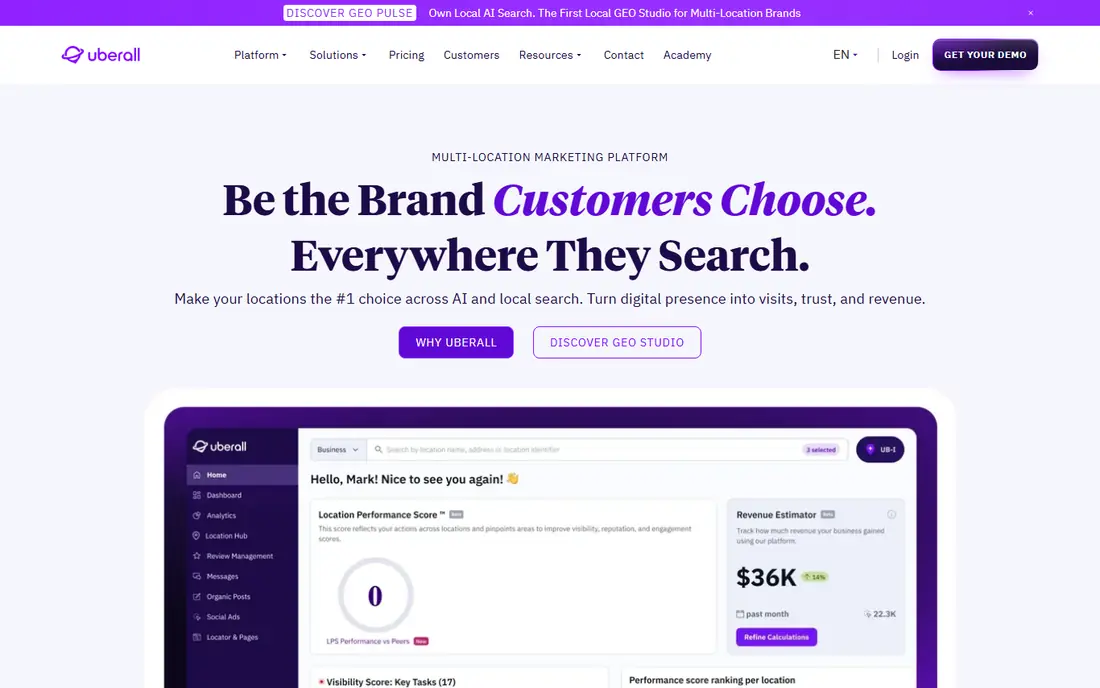
Uberall targets global brands managing locations across countries. For an US-only business with a handful of dozen locations, that global strength matters less, so verify the directory list matches your markets before buying.
Where it is weaker: US buyers should verify directory relevance.
Pricing is quote-based and the sales process is enterprise-grade. Pricing for Uberall is not stated here, so ask the vendor for current figures. There is no free plan with Uberall.
- Local pages and store locator
- 150-plus directory network with capable European coverage
- Quote-based pricing
Synup
Ideal for: Agencies that resell local SEO under their own brand

Synup is designed for agencies that resell local SEO under their own brand. Synup is designed for agencies first. For agencies that require to look professional to clients from day one, Synup is the pragmatic pick.
Drawbacks to consider: Smaller review feature set than Birdeye.
The system white-labels fully: your logo, your colors, your domain, and a client portal that looks like your product. The trade-off against the enterprise players is depth in reviews and analytics: Birdeye and Reputation go further on sentiment and benchmarking. Every plan starts with a 14-day free trial including AI credits and one location, with no sales call required to start, which is refreshing in this category. From a buyer's view, under the hood it manages listings sync across Google, Apple, Bing, Facebook, and 100-plus publishers, review monitoring and responses, local rank tracking, social publishing, and AI search visibility checks. Check the vendor site for Synup pricing; none is listed in this comparison. As for free access: Free trial.
- API and AI agent features
- 14-day free trial
- Pricing scales with locations
Semrush Local
Ideal for: Marketing teams already paying for Semrush
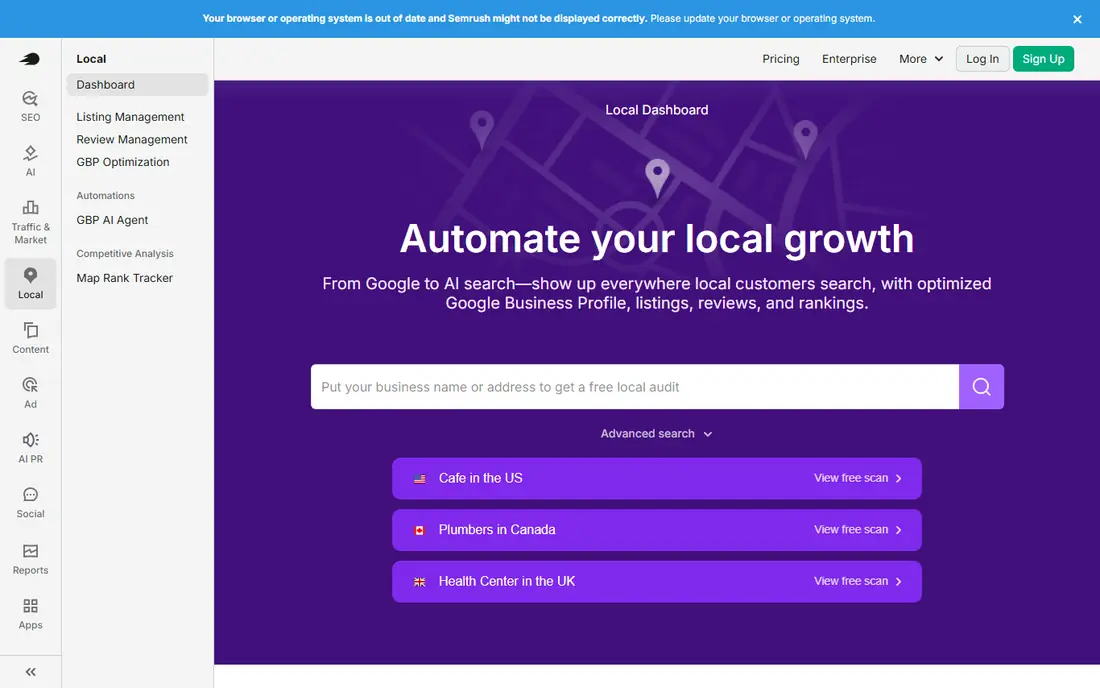
Choose Semrush Local for marketing teams already paying for Semrush. If your team lives in Semrush and runs a modest location count, the convenience is real.
Honest limits: Needs a Semrush subscription.
In practice, the main limit is the stack math. This comparison lists no price for Semrush Local; ask the vendor. Semrush Local does not include a free plan.
- Listing management included
- Map rank tracker with geo-grid
- Per-location costs add up
Reputation
Ideal for: Multi-location brands tying reputation to revenue
Reputation works best for multi-location brands tying reputation to revenue. Reputation positions itself as the product for turning customer feedback into business results. In practice, if your board asks how reputation drives revenue, Reputation has the dashboards to answer.
On top of that, industry setups handle healthcare, automotive, property management, retail, and financial services. Also, regional managers see which locations drag the score and what to fix, and the survey tools link feedback to operations. On top of that, the Rep Score provides every location a single number built from review volume, sentiment, and spread, which executives use to benchmark locations against each other and competitors. Reputation does not show a starting price in this comparison, so check the vendor site for current pricing. Reputation has no permanent free option.
Watch-outs: Overkill for small operations.
- Rep Score benchmarking across locations
- Deep industry templates
- Enterprise pricing and sales process
BrightLocal
Ideal for: Agencies and SMBs that live on client reports
BrightLocal targets agencies and SMBs that live on client reports. Here is the blunt version: most local marketing systems sell listings, reviews, rankings, and reports in different packaging. In daily use, for everyone else, start here.
In practice, the honest limits: listing sync runs on fewer publishers than Yext's 200-plus network, and review generation features sit on higher levels. More specifically, a free toolkit with a local SERP checker and review link generator is genuinely handy. Beyond that, if you run hundreds of locations or need deep reputation workflows, the enterprise tools below fit better. Agencies managing a handful of clients and local companies with a handful of locations get rank tracking, citation management, review monitoring, and GBP insights from $31 per month, with a free 14-day trial to prove it suits. BrightLocal starts at: $31/month. BrightLocal has no free plan.
Limits to weigh: Listing sync includes fewer publishers than Yext.
- Capable white-label reporting
- Citation builder and rank tracking included
- Review generation only on higher levels
SOCi
Ideal for: Franchises running local search, social, and reviews together
In short, SOCi is for franchises running local search, social, and reviews together. The franchise DNA presents in the details: permission levels, brand compliance guardrails, and reporting that rolls up from location to region to brand.
Downsides: Quote-based enterprise pricing.
As for the details, pricing is custom, onboarding is a project, and the product assumes you have a marketing team to run it. More specifically, the trade-off is the enterprise buying motion. SOCi does not show a starting price in this comparison, so check the vendor site for current pricing. SOCi has no free tier.
- Capable franchise feature set
- Genius AI agents for search, reputation, social
- Onboarding takes real effort
TruLata
Ideal for: Local service firms that want marketing run and leads tracked in one place
TruLata is built with Local service firms that want marketing run and leads tracked in one place in mind. TruLata, AI marketing software for service firms, goes a step further: it tracks rankings and listings, then runs the marketing work and counts the leads it brings in. From a buyer's view, pricing is published and month to month with no setup fee: Starter $400, Launch $650 and Growth $1,200 per month.
That is more than a tracking-only tool like BrightLocal, and TruLata is made for service companies instead of every business type. Search, Google and Meta ads, content and email all run on a schedule from one dashboard. Each lead from the business's own site is logged with its source, outcome and cost. It also tracks how commonly the business is named in ChatGPT, Gemini, Perplexity and the other AI engines. What you pay to start with TruLata: From $400/mo. Free options: Not stated.
Points against: Made for service firms instead of every business type.
- Tracks rankings and listings
- Then runs the work
- More than tracking-only tools
Yext
Ideal for: Enterprise brands needing maximum listing coverage
Yext makes the most sense for enterprise brands needing maximum listing coverage. The catch has always been price and lock-in. In practice, buy Yext when listing scale and data governance across hundreds of locations is the job.
The system has expanded into reviews, local pages, social, and AI search visibility, positioning itself as an agentic marketing system for big teams. Yext is the enterprise default for a reason: its listing network reaches more than 200 publishers including Apple Maps, Bing, and Yelp, and its Knowledge Graph provides large organizations one place to handle business facts across every location. This comparison lists no price for Yext; ask the vendor. No free plan comes with Yext.
Where it is weaker: Pricey.
- Knowledge Graph as a single source of truth
- 200-plus publisher listing network
- Historically rigid contracts, check current terms
Birdeye
Ideal for: Brands drowning in reviews across locations
Birdeye is built with brands drowning in reviews across locations in mind. Social publishing across locations from one calendar and centralized messaging round out the package. On top of that, the downside is the buying process.
More specifically, industry-specific setups for healthcare, dental, legal, and auto mean the workflows match how those companies actually operate. The scale argument is real: brands with dozens or hundreds of locations use it to keep response rates high without hiring an army. More specifically, Birdeye built its name on review generation and has grown into a full customer experience product for multi-location brands. No starting price is listed for Birdeye here; confirm pricing on the vendor site. No free plan comes with Birdeye.
Points against: Can be more system than a small business needs.
- Strong healthcare and dental footprint
- Review generation at serious scale
- Quote-based pricing
Selection criteria
For each of the 9 tools we noted price, free plan or trial, fit for local marketing software and the main limit, using vendor pages and documentation. Figures are shown as the vendors publish them. Billing terms, seat minimums and add-ons can change the real cost. Position on the page reflects fit for a typical buyer first, with price clarity and free access breaking ties. Treat it as a guide, not a ruling.
What to check before you buy
- Get a written quote from Uberall, Synup, Semrush Local and others; the list shows no starting price for them.
- Take the trial from Synup and push a live task through it before you pay.
- Read the limits listed for Uberall first: quote-based pricing.
- Run a one or two week pilot of Reputation with the people who will use it every day.
- Test how quickly Semrush Local answers a pre-sales question; it hints at how support will feel later.
Frequently asked questions
Does any tool for local marketing software here have a free plan?
A permanent free plan is not offered by Uberall, Birdeye or the other tools here. Synup offer a trial. Plan a short evaluation period instead.
What is the cheapest option for local marketing software in this list?
On published monthly entry prices, BrightLocal is the lowest here at $31/month. Entry price is only part of the cost, because seats, add-ons and billing terms can change the total.
Do these tools publish their prices?
Not all of them. Uberall, Synup, Semrush Local and others publish no starting price, so expect a quote request for those. The rest, BrightLocal included, show a starting price, though seats and billing terms still change the final cost.
Is Uberall the right pick for everyone comparing local marketing software?
No single tool suits every team. Uberall comes first because it fits global brands managing locations across countries, while Synup suits agencies that resell local SEO under their own brand and Semrush Local suits marketing teams already paying for Semrush. Match the tool to your own size, budget and workflow before deciding.
What is AI search visibility and should I care?
It measures whether AI systems like ChatGPT and Google AI Overviews mention or recommend your business. The underlying drivers are the same as local SEO: accurate listings, capable reviews, and complete profiles.