6 Strong LXP Platforms in 2026

- 1
 ContinuFirms whose training audience is largely customers and partnersVisit
- 2
 DoceboOrganizations training several audiences: employees, customers, and partnersVisit
- 3
 DisprzFrontline and deskless workforces in retail, banking, insurance, and manufacturingVisit
- 4
 Cornerstone (EdCast)Large enterprises already using Cornerstone, or needing full talent-suite depthVisit
- 5
 DegreedLarge enterprises running skills-based talent and workforce planningVisit
- Top of the list is Continu, which targets firms whose training audience is largely customers and partners.
- A permanent free plan is missing from all 6 tools, Continu and 360Learning included; plan for a trial or a premium start.
- Check the limits for Disprz before you commit: thinner presence and partner network in the US and Europe than the category leaders.
- Docebo has the lowest monthly starting price in this list: $9/user/month.
Direct answer
This list puts Continu first for companies whose training audience is largely customers and partners. Docebo is better for organizations training several audiences: employees, customers, and partners, and Disprz is better for frontline and deskless workforces in retail, banking, insurance, and manufacturing. Details, prices and limits for the rest of the 6 tools are below.
Quick comparison
| Product | Ideal for | Price from | Free version | |
|---|---|---|---|---|
| Continu | Firms whose training audience is largely customers and partners | See website (custom quote) | No | Visit |
| Docebo | Organizations training several audiences: employees, customers, and partners | $9/user/month (250-user minimum on the main tier; complex enterprise deals quoted custom) | No | Visit |
| Disprz | Frontline and deskless workforces in retail, banking, insurance, and manufacturing | See website (custom quote) | No | Visit |
| Cornerstone (EdCast) | Large enterprises already using Cornerstone, or needing full talent-suite depth | See website (custom quote) | No | Visit |
| Degreed | Large enterprises running skills-based talent and workforce planning | See website (custom quote) | No | Visit |
 360Learning | Mid-sized businesses that want internal experts to build the training | See website (custom quote) | No | Visit |
LXP Platforms compared in detail
If you are comparing LXP platforms, this page covers 6 tools in one place: what each is best for, what it costs to start, whether it has a free plan, and the main limit to know about.
Continu
Ideal for: Firms whose training audience is largely customers and partners
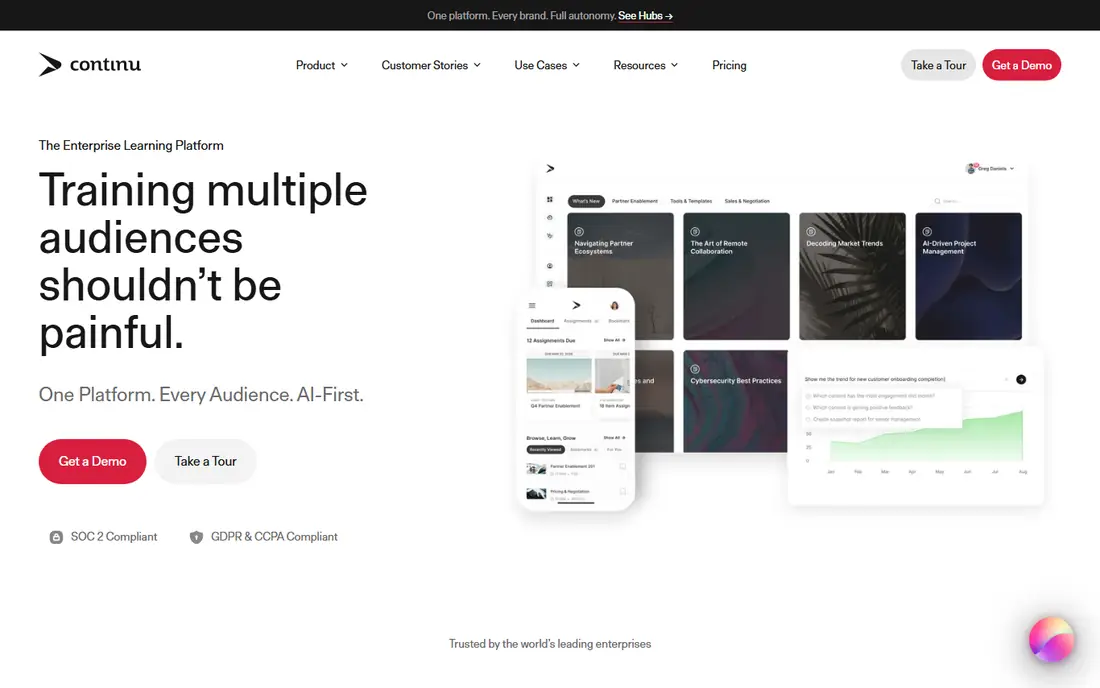
Where Continu fits: firms whose training audience is largely customers and partners. Buy it for the second job, and let it handle the first as a bonus.
What Continu does well: Audience segmentation for employees, partners.
Limits to weigh: Younger vendor with a smaller analyst footprint.
As an internal employee LXP competing head-on with Degreed, it has less track record. No starting price is listed for Continu here; confirm pricing on the vendor site. Continu has no permanent free option.
- Customers from one system
- AI learning agent (Eddy) answers questions inside Slack, Teams, SMS
- Quote-based pricing with no public levels
Docebo
Ideal for: Organizations training several audiences: employees, customers, and partners
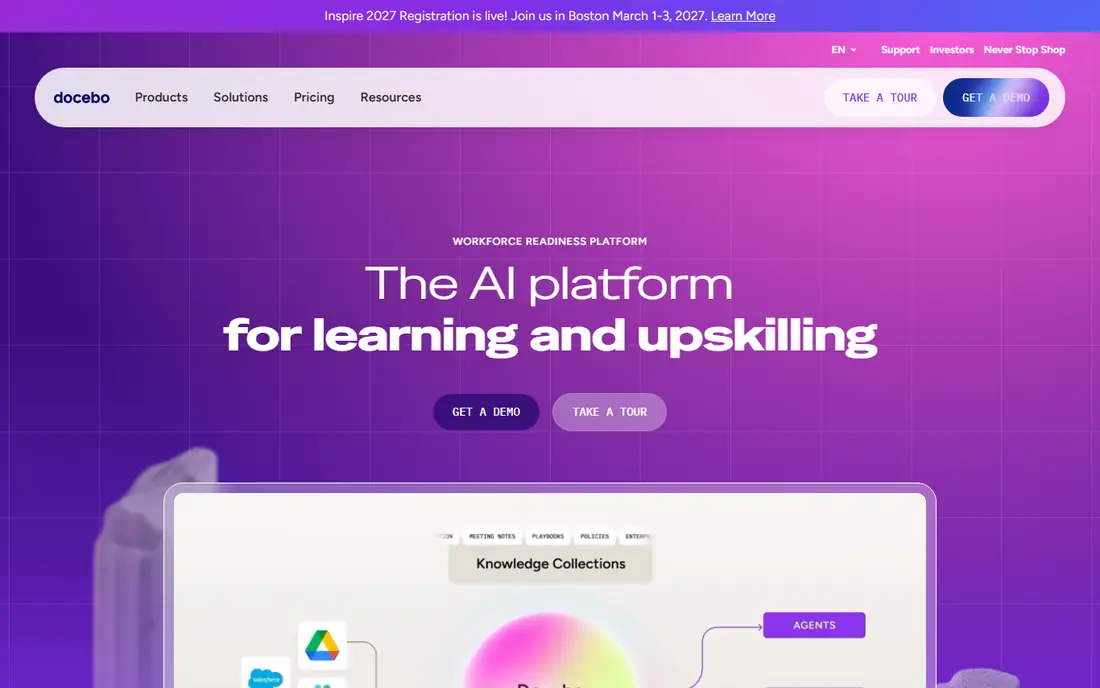
Docebo serves organizations training several audiences: employees, customers, and partners. One contract can include employee onboarding, compliance, customer education, and partner training, each with its own branded portal, whereas the AI authoring tools turn existing documents into courses. On top of that, the honest catch is scope creep in the quote.
What to check first: Administration takes real training to master.
It is still one of the most complete products here for firms that train people outside their own payroll. For everyday use, the published starting point of $9 per user a month with a 250-user minimum is a minimum of a real number, which is rare in this category. The starting price for Docebo: $9/user/month. Docebo has no permanent free option. Upsides: Marketplace with 30,000-plus ready-made courses; Aimed at multi-audience training with white-labeled portals.
- Combines LMS, LXP, authoring
- Analytics in one product
- The 250-user minimum on the published level prices out small teams
Disprz
Ideal for: Frontline and deskless workforces in retail, banking, insurance, and manufacturing
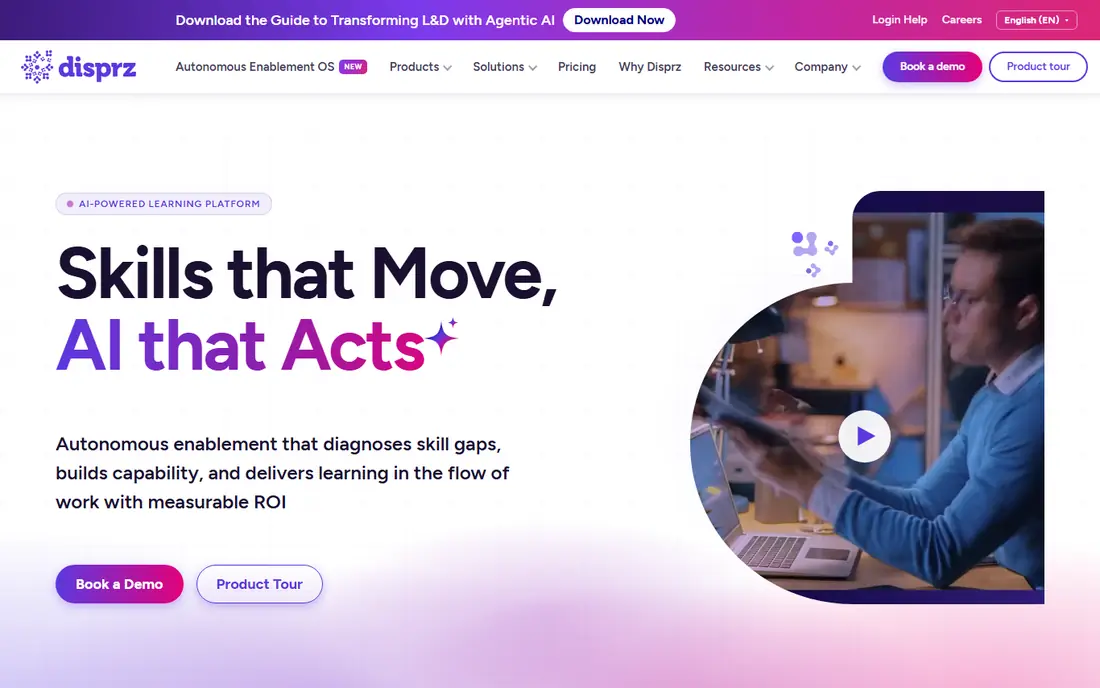
Disprz is built with frontline and deskless workforces in retail, banking, insurance, and manufacturing in mind. The company reports 3.5 million-plus learners across 25-plus countries.
Worth adding: Disprz, founded in Chennai in 2015, built its product for the workers most learning tools ignore: store staff, field sales, factory teams, and branch bankers. No starting price is listed for Disprz here; confirm pricing on the vendor site. No free plan comes with Disprz.
Watch-outs: Advanced analytics depth trails the biggest products.
- Mobile-first microlearning made for people who do not sit at desks
- Skills analytics
- Thinner presence and partner network in the US and Europe than the category leaders
Cornerstone (EdCast)
Ideal for: Large enterprises already using Cornerstone, or needing full talent-suite depth
Cornerstone (EdCast) targets large enterprises already using Cornerstone, or needing full talent-suite depth. Cornerstone bought EdCast in 2022 and folded its LXP into a broader product for workforce readiness. For businesses already running Cornerstone's LMS or performance products, the LXP layer layers on AI-curated content, knowledge sharing, and skills data without a second vendor.
Also, the honest catch is that Cornerstone sells a system, not a point tool. In daily use, the math fits best when learning, performance, and skills planning consolidate onto one contract. No starting price is listed for Cornerstone (EdCast) here; confirm pricing on the vendor site. Cornerstone (EdCast) has no free tier.
Where it falls short: The suite's breadth means longer, heavier implementations.
Reasons to shortlist it: Skills intelligence spans the entire employee lifecycle.
- Deep compliance and certification tooling
- Pairing learning experience with LMS, performance, recruiting
- Buying the LXP alone leaves much of the value on the table
Degreed
Ideal for: Large enterprises running skills-based talent and workforce planning
Think of Degreed for large enterprises running skills-based talent and workforce planning. The system links everything people learn from, formal courses and informal content alike, then uses that data to display which skills exist in the workforce and which are missing.
Beyond that, the honest catch is the entry ticket. In practice, Degreed does not publish prices, every deal is a custom annual quote, and implementations take months with real services work. Degreed shows no starting price here, so confirm the cost on the vendor site. Degreed has no permanent free option.
Watch-outs: Implementation is a real project with change management attached.
- Solid integrations with HCM and LMS systems
- Aggregates internal and external content (courses, videos, articles, podcasts) into one learner hub
- Smaller organizations will find it oversized and overpriced
360Learning
Ideal for: Mid-sized businesses that want internal experts to build the training
360Learning is aimed squarely at mid-sized businesses that want internal experts to build the training. The system makes it quick for an engineer, a salesperson, or a support result in turn what they know into a course, with colleagues reviewing and improving it. From a buyer's view, skip it if training will stay a centralized L&D function.
Points against: Less depth on regulated compliance workflows than Cornerstone or Valamis.
Buy it when you have willing experts and a backlog of tribal knowledge to capture. Worth adding: the honest catch is cultural, not technical. 360Learning shows no starting price here, so confirm the cost on the vendor site. 360Learning has no free plan.
- 80-plus HRIS and workplace integrations
- Collaborative authoring lets any subject-matter expert create a course in days, with peer review built in
- No published pricing, so every deal starts with a sales call
How these tools were picked
Selection started from tools commonly considered for LXP platforms, then narrowed to 6 that have clear pricing information or a clear quote process. Seat minimums, billing terms and add-ons can move the real cost, so the starting prices here are a guide and not a quote. The order reflects how well each tool fits the most common buying scenario for LXP platforms, then price clarity, then free plan access. It is a starting point, not a verdict.
Pre-purchase checklist
- Ask Continu, Disprz, Cornerstone (EdCast) and others for a written quote, since no starting price is shown.
- Read the limits listed for Continu first: less proven than Degreed or Docebo for internal employee upskilling programs.
- Price Disprz for your actual team size; headline prices rarely include add-ons or overage.
- Test how quickly Degreed answers a pre-sales question; it hints at how support will feel later.
- List the apps you already depend on and check that Continu supports each one on the plan you would buy.
Frequently asked questions
How much does a LXP cost?
Most LXPs are quote-only annual enterprise contracts. Also, always ask for the three-year total including implementation and content.
Does any tool for LXP platforms here have a free plan?
A permanent free plan is not offered by Continu, 360Learning or the other tools here. Plan a short evaluation period instead.
Do LXPs contain course content?
The product and the content are typically separate purchases. Docebo bundles a marketplace of 30,000-plus courses, and most others connect with LinkedIn Learning, Udemy Business, or OpenSesame.
Do these tools publish their prices?
Not all of them. Continu, Disprz, Cornerstone (EdCast) and others publish no starting price, so expect a quote request for those. The rest, Docebo included, show a starting price, though seats and billing terms still change the final cost.
How long does LXP implementation take?
For enterprise products, expect 4 to 20 weeks based on scope: user provisioning, HRIS integration, content migration, and branding all take time. Docebo publishes that 4-to-20-week range for its own system, which is representative.
How are the tools for LXP platforms ordered?
The order follows typical fit for LXP platforms, with Continu first and 360Learning last, then price clarity and free access. It is editorial judgement, not a score, so another team could rank the tools differently.