Best Machine Identity Management Tools for Teams

- 1
 Venafi Control PlaneLarge multi CA certificate estatesVisit
- 2
 Keyfactor CommandPKI plus lifecycle in one vendorVisit
- 3
 HashiCorp VaultSecrets and machine identity togetherVisit
- 4
 AWS Private CAPrivate PKI inside AWSVisit
- 5
 AppViewX AVX ONEEnterprise CLM with PKI as a serviceVisit
- Venafi and Keyfactor lead for large estates, but both are quote only, with base licences estimated at $50,000 to $300,000 a year.
- AWS Private CA is the only tool here with a clear public price: $400 per CA per month for general purpose use, or $50 for short lived certificates.
- HashiCorp Vault and Smallstep give smaller teams a real starting point, with a free open source edition and managed pricing from $0.62 per cluster hour.
- The CA/Browser Forum plan to cut public TLS lifetimes to 47 days by 2029 makes automation a requirement, not a nice extra, so check renewal automation first.
- Count your certificates before you buy, because per certificate pricing turns a large estate into a large bill, and short lived certificates multiply renewals.
Quick comparison
| Product | Ideal for | Price from | Free version | |
|---|---|---|---|---|
| Venafi Control Plane | Large multi CA certificate estates | quote only | No | Visit |
| Keyfactor Command | PKI plus lifecycle in one vendor | quote only | Free trial (30 days) | Visit |
| HashiCorp Vault | Secrets and machine identity together | $0.62 per cluster/hour | Yes | Visit |
| AWS Private CA | Private PKI inside AWS | $400 per CA per month | No | Visit |
| AppViewX AVX ONE | Enterprise CLM with PKI as a service | quote only | Free trial | Visit |
 Smallstep Certificate Manager | DevOps PKI with open source core | quote only | Yes | Visit |
 DigiCert Trust Lifecycle Manager | CA bundled lifecycle management | quote only | No | Visit |
 Sectigo Certificate Manager | Value priced CA bundled management | quote only | No | Visit |
The best machine identity management tools
Venafi Control Plane
Ideal for: Large multi CA certificate estates
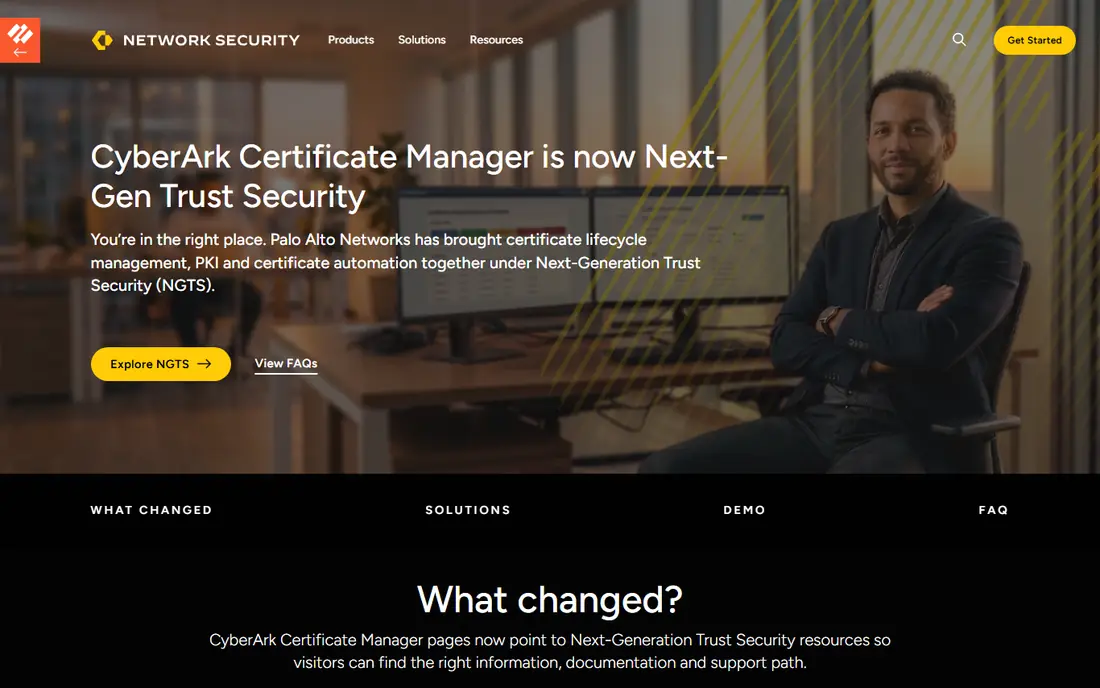
Venafi Control Plane is the category defining machine identity platform, now sold as CyberArk Certificate Manager after CyberArk acquired Venafi for $1.54 billion in 2024. It discovers every certificate across the estate, enforces issuance policy, automates renewal and installation, and reports on expiry and crypto agility. It sits above whichever certificate authorities you already use, covering TLS, code signing, mobile and SSH identities, and it includes TLS Protect for Kubernetes, built on the cert-manager project, for cloud native workloads.
The price is the barrier. Venafi publishes no rate card, and independent comparisons estimate a base licence of $100,000 to $300,000, plus $1 to $8 per certificate a year at enterprise scale. Implementation typically takes three to six months, and the roadmap now follows CyberArk identity strategy rather than pure PKI. For a large enterprise with more than a million certificates and a real outage risk from expiry, Venafi is the reference pick. Smaller teams should look at Keyfactor, Smallstep or AWS Private CA first.
- CA agnostic control plane for every certificate type
- Deep discovery, policy and automation across data centres and cloud
- No public price and high entry cost
- Implementation typically takes three to six months
Keyfactor Command
Ideal for: PKI plus lifecycle in one vendor
Keyfactor Command is the main mid market alternative to Venafi, and it pairs a dedicated certificate lifecycle platform with EJBCA, its own certificate authority software, so one vendor covers issuance and automation together. It offers discovery, monitoring, issuance, renewal and reporting across any CA, cloud and environment, with native EJBCA integration, advanced role based access, custom dashboards and a ServiceNow integration. Keyfactor added cryptographic discovery and post quantum capabilities through two acquisitions in 2025, with ML-DSA and SLH-DSA support for teams planning ahead.
Keyfactor publishes no rate card, and independent comparisons estimate a base licence of $50,000 to $100,000, plus $1 to $5 per certificate a year. Implementation takes two to four months, and user reviews put the average time to implement at six months. A 30 day free Test Drive is offered, which is more than most rivals give. For a large PKI team that wants one vendor for CA and lifecycle, Keyfactor is the strongest alternative to Venafi, and it usually costs less at the same scale.
- One vendor for issuance through EJBCA and lifecycle automation
- Strong post quantum readiness with ML-DSA support
- No public price and a six month average implementation
- Proven scale ceiling near 500,000 certificates
HashiCorp Vault
Ideal for: Secrets and machine identity together
HashiCorp Vault is a secrets management platform that also handles machine identity, with dynamic secrets, PKI as a secrets engine, and certificate issuance for services, workloads and AI agents. Vault Community Edition is free to self host under a Business Source Licence, while the managed HCP Vault Dedicated tier bills by the hour per cluster, starting at $0.62 an hour for an extra small development cluster, $1.58 for Essentials small and $1.84 for Standard small, which works out to roughly $450, $1,150 and $1,345 a month. Vault 2.2, released in late 2026, added SCIM and machine identity governance for non human identities.
The cost model needs care. Essentials and Standard tiers add $72.92 a month per Vault client, which is any unique application, service or user that authenticates, so a large estate of services can push the bill well above the cluster rate. Vault Enterprise pricing is not published. For a DevOps team that already runs Vault for secrets, using it for machine identity as well avoids a second platform, and the free edition is a fair way to learn the workflow before buying the managed tier.
- Free Community Edition to self host
- Managed HCP Vault Dedicated from $0.62 per cluster hour
- Per client fee of $72.92 a month adds up fast
- Enterprise pricing needs a sales conversation
AWS Private CA
Ideal for: Private PKI inside AWS
AWS Private CA is a fully managed private certificate authority service that lets a team build a private PKI hierarchy inside AWS without buying or managing CA hardware. General purpose mode costs $400 per private CA per month, and short lived certificate mode costs $50 per CA per month for certificates valid seven days or fewer, with per certificate fees of $0.75 for the first 1,000, $0.35 for the next 9,000 and $0.001 above 10,000 in general purpose mode. Short lived mode is purpose built for service mesh, SPIFFE style workload identity and high frequency mutual TLS.
The limits are scope and cost at scale. Private CA fits AWS first teams, and a multi cloud estate will need a control plane such as Venafi or Keyfactor on top. A root plus subordinate CA pair costs $800 a month before any certificate is issued, so a team should delete test CAs when done. For an AWS shop that needs private certificates for internal workloads, AWS Private CA is the simplest priced option in this list, and the $50 short lived mode is the cheapest route to modern workload identity.
- Clear public pricing with no sales call
- Short lived certificate mode costs only $50 per CA per month
- Works best inside AWS, so multi cloud teams need more
- Per certificate fees add up at high volume
AppViewX AVX ONE
Ideal for: Enterprise CLM with PKI as a service
AppViewX AVX ONE is a software as a service certificate lifecycle management platform for enterprise PKI, identity and access, security, DevOps and cloud teams. It covers enterprise wide CLM, Kubernetes and container TLS automation, scalable PKI as a service, Microsoft PKI modernisation, secure code signing, IoT identity and post quantum readiness, with AI and machine learning risk reduction across hybrid multi cloud estates. A free trial is offered, and the EKS add on for Kubernetes certificate management is listed free on AWS Marketplace.
Pricing is quote only across the SaaS, PKIaaS and on premises editions, and public price lists from UK government procurement put server certificate management near 78 pounds per instance per year at low volume, falling with scale, with a dedicated SaaS deployment near 114,000 pounds a year. A Forrester study of a composite customer put annual licence and services near $854,000 over three years for 10,000 actively managed certificates. For a large enterprise that wants CLM plus PKI as a service from one vendor, AVX ONE is a credible pick, and the free trial is the right first step.
- One platform for CLM, Kubernetes TLS, PKI as a service and code signing
- Free EKS add on for container certificates
- No public price and enterprise scale pricing
- Implementation needs professional services
Smallstep Certificate Manager
Ideal for: DevOps PKI with open source core
Smallstep Certificate Manager is an opinionated platform for DevSecOps public key infrastructure, built on step-ca, the leading open source certificate toolchain. It manages private TLS certificates for internal workloads and developers, with managed, linked or on premises deployment, and it bills on endpoint months rather than per certificate, so a device that renews a one day certificate every 12 hours costs the same as one with a 30 day certificate. The open source step-ca and step CLI are free for teams that want to run their own CA infrastructure.
The managed platform price is not published, so buyers must contact sales, and the enterprise feature set is narrower than Venafi or Keyfactor. Smallstep SSH Professional starts at $3 per host per month, which gives a separate entry point for SSH identity. For a DevOps team that wants modern PKI without an enterprise sales cycle, Smallstep is the most developer friendly pick in this list, and the open source core means you can start free and buy the managed platform later.
- Built on step-ca, the leading open source CA toolchain
- Endpoint based billing suits short lived certificates
- No published price for the managed platform
- Smaller vendor with a narrower enterprise feature set
DigiCert Trust Lifecycle Manager
Ideal for: CA bundled lifecycle management
DigiCert Trust Lifecycle Manager, part of the DigiCert ONE platform, manages certificates from DigiCert and other authorities, with discovery, automation, renewal and reporting in one console. Because DigiCert is also a public certificate authority, a team can buy public TLS certificates and manage their lifecycle from the same vendor, which simplifies procurement and support. The platform covers TLS, code signing, document signing and IoT device certificates, with compliance reporting that fits regulated industries.
DigiCert publishes no price for Trust Lifecycle Manager, and the CA bundle usually carries premium pricing next to a neutral control plane. Teams that buy public certificates in volume should ask for a combined quote covering certificates and management, since the two are often priced together. For an enterprise that already trusts DigiCert as its public CA and wants one vendor for issuance and lifecycle, Trust Lifecycle Manager is a natural pick, and the audit reporting is a genuine strength.
- One vendor for public certificates and lifecycle management
- Strong compliance and audit reporting
- No public price list
- Premium pricing reflects the CA bundle
Sectigo Certificate Manager
Ideal for: Value priced CA bundled management
Sectigo Certificate Manager is a certificate lifecycle platform from Sectigo, one of the largest public certificate authorities, and it manages certificates from Sectigo and other issuers with discovery, issuance, renewal and expiry alerts. Independent comparisons place Sectigo as the value option among CA bundled platforms, with per certificate pricing at enterprise scale below DigiCert and Venafi, though no public rate card is published. It covers TLS, code signing, S/MIME and device certificates, and it suits teams that want a single vendor for certificates and management without the top tier price.
The trade off is depth. Automation, policy controls and reporting are solid but thinner than Venafi or Keyfactor, and a very large estate may outgrow the platform. For a mid size enterprise that buys public certificates from Sectigo and needs lifecycle management without a six figure base licence, Certificate Manager is a practical pick. Ask for a written quote based on your real certificate count, since volume discounts change the price sharply.
- Lower cost than DigiCert or Venafi at enterprise scale
- CA agnostic management with public certificate supply
- No public price list
- Fewer advanced automation features than the top two platforms
How we chose
We compared vendor pricing pages, product documentation and feature lists for machine identity tools that manage certificates, secrets and workload identity, and we checked each homepage to confirm the vendor is still selling the product. Prices shown are the entry list prices found on vendor pages or in pricing reviews checked in October and November 2026, and quote only means the vendor does not publish a price. We did not run hands on tests, and we did not count review scores as evidence. We favoured tools with discovery, automated renewal, policy control and a clear story on the 47 day TLS lifetime change, and we kept a mix of enterprise, cloud and open source options so teams of different sizes can compare.
What to check before you buy
Count every certificate, including internal, test and IoT certificates, before you ask for a quote, since per certificate pricing punishes an uncounted estate. Check that renewal automation covers every endpoint type you run, from load balancers to Kubernetes clusters, and test a renewal in a staging environment. Confirm post quantum readiness and crypto agility, since the 47 day lifetime change raises renewal frequency about eight times. Ask about the base licence, the per certificate rate, and the cost of adding a second CA. Finally, check that audit logs record every issuance, renewal and revocation, because an auditor will ask for them.
| Estate size | Best starting pick | Why it fits | Budget guide | | Under 1,000 certificates | Smallstep or AWS Private CA | Low cost, fast start | $0 to $400 per month | | 1,000 to 10,000 certificates | HashiCorp Vault or AWS Private CA | Secrets plus PKI, clear pricing | $450 per month and up | | 10,000 to 100,000 certificates | Keyfactor Command | One vendor, lower base licence | $50,000 to $100,000 a year, quote only | | Over 100,000 certificates | Venafi or AppViewX | Proven scale, deep automation | $100,000 and up, quote only |
Frequently asked questions
What is machine identity management?
Machine identity management is the practice of issuing, renewing and revoking digital identities for non human entities such as servers, workloads, containers, devices and APIs. These identities are usually X.509 certificates, SSH keys or secrets, and they prove that a machine is who it claims to be. A management platform discovers every identity, automates renewal and enforces policy, so an expired certificate cannot take a service offline.
Why are TLS certificate lifetimes getting shorter?
The CA/Browser Forum is cutting the maximum validity of public TLS certificates to 200 days from March 2026, 100 days from March 2027 and 47 days from March 2029, to reduce the risk of a compromised certificate staying valid for long. Shorter lifetimes mean renewals happen about eight times more often, so manual renewal no longer works at scale. Automation is now a requirement for any team with more than a handful of certificates.
How much does machine identity management cost?
Costs vary widely. AWS Private CA charges $400 per CA per month, HashiCorp Vault managed clusters start at $0.62 per hour, and Smallstep open source costs nothing to run. Enterprise platforms are quote only, with Keyfactor estimated at $50,000 to $100,000 a year and Venafi at $100,000 to $300,000, plus $1 to $8 per certificate. Always get a quote based on your real certificate count.
Can I manage certificates without buying an enterprise platform?
Yes, for a small estate. Smallstep open source and HashiCorp Vault Community Edition are free to run, AWS Private CA costs $400 a month, and the open source cert-manager project automates Kubernetes certificates at no licence cost. These options work well up to a few thousand certificates. Above that, the reporting, policy and audit features of an enterprise platform usually justify the cost.
What is the difference between a CA and a lifecycle manager?
A certificate authority issues certificates, while a lifecycle manager discovers, tracks, renews and revokes them across every CA you use. Some vendors do both, such as DigiCert and Sectigo, while neutral platforms such as Venafi and Keyfactor sit above any CA. A team that uses several CAs needs a lifecycle manager, while a team with one CA can often use that CA bundled tool.