Top 7 Machine Learning Cloud Platforms for 2026, Compared

- 1
 Google Vertex AIGoogle Cloud teams building agents and generative AIVisit
- 2
 Azure Machine LearningEnterprises running on MicrosoftVisit
- 3
 DatabricksData teams unifying analytics and MLVisit
- 4
 Amazon SageMakerTeams standardized on AWSVisit
- 5
 DataRobotEnterprises deploying agentic AI at scaleVisit
- The list opens with Google Vertex AI, aimed at Google Cloud teams building agents and generative AI.
- None of the 7 tools, from Google Vertex AI to H2O.ai, has a free plan, so budget for a subscription or use a trial.
- Before buying Databricks, weigh this: usage-based DBU pricing needs monitoring.
- H2O.ai suits regulated industries that must control their AI.
Direct answer
Our first pick is Google Vertex AI, best for Google Cloud teams building agents and generative AI. Azure Machine Learning is the stronger choice for enterprises running on Microsoft, while Databricks suits data teams unifying analytics and ML. The full list of 7 tools follows, with prices and free plan facts.
Quick comparison
| Product | Ideal for | Price from | Free version | |
|---|---|---|---|---|
| Google Vertex AI | Google Cloud teams building agents and generative AI | See website | Free trial | Visit |
| Azure Machine Learning | Enterprises running on Microsoft | See website | No | Visit |
| Databricks | Data teams unifying analytics and ML | See website | Free trial | Visit |
| Amazon SageMaker | Teams standardized on AWS | See website | No | Visit |
| DataRobot | Enterprises deploying agentic AI at scale | See website | No | Visit |
 Domino Data Lab | Enterprises that require governed data science at scale | See website | No | Visit |
 H2O.ai | Regulated industries that must control their AI | See website | No | Visit |
Tool-by-tool breakdown
Ainotely put together this guide to machine learning cloud platform for readers who want a clear shortlist without reading every vendor page. It compares 7 tools on starting price, free plans, who each one suits and where each one falls short.
Google Vertex AI
Ideal for: Google Cloud teams building agents and generative AI

Google Vertex AI targets Google Cloud teams building agents and generative AI. Google has folded Vertex AI into its Gemini product, positioning it as the place to build enterprise AI agents plus classic ML models. Model Garden provides more than 200 Google, external, and open models to start from.
The recent rebranding from Vertex AI to Gemini system also means documentation and naming are in flux. Confirm exactly which services a proposal handles. Pricing is pay-as-you-go across models, compute, and storage, so cost discipline matters. On top of that, the system spans custom training, tuning, deployment, and MLOps: pipelines, feature store, model registry, and monitoring for drift. For Google Cloud teams, it remains the natural home for ML. Google Vertex AI shows no starting price here, so confirm the cost on the vendor site. Free options: Free trial.
Watch-outs: Usage-based pricing with numerous dimensions.
- 200+ models in Model Garden
- $300 in free credits for new customers
- The Vertex AI to Gemini system rebrand may confuse buyers
Azure Machine Learning
Ideal for: Enterprises running on Microsoft
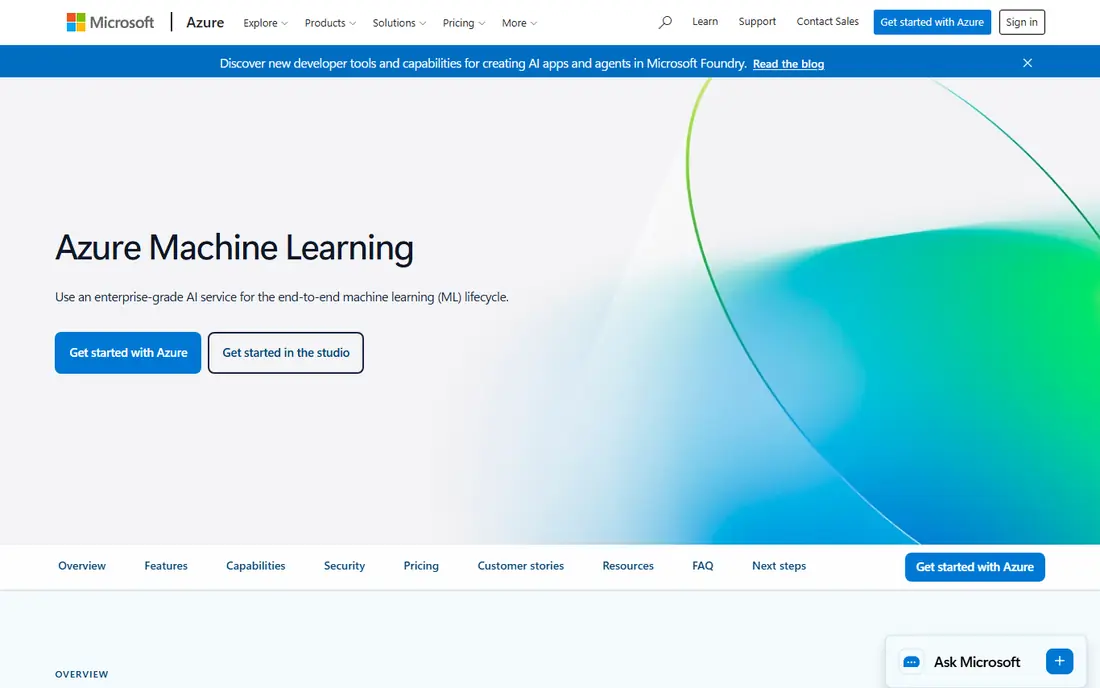
In short, Azure Machine Learning is for enterprises running on Microsoft. It manages training, deployment, and MLOps inside the Azure boundary, with the compliance certifications and identity integration that enterprise IT expects.
Integration with the rest of Azure, from data services to DevOps tooling, keeps the ML lifecycle inside one cloud. Beyond that, teams on AWS or Google Cloud should look at those clouds' native choices first. No starting price is listed for Azure Machine Learning here; confirm pricing on the vendor site. Azure Machine Learning does not include a free plan.
Trade-offs to know: Best value only inside Azure.
- ML as a service inside the Azure ecosystem
- Solid enterprise security and compliance
- Pricing is usage-based and opaque until you estimate
Databricks
Ideal for: Data teams unifying analytics and ML
Databricks serves data teams unifying analytics and ML. That matters since most ML projects stall on data plumbing, not modeling. On top of that, the product now spans AI agents, apps, and natural language analytics on top of the same foundation.
Points against: Usage-based DBU pricing needs monitoring.
With Databricks, the team that builds the pipelines and the team that trains the models work in one place. More specifically, pricing is usage-based on Databricks Units, and costs scale with compute, so budgets and autoscaling policies need attention. For organizations where analytics and ML must live together under one governance model, Databricks is the leader. No starting price is listed for Databricks here; confirm pricing on the vendor site. On free options: Free trial.
- Solid governance with Unity Catalog
- Used by 60%+ of the Fortune 500
- Can be overkill for pure ML experiments
Amazon SageMaker
Ideal for: Teams standardized on AWS
Amazon SageMaker makes the most sense for teams standardized on AWS. It handles the whole lifecycle: data preparation, distributed training, model tuning, deployment, inference, monitoring, and governance. As for the details, the newer SageMaker Unified Studio brings analytics, SQL, and generative AI development into the same workspace, and the lakehouse architecture brings together S3 data lakes with Redshift warehouses.
Highlights: SageMaker Unified Studio for analytics and AI in one place.
Points against: The service surface is enormous and takes time to learn.
For everyday use, the honest catch is complexity and cost. For everyday use, models train against data already in S3, deploy to endpoints in your VPC, and inherit your existing IAM and compliance posture. In practice, for AWS shops, the integration argument is decisive. Check the vendor site for Amazon SageMaker pricing; none is listed in this comparison. Amazon SageMaker has no free plan.
- Full ML lifecycle from training to inference
- AWS services
- Pricing is complicated and usage-based
DataRobot
Ideal for: Enterprises deploying agentic AI at scale
In short, DataRobot is for enterprises deploying agentic AI at scale. DataRobot started in AutoML and has grown into a full enterprise AI system, now centered on an agent workforce: building, operating, and governing AI agents across the business. It supports predictive models, generative AI, and agents in one place, with deployment choices spanning on-prem, hybrid, and cross-cloud.
Points against: Enterprise pricing through sales.
In daily use, governance is the differentiator. Regulated enterprises that require to prove how their AI behaves find this compelling. DataRobot shows no starting price here, so confirm the cost on the vendor site. There is no free plan with DataRobot.
- Generative AI
- Unified system for agents, predictive
- Wide product takes effort to adopt completely
Domino Data Lab
Ideal for: Enterprises that require governed data science at scale
Choose Domino Data Lab for enterprises that require governed data science at scale. Data scientists get self-service access to data, tools, and compute across environments, whereas IT keeps security and compliance controls. Smaller organizations will find less expensive paths.
Worth adding: Domino is enterprise software with quote-based pricing, and it is made for teams, not individual experimenters. Domino Data Lab provides enterprise data science teams one governed place to build, deploy, and handle models. As for the details, the emphasis on reproducibility and best practices helps organizations scale from a handful of models to hundreds. Domino Data Lab shows no starting price here, so confirm the cost on the vendor site. Domino Data Lab has no free tier.
Downsides: Enterprise pricing through sales.
- Unified environment for data science teams with capable governance
- Designed for collaboration and reproducibility
- Targeted at bigger teams, not solo practitioners
H2O.ai
Ideal for: Regulated industries that must control their AI
In short, H2O.ai is for regulated industries that must control their AI. H2O.ai takes a different stance from the cloud giants: sovereign AI.
For everyday use, the tradeoff is ecosystem. Beyond that, banks, telecoms, and government agencies that cannot send data to public clouds are the core audience. Check the vendor site for H2O.ai pricing; none is listed in this comparison. H2O.ai has no free plan.
The main drawbacks: Annual license pricing is quote-based.
- Model-agnostic with no lock-in
- Predictable annual licensing instead of per-token pricing
- Smaller ecosystem than hyperscaler products
How we chose
Ainotely looked at what each vendor publishes: pricing, plan limits, feature coverage for machine learning cloud platform and stated drawbacks. No hands-on testing is claimed. Seat minimums, billing terms and add-ons can move the real cost, so the starting prices here are a guide and not a quote. The ranking is editorial: typical fit first, then clear pricing, then free access. If your needs are unusual, read the profiles rather than relying on position.
A buyer's checklist
- Confirm the entry price with every vendor: no tool from Google Vertex AI to H2O.ai shows a fixed starting price.
- Use real work to test the free trial from Google Vertex AI and Databricks, rather than a demo project.
- Before choosing Google Vertex AI, weigh its main limit: usage-based pricing with numerous dimensions.
- Check whether the features you need in Google Vertex AI sit on the entry plan or only on higher tiers.
- Look at the renewal terms for Azure Machine Learning: auto-renewal, notice periods and price changes can matter more than the first-year price.
Frequently asked questions
Can I try these tools before paying?
Often, yes. Google Vertex AI and Databricks offer a free trial. Use your own data and a real task during the test, and check what the free tier or trial limits before you rely on it.
Does any tool for machine learning cloud platform here have a free plan?
A permanent free plan is not offered by Google Vertex AI, H2O.ai or the other tools here. Google Vertex AI, Databricks offer a trial. Plan a short evaluation period instead.
What is the difference between SageMaker, Vertex AI, and Azure ML?
They are the managed ML products of AWS, Google Cloud, and Azure respectively, each deeply integrated with its own cloud's data, identity, and compliance services. Capabilities overlap heavily; the deciding factor is normally which cloud your company already runs on.
How much does a machine learning platform cost?
Most systems charge for the compute you use, so costs scale with training and inference workloads. Hyperscalers bill per second or per hour for training instances plus storage and API calls. Always estimate your heaviest month before committing.
Which system is best for a startup on a budget?
Google Vertex AI comes first here and is built for Google Cloud teams building agents and generative AI. Buyers with other needs may prefer Azure Machine Learning (for enterprises running on Microsoft) or Databricks (for data teams unifying analytics and ML). Compare costs and limits first.
Do these tools publish their prices?
No. None of the tools, from Google Vertex AI to H2O.ai, shows a fixed starting price here, so budget time for quotes.