7 Top Marketing Intelligence Software Options Compared (2026)

- 1
 CrayonEnterprises that want automatic competitor tracking feeding sales battlecardsVisit
- 2
 BuiltWithSales and marketing teams building prospect lists from website technology dataVisit
- 3
 KlueProduct marketers building a competitive enablement program for salesVisit
- 4
 AdbeatMedia buyers and agencies spying on competitor display and native ad creativesVisit
- 5
 SpyFuSmall companies and freelancers doing competitor keyword and ad research on a budgetVisit
- Crayon sits first on this list: enterprises that want automatic competitor tracking feeding sales battlecards.
- Only 3 of the 7 tools have a free plan (Adbeat, Semrush, Similarweb), so check the caps.
- Klue comes with a trade-off: custom pricing with no self-serve choice.
- Similarweb is the one to check for Marketers and analysts benchmarking competitor website traffic and audience behavior.
Direct answer
Crayon comes first here, mainly for enterprises that want automatic competitor tracking feeding sales battlecards. BuiltWith is better for sales and marketing teams building prospect lists from website technology data, and Klue is better for product marketers building a competitive enablement program for sales. The full list of 7 tools follows, with prices and free plan facts.
Quick comparison
| Product | Ideal for | Price from | Free version | |
|---|---|---|---|---|
| Crayon | Enterprises that want automatic competitor tracking feeding sales battlecards | See website (custom quote) | No | Visit |
| BuiltWith | Sales and marketing teams building prospect lists from website technology data | $295/month (Basic plan) | No | Visit |
| Klue | Product marketers building a competitive enablement program for sales | See website (custom quote) | No | Visit |
| Adbeat | Media buyers and agencies spying on competitor display and native ad creatives | $249/month (Standard plan) | Yes | Visit |
| SpyFu | Small companies and freelancers doing competitor keyword and ad research on a budget | $39/month (Basic plan) | No | Visit |
 Semrush | Marketing teams that want competitor SEO, PPC and traffic data in one subscription | $139.95/month (Pro plan) | Yes | Visit |
 Similarweb | Marketers and analysts benchmarking competitor website traffic and audience behavior | See website (Starter widely reported around $199/month) | Yes | Visit |
7 options for marketing intelligence software in detail
Choosing marketing intelligence software usually comes down to price, fit and limits. This Ainotely guide sets 7 tools side by side on those three points, with the facts kept short and checkable.
Crayon
Ideal for: Enterprises that want automatic competitor tracking feeding sales battlecards
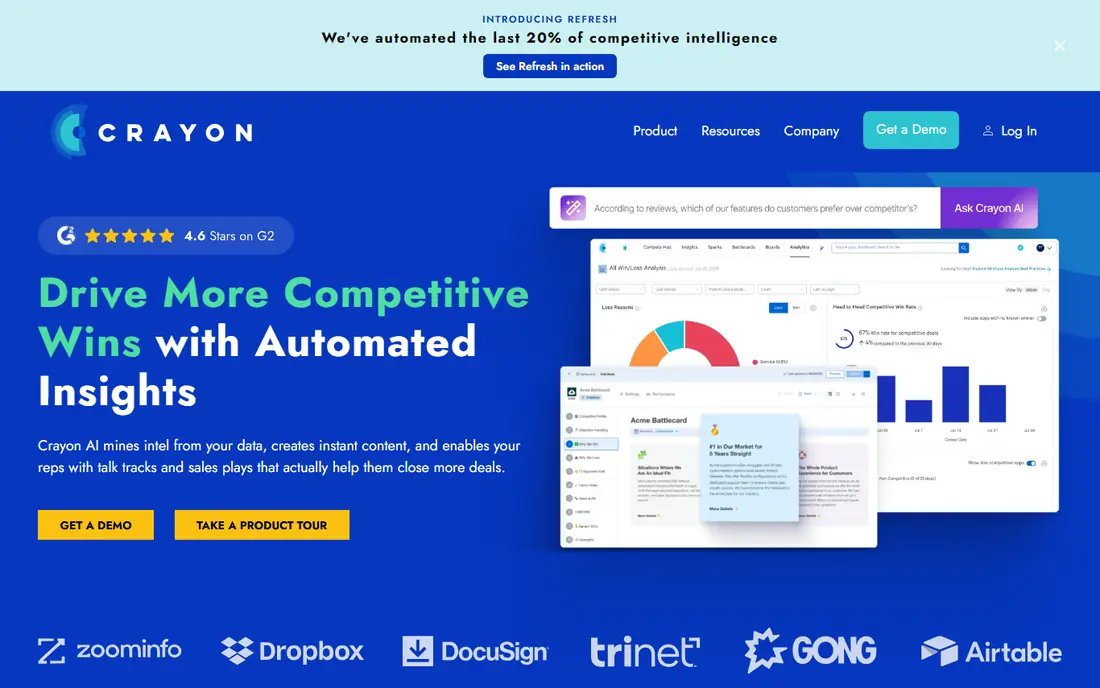
For enterprises that want automatic competitor tracking feeding sales battlecards, Crayon is a natural candidate. Crayon solves a different problem from the traffic tools: it watches competitors for you.
Trade-offs to know: Custom pricing means a sales process and annual contract.
Reasons to shortlist it: Automated capture of competitor website.
In daily use, if your team is five marketers doing their own research, Crayon is the wrong shape. Beyond that, if you have fifty sellers who require to answer "how do we beat competitor X" on calls, it earns its keep. No starting price is listed for Crayon here; confirm pricing on the vendor site. Crayon has no free plan.
- Solid coverage of mid-market and enterprise software markets
- Battlecards delivered inside Salesforce and Slack where sellers work
- Overkill and overpriced for teams that just need ad or keyword data
BuiltWith
Ideal for: Sales and marketing teams building prospect lists from website technology data
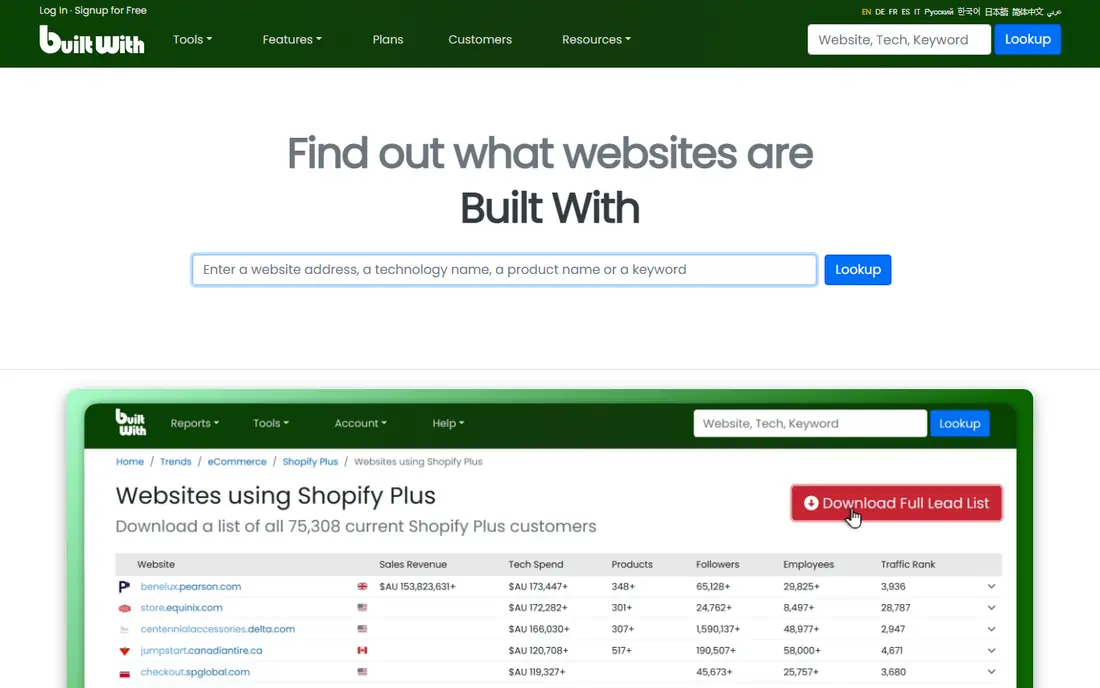
BuiltWith was built for sales and marketing teams building prospect lists from website technology data. The vendor's own knowledge base publishes these prices plainly, a rarity in this category.
From a buyer's view, the honest catch is the two-technology cap on Basic, which makes the entry plan a teaser for most prospecting workflows. The absence of contact data: you get the businesses, not the people. Starting cost for BuiltWith: $295/month. BuiltWith has no free tier.
Where it is weaker: No free trial.
- In-depth per-site lookups available on the $144-per-year Advanced plan
- Historical trend data presents technology adoption over time
- List building needs contact data from elsewhere
Klue
Ideal for: Product marketers building a competitive enablement program for sales
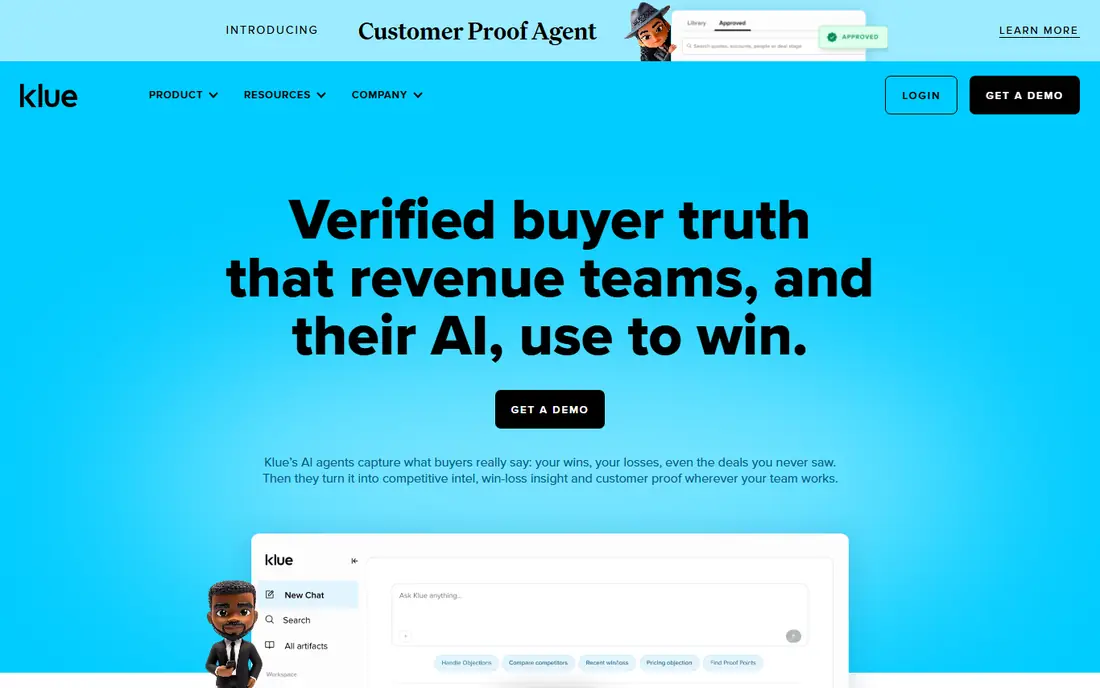
Klue targets product marketers building a competitive enablement program for sales. The honest catch is the same as Crayon's: custom quotes, annual contracts, and a product whose ROI lives or dies on seller adoption. Beyond that, Klue is Crayon's closest rival and the choice of product marketers who think in programs, not dashboards.
Honest limits: Value relies on sales team adoption, which needs internal change management.
Its enablement methodology is a real differentiator: Klue teaches you how to run the program, not just how to use the software. Worth adding: buying Klue without a plan to drive usage is buying a pricey library nobody opens. This comparison lists no price for Klue; ask the vendor. Klue has no free tier.
- Curated intel from analyst-curated sources plus your own field input
- Capable adoption playbooks for competitive programs
- Custom pricing with no self-serve choice
Adbeat
Ideal for: Media buyers and agencies spying on competitor display and native ad creatives
Choose Adbeat for media buyers and agencies spying on competitor display and native ad creatives. The honest catch is the price-to-use-case fit.
Watch-outs: $249 a month is steep if you only run search ads.
Worth adding: the restricted free plan is a real advantage: you can confirm Adbeat tracks your competitors before spending anything. The starting price for Adbeat: $249/month. You can start on Adbeat without paying. Main advantages: native and programmatic creative coverage in the category.
- Landing pages and publisher placements
- Presents actual ad creatives
- Interface feels dated and takes time to learn
SpyFu
Ideal for: Small companies and freelancers doing competitor keyword and ad research on a budget
SpyFu works best for small firms and freelancers doing competitor keyword and ad research on a budget. SpyFu is the budget pick that refuses to die, since $39 a month buys unlimited competitor keyword and ad history searches with data stretching back over a decade.
At $39 a month it does not need to be more, but buyers expecting Semrush breadth will be disappointed. SpyFu starts at: $39/month. SpyFu has no permanent free option.
Downsides: No traffic estimation or display ad creative coverage.
- Lowest-priced serious competitor research tool with unlimited searches on premium plans
- Straightforward interface with no training required
- Data depth and freshness trail Semrush and Similarweb
Semrush
Ideal for: Marketing teams that want competitor SEO, PPC and traffic data in one subscription
Semrush was built for marketing teams that want competitor SEO, PPC and traffic data in one subscription. Traffic Analytics estimates competitor visits and sources, Advertising Research presents their ad copies and budgets, and Keyword Gap finds the terms they rank for that you do not. In practice, heavy users also hit Pro's project limits quick.
Strengths: traffic analytics and inbound link gaps in one login.
Drawbacks to consider: Traffic estimates are modeled, not measured, so treat small-site numbers as directional.
Beyond that, at $139.95 a month with a restricted free account to test, it is the cheapest way to get credible competitor data across channels. On top of that, the honest catch is precision. Starting cost for Semrush: $139.95/month. A free plan is available with Semrush.
- Broadest data set per dollar: keyword gaps
- Ad copies
- Pro project and keyword limits push active teams toward Guru rapidly
Similarweb
Ideal for: Marketers and analysts benchmarking competitor website traffic and audience behavior
Think of Similarweb for Marketers and analysts benchmarking competitor website traffic and audience behavior. For agencies and enterprises doing market sizing, it is the reference dataset.
Downsides: No published pricing beyond the self-serve level, so costs escalate through sales calls.
In daily use, Similarweb is what analysts mean when they say "competitive traffic data." Its panel-based estimates handle traffic sources, audience geography, engagement and app rankings at a depth no SEO tool matches. Also, the honest catch is the price curve. No starting price is listed for Similarweb here; confirm pricing on the vendor site. Similarweb includes a free tier.
- Industry and app intelligence modules for market sizing
- Deepest website traffic and audience dataset in the category
- Upper levels run $14,000-plus a year, which prices out small teams
How we built this list
Each tool was reviewed on what its vendor publishes: price, plan limits, core features and stated drawbacks. We did not run hands-on tests. Where a vendor does not publish a price, the entry says quote. Where a price depends on seats or billing term, the entry says so. The sequence is a judgement call: typical use case first, then pricing transparency, then free access. Use the profiles to check fit.
Things to verify first
- Ask Crayon, Klue and Similarweb for a written quote, since no starting price is shown.
- Look at free plan limits closely: Adbeat, Semrush and Similarweb have one, and the caps decide whether it is usable for real work.
- Before choosing Crayon, weigh its main limit: custom pricing means a sales process and annual contract.
- A short pilot of Klue with your real workflow tells you more than a feature table.
- Find out whether the entry plan of BuiltWith covers your must-haves or only a trimmed-down version.
Frequently asked questions
Do I need a battlecard product like Crayon or Klue?
Both are custom-quoted annual contracts made for product marketers supporting sellers. If you are a marketer doing your own research, self-serve tools answer the same questions for a tenth of the cost.
What is marketing intelligence software?
Software that collects and organizes data about competitors' marketing: their ad creatives and spend, keyword rankings, website traffic, pricing changes and messaging. It ranges from $39-per-month ad spies to enterprise battlecard systems.
Can I try these options before paying?
Often, yes. Adbeat, Semrush and Similarweb have a free plan. Use your own data and a real task during the test, and check what the free tier or trial limits before you rely on it.
How are the tools for marketing intelligence software ordered?
The order follows typical fit for marketing intelligence software, with Crayon first and Similarweb last, then price clarity and free access. It is editorial judgement, not a score, so another team could rank the tools differently.
How is marketing intelligence different from market intelligence?
Marketing intelligence tracks competitors' marketing activity (ads, keywords, traffic, messaging). Market intelligence is broader: industry trends, market sizing and customer research. The tools here do the first; businesses like Gartner or IDC do the second.
Which options for marketing intelligence software have a free plan?
On this list, Adbeat, Semrush and Similarweb include a free plan. Caps on seats, usage or features are common, so test the free plan against your real workload.