Best meditation apps for mental health in 2026: 8 Options Compared

- Headspace is best for beginners learning meditation step by step, while Calm is best for sleep.
- Insight Timer offers the largest free library, and Waking Up suits meditators wanting depth.
- These apps support wellbeing but are not a substitute for professional care for serious symptoms.
- If you are in crisis in the US, call or text 988 for immediate support.
Quick comparison
| Product | Ideal for | Price from | Free version | |
|---|---|---|---|---|
 Headspace | beginners learning meditation step by step | $69.99 per year | Free trial (14 days) | Visit |
 Calm | sleep and relaxation | $69.99 per year | Free trial (7 days) | Visit |
 Insight Timer | largest free meditation library | $60 per year | Yes | Visit |
 Waking Up | depth and theory for serious meditators | $129.99 per year | Free trial (30 days) | Visit |
 Balance | personalised meditation plans | See website | Free trial | Visit |
 Woebot | CBT-based support for anxious thoughts | Free | Yes | Visit |
 Happify | mood-boosting games and CBT activities | $139.99 per year | Free trial | Visit |
 MindShift | free anxiety-specific tools | Free | Yes | Visit |
The best meditation apps for mental health
Here is our shortlist for best meditation apps for mental health, ordered from the most broadly useful picks to the more specialised ones. Every entry below is a real product you can sign up for or buy today, with pricing taken from the vendor site or app store listing where we could verify it.
Headspace
Ideal for: beginners learning meditation step by step
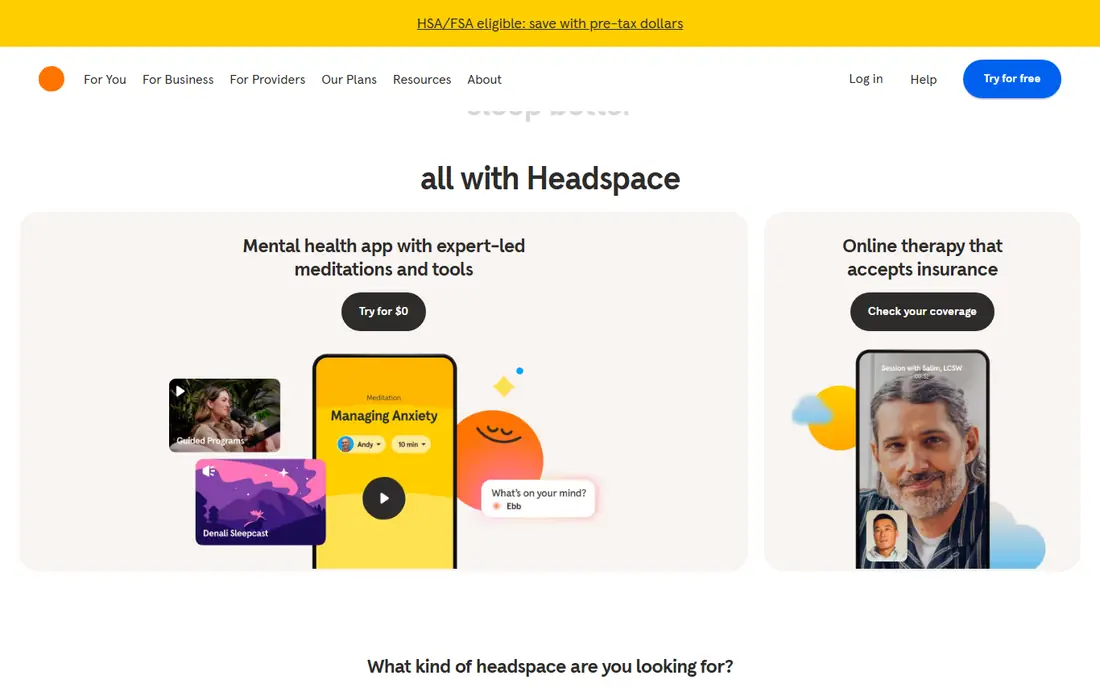
This one is aimed at beginners learning meditation step by step. Headspace teaches meditation through structured, progressive courses that walk beginners from breathing basics to longer sits, with animated explainers that make the ideas stick. Its anxiety content includes a dedicated course and short SOS sessions for moments when stress spikes.
The library is smaller than Insight Timer, and sleep content is thinner than Calm. For a beginner who wants a clear path rather than a huge library, it is the best teacher here.
- Structured courses that teach fundamentals
- Anxiety-specific content
- SOS sessions for stressful moments
- Library is smaller than rivals
- Sleep content is thinner than Calm
Calm
Ideal for: sleep and relaxation
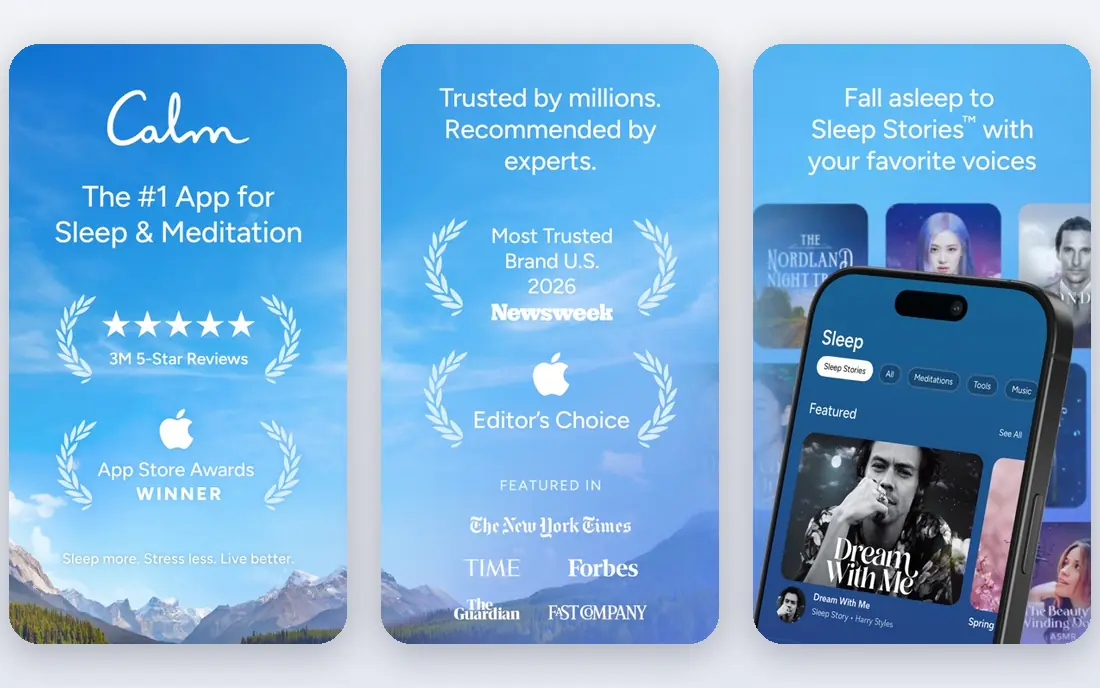
Think of Calm as the pick for sleep and relaxation. Calm built its name on Sleep Stories and relaxation content, with narrated stories, soundscapes and breathing exercises that help many users wind down at night. It also covers meditation, music and masterclasses for daytime stress.
The free tier is limited, and it teaches less systematically than Headspace. If sleep is the main problem, Calm is the strongest pick here.
- Large Sleep Stories library
- Breathing exercises and music
- Masterclasses
- Free tier is limited
- Annual price matches Headspace without the structured courses
Insight Timer
Ideal for: largest free meditation library
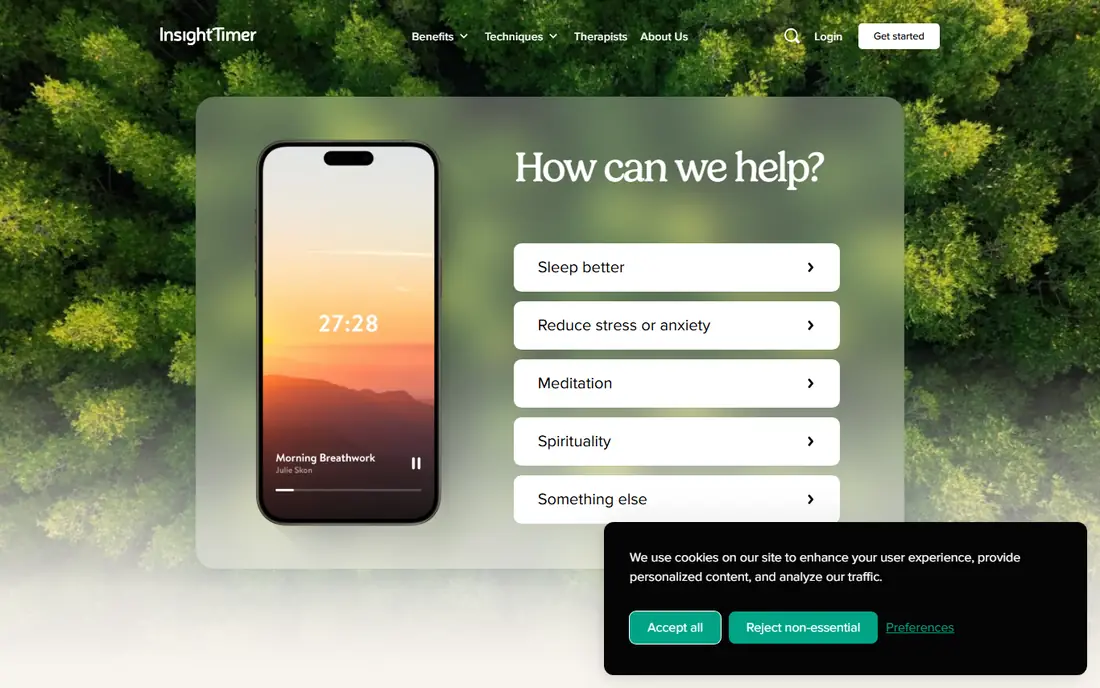
For largest free meditation library, Insight Timer deserves a close look. Insight Timer offers a huge free library of guided meditations from thousands of teachers, plus one of the best timers for silent, unguided sits. The free experience is genuinely complete for daily practice, with premium at $60 a year adding courses and offline listening.
Quality varies because anyone can publish, so finding teachers you trust takes time. For budget-conscious meditators who want variety, the free library is unmatched.
- Huge free library from thousands of teachers
- Excellent timer for silent sits
- Free core experience
- Quality varies across teachers
- Premium features need the paid tier
Waking Up
Ideal for: depth and theory for serious meditators
This is the option we would point depth and theory for serious meditators toward first. Waking Up pairs daily guided meditations with short theory lessons that explain what meditation is doing and why, which suits users who want understanding as well as practice. Guest teachers add variety without losing the coherent approach.
At $129.99 a year it is the priciest app here, and casual users may find the intellectual tone heavy. For meditators who want depth, it is the most thoughtful option.
- Daily guided meditations with theory lessons
- Thoughtful, intellectual approach
- Guest teachers
- Highest price here
- Less suited to casual or sleep-first users
Balance
Ideal for: personalised meditation plans
Balance earns its place here for personalised meditation plans. Balance builds a personalised meditation plan from your experience, goals and available time, adjusting as you progress. New users are often offered a free first year, which makes it a low-risk way to test a structured plan.
The content library is smaller than Calm or Insight Timer, and pricing varies with current offers, so check the app before paying. For a plan that adapts to you, it is a strong choice.
- Plans adapt to your experience and goals
- First year often offered free
- Clean, simple design
- Smaller content library than Calm or Insight Timer
- Pricing varies by offer
Woebot
Ideal for: CBT-based support for anxious thoughts
If your shortlist is built around CBT-based support for anxious thoughts, start with Woebot. Woebot is a CBT-based chatbot that runs short daily conversations designed to catch distorted thinking patterns, such as spiralling worries, in real time. It is free and suits users who want structured mental health support rather than meditation alone.
It is not a meditation app and not a replacement for therapy, and its conversations follow structured scripts. As a free, research-backed starting point for anxiety-related thinking, it is a useful complement.
- Structured CBT conversations
- Short daily check-ins
- Research-backed approach
- Not a meditation app
- Not a replacement for therapy
Happify
Ideal for: mood-boosting games and CBT activities
Among the options here, Happify speaks most directly to mood-boosting games and CBT activities. Happify uses CBT strategies inside short games and activities designed to build optimism, gratitude and resilience, with tracks for stress, anxiety and confidence. It tracks mood over time so progress is visible.
At $139.99 a year it is pricey, and the game style will not suit everyone. For users who find sitting still hard, its active approach can be more engaging than pure meditation.
- CBT-based games and activities
- Tracks mood and progress
- Science-based tracks
- Higher price
- Game style suits some users more than others
MindShift
Ideal for: free anxiety-specific tools
For readers focused on free anxiety-specific tools, MindShift is a strong match. MindShift from Anxiety Canada is free and tailored to anxiety, with a thought journal, coping cards and tools matched to different anxiety types. It suits users who want practical anxiety tools without a subscription.
It has no guided meditation library on the scale of Calm or Headspace. As a free, focused anxiety tool, it pairs well with a meditation app rather than replacing one.
- Free from Anxiety Canada
- Thought journal and coping cards
- Tailored to anxiety types
- Smaller feature set than paid apps
- No guided meditation library of the same size
How we picked these
We compared official feature pages, pricing pages, app store listings, privacy policies and public reviews for each product on this list, and we kept only products that exist and work today and that truly fit the topic. Where a price had changed between sources or we could not verify it on the vendor site, we wrote See website rather than print a number we could not stand behind. We also weighed who each product is really for, not just how long its feature list runs. A product with a smaller set of features can be the better buy when it matches your workflow, your budget and the size of your team, and we say so plainly in each write-up. We also checked what each product costs over a full year, not just the headline monthly price, since annual billing, seat minimums and add-on fees can change the real total by a wide margin. Free plans were judged against their limits too: a free tier that caps the exact feature you need most is not really free for your use case, and we say so in the write-up when that is the case. Where prices differed between the vendor site and review listings, we trusted the vendor site, and where we could not confirm a figure on the vendor site at all, we wrote See website rather than repeat a number from a third party. That caution is deliberate, because a wrong price is worse than no price when you are building a budget.
How to choose, and when to get more help
Match the app to the problem: Headspace for learning meditation, Calm for sleep, Insight Timer for free variety, Waking Up for depth, and Woebot or MindShift for anxiety-specific tools. Try the free tier or trial for two weeks of daily use before paying, since the app you open daily beats the cleverer one you abandon.
Remember that apps support wellbeing but do not treat serious mental health conditions. If symptoms are severe, persistent or worsening, talk to a doctor or mental health professional, and use crisis lines such as 988 in the US for immediate support. An app can be part of a care plan, not a replacement for one.
Finally, before you commit to one of the options above, run it on a real task from your own work rather than a polished demo project. Use the free tier or trial for a full week, invite the people who will actually use it every day, and test the one workflow you cannot live without, whether that is exporting your data, inviting a teammate, sharing a result with a client or getting help when something breaks. Note how long each step takes and where you get stuck, since those friction points are what you will live with for months. The product that handles your real task with the least friction is the right one, even if another option looks stronger on a feature comparison page.
Frequently asked questions
What is the best meditation app for mental health?
Headspace is best for beginners, Calm is best for sleep, and Insight Timer offers the largest free library. Waking Up suits meditators wanting depth, while Woebot and MindShift add anxiety-specific tools.
Are meditation apps good for anxiety?
Meditation apps can help with everyday stress and anxiety through guided practice and breathing exercises, and Headspace offers anxiety-specific courses. They are not a substitute for professional care for serious or persistent anxiety.
Is there a free meditation app?
Yes, Insight Timer has a large free library, MindShift is free, and Woebot is free. Headspace and Calm offer trials, while Balance often offers a free first year.
What is the difference between Calm and Headspace?
Headspace teaches meditation through structured courses and suits beginners, while Calm focuses more on sleep stories and relaxation. Both cost $69.99 a year, so the choice comes down to learning versus sleep.