Best Multi-Cloud Management Platforms in 2026: 8 Platforms Compared

- 1
 Morpheus Dataself-service multi-cloud provisioningVisit
- 2
 Flexeracloud cost and licence managementVisit
- 3
 CloudBolthybrid and multi-cloud cost controlVisit
- 4
 VMware AriaVMware-based multi-cloud operationsVisit
- 5
 Terraform Cloudinfrastructure as code collaborationVisit
- Our pick for most readers is Morpheus Data, because it fits self-service multi-cloud provisioning and keeps its core pitch easy to understand.
- Prices in this category vary widely, so check the vendor pricing page and confirm what is included before you pay.
- A free plan or free trial is worth testing with your own data, since a demo with sample data can hide daily friction.
- The right choice depends on team size, budget, and how much setup help you need, not on the longest feature list.
- Read the privacy and support terms for best multi-cloud management platforms tools carefully, especially if you will store customer or financial data in them.
Quick comparison
| Product | Ideal for | Price from | Free version | |
|---|---|---|---|---|
| Morpheus Data | self-service multi-cloud provisioning | See website | Free trial | Visit |
| Flexera | cloud cost and licence management | See website | Free trial | Visit |
| CloudBolt | hybrid and multi-cloud cost control | See website | Free trial | Visit |
| VMware Aria | VMware-based multi-cloud operations | See website | Free trial | Visit |
| Terraform Cloud | infrastructure as code collaboration | Free | Free trial | Visit |
 Nutanix | hyperconverged multi-cloud infrastructure | See website | Free trial | Visit |
 Turbonomic | automated cloud resource optimisation | See website | Free trial | Visit |
 Spot by NetApp | cloud cost optimisation and automation | See website | Free trial | Visit |
The best multi-cloud management platforms
We compared official feature pages, pricing pages, app store listings, privacy policies, and public reviews to put this list together for readers looking for best multi-cloud management platforms. Each option below is a real product that works in October 2026, with a clear note on who it suits and where it falls short.
Morpheus Data
Ideal for: self-service multi-cloud provisioning
Morpheus Data suits IT teams that run workloads across several clouds and want one self-service catalog. Developers request resources from approved templates, while IT keeps control over cost, policy, and lifecycle. That focus matters most in the first weeks, when a team either settles into a tool or quietly stops opening it.
Its strength is self-service with guardrails. Teams move faster without losing governance, and automation handles provisioning, scaling, and teardown in a consistent way. It also matters for teams that need to show results to a manager or a client without extra reporting work.
The catch is expertise. Setup needs people who understand each cloud involved, and enterprise pricing needs a quote, so small teams may find it heavy. It is worth weighing against the strengths above, especially if you plan to use the tool for years.
- Self-service catalog
- Automation and orchestration
- Cost and governance controls
- Enterprise pricing
- Setup needs cloud expertise
Flexera
Ideal for: cloud cost and licence management

Flexera suits companies that want to control cloud spend and software licences from one view. Its tools track usage across clouds, flag waste, and help teams reclaim unused capacity. We gave extra weight to tools that explain their limits plainly instead of hiding them behind a sales call.
Its strength is cost visibility. Finance and IT teams can see where money goes across providers, which makes budget talks concrete instead of guesswork. We checked this against the vendor's own feature page and public reviews, not just marketing copy.
The drawback is breadth. The suite covers a lot, so teams that only need cost control may find the wider product set confusing, and pricing needs a quote. Teams with strict requirements should test this exact point before signing a contract.
- Cloud cost optimisation
- Licence management
- Usage analytics
- Broad suite can feel complex
- Pricing needs a quote
CloudBolt
Ideal for: hybrid and multi-cloud cost control
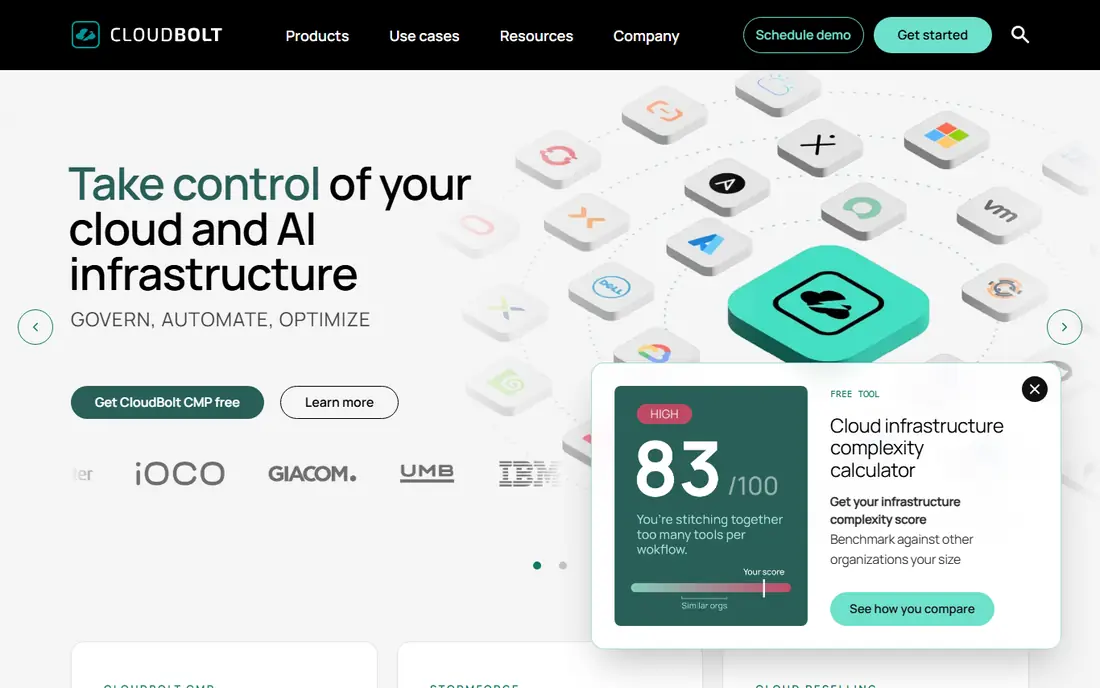
CloudBolt suits hybrid cloud teams that need cost control and self-service in one platform. It covers public clouds and private infrastructure, which helps companies that still run their own data centres. The best fit is often the tool your team will actually use every day, not the one with the longest list of features.
Its strength is hybrid coverage. Teams with a foot in both worlds get one cost and provisioning view instead of separate tools for each side. Look for this in the trial, and check how it behaves with your own data rather than sample data.
The catch is integration effort. Connecting every cloud and finance system takes work, and enterprise pricing needs a quote, so buyers should plan a pilot. If this point is a deal breaker for you, the next options on this list handle it differently.
- Cost management
- Self-service provisioning
- Hybrid cloud support
- Enterprise pricing
- Integration work needed
VMware Aria
Ideal for: VMware-based multi-cloud operations
VMware Aria suits companies that already run VMware and want to extend operations across clouds. Its tools cover automation, operations, and cost insights for VMware-based estates. Setup effort, daily friction, and the clarity of the pricing page shaped how we weighed that fit.
Its strength is VMware depth. Teams with large VMware footprints get application-aware views and automation that generic tools may not match. That strength shows up in daily work, not just in a demo, which is why we ranked it highly.
The drawback is fit. Companies with little VMware usage may get less value, and licensing across the VMware portfolio can be hard to compare without a quote. That drawback may not matter for a small team, but it can grow into a real problem as usage grows.
- Operations and automation for VMware estates
- Cost insights
- Application-aware views
- Best value inside VMware environments
- Licensing can be complex
Terraform Cloud
Ideal for: infrastructure as code collaboration
Terraform Cloud suits engineering teams that manage infrastructure as code across clouds. It adds collaboration, policy checks, and run history to Terraform workflows, so teams can review changes before they apply. A short trial with real data tells you more than a feature list, so plan one before you commit.
Its strength is workflow discipline. Versioned infrastructure, policy checks, and audit trails make multi-cloud changes safer and easier to review. This kind of strength tends to save time week after week, which adds up faster than a small price difference.
The catch is scope. It is not a full cost management platform, and it needs coding skill, so finance-led teams looking for spend reports alone should look elsewhere. Ask about it on a sales call or in the trial, and get the answer in writing if it affects your budget.
- Infrastructure as code workflows
- Policy as code
- Team collaboration
- Cloud cost management is not its main job
- Needs coding skill
Nutanix
Ideal for: hyperconverged multi-cloud infrastructure
Nutanix suits companies that want a unified platform for private and public cloud infrastructure. Its software manages virtual machines, storage, and networking across environments from one control plane. That focus matters most in the first weeks, when a team either settles into a tool or quietly stops opening it.
Its strength is consistency. Teams can run similar operations on premises and in the cloud, which simplifies training and support. It also matters for teams that need to show results to a manager or a client without extra reporting work.
The drawback is cost and lock-in risk. Licensing and infrastructure costs need careful review, and the strongest value comes for teams already committed to Nutanix. It is worth weighing against the strengths above, especially if you plan to use the tool for years.
- Unified infrastructure management
- Hybrid cloud mobility
- Enterprise support
- Hardware and licensing costs
- Best for Nutanix estates
Turbonomic
Ideal for: automated cloud resource optimisation
Turbonomic suits teams that want cloud resources adjusted automatically as demand changes. It analyses performance and cost together and recommends or applies rightsizing actions for workloads. We gave extra weight to tools that explain their limits plainly instead of hiding them behind a sales call.
Its strength is automation. Instead of periodic manual reviews, the platform keeps adjusting resources, which can cut waste without constant human attention. We checked this against the vendor's own feature page and public reviews, not just marketing copy.
The catch is trust. Teams must tune automation levels and review early actions, since an aggressive setting can affect performance if it is not watched. Teams with strict requirements should test this exact point before signing a contract.
- Automated rightsizing
- Performance and cost balance
- Application-aware actions
- Automation needs trust and tuning
- Enterprise pricing
Spot by NetApp
Ideal for: cloud cost optimisation and automation
Spot by NetApp suits teams that run cloud workloads and want to cut costs with spot capacity and automation. It manages spot instances, handles interruptions, and optimises Kubernetes clusters. The best fit is often the tool your team will actually use every day, not the one with the longest list of features.
Its strength is cost saving on suitable workloads. Stateless and fault-tolerant workloads can benefit most, and automation handles the complexity of spot markets. Look for this in the trial, and check how it behaves with your own data rather than sample data.
The catch is workload fit. Not every workload suits spot capacity, and savings vary, so teams should test with non-critical workloads first. If this point is a deal breaker for you, the next options on this list handle it differently.
- Spot instance automation
- Cost analytics
- Kubernetes optimisation
- Learning curve for spot strategies
- Savings vary by workload
How we picked these
We started from the main keyword for this article and checked each candidate against official feature pages, pricing pages, app store listings, privacy policies, and public reviews. We kept only products that exist and work in October 2026 and that truly fit best multi-cloud management platforms, and we left out options that did not fit even when they looked popular in a general search.
We did not claim hands-on testing that did not happen. Where a price or a free tier could not be confirmed from the vendor's own site, we wrote See website rather than guessing a number. That approach keeps the list honest, and it means you should still confirm current pricing before you buy.
How to choose a multi-cloud management platform
Start by writing down the one job this tool must do well for you. For best multi-cloud management platforms, that job might be daily use by a small team, reporting for a manager, or handling a larger volume without constant manual work. A tool that does that one job well is usually a better buy than a tool that does many jobs in a shallow way.
Next, run a short trial with real data and the people who will use the tool every day. Watch how long setup takes, how clear the billing is, and how fast support answers a real question. If the trial feels confusing, that confusion rarely disappears after you pay, so take it as a useful warning.
Finally, check the terms that matter after the first month: renewal pricing, data export, cancellation, and what happens to your data if you leave. A tool with a clear export path and plain renewal terms is easier to live with, even if a rival looks slightly cheaper on the first invoice.
Frequently asked questions
What is the best option for best multi-cloud management platforms?
For most readers, Morpheus Data is a strong starting point because it fits self-service multi-cloud provisioning. The best choice still depends on your budget and team size, so compare the top three on this list in a trial before you decide.
Is there a free option for best multi-cloud management platforms?
Some options on this list offer a free plan, and others offer a free trial, as shown in the comparison table. Free plans usually cover basic use, while paid plans add reporting, integrations, and support, so check the limits before you rely on a free tier.
How much do best multi-cloud management platforms tools cost?
Pricing varies widely in this category, and some vendors only quote after a sales call. Where we could confirm a starting price, we listed it in the table, and where we could not, we wrote See website so you can check the vendor page directly.
Can I switch tools later if I pick the wrong one?
In most cases, yes, but switching takes more work than people expect. Before you commit, check how to export your data, whether integrations carry over, and how long a migration would take for your team.
How should I test a tool before buying?
Use a short trial with real data, invite the people who will use it daily, and test support with a genuine question. Keep notes on setup time, billing clarity, and any feature that was promised but hard to find in the product itself.