8 Best OKR Software for Small Business

- Tability is the cheapest priced entry at $6 per user per month billed annually, and Perdoo starts at 6.40 euros per user per month with a free plan for up to 5 users.
- Lattice looks cheap at $8 per seat per month, but a $4,000 minimum annual agreement means a small team pays the floor, not the rate.
- Weekdone is free for up to 3 users, and Perdoo is free for up to 5 users, so a very small team can run OKRs at no cost.
- Profit.co is quote only with no free tier, so a small business cannot budget from the site at all.
- Leapsome cannot be bought as OKRs alone: the HR platform is mandatory, so the real entry is 11 euros per employee per month.
Quick comparison
| Product | Ideal for | Price from | Free version | |
|---|---|---|---|---|
 Weekdone | Tiny teams that want a free start | $90 per month for 10 users (billed annually) | Yes | Visit |
 Perdoo | Small teams on a euro budget | €6.40 per user/month | Yes | Visit |
 Lattice | Teams that also need performance reviews | $8 per seat/month (billed annually) | No | Visit |
 15Five | OKRs plus weekly check ins | $11 per user/month (billed annually) | No | Visit |
 Tability | Lowest priced OKR tracking | $6 per user/month (billed annually) | Free trial (14 days) | Visit |
 Mooncamp | Simple OKRs with a 14 day trial | €7 per user/month (billed annually) | Free trial (14 days) | Visit |
 Profit.co | Larger teams that want a sales quote | quote only | Free trial (30 days) | Visit |
 Leapsome | Teams that also need an HR platform | €11 per employee/month (billed annually) | Free trial (14 days) | Visit |
The best OKR software for small business
Weekdone
Ideal for: Tiny teams that want a free start
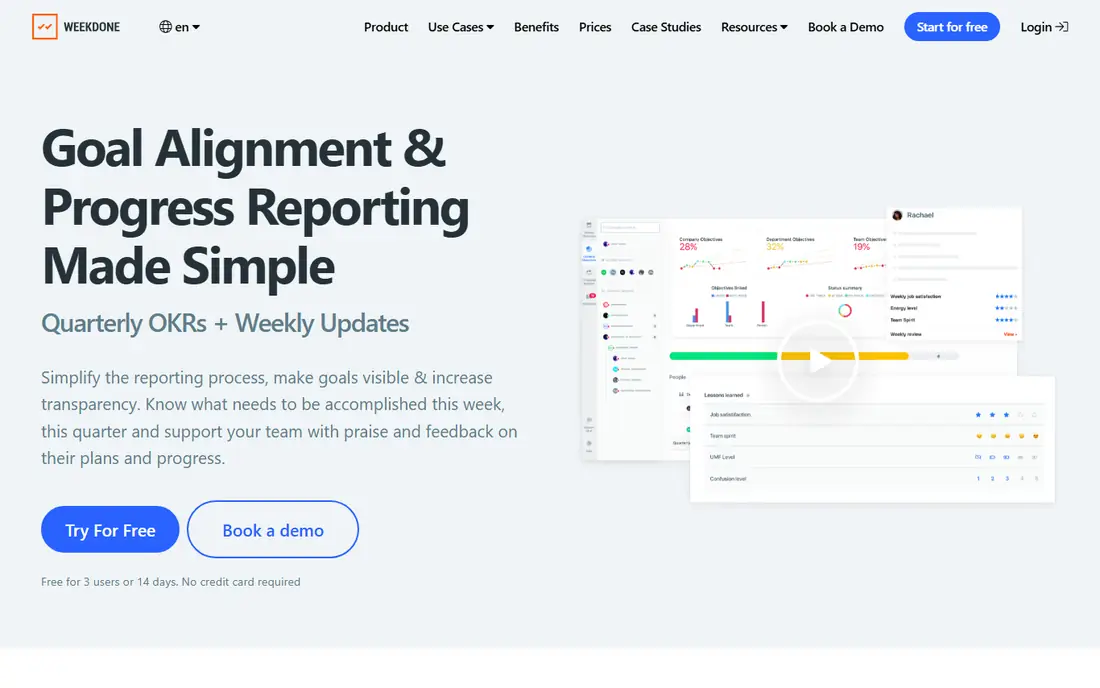
Weekdone is one of the simplest OKR tools for a small business, pairing objectives with a weekly check in that takes a few minutes. The price is $90 per month for a 10 user package, which works out to $9 per user per month billed annually, or $108 per month billed monthly at $10.80 per user per month. The free plan covers up to 3 users, and a 14 day trial is available. For a team of three founders, that free plan covers the whole company.
The package model is the limit to plan around. Weekdone sells fixed user packages rather than per seat pricing, so a 4 person team must buy a larger package, and the per user rate only falls with volume, at $9.86 per user per month for 4 to 6 users and $9 for 7 to 15. The price figures here come from third party reads that cite Weekdone pricing, because the vendor pricing page returned a 404 on the check date. Confirm the current package prices with the vendor before you buy.
- Free for up to 3 users with no credit card required
- Simple weekly check in flow that suits first time OKR teams
- Sold only as fixed user packages, not per seat, so a 4 person team must buy a larger package
- The vendor pricing page returned a 404 on the check date
Perdoo
Ideal for: Small teams on a euro budget
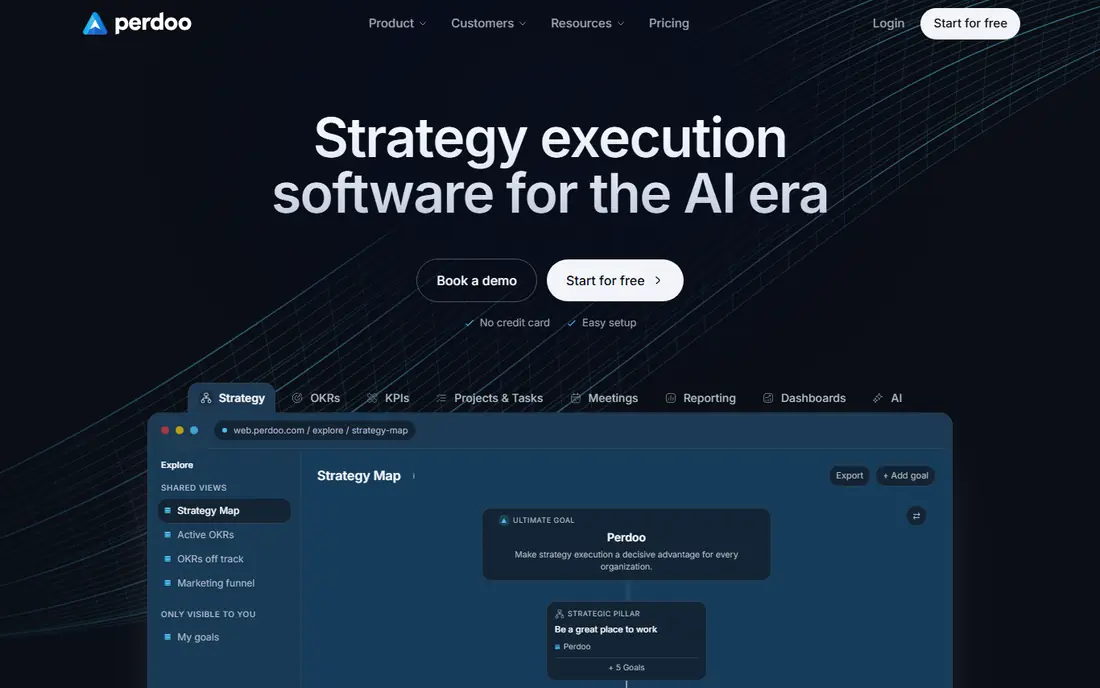
Perdoo is a focused OKR tool with a clean price ladder. Premium costs 6.40 euros per user per month, Supreme costs 8.00 euros, and the free plan covers up to 5 users. Both prices were read from the vendor pricing page on 13 November 2026, and they are lower than the 8 and 10 euro figures quoted in third party guides from September 2026, so use the current vendor figures. The billing basis was not stated in the vendor page text we opened, and third party reads say annual or quarterly billing with no monthly option.
The feature split is the thing to check. Private goals, custom dashboards, performance reviews and view only licences are gated to Supreme at 8.00 euros, so a team that wants private goals or review cycles will pay the higher rate. Priced tiers also carry a 5 licence minimum, according to a July 2026 third party read. A team of 6 to 10 should budget for Supreme if it needs the gated features.
- Free plan covers up to 5 users
- Premium price of 6.40 euros per user per month is among the lowest in this guide
- Private goals, custom dashboards, performance reviews and view only licences are gated to Supreme at 8.00 euros
- Priced tiers carry a 5 licence minimum
Lattice
Ideal for: Teams that also need performance reviews
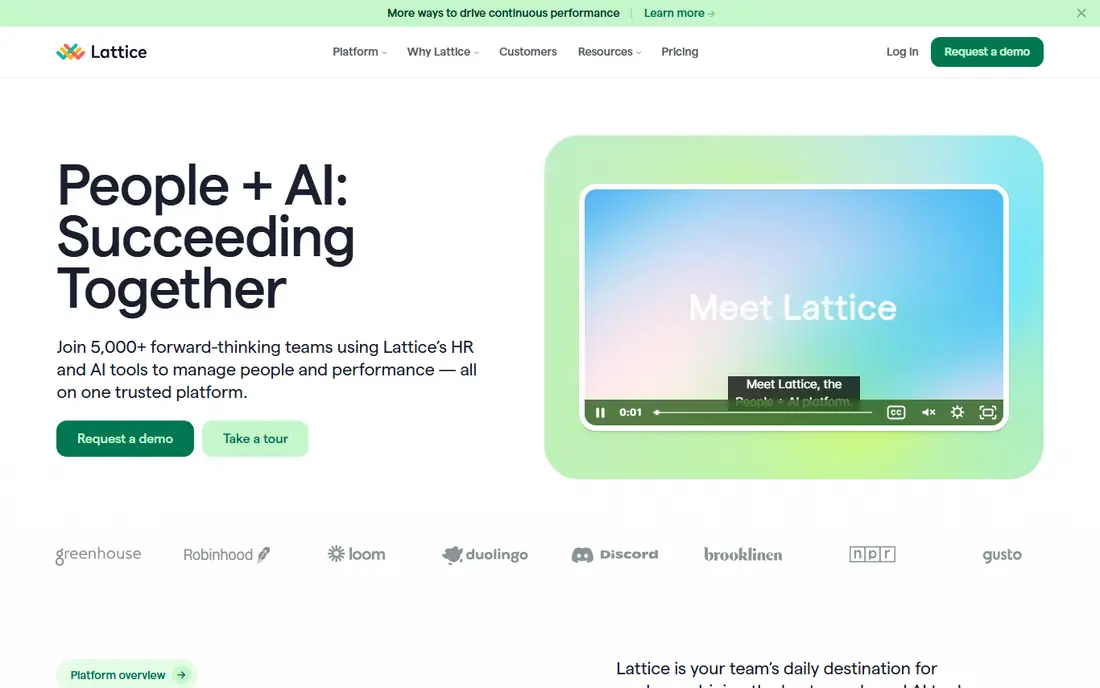
Lattice sells its Goals and OKRs module on its own at $8 per seat per month billed annually, and the Foundations bundle, which adds performance management, costs $13 per seat per month. The Performance module alone is $10, Engagement is $4, Compensation adds $6 and Grow adds $4. These figures were read from the vendor pricing page on 13 November 2026. For a team that wants OKRs and performance reviews in one place, the Foundations bundle is the natural pick.
The minimum agreement changes the maths for a small business. The vendor pricing FAQ states a $4,000 minimum annual agreement, with annual billing only and USD only, so a 10 person team pays $4,000 a year, not $960. There is no free plan and no free trial listed on the vendor pricing page. A team under 20 people should treat the $4,000 floor as the real price.
- Goals and OKRs module available on its own at $8 per seat per month
- Foundations bundle combines performance and goals at $13 per seat per month
- $4,000 minimum annual agreement, annual billing only, so a small team pays the floor, not the $8 rate
- No free plan and no free trial listed
15Five
Ideal for: OKRs plus weekly check ins
15Five combines OKRs with weekly check ins, one on ones and performance reviews, which suits a small business that wants one rhythm for goals and people. The Perform tier, which is the tier that includes OKRs, costs $11 per user per month billed annually. Engage costs $4 and Total Platform costs $16. The vendor pricing feature table confirms that weighted OKRs and goal management sit only in the middle Perform column, not in Engage, so a buyer must pick Perform to get OKRs at all.
The price figures are corroborated rather than directly read, because the text crawl of the vendor pricing page stripped the price headers, though the feature table was visible. The trial picture also conflicts: one source reports a 14 day trial and another reports no self serve trial, only a demo with sales. Add ons are priced separately too, including Compensation at $9 to $11 and Manager Content at $49 per manager per month, so the $11 rate is the floor, not the full cost.
- Perform tier includes weighted OKRs and goal management alongside check ins and reviews
- Total Platform bundles everything at $16 per user per month
- OKRs are not in the $4 Engage plan, so the cheapest tier buys surveys only
- No free plan, and trial reports conflict between sources
Tability
Ideal for: Lowest priced OKR tracking
Tability is a focused OKR tracker, and it is the cheapest priced entry in this guide at $6 per user per month on Basic billed annually, or $7 billed monthly. Premium costs $10 billed annually or $12 monthly. The price figures are corroborated by several reads from September to November 2026, because the vendor pricing page loaded but its price figures were not visible in the text crawl. The 14 day free trial was confirmed on the vendor pricing FAQ on 13 November 2026, with the vendor wording that you get 14 days to try Tability, absolutely risk free.
There is no free tier, so every user is a paying user after the trial. SSO, advanced permissions and all integrations beyond Slack are gated to Premium at $10, and Basic also lacks custom dashboards and automated check ins. Budget for Premium if integrations matter to your workflow.
- Lowest priced entry in this guide at $6 per user per month billed annually
- 14 day free trial confirmed on the vendor pricing FAQ
- No free tier
- SSO, advanced permissions and all integrations beyond Slack are gated to Premium at $10 per user per month
Mooncamp
Ideal for: Simple OKRs with a 14 day trial
Mooncamp keeps the OKR workflow simple, with objectives, key results and check ins in a clean interface. Essential costs 7 euros per user per month and Professional costs 10 euros, both billed annually. The price figures are corroborated by the vendor own blog from November 2026 and by third party reads from September and October 2026, because the vendor pricing page loaded but its price figures were not visible in the text crawl. The 14 day free trial with no credit card was confirmed on the vendor pricing FAQ on 13 November 2026.
The limits are the user minimum and the billing terms. Priced tiers carry a 5 user minimum, so a team of 2 or 3 people cannot buy a plan at all, and there is no monthly billing option. Enterprise requires 100 or more users, and SAML SSO is a priced add on on the lower tiers. A smaller team should look at Weekdone or Perdoo, which both have free plans.
- 14 day free trial with no credit card required, confirmed on the vendor pricing FAQ
- Clear two tier ladder at 7 and 10 euros
- 5 user minimum on priced tiers, so a team under 5 users cannot buy a plan
- No monthly billing, and Enterprise requires 100 or more users
Profit.co
Ideal for: Larger teams that want a sales quote
Profit.co is a full OKR platform with task management, reviews and integrations, but it does not publish prices. The vendor pricing page shows no prices anywhere, and it directs buyers to talk to sales or book a demo for a custom proposal within 48 hours. The price is set by the modules selected and the user count. A 30 day free trial is stated on the vendor pricing page, which is the longest trial in this guide.
The lack of a published rate is the real drawback for a small business. A team cannot budget from the site at all, and there is no free tier. The formerly published Growth plan, at about $7 to $9 per user per month, and the free Launch plan have both been removed from the site. One third party read estimates about $9 per user per month with a $10,000 minimum annual spend, but that minimum is an estimate, not a vendor stated figure, so do not treat it as a price.
- 30 day free trial stated on the vendor pricing page
- Pricing is set by the modules selected and the user count, so larger teams can shape the deal
- Quote only with no published rate, so a small business cannot budget from the site
- No free tier, and the formerly published Growth plan and free Launch plan have been removed
Leapsome
Ideal for: Teams that also need an HR platform
Leapsome is a people platform with a Goals and OKRs module, and it suits a team that wants OKRs, reviews, learning and engagement in one system. The Goals and OKRs module is priced at 4 euros per employee per month, but it cannot be bought alone. The Agentic HRIS Foundation platform, at 7 euros per employee per month on the list price, is required, so the real list entry is 11 euros per employee per month. The vendor page confirms the module exists and the Foundation price, and a 14 day free trial is advertised, with trial access following a consultation and a sandbox provided.
The mandatory platform is the catch. The vendor FAQ states that every module reads from the employee record, so the platform is always part of the plan. A small team that wants only OKRs still pays for the HR platform, which makes Leapsome the wrong pick for a goals only purchase. It suits a team already buying an HR system, where the module costs only the 4 euro increment.
- Goals and OKRs module sits on a full HR platform with reviews, learning and engagement
- 14 day free trial advertised on the vendor pricing page
- The HR platform is mandatory, so OKRs cannot be bought alone
- The real list entry is 11 euros per employee per month, not the 4 euro module rate
How we chose
We compared vendor pricing pages, product docs and feature tables for eight OKR tools that suit a small business, and we checked each vendor homepage to confirm it loads. Prices were read from vendor pages on 13 November 2026 where the page text showed them. Weekdone, 15Five, Tability and Mooncamp prices are corroborated by consistent third party reads of the vendor pages, because the vendor pages did not show the figures in the text crawl on the check date. Quantive was excluded, because WorkBoard acquired it in May 2025 and the standalone product no longer exists. We did not claim hands on testing, and we did not use third party ratings to rank the tools.
What to check before you buy
Check the minimums before the headline rate. Lattice has a $4,000 annual floor, Mooncamp needs 5 users, Perdoo needs 5 licences on priced tiers, and Leapsome needs the HR platform. Then check which tier holds OKRs: 15Five gates them to Perform, and Leapsome gates them behind the platform. Then check the trial, which runs from 14 days to 30 days here, and some trials follow a consultation. Finally, check the currency, because Perdoo, Mooncamp and Leapsome quote in euros.
| Tool | Year one cost for 10 people | Notes |
|---|---|---|
| Weekdone | $1,080 | $90 per month for the 10 user package, billed annually |
| Perdoo | €768 | 6.40 euros times 10 users times 12 months |
| Lattice | $4,000 | $8 rate, but the $4,000 minimum applies |
| 15Five | $1,320 | $11 times 10 users times 12 months, Perform tier |
| Tability | $720 | $6 times 10 users times 12 months, Basic tier |
| Mooncamp | €840 | 7 euros times 10 users times 12 months, Essential tier |
| Profit.co | Quote only | No published rate, 30 day trial |
| Leapsome | €1,320 | 11 euros times 10 employees times 12 months |
Frequently asked questions
Is there free OKR software for small teams?
Yes. Weekdone is free for up to 3 users, and Perdoo is free for up to 5 users, so a very small team can run OKRs at no cost. Tability, Mooncamp and Leapsome offer 14 day trials instead of a free tier, and Profit.co offers a 30 day trial. Lattice and 15Five have no free plan. A free plan suits a team of 3 to 5 people.
How long does it take to set up OKR software?
Most tools in this guide can be set up in a day. The work that takes time is writing good objectives, not configuring the tool. Teams that link OKRs to reviews should allow a week to set up the review cycle and the permissions.
Can small businesses use OKRs without a consultant?
Yes. The tools in this guide are built for self serve use, with templates, check in reminders and progress charts. Weekdone, Tability and Mooncamp are the simplest starts, because they focus on the OKR loop and little else. A consultant helps when a team is rolling OKRs out across departments, but a team under 20 people can usually start with the vendor templates and a weekly check in.
How many OKRs should a small business set?
A common guide is 3 to 5 objectives per team per quarter, with 3 to 5 key results under each. More than that spreads focus and makes check ins a chore. Start with fewer objectives and add more only when the team keeps the rhythm for a full quarter.
Should OKRs link to pay or performance reviews?
Most OKR practitioners say no, because linking goals to pay makes teams set safe targets they know they can hit. Lattice and Leapsome do connect OKRs with reviews, which suits teams that want one people system, but the link should stay visible and separate from bonus maths. Keep OKR scores out of the compensation formula and use them for coaching instead.