Which OKR Software for Startups Fits You? 7 Tools Compared

- 1
 PerdooStrategy-first startups that want goals tied to a real strategy mapVisit
- 2
 MooncampStartups that want a modern OKR system to growVisit
- 3
 LatticeStartups that want OKRs inside a full people systemVisit
- 4
 TabilityStartups that want budget-friendly OKRs with AI-assisted check-insVisit
- 5
 WeekdoneSmall startups that want straightforward OKRs with weekly status reportingVisit
- The list opens with Perdoo, aimed at strategy-first startups that want goals tied to a real strategy map.
- Only Weekdone offers a free plan among these 7 tools.
- For the cheapest start, look at 15Five: From $4/user/month.
- Before buying Mooncamp, weigh this: pricing is not published on the homepage.
Direct answer
This list puts Perdoo first for strategy-first startups that want goals tied to a real strategy map. Mooncamp fits startups that want a modern OKR product to grow with; Lattice fits startups that want OKRs inside a full people system. The full list of 7 tools follows, with prices and free plan facts.
Quick comparison
| Product | Ideal for | Price from | Free version | |
|---|---|---|---|---|
| Perdoo | Strategy-first startups that want goals tied to a real strategy map | See website | Not stated | Visit |
| Mooncamp | Startups that want a modern OKR system to grow | See website | Free trial | Visit |
| Lattice | Startups that want OKRs inside a full people system | See website | No | Visit |
| Tability | Startups that want budget-friendly OKRs with AI-assisted check-ins | $6/user/month | Free trial (14 days) | Visit |
| Weekdone | Small startups that want straightforward OKRs with weekly status reporting | See website | Yes | Visit |
 Profit.co | Startups that want OKRs, performance and projects in one system | See website | Not stated | Visit |
 15Five | Startups that want OKRs with engagement surveys and manager coaching | From $4/user/month (annual) | No | Visit |
Tool-by-tool breakdown
Ainotely compared 7 OKR software for startups. The goal is a practical shortlist: published prices, free plan facts, best-fit use cases and honest limits for every entry.
Perdoo
Ideal for: Strategy-first startups that want goals tied to a real strategy map
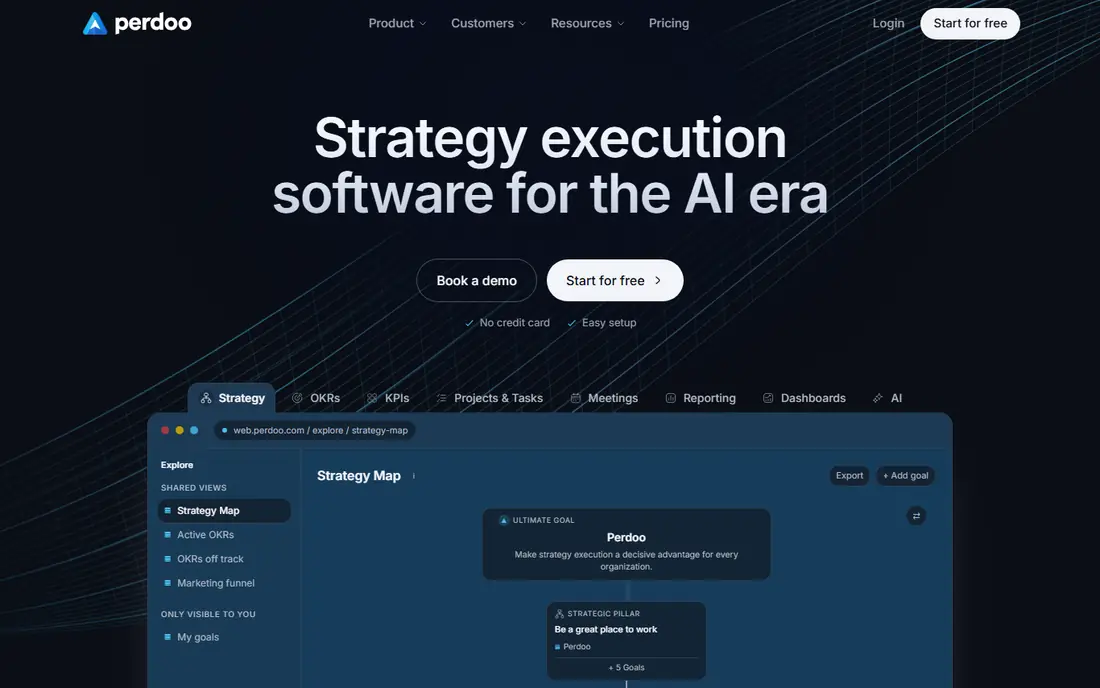
In short, Perdoo is for strategy-first startups that want goals tied to a real strategy map. For teams still finding product-market fit, a lighter tool may fit better until the strategy solidifies.
No starting price is listed for Perdoo here; confirm pricing on the vendor site. Free options: Not stated.
Best features of Perdoo: Auto-generated status reports from app integrations.
Points against: Pricing and free-tier terms are not published on the homepage.
- Key results and KPIs
- Strategy maps link ultimate goals, pillars, objectives
- Onboarding takes more thought than check-in tools
Mooncamp
Ideal for: Startups that want a modern OKR system to grow
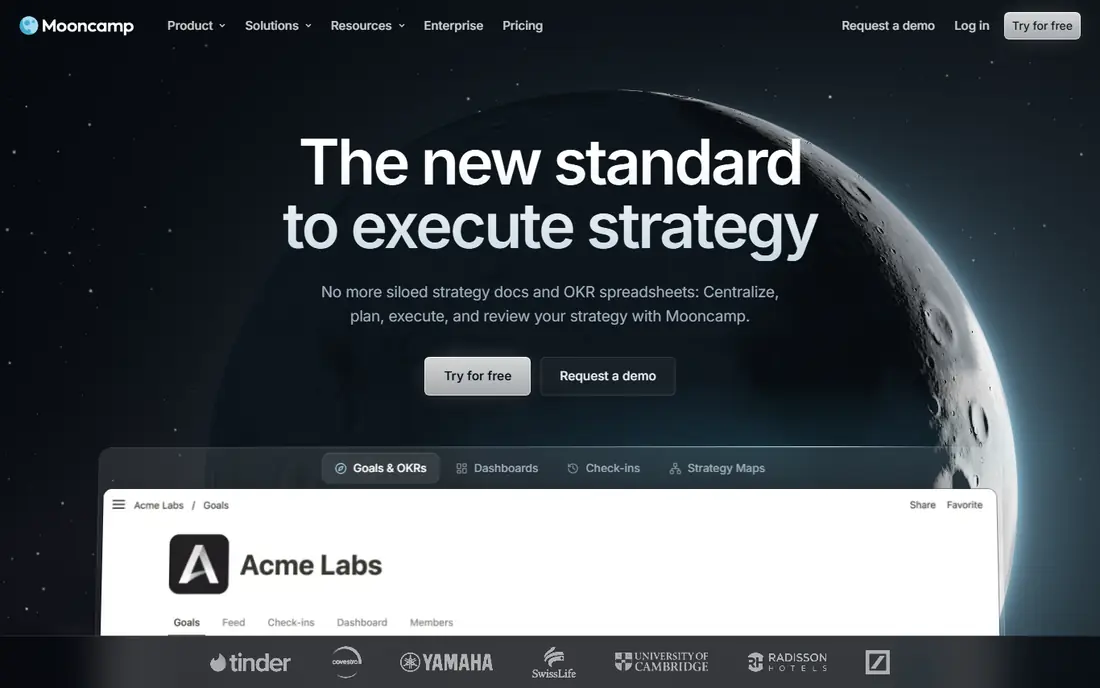
Mooncamp serves startups that want a modern OKR system to grow with. Mooncamp's pitch is centralizing strategy, goals and reviews: plan your strategy in one place, execute with OKR check-ins and accountability, and review with performance dashboards and alignment trees.
Reasons to shortlist it: OKR check-ins.
The main drawbacks: Enterprise messaging may put off tiny teams. No starting price is listed for Mooncamp here; confirm pricing on the vendor site. Free access: Free trial.
- Strategy planning
- KPI trees and dashboards in one place
- The strategy breadth can be more than a seed-stage team needs
Lattice
Ideal for: Startups that want OKRs inside a full people system
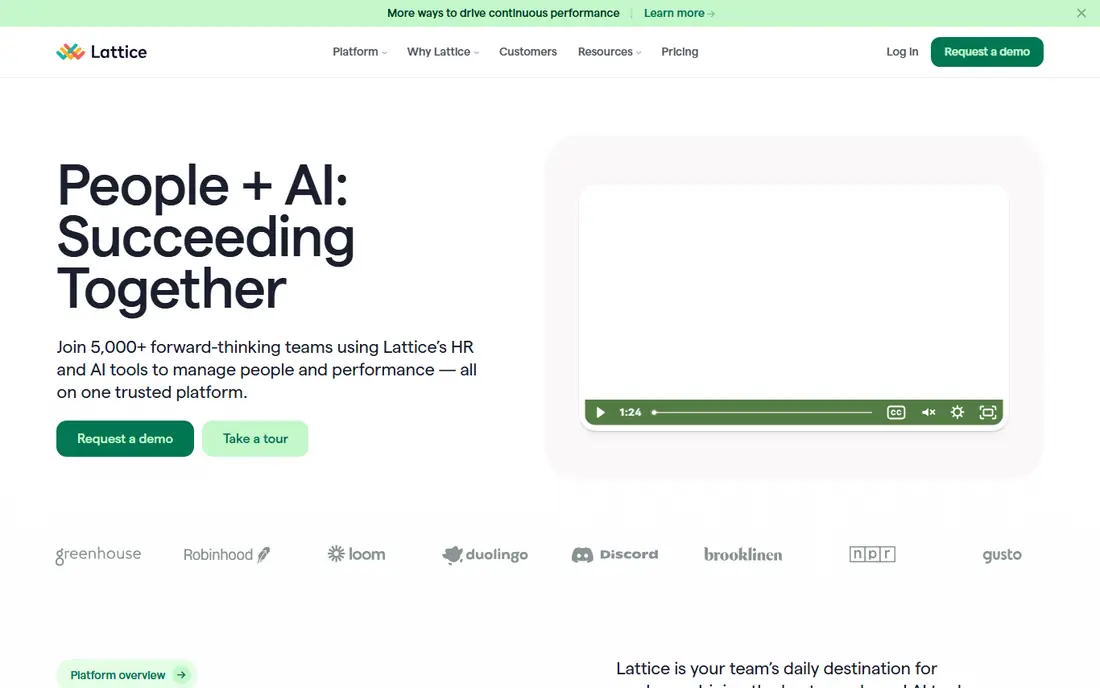
Lattice was built for startups that want OKRs inside a full people system. For a team that just wants goals tracked, a dedicated OKR tool is leaner and less expensive. Lattice is the HR product that comes with goals: set OKRs and align them across the team, then run performance reviews, 1:1s, feedback and engagement surveys in the same place.
As for the details, for a startup that is hiring and formalizing people processes anyway, running OKRs inside Lattice avoids a separate tool. As for the details, the homepage emphasizes habits (1:1s, updates, feedback) turning into clarity and alignment, with an AI agent layer on top. Check the vendor site for Lattice pricing; none is listed in this comparison. No free plan comes with Lattice.
Where it shines: feedback and engagement.
The main drawbacks: It is a people product first, OKR tool second.
- Goals and OKRs alongside performance reviews, 1:1s
- Deep HRIS and productivity integrations
- Pricing is not published on the homepage
Tability
Ideal for: Startups that want budget-friendly OKRs with AI-assisted check-ins
Tability is a good fit for startups that want budget-friendly OKRs with AI-assisted check-ins. At $6/user/month, Tability is among the cheapest full OKR products here, and the startup-specific messaging ("outperform teams 10x your size") suits. As for the details, for a cost-conscious startup that wants AI help with the reporting overhead, it is the value pick.
More specifically, free read-only seats mean the whole company sees the strategy without everyone needing a premium seat. It is GDPR compliant with SOC 2-aligned practices. On top of that, Tability is designed for modern teams: set goals, assign them to humans or AI agents, monitor with live dashboards and scheduled agent check-ins, and let reports write themselves from execution data. The starting price for Tability: $6/user/month. Free plan details: Free trial (14 days).
Points against: The $6 level's limits need checking on the pricing page.
- 14-day trial
- OKR generator and agent check-ins
- The AI-agent positioning is newer and less proven than classic OKR workflows
Weekdone
Ideal for: Small startups that want straightforward OKRs with weekly status reporting
Weekdone was built for small startups that want simple OKRs with weekly status reporting. The free level (up to 3 users, or a 14-day trial of everything) makes Weekdone the natural starting point for a founding team.
It is deliberately more straightforward than the strategy suites below, which is a feature for teams that want OKRs running this week, not next quarter. Pricing for Weekdone is not stated here, so ask the vendor for current figures. Weekdone includes a free tier.
Downsides: Scaling past the free level needs a premium plan.
- KPIs and pulse surveys included
- Visual OKR hierarchy trees
- The feature set is more straightforward than strategy suites
Profit.co
Ideal for: Startups that want OKRs, performance and projects in one system
For startups that want OKRs, performance and projects in one system, Profit.co is a natural candidate. For startups that hate tool sprawl, Profit.co's breadth is the appeal: one subscription handling goals, reviews and projects.
For teams that prefer specialized tools, the same breadth is the risk. Check the vendor site for Profit.co pricing; none is listed in this comparison. As for free access: Not stated.
Points against: Pricing is not published on the homepage.
- Balanced Scorecard and Hoshin Kanri
- Single system for strategy, OKRs
- The all-in-one pitch means compromises compared with best-of-breed tools
15Five
Ideal for: Startups that want OKRs with engagement surveys and manager coaching
Where 15Five fits: startups that want OKRs with engagement surveys and manager coaching. The Perform plan ($11/user/month annually) comes with OKRs, reviews and check-ins.
Honest limits: The OKR module is part of a broader system.
The Engage plan ($4) handles surveys and analytics; the Total Platform plan ($16) bundles everything plus manager training. Choose 15Five if performance management is the job and OKRs ride along; choose a dedicated tool if goals are the job. Price to start with 15Five: From $4/user/month. 15Five has no free plan.
- Total Platform from $16 per user/month
- 1:1s and feedback
- The cheapest plan does not include performance reviews
How we compared the tools
Each tool was reviewed on what its vendor publishes: price, plan limits, core features and stated drawbacks. We did not run hands-on tests. Where a vendor does not publish a price, the entry says quote. Where a price depends on seats or billing term, the entry says so. Order on the page follows fit for the typical buyer first, then price transparency and free access. Your own requirements should decide the final pick.
Before you commit
- Get a written quote from Perdoo, Mooncamp, Lattice and others; the list shows no starting price for them.
- Test the free plan from Weekdone against your real workload before relying on it.
- Take the trial from Mooncamp and Tability and push a live task through it before you pay.
- Before choosing Perdoo, weigh its main limit: pricing and free-tier terms are not published on the homepage.
- Ask Lattice about contract length, onboarding fees and user minimums before you sign.
- Check the integration list for 15Five against the tools you run today, and note which ones need a higher plan.
Frequently asked questions
What is the difference between OKRs and KPIs?
OKRs (Objectives and Key Results) are a goal-setting framework: an ambitious objective plus measurable key results that define success, reset quarterly. Most tools here manage both: OKRs for what you are trying to change this quarter, KPIs for what you must keep healthy.
Can we just use spreadsheets for OKRs?
You can, and numerous startups start there. Spreadsheets break at the check-in rhythm: no reminders, no dashboards, no integrations, and the file becomes one person's job to maintain. If your spreadsheet OKRs are actually updated weekly, keep them; if not, the tool is the less expensive fix.
How much should a startup pay for OKR software?
Weekdone is free for up to 3 users; Tability begins at $6/user/month with free read-only seats; 15Five's Perform plan is $11/user/month. Do not buy an enterprise system until you have outgrown the startup-priced ones; the framework matters more than the tool.
Do these tools publish their prices?
Not all of them. Perdoo, Mooncamp, Lattice and others publish no starting price, so expect a quote request for those. The rest, Tability included, show a starting price, though seats and billing terms still change the final cost.
How are the tools for OKR software for startups ordered?
Perdoo sits first and 15Five last because the order follows typical fit for OKR software for startups, then price clarity and free access. It is a judgement call, so read each profile for fit and limits.
Which options for OKR software for startups have a free plan?
Weekdone is the only tool in this list with a free plan. Free plans usually cap users, projects or features, so check the limits on the vendor page. Several others offer a trial instead.