Best Online Tutoring Platforms for Kids in 2026: 7 Compared

- 1
 Khan Academy and Khanmigofamilies who want free practice and a low-cost AI tutorVisit
- 2
 Outschoolkids who learn better in small live classes than in 1-on-1 lessonsVisit
- 3
 Varsity Tutorsprivate 1-on-1 tutoring across school subjects and test prepVisit
- 4
 Preplylanguage lessons for kids with a free tutor swap if the match is wrongVisit
- 5
 Cuemathkids in kindergarten through grade 8 who need math practiceVisit
- Khan Academy says its content library "will always remain 100% free," and Khanmigo, its AI tutor, costs families $4 per month or $44 per year, which makes it the cheapest place to start.
- Varsity Tutors, Preply, Cuemath, Sylvan and Club Z do not publish prices on the pages we read, so expect to request a quote or book a trial first.
- Cuemath offers a free trial class and describes a refund for unused classes, but its US prices were not shown on the pages we could reach.
- Outschool is built around live small-group classes for ages 3 to 18, and it lists an average class size of 4 students per teacher.
- No platform can replace a parent check: sit in on the first session, ask how tutors are screened, and read the privacy policy.
Quick comparison
| Product | Ideal for | Price from | Free version | |
|---|---|---|---|---|
| Khan Academy and Khanmigo | families who want free practice and a low-cost AI tutor | Free ($4 per month for Khanmigo) | Yes | Visit |
| Outschool | kids who learn better in small live classes than in 1-on-1 lessons | See website | No | Visit |
| Varsity Tutors | private 1-on-1 tutoring across school subjects and test prep | See website | No | Visit |
| Preply | language lessons for kids with a free tutor swap if the match is wrong | See website | No | Visit |
| Cuemath | kids in kindergarten through grade 8 who need math practice | See website | Free trial | Visit |
 Sylvan Learning | parents who want an assessment before choosing a program | See website | Free assessment | Visit |
 Club Z Tutoring | families who want a human tutor match with a stated guarantee | See website | No | Visit |
The best online tutoring platforms for kids
Parents usually want one of three things: free practice, live classes with other kids, or a private tutor. The seven platforms below cover all three. We list the free option first, then group classes, then private tutoring services.
A note on safety: your child will be talking to an adult on a screen. Ask each company how it screens tutors, stay nearby for early sessions, and keep payment details on your own account.
Khan Academy and Khanmigo
Ideal for: families who want free practice and a low-cost AI tutor
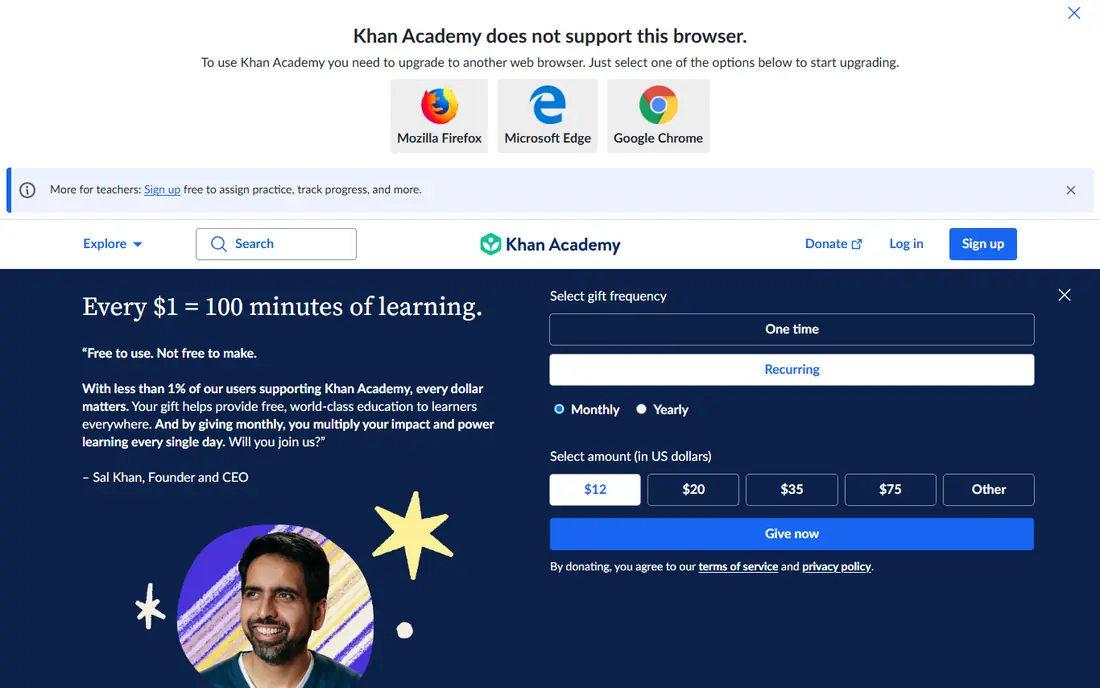
Khan Academy is where we would send most families first, because the core lessons and practice cost nothing. The Khanmigo site states that the content library and learning platform "will always remain 100% free." That alone covers a lot of school subjects before you pay anyone.
Khanmigo is the paid add-on. Its pricing page lists $4 per month or $44 per year for families, and teachers can sign up for free. The family plan includes tools to add children to a parent account, view their interaction history, and receive moderation alerts. Other features include personalized tutoring on Khan Academy content, guided writing and debate practice, and coding feedback.
The tutor is artificial intelligence, and Khan Academy says Khanmigo guides a child toward answers instead of giving them directly. That suits curious, self-motivated kids. A child who needs a person to keep them accountable will probably need a human tutor on top.
- The content library "will always remain 100% free" per its Khanmigo page
- Khanmigo family plan is $4 per month or $44 per year
- Parents can enable access for up to 10 children
- Khanmigo is an AI guide, not a human tutor
- It will not give the personal rapport of a live tutor
Outschool
Ideal for: kids who learn better in small live classes than in 1-on-1 lessons
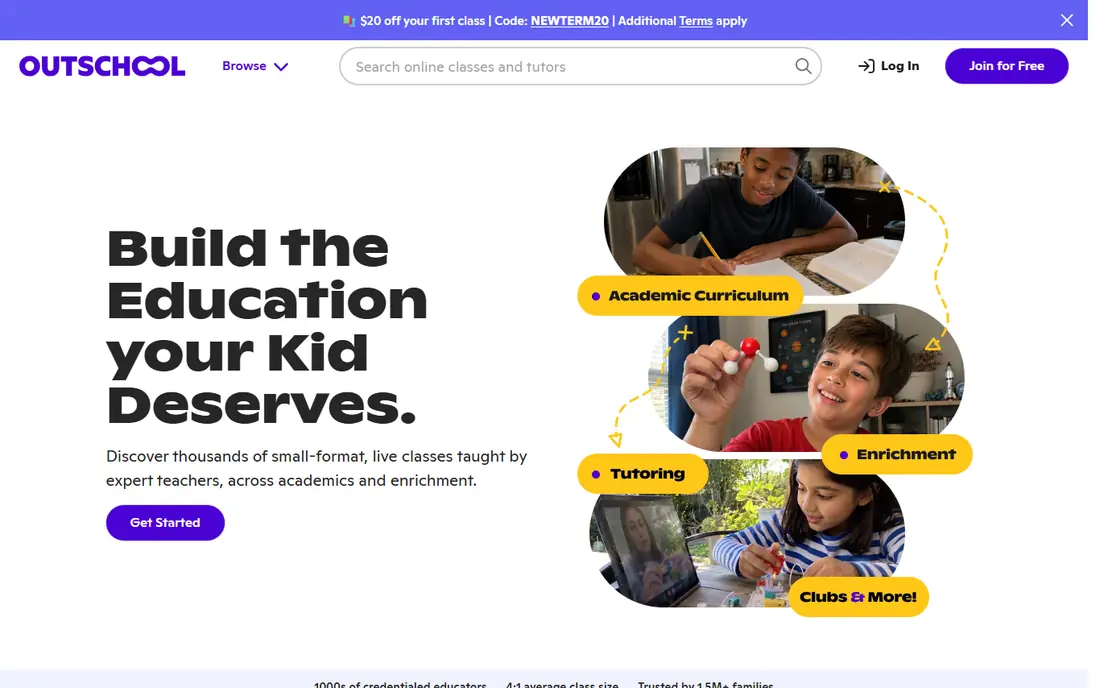
Outschool sells live online classes rather than hourly tutoring. Its homepage describes small-format live classes taught by educators across academics and enrichment, and its title page promises ages 3 to 18. The company states an average class size of four students.
The homepage offers a free sign-up, but it does not list class prices, so we cannot give you a number. Check each class listing for the total cost, how many weeks it runs, and whether the course is a one-time session or an ongoing club.
This format suits younger children and kids who benefit from social learning, such as coding clubs, writing groups and science classes. It is less suited to a child who needs targeted help catching up on a specific school topic. We could not confirm details of how Outschool screens teachers from the pages available to us, so read its trust and safety material before enrolling.
- Ages 3 to 18
- Live small-format classes with a stated 4-to-1 average class size
- Wide range of academic and enrichment topics
- The homepage does not list class prices
- Quality varies by teacher
Varsity Tutors
Ideal for: private 1-on-1 tutoring across school subjects and test prep
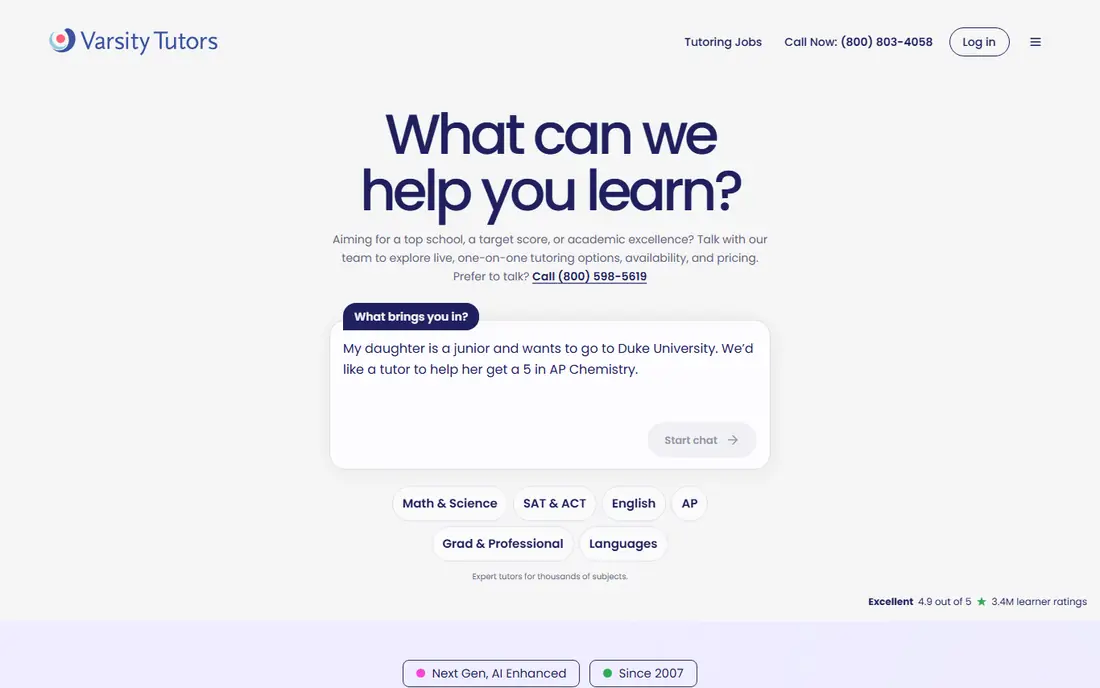
Varsity Tutors is the broadest option on this list. Its K-12 page describes private one-on-one tutoring and weekly live classes for academic support, with practice tests and diagnostics. It lists elementary math, phonics, reading and writing for younger kids, plus middle school, high school, AP courses and SAT, ACT and PSAT prep.
The page says families are matched with a "top 5% tutor," but it does not describe how tutors are vetted. It links to "Our Guarantee" without showing the terms. The company also reports a 4.9 out of 5 rating from 3.4 million learner ratings, which is a number from the company, not an independent review.
Pricing is the sticking point. The page tells families to talk with the team about options, availability and pricing, so you cannot compare costs before you speak to someone. We would ask for the hourly rate in writing, how a tutor switch works, and what the guarantee covers.
- Private 1-on-1 tutoring and weekly live classes
- Lists 3,000+ subjects and test prep for SAT, ACT and PSAT
- Links to a satisfaction guarantee
- No prices published
- You must talk to the team about pricing
Preply
Ideal for: language lessons for kids with a free tutor swap if the match is wrong
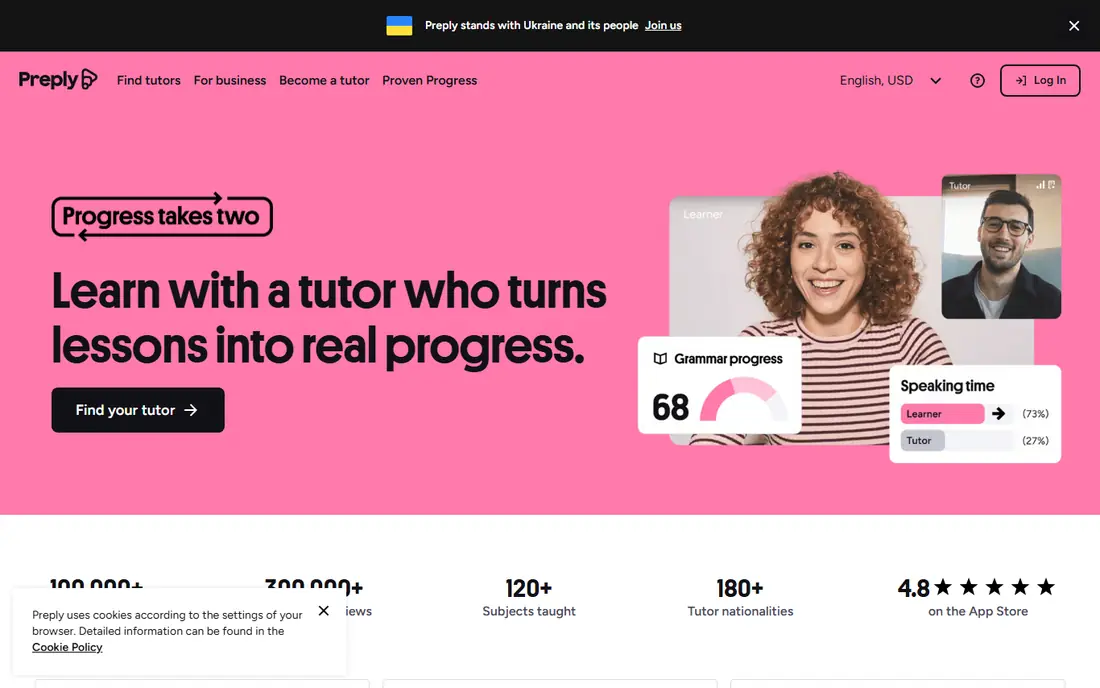
Preply is a marketplace where you browse tutors and book lessons. Its homepage lists more than 100,000 tutors, more than 120 subjects, and tutors from over 180 nationalities. The strongest section is languages, with 33,602 English tutors, 10,057 Spanish tutors, 5,252 Chinese tutors and 3,712 French tutors listed at the time we looked.
The page does not state a price range, a free trial lesson or a refund guarantee. It does say you can try another tutor for free if you are not satisfied, which is a useful safety net when matching a child with an adult. A link to "English classes for kids" suggests younger learners are supported, but we did not see detail on tutor screening for children.
Preply fits a family looking for a tutor in Spanish or English as a second language. For general school subjects, compare it with Varsity Tutors.
- 100,000+ tutors and 120+ subjects per its homepage
- "Try another tutor for free if you're not satisfied"
- You choose how many lessons to take each week
- Homepage shows no price range
- The kids focus is mostly language, with limited detail on other school subjects
Cuemath
Ideal for: kids in kindergarten through grade 8 who need math practice
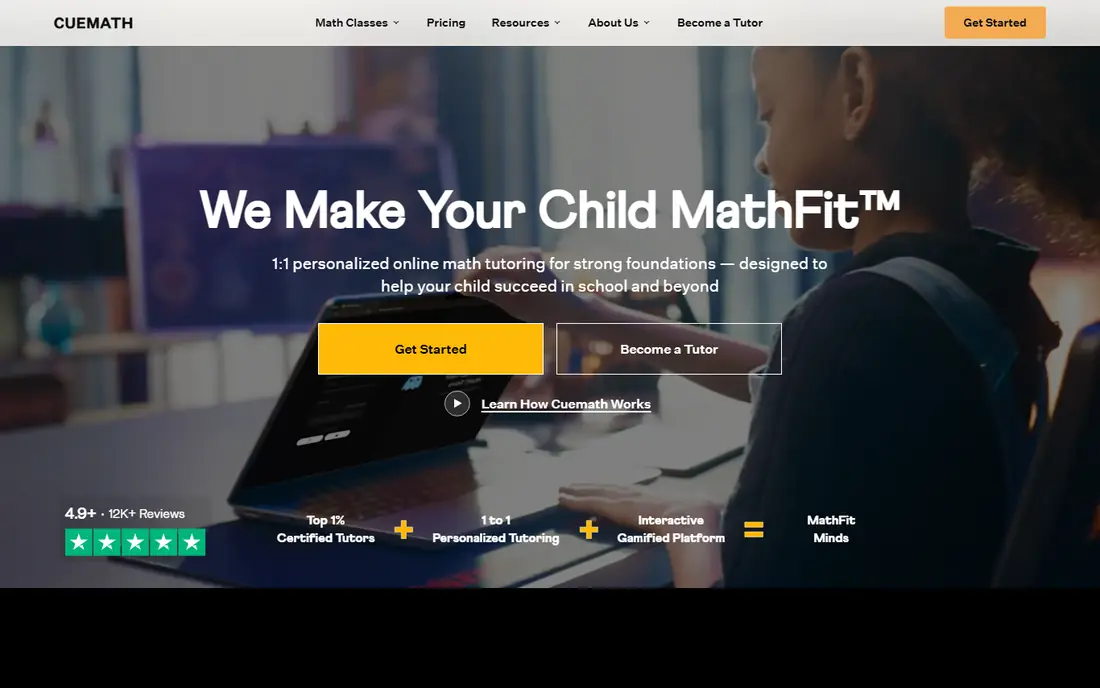
Cuemath focuses on math only, which makes it easier to judge. The homepage describes 1-on-1 online math tutoring for kindergarten through grade 8, with high school classes as well. Classes run 55 minutes, usually twice a week for K-8 and three times a week for high school.
You book a free trial class, an admissions counselor calls to match a tutor, and you choose a plan afterward. The site describes a "no questions asked refund policy" with a full refund for unused classes. The company says its tutors are "Top 1% Certified," but the page does not explain how it selects them. You can ask for a different tutor by raising a helpdesk ticket.
The pricing page we could reach was the India version, quoted in rupees, so we cannot give you a US dollar price. Ask for a written quote before the trial ends. The India page showed a separate platform fee on its 6-month plan, so ask whether any extra fees apply in the US.
- Free trial class booked through an admissions counselor
- 1-on-1 classes of 55 minutes
- "no questions asked refund policy" for unused classes
- US prices were not shown on the pages we reached
- The 'Top 1%' tutor claim has no explained process
Sylvan Learning
Ideal for: parents who want an assessment before choosing a program
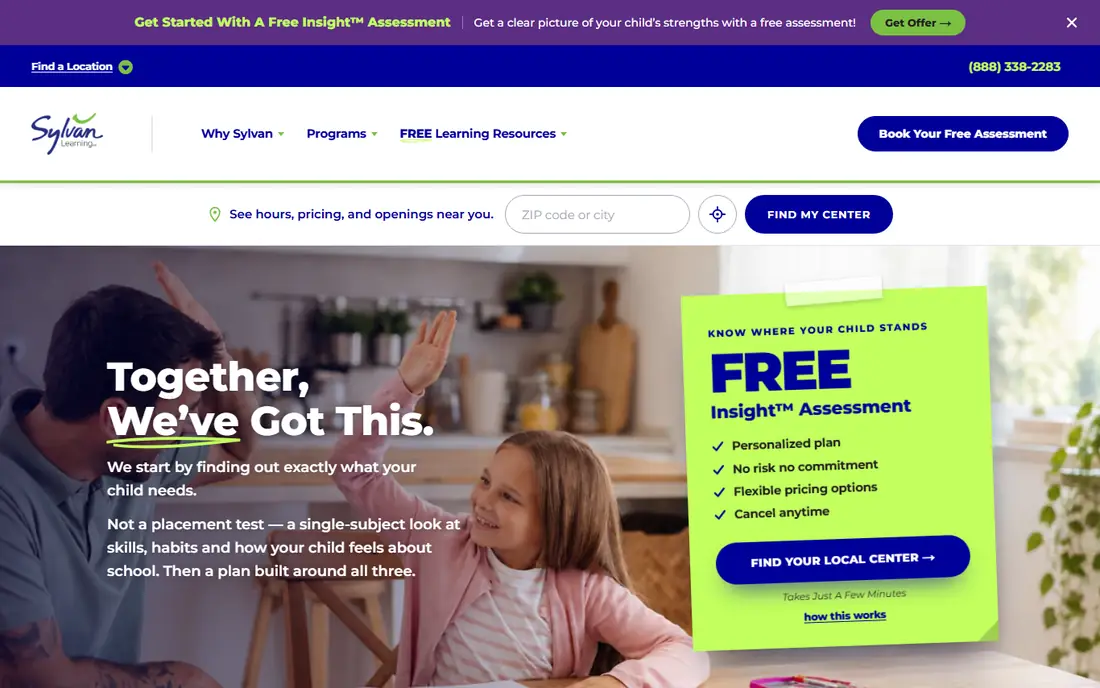
Sylvan puts the assessment first. Its homepage describes a free assessment that is "not a placement test" but a single-subject look at skills, habits and how your child feels about school. It combines an adaptive test, teacher observation and the child's own take, and the page says they will reach out within one business day after you fill in the form.
The site lists online tutoring and "Report Card Help," but with little detail on how sessions run. Pricing is described as flexible, with the actual numbers on a separate page that we did not read. The page links to a guarantee but does not show its terms in the content we saw.
Sylvan suits parents who do not know what is wrong yet. The free assessment gives you a starting point you can also use to compare other services. The catch is that you will have to speak with the company before learning what it costs.
- Free assessment that combines an adaptive test, teacher observation and your child's own view
- No-commitment framing
- Phone and form booking
- No prices on its homepage ("flexible pricing options")
- The assessment covers a single subject
Club Z Tutoring
Ideal for: families who want a human tutor match with a stated guarantee
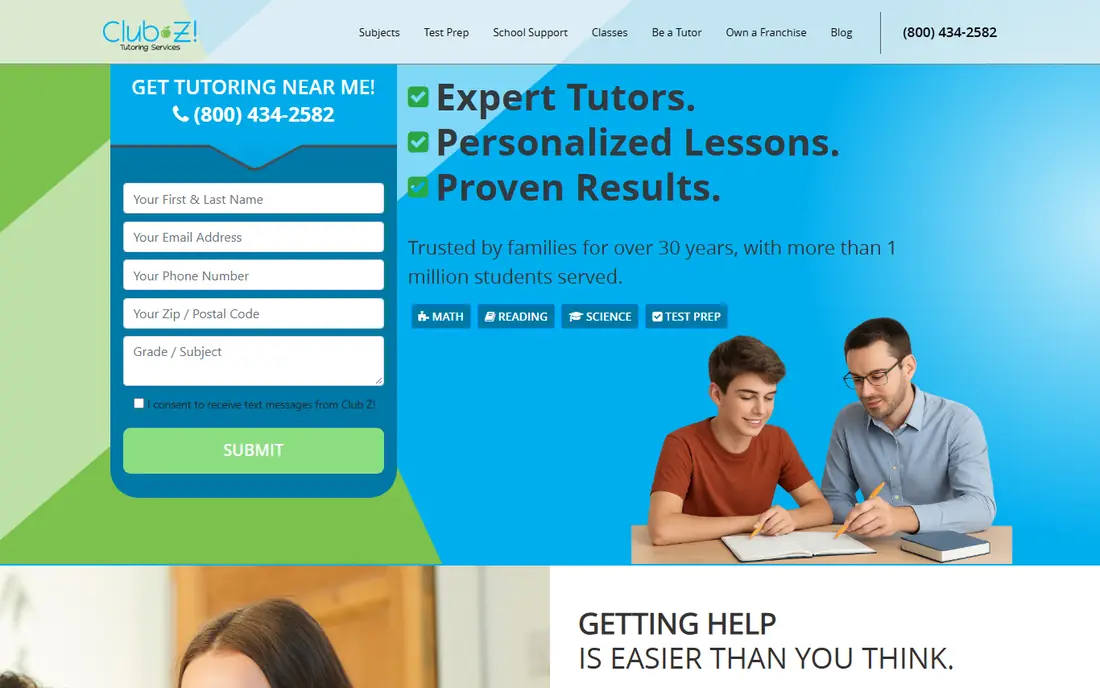
Club Z is a smaller service that pairs families with tutors. Its homepage describes in-home and online math tutoring, online SAT and ACT classes, and tutors in over 300 subjects. The company says: "We guarantee you'll find the right tutor, or we'll cover the first hour of your lesson."
For vetting, the page says college tutors are "rigorously vetted" and writing tutors are "highly qualified," but gives few details. There is no mention of a free consultation, though you can request a tutor through a form or call to speak with an educational specialist.
Club Z is best for families who want personal help finding a tutor and are willing to talk to someone first. If you want to compare prices online, a marketplace like Preply will be quicker.
- In-home and online math tutoring and online SAT and ACT classes
- Connects you with tutors in 300+ subjects
- Guarantee: find the right tutor or Club Z covers the first hour
- No rates on the homepage
- Screening detail is only given for college tutors
How we picked these
We read each platform's own homepage, program pages, pricing pages and safety or guarantee statements, and kept services that are available to US families today. We did not enroll children or book sessions, so we report what each company publishes. When a company does not publish prices, we say "See website" instead of estimating. Ratings and customer counts are the companies' own claims and are labeled that way. We tried to cover free learning, group classes and private tutoring.
How to choose a tutoring platform for your child
Start with the goal. Catching up in one subject calls for a private tutor. Enrichment calls for classes. Daily practice calls for something free and always available.
Match the format to your child
Younger children usually do better with short, playful sessions and a familiar group, which favors Outschool. Older students preparing for tests tend to want a direct tutor, such as Varsity Tutors or Club Z. Confident, self-directed kids can get far with Khan Academy alone.
Ask the safety questions
Ask how tutors are screened and what happens if a session feels wrong. Find out whether sessions are recorded, who can see them, and how to report a problem. Keep conversations on the platform instead of moving to text messages.
Test before you commit
Cuemath offers a free trial class and Sylvan offers a free assessment. Preply offers a free tutor swap. Use these to see whether your child clicks with the style before you pay for a package.
Watch the contract
For services that do not publish prices, ask about the hourly rate, the number of sessions required, cancellation terms and any platform or registration fee. Get the answers in writing.
Frequently asked questions
What is the best online tutoring platform for kids?
It depends on the goal. Khan Academy is the best free starting point, Varsity Tutors suits private tutoring across many subjects, and Outschool is better for live group classes. Cuemath is a focused choice for K-8 math.
How much does online tutoring cost?
Most of the paid services here do not publish prices, so you need a quote. The only price we could verify is Khanmigo at $4 per month or $44 per year. Ask any other provider for rates in writing.
Are there good online tutoring services for college students?
The pages we read for Varsity Tutors list K-12, AP and test prep subjects, and we could not confirm college-level coverage. Ask any service which college courses it covers and how it screens those tutors before you sign up.
Which tutoring platforms let tutors work for them?
Marketplaces such as Preply and Outschool are built around independent tutors and teachers. Check each site's tutor or teacher sign-up page for requirements and pay terms before you apply.
Is online tutoring safe for children?
It can be, with precautions. Choose services that explain how they screen tutors, sit in on early sessions, use the platform's messaging only, and read the privacy policy. If a tutor asks to move to a private channel, treat that as a red flag.