Best Payment Gateway Software in 2026: 8 Platforms Compared

- Stripe is our pick for most online businesses because it pairs developer tools with broad payment methods and fraud protection.
- PayPal suits sellers who want buyer trust and fast setup with a huge existing user base.
- Square suits small businesses that sell online and in person through one system.
-
Transaction fees, payout timing, and supported payment methods differ, so compare total cost at your real volume.
-
Payout timing and hold policies affect cash flow as much as the headline transaction fee for growing sellers.
Quick comparison
| Product | Ideal for | Price from | Free version | |
|---|---|---|---|---|
 Stripe | Developer-friendly online payments | See website | No | Visit |
 PayPal | Buyer trust and fast setup | See website | No | Visit |
 Square | Online plus in-person selling | See website | No | Visit |
 Authorize.net | Established gateway for merchants | See website | No | Visit |
 Adyen | Global enterprise payments | See website | No | Visit |
 Checkout.com | Global online payments | See website | No | Visit |
 Braintree | PayPal-owned developer gateway | See website | No | Visit |
 Verifone | Enterprise gateway and 2Checkout | See website | No | Visit |
The best payment gateway software
A payment gateway moves money from a customer's card or wallet to your account securely, handling authorization, fraud checks, and settlement. The best gateways support the payment methods your customers use and integrate cleanly with your store or platform. We compared official feature pages, pricing pages, and public reviews for the options below.
Stripe
Ideal for: Developer-friendly online payments
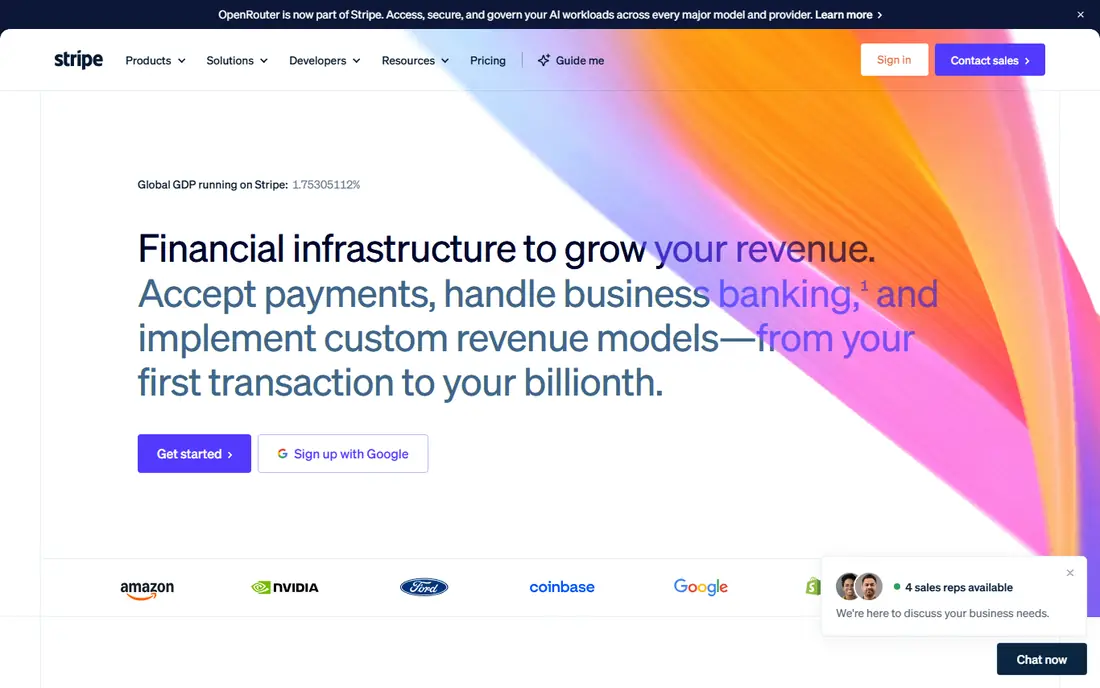
Stripe is the default gateway for many online businesses, with developer tools, clear docs, and support for cards, wallets, bank debits, and local payment methods worldwide. Fraud tools, subscription billing, and checkout components cover most selling models. The dashboard gives finance teams clear payout and dispute views.
Standard transaction fees apply per successful charge, and costs add up at scale, though volume pricing exists. Support is online-first, which suits tech teams but not everyone. For most online sellers, Stripe is our top pick.
- Strong developer tools and docs
- Many payment methods
- Fraud tools included
- Fees add up at scale
- Support is online-first
PayPal
Ideal for: Buyer trust and fast setup

PayPal lets customers pay with a PayPal balance, bank, or card without sharing card details with the seller, and its brand recognition lifts conversion for many stores. Setup is fast, and buyer and seller protection programs cover eligible transactions. PayPal also offers invoicing, subscriptions, and checkout buttons.
Fees vary by transaction type and region, and new sellers may face holds on funds. For sellers who want trust and fast setup, PayPal is a strong choice, often alongside Stripe for card payments.
- Huge buyer base and trust
- Fast setup
- Buyer and seller protection programs
- Fees vary by transaction type
- Holds can affect new sellers
Square
Ideal for: Online plus in-person selling

Square unifies online checkout, in-person point of sale, invoicing, and hardware in one system. Small businesses that sell at markets, shops, and online benefit from one dashboard for all sales. Setup is easy, and the free online store option helps new sellers start fast.
Online developer depth trails Stripe, and per-transaction fees apply. For a small business selling both online and in person, Square is an excellent, simple choice.
- One system for online and in-person
- Easy setup
- Hardware options
- Online feature depth trails Stripe
- Fees per transaction
Authorize.net
Ideal for: Established gateway for merchants
Authorize.net, from Visa, is a long-established payment gateway that works with many merchant accounts and shopping carts. It supports recurring billing, fraud filters, and customer payment profiles for repeat buyers. Merchants with existing bank relationships often pair Authorize.net with their own merchant account.
The interface feels older than Stripe, and monthly gateway fees may apply on top of processing costs. For merchants who want an established gateway with bank flexibility, Authorize.net is a dependable choice.
- Long-established gateway
- Broad merchant account support
- Recurring billing
- Older interface
- Monthly gateway fees may apply
Adyen
Ideal for: Global enterprise payments
Adyen serves global enterprises with a unified platform for online, in-app, and in-person payments across many countries and methods. Local payment methods, currency support, and consolidated reporting suit multinational sellers. Fraud and risk tools are built for scale.
Adyen focuses on enterprises, and setup needs technical resources. Small sellers will find Stripe or Square simpler. For a global enterprise seller, Adyen is a leading gateway choice.
- Global payment methods
- Unified commerce
- Strong enterprise reporting
- Enterprise focus
- Setup needs technical resources
Checkout.com
Ideal for: Global online payments
Checkout.com offers global online payments with strong APIs, card processing, and local payment methods. Performance and authorization optimization help large sellers lift approval rates across regions. The platform suits digital businesses with international customers.
Pricing leans enterprise, and small-business support is thinner than Stripe or PayPal. For a growing global online seller, Checkout.com is a capable, performance-focused gateway.
- Global card and local method support
- Strong APIs
- Performance focus
- Enterprise-leaning pricing
- Smaller small-business focus
Braintree
Ideal for: PayPal-owned developer gateway
Braintree, owned by PayPal, offers developer-friendly gateway tools with PayPal and Venmo support built in. Vault storage for repeat payments, subscription billing, and mobile SDKs suit apps and marketplaces. Sellers who want PayPal reach plus card processing in one gateway often pick Braintree.
Support quality varies in reviews, and feature pace trails Stripe. For a developer-led seller who wants PayPal plus cards together, Braintree is a solid choice.
- Developer tools
- PayPal and Venmo support
- Vault for repeat payments
- Support varies
- Feature pace trails Stripe
Verifone
Ideal for: Enterprise gateway and 2Checkout
Verifone offers enterprise payment gateway services plus 2Checkout, now Verifone, for global digital sales with subscriptions and local methods. Device and point-of-sale support covers in-person needs too. The range suits enterprises with mixed online and in-person sales.
The product range is complex, and setup needs guidance to pick the right service. For an enterprise seller with global digital and in-person needs, Verifone is a broad, capable option.
- Enterprise gateway services
- 2Checkout for global digital sales
- Broad device support
- Complex product range
- Setup needs guidance
How we picked these
We compared official feature pages, pricing pages, and public reviews, and we kept only payment gateways processing online payments in October 2026 with real merchant tools. We favored gateways with broad payment methods, fraud tools, and clear pricing. We left out single-store checkout buttons with no gateway function and processors with no public merchant offering.
We also compared dashboard clarity for finance teams, since payout reconciliation consumes hours monthly when reports are unclear. Confirm that payout reports map cleanly to your accounting system, that fees and refunds are itemized, and that multi-currency payouts are easy to reconcile. A clear finance view saves more time than a small fee difference.
What to check before you choose a payment gateway
Start with your customers. List the payment methods they use: cards, wallets, bank debits, and local methods by country. A gateway that misses a key method loses sales. Then compare total cost at your volume: per-transaction fees, monthly fees, chargeback fees, and payout timing all affect cash flow.
Next, test integration and fraud tools. Confirm plugins or APIs for your store platform, check fraud rules and dispute handling, and test checkout on mobile. Finally, confirm support and account stability: holds, reserves, and account reviews affect sellers in high-risk categories, so read terms for your industry before switching.
Currency and local payment support deserve testing with real customers in each market you serve. A gateway that lacks a popular local method in a key country loses sales at checkout, no matter how good its card processing is. Run test checkouts in local languages and currencies before launch, and confirm settlement currency and conversion fees for each region.
Security and compliance checks should include PCI scope, tokenization, and 3D Secure handling. A gateway that tokenizes cards and supports modern authentication reduces your compliance burden and fraud losses at once. Ask vendors how they handle stored cards and what happens during a suspected breach, since answers vary widely.
Questions to ask before you commit
Ask providers about account reserve policies, since some gateways hold a percentage of volume as a reserve against chargebacks. Confirm reserve size, release schedules, and which business types face reserves, since reserves tie up working capital. A reserve surprise after launch strains cash flow for growing sellers.
Ask how the gateway handles subscription billing edge cases such as failed renewals, prorations, and plan changes. Confirm dunning workflows, retry schedules, and customer notification options, since subscription revenue depends on graceful failure handling. Test renewal failures during evaluation, not after launch.
Ask about support during payment outages, including status communication and escalation paths. Confirm whether support covers your selling hours across time zones, since payment downtime during peak sales costs revenue immediately. A gateway with slow outage support costs more than its fees suggest.
Frequently asked questions
What is the best payment gateway software?
Stripe is our pick for most online businesses because of developer tools, payment methods, and fraud protection. PayPal suits trust and fast setup, while Square suits sellers who also sell in person.
What fees do payment gateways charge?
Most charge a per-transaction fee plus a fixed amount, with extra fees for chargebacks, international cards, and currency conversion. Monthly gateway fees may apply for some providers. Compare total cost at your real volume and mix.
Do I need a merchant account with a payment gateway?
It depends. Stripe, PayPal, and Square bundle processing so you may not need a separate merchant account. Authorize.net typically pairs with a merchant account from a bank or processor. Confirm the model before choosing.
Which payment gateway is best for small businesses?
Square suits small businesses selling online and in person, while PayPal suits fast setup with buyer trust. Stripe suits online-first sellers who want developer tools and many payment methods.
How do payment gateways handle fraud?
Gateways use fraud filters, address checks, 3D Secure, velocity rules, and machine learning to flag risky transactions. Stripe Radar, PayPal protection, and Adyen risk tools are examples. Tune rules for your business, since strict filters can block good customers.
What happens when a customer disputes a payment?
The gateway notifies you, holds the disputed amount during review, and asks for evidence such as order records, delivery proof, and customer messages. Strong evidence wins most legitimate disputes, so keep order and shipping records organized. Frequent disputes can trigger account reviews, so monitor dispute rates and fix product or shipping issues that cause them.