8 Best Payroll Software for Midsize Businesses in 2026

- 1
 ADP Workforce NowMidsize to large companies that want payroll plus full HRVisit
- 2
 PaylocityMidsize companies that want payroll plus engagement toolsVisit
- 3
 PaycomCompanies that want one database for HR and payrollVisit
- 4
 Workday PayrollLarger midsize companies running Workday HR and financeVisit
- 5
 UKG ProMidsize companies that need workforce management with payrollVisit
- Midsize payroll needs multi-state tax filing, benefits integration, and reporting that small-business tools often lack.
- ADP Workforce Now and Workday suit larger midsize companies with complex HR and finance needs.
- Paylocity, Paycom, and UKG Pro balance payroll depth with employee experience features.
- Rippling and Paycor suit growing midsize firms that want payroll connected to HR and IT workflows.
- Price is almost always per employee per month plus a base fee, so model cost at your real headcount, including part-time and seasonal staff.
Quick comparison
| Product | Ideal for | Price from | Free version | |
|---|---|---|---|---|
| ADP Workforce Now | Midsize to large companies that want payroll plus full HR | See website | No | Visit |
| Paylocity | Midsize companies that want payroll plus engagement tools | See website | No | Visit |
| Paycom | Companies that want one database for HR and payroll | See website | No | Visit |
| Workday Payroll | Larger midsize companies running Workday HR and finance | See website | No | Visit |
| UKG Pro | Midsize companies that need workforce management with payroll | See website | No | Visit |
 Rippling | Growing midsize firms that want payroll tied to HR and IT | See website | No | Visit |
 Paycor | Midsize businesses that want payroll plus usable HR analytics | See website | No | Visit |
 Deel | Midsize companies with global employees and contractors | See website | No | Visit |
The best payroll software for midsize businesses
ADP Workforce Now
Ideal for: Midsize to large companies that want payroll plus full HR
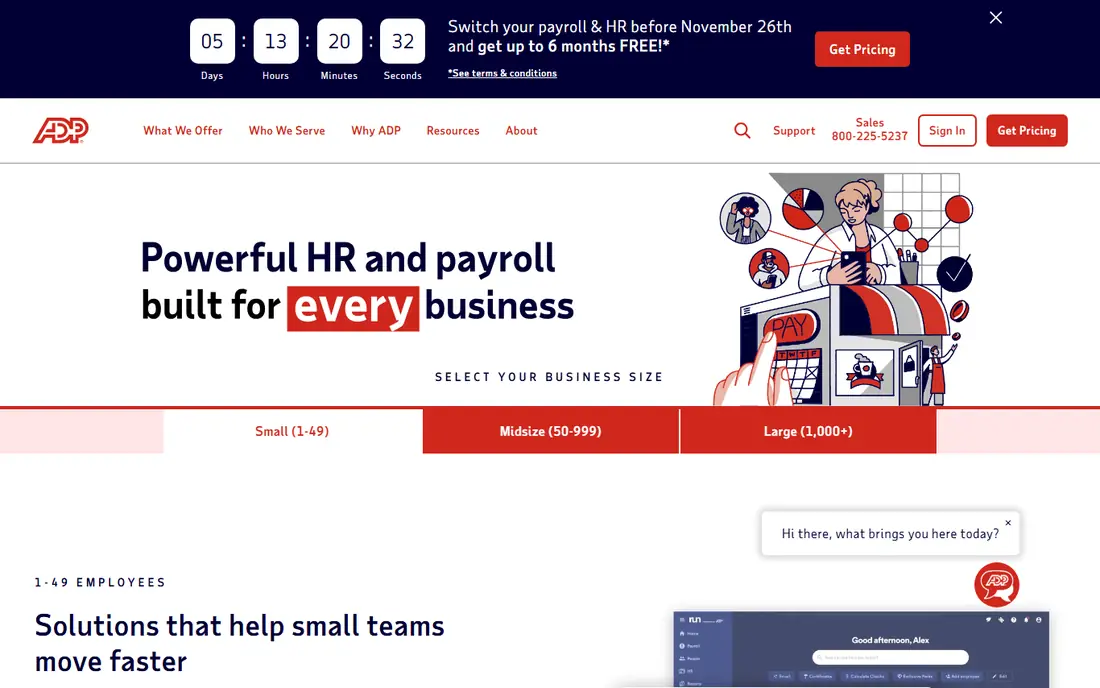
ADP Workforce Now is a cloud payroll and HR platform for midsize and larger businesses, covering payroll with automatic tax filing, time and attendance, benefits administration, talent management, and analytics. ADP's scale is its main advantage: tax expertise across many jurisdictions, compliance support, and a large service organization for questions that software alone cannot answer. The platform handles complex pay rules, multiple entities, and varied worker types, and employees get self-service access to pay, tax forms, and time off. Implementation is a project rather than a signup, and pricing is quote-based. For midsize companies approaching enterprise complexity, ADP Workforce Now offers the depth and support to match.
- Deep payroll and tax expertise, broad HR modules, large support network
- Enterprise pricing, implementation takes planning
Paylocity
Ideal for: Midsize companies that want payroll plus engagement tools
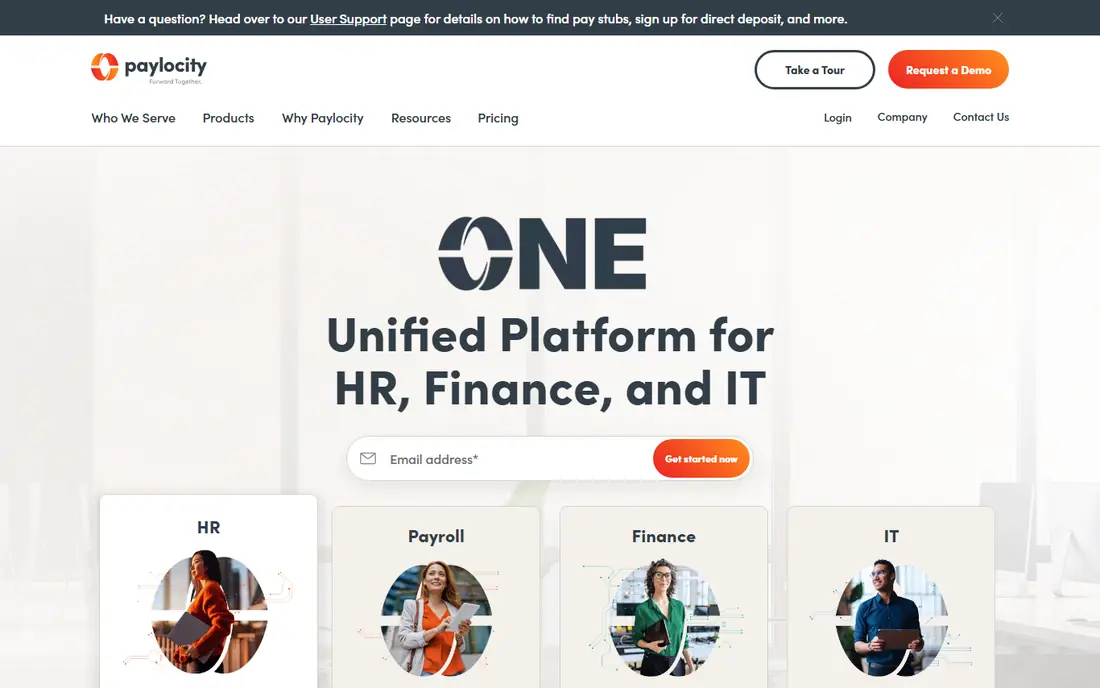
Paylocity combines payroll, HR, time and labor, benefits, and talent management with employee experience features such as communication tools, recognition, and learning. For midsize businesses, that combination matters: payroll accuracy is the baseline, but engagement and communication tools help retain staff in a competitive hiring market. Paylocity's payroll covers multi-state filing, garnishments, and varied pay types, and its reporting gives managers labor cost and headcount views without spreadsheet work. Implementation is guided, and pricing is quote-based with modules adding cost. For midsize companies that want payroll done well plus a modern employee experience, Paylocity is a strong contender.
- Strong payroll, modern employee experience, learning and engagement features
- Pricing requires a quote, some modules add cost
Paycom
Ideal for: Companies that want one database for HR and payroll
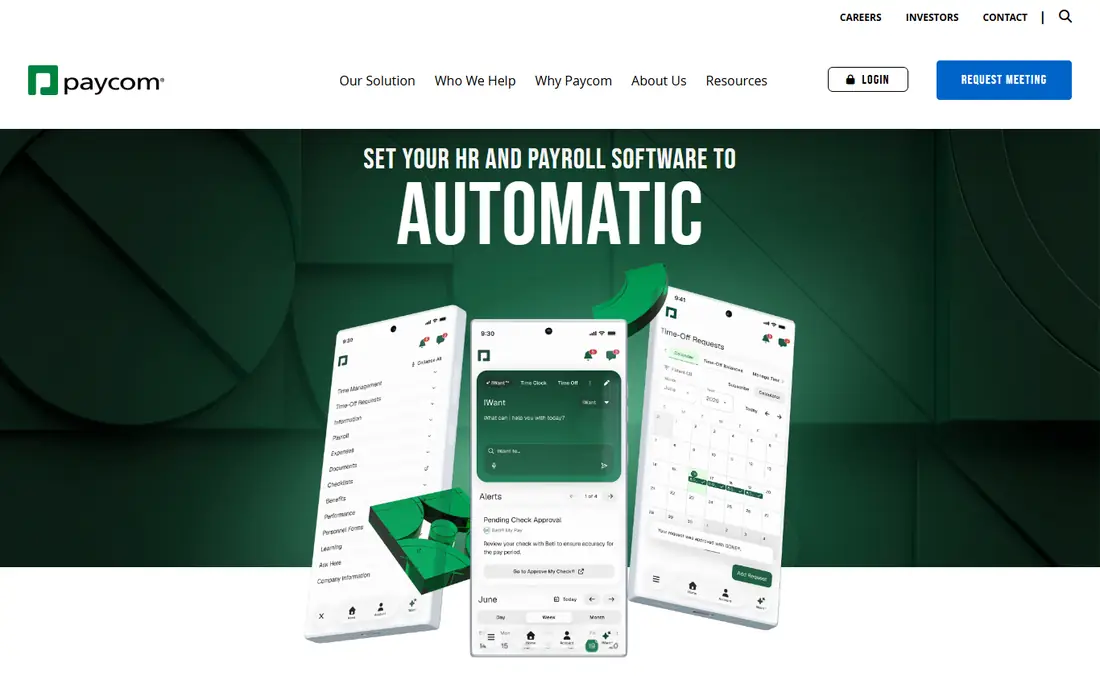
Paycom's pitch is a single database: employee data entered once flows through hiring, time tracking, payroll, benefits, and talent management without re-entry or reconciliation between systems. That design reduces the errors that come from syncing separate tools, which is a real payroll risk at midsize scale. Employees handle their own onboarding, time, expenses, and benefits changes through self-service, and managers approve from one workflow. Paycom covers payroll tax filing, garnishments, and reporting, with compliance tools for changing regulations. Pricing is quote-based, and the interface's structured workflow suits some teams more than others. For companies that value data consistency above all, Paycom's single-database approach is distinctive.
- Single-database design, employee self-service, strong compliance tools
- Pricing requires a quote, interface opinions divide users
Workday Payroll
Ideal for: Larger midsize companies running Workday HR and finance
Workday Payroll sits inside Workday's human capital and financial management platform, giving larger midsize companies one system for HR, payroll, time, and finance. Its strengths are global payroll coverage, unified reporting across HR and finance, and analytics that connect workforce cost to business performance. For companies already running Workday HCM, adding payroll keeps data consistent and removes integration work. The scope is enterprise: implementation is a major project, pricing is quote-based and substantial, and smaller midsize firms will find it more system than they need. For companies at the upper end of midsize, or those planning to grow into enterprise scale, Workday Payroll is a long-term platform choice.
- Unified HR and finance, global payroll, strong reporting and analytics
- Enterprise scope and cost, implementation is a major project
UKG Pro
Ideal for: Midsize companies that need workforce management with payroll
UKG Pro, formerly UltiPro, combines HR, payroll, talent management, and workforce management, with particular strength in scheduling, time and attendance, and labor forecasting. That workforce management depth suits midsize companies with shift-based staff, such as healthcare, retail, manufacturing, and hospitality, where scheduling and payroll are tightly linked. Payroll covers tax filing and varied pay rules, and analytics connect labor cost to operations. UKG's scale gives it deep compliance expertise, and its employee experience tools cover self-service and communication. Implementation planning matters given the suite's breadth, and pricing is quote-based. For workforce-heavy midsize businesses, UKG Pro's combination of scheduling and payroll is hard to match.
- Strong scheduling and time, payroll, talent, and analytics in one suite
- Suite breadth needs implementation planning, pricing requires a quote
Rippling
Ideal for: Growing midsize firms that want payroll tied to HR and IT
Rippling unifies HR, payroll, benefits, and IT, so a new hire's payroll enrollment, benefits, and app access trigger from one workflow, and departures update everything together. For midsize companies, that automation removes a growing source of errors: the handoffs between HR, payroll, and IT that multiply as headcount grows. Rippling covers time tracking, talent management, and spend, with global payroll for companies hiring across borders. The platform's breadth means setup deserves thought, and pricing is quote-based by headcount and modules. For a midsize company that already feels the pain of disconnected people systems, Rippling's unified model is a compelling upgrade from a payroll-only tool.
- Unified HR, payroll, and IT access, strong automation, global payroll options
- Power needs setup thought, pricing requires a quote
Paycor
Ideal for: Midsize businesses that want payroll plus usable HR analytics
Paycor combines payroll, HR, recruiting, onboarding, time tracking, benefits, and analytics for growing and midsize businesses. Its reporting stands out for finance and HR leaders who want labor cost, turnover, and time-off patterns without exporting data elsewhere. Payroll covers tax filing across states, and recruiting and onboarding flow into payroll without re-entry. Employee self-service covers pay, tax forms, and time off, and the platform serves a wide range of industries. Setup time grows with team size and module count, and pricing is quote-based. For a midsize business moving from a small-business payroll tool to something with real HR depth and reporting, Paycor is a practical step up.
- Payroll and tax filing, recruiting, time, benefits, strong reporting
- Pricing requires a quote, setup time grows with team size
Deel
Ideal for: Midsize companies with global employees and contractors
Deel specializes in global hiring: payroll for employees in many countries, payments for contractors, and employer-of-record services where a company lacks a local entity. For midsize businesses hiring internationally, Deel handles local tax, benefits, and compliance requirements that domestic payroll tools do not cover, with one dashboard for a distributed workforce. Contractor management covers onboarding, contracts, and payments, which suits companies blending employees and contractors. Pricing varies by worker type and country, and purely domestic companies will get less value from Deel's global depth. For midsize firms whose growth is international, Deel solves the hardest payroll problem they face.
- Global payroll in many countries, contractor payments, compliance support
- Less suited to purely domestic payroll, pricing varies by worker type
How we picked these
We looked for payroll tools proven at midsize scale: multi-state or multi-country tax filing, benefits and time integration, employee self-service, and reporting that finance can rely on. We balanced enterprise platforms with growing-company options and one global specialist, because midsize includes both domestic firms and international ones. We compared official feature pages, pricing pages, documentation, and public reviews, and we left out small-business-only tools and point time-tracking apps without payroll. Where a vendor did not publish a current price, we wrote "See website" rather than repeat a third-party figure.
What to test before switching payroll providers
Payroll switching is high stakes, so test with a parallel run: process one real pay period in the new system alongside the old one and compare every paycheck, tax figure, and deduction before going live. Check tax filing coverage for every state and locality where you have staff, and confirm how year-end forms and corrections are handled. Test benefits deductions, garnishments, and overtime rules with real cases, not demo data. Confirm data migration for history, because year-to-date figures must carry over cleanly. Finally, check support response times during payroll week, not just during sales calls: the week a payroll fails is when support quality matters most.
Frequently asked questions
What is payroll software for midsize businesses?
It is software that calculates pay, handles deductions and benefits, files payroll taxes across jurisdictions, and gives employees self-service access, at a scale suited to companies with dozens to thousands of staff.
How is midsize payroll different from small business payroll?
Midsize payroll adds multi-state tax filing, complex pay rules, benefits integration, larger reporting needs, and often multiple entities or worker types that small-business tools handle poorly.
Do these tools file payroll taxes automatically?
Yes, the tools on this list generally file federal, state, and local payroll taxes and handle year-end forms, though coverage varies by jurisdiction, so confirm your locations are covered.
How much does midsize payroll software cost?
Most vendors charge a base fee plus a per-employee monthly fee, and many require a quote. Model total cost at your current and projected headcount, including seasonal and part-time staff.
Can payroll software handle contractors and global workers?
Some can. Deel specializes in global employees and contractors, and Rippling offers global payroll options, while domestic-focused tools cover US employees and may handle contractors through separate features.
How long does it take to switch payroll providers?
Plan for several weeks to a few months, including data migration, a parallel pay run, benefits setup, and training. Avoid switching mid-quarter if possible, and never switch without a parallel run.