7 Physical Therapy Software Options Compared on Price and Fit

- 1
 PROMPTExpanding outpatient rehab groups that want automationVisit
- 2
 JaneCash-based and hybrid PT practices that want straightforward, published pricingVisit
- 3
 RaintreeLarge multi-location therapy organizationsVisit
- 4
 WebPTPT practices of any size that want the market-leading EMRVisit
- 5
 StrataPTClinics that want billing and EMR in one packageVisit
- This list starts with PROMPT, which is built for expanding outpatient rehab groups that want automation.
- A permanent free plan is missing from all 7 tools, PROMPT and HENO included; plan for a trial or a premium start.
- What to know about Jane first: the cheapest plan caps at 20 appointments a month.
- HENO fits PT-owned practices that want marketing built into the EMR.
- The cheapest monthly starting price in the list is $59/month, offered by Jane.
Direct answer
PROMPT leads the list, best for expanding outpatient rehab groups that want automation. Look at Jane for cash-based and hybrid PT practices that want straightforward, published pricing, and at Raintree for large multi-location therapy organizations. Details, prices and limits for the rest of the 7 tools are below.
Quick comparison
| Product | Ideal for | Price from | Free version | |
|---|---|---|---|---|
| PROMPT | Expanding outpatient rehab groups that want automation | See website (custom quote) | No | Visit |
| Jane | Cash-based and hybrid PT practices that want straightforward, published pricing | $59/month (Balance plan, up to 20 appointments per month) | First month free | Visit |
| Raintree | Large multi-location therapy organizations | See website (custom quote) | No | Visit |
| WebPT | PT practices of any size that want the market-leading EMR | See website (custom quote) | No | Visit |
| StrataPT | Clinics that want billing and EMR in one package | See website (custom quote) | No | Visit |
 Fusion Web Clinic | Pediatric PT, OT and speech practices | See website (custom quote) | No | Visit |
 HENO | PT-owned practices that want marketing built into the EMR | See website (customized per-provider or transaction-based pricing) | No | Visit |
The best physical therapy software
Ainotely compared 7 tools for physical therapy software. The goal is a practical shortlist: published prices, free plan facts, best-fit use cases and honest limits for every entry.
PROMPT
Ideal for: Expanding outpatient rehab groups that want automation

Pick PROMPT if this describes you: expanding outpatient rehab groups that want automation. Online scheduling, electronic intake, documentation, billing, reporting and patient relationship tools all live in one database, so nothing gets retyped between systems. There is no pricing page and no starter level advertised, which normally means the product is sold to practices with real budgets instead of startups.
For everyday use, the company publishes in-depth case results from its customer base, including claims of lower documentation time and higher per-clinician revenue, which at minimum displays where the product team focuses its energy. What provides buyers pause is opacity on price. Pricing for PROMPT is not stated here, so ask the vendor for current figures. PROMPT has no free plan.
What works well: Built-in clearinghouse for claims.
Points against: The enterprise positioning means it is designed for groups, not solo clinics.
- Patient management and CRM-style marketing
- Heavy automation focus
- No published pricing and no pricing page on the site
Jane
Ideal for: Cash-based and hybrid PT practices that want straightforward, published pricing

Jane is designed for cash-based and hybrid PT practices that want straightforward, published pricing. Insurance billing works through an add-on and a clearinghouse integration instead of being the product's center of gravity.
From a buyer's view, the first month is free, so you can run a real pilot before committing. For everyday use, practice at $79 brings unlimited appointments and staff profiles, and Thrive at $99 layers on packages, memberships and advanced scheduling. What you pay to start with Jane: $59/month. Trial and free access: First month free.
Watch-outs: not PT documentation depth specifically; Insurance billing is an add-on instead of the core strength.
What Jane does well: Links up with Physitrack for home exercise programs.
- Completely published pricing from $59 to $99 a month with no sales call required
- Online booking, charting, billing
- Designed for allied health broadly
Raintree
Ideal for: Large multi-location therapy organizations
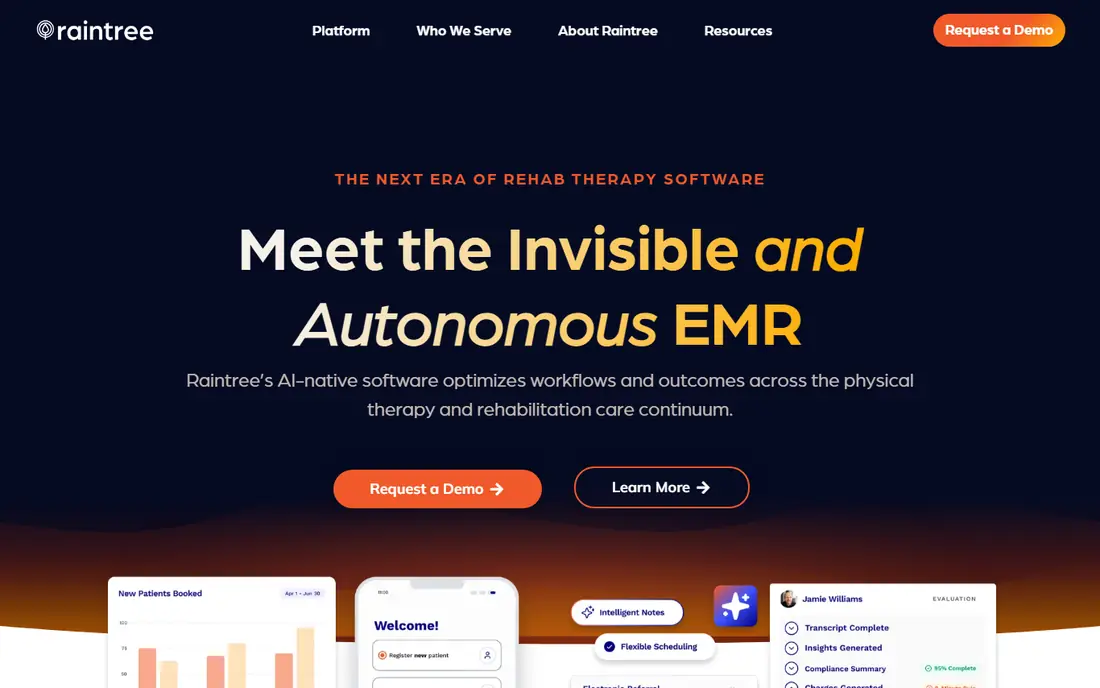
Raintree makes the most sense for large multi-location therapy organizations. Its customer base bundles large therapy organizations running thousands of locations.
The product is engineered around that reality: centralized reporting across locations, standardized workflows, revenue cycle management and an AI layer that drafts documentation and optimizes schedules. Raintree does not publish prices, sells through an enterprise process and implements like an enterprise system, which means months of onboarding instead of weeks. Pricing for Raintree is not stated here, so ask the vendor for current figures. Raintree has no free plan.
What to check first: Enterprise focus means it is overkill for a one- or two-location clinic.
- AI documentation (NoteIQ) and smart scheduling (SchedulerIQ) targeted at cutting admin time
- Designed for enterprise scale, with customers running hundreds to thousands of locations
- No published pricing and an enterprise sales cycle
WebPT
Ideal for: PT practices of any size that want the market-leading EMR
WebPT targets PT practices of any size that want the market-leading EMR. Hundreds of thousands of therapists use it, which means new hires frequently arrive already trained and external tools tend to connect with it first. As for the details, if your clinic runs five or more therapists and bills insurance heavily, WebPT is usually worth the conversation.
Limits to weigh: No published pricing, so every quote starts with a sales conversation.
From a buyer's view, if you are a solo cash-based practice, it is likely more system than you need. From a buyer's view, the honest catch is the buying process. More specifically, the product spans the entire clinic workflow, from intake and scheduling through documentation, billing and revenue cycle management, with patient marketing tools on top. WebPT shows no starting price here, so confirm the cost on the vendor site. WebPT has no free plan. Main advantages: The most widely adopted rehab therapy product, so staff you hire probably already know it.
- Billing and RCM
- AI-assisted documentation and compliance checks built in
- Onboarding a large team takes real project time
StrataPT
Ideal for: Clinics that want billing and EMR in one package
StrataPT makes the most sense for clinics that want billing and EMR in one package. StrataPT takes a different angle from the pure software vendors: it pairs its EMR with billing services. So the same company that built your documentation templates is responsible for getting your claims premium.
What works well: US-based support with guided onboarding.
For owners who are tired of managing a biller or a billing company separately, that single point of accountability is the entire argument. More specifically, the product bundles scheduling, configurable documentation templates, reporting and denial-prevention workflows pitched at first-pass clean claims. Worth adding: the trade-off is adaptability. If you already have billing handled and just want software, a bundled model can feel like paying for something you do not need, so ask whether a software-only choice exists and what it costs. This comparison lists no price for StrataPT; ask the vendor. StrataPT has no permanent free option.
Trade-offs to know: The bundled billing-service model does not suit clinics that want software only.
- Per the company's site
- Billing services and EMR in a single package, so one vendor owns the revenue cycle
- No published pricing
Fusion Web Clinic
Ideal for: Pediatric PT, OT and speech practices
Fusion Web Clinic serves Pediatric PT, OT and speech practices. Pediatric documentation has requirements that general PT systems deal with awkwardly, from school-based plan formats to family communication, and a purpose-built tool avoids the workarounds.
Main advantages: including school-based documentation needs.
Beyond that, Fusion Web Clinic is the specialist pick: a web-based EMR made for pediatric occupational, speech and physical therapy. More specifically, the specialization is also the limitation. Pricing for Fusion Web Clinic is not stated here, so ask the vendor for current figures. Fusion Web Clinic has no free tier.
The main drawbacks: The pediatric focus makes it a poor fit for adult ortho or neuro practices.
- Patient portal for families
- Documentation and billing in one system
- A smaller company with a narrower integration ecosystem
HENO
Ideal for: PT-owned practices that want marketing built into the EMR
HENO is built with PT-owned practices that want marketing built into the EMR in mind. HENO was built by a PT clinic owner who got tired of stitching systems together, and that origin presents in the feature list.
Beyond that, beyond scheduling, documentation and billing, it includes the growth tools most EMRs leave to third parties: automated text and email campaigns to win back lost patients, mass texting for waitlists, landing pages with intake forms and a retail module for cash-based packages. In daily use, the AI scribe produces SOAP notes from patient conversations, which is the feature most likely to win over skeptical therapists. Pricing for HENO is not stated here, so ask the vendor for current figures. HENO has no permanent free option.
Watch-outs: A smaller vendor, so integrations are fewer than the big products.
- Mass texting and landing pages included instead of bolted on
- AI scribe that turns conversations into SOAP notes
- The marketing features add surface area you may never use
How these tools were picked
We compared the tools on published pricing, free plan or trial availability, feature coverage for physical therapy software, and the limits each vendor documents. Treat prices as a snapshot: vendors change plans often, so check the vendor site for the figure that applies today. The order reflects how well each tool fits the most common buying scenario for physical therapy software, then price clarity, then free plan access. It is a starting point, not a verdict.
Before you commit
- Ask PROMPT, Raintree, WebPT and others for a written quote, since no starting price is shown.
- Read the limits listed for PROMPT first: no published pricing and no pricing page on the site.
- Work out what Raintree costs with your real seat count, add-ons and usage, not just the entry price.
- Ask StrataPT whether prices are locked for the first term and what happens at renewal.
- Ask the daily users to test Jane on a live task before you roll it out to everyone.
Frequently asked questions
Is PROMPT the right pick for everyone comparing physical therapy software?
No single tool suits every team. PROMPT comes first because it fits growing outpatient rehab groups that want automation, while Jane suits cash-based and hybrid PT practices that want simple, published pricing and Raintree suits large multi-location therapy organizations. Match the tool to your own size, budget and workflow before deciding.
What is the cheapest option for physical therapy software in this list?
On published monthly entry prices, Jane is the lowest here at $59/month. Entry price is only part of the cost, because seats, add-ons and billing terms can change the total.
How are the tools for physical therapy software ordered?
PROMPT sits first and HENO last because the order follows typical fit for physical therapy software, then price clarity and free access. It is a judgement call, so read each profile for fit and limits.
How long does PT software implementation take?
Mid-sized practices moving to WebPT or PROMPT should plan six to twelve weeks including data migration and training. Enterprise rollouts on Raintree can run multiple months across locations. Whatever the vendor quotes, add a buffer: migrations slip more commonly than they finish early.
Can I try these options before paying?
Not by default. None of the tools, from PROMPT to HENO, lists a free plan or a free trial here, so ask each vendor for a demo before committing.