7 Best Platform to Host Webinars for 2026

- 1
 DemioMarketing teams that want a no-download, interactive webinar roomVisit
- 2
 GoTo WebinarTraining teams and businesses running multi-session virtual conferencesVisit
- 3
 ON24Enterprise B2B marketing teams running webinars as pipeline enginesVisit
- 4
 LivestormB2B teams that want webinar pricing tied to real attendanceVisit
- 5
 WebinarJamCoaches, consultants and course sellers running live sales webinarsVisit
- Demio is the opening pick, best for marketing teams that want a no-download, interactive webinar room.
- Starting prices begin at $39/month with WebinarJam.
- What to know about ON24 first: quote-only pricing that lands at enterprise contract levels.
- Zoom Webinars suits businesses already standardized on Zoom Workplace.
Direct answer
If you need marketing teams that want a no-download, interactive webinar room, Demio is the first tool to look at here. For a different need, GoTo Webinar covers training teams and businesses running multi-session virtual conferences and ON24 covers enterprise B2B marketing teams running webinars as pipeline engines. The remaining 4 options are covered below with prices and limits.
Quick comparison
| Product | Ideal for | Price from | Free version | |
|---|---|---|---|---|
| Demio | Marketing teams that want a no-download, interactive webinar room | $499/year (Starter, 50 attendees) | Free trial (14 days) | Visit |
| GoTo Webinar | Training teams and businesses running multi-session virtual conferences | $59/month per organizer (Reach, billed yearly, 500 participants) | Free trial (7 days) | Visit |
| ON24 | Enterprise B2B marketing teams running webinars as pipeline engines | See website (custom annual contracts) | No | Visit |
| Livestorm | B2B teams that want webinar pricing tied to real attendance | From $3.00/attendee (Pro) | Yes | Visit |
| WebinarJam | Coaches, consultants and course sellers running live sales webinars | $39/month (Starter, billed annually, 100 attendees) | Free trial (14 days) | Visit |
 EasyWebinar | Course creators and demand-gen teams running live plus automatic funnels | $44/month (Launch, 50 live attendees) | Free trial (7 days) | Visit |
 Zoom Webinars | Firms already standardized on Zoom Workplace | See website (attendee-tiered Webinars, Webinars Plus and Events plans) | No | Visit |
Platform to Host Webinars profiles
Ainotely compared 7 platform to host webinars. The goal is a practical shortlist: published prices, free plan facts, best-fit use cases and honest limits for every entry.
Demio
Ideal for: Marketing teams that want a no-download, interactive webinar room
In short, Demio is for marketing teams that want a no-download, interactive webinar room. Everything runs in the browser, which removes the single biggest attendance killer in this category: the software download. If you run small, frequent webinars and care about show-up rates more than production theatrics, the browser-only experience is worth the premium over less expensive rooms.
More specifically, Demio gets pricey as rooms grow, and the features marketers actually want, custom domains, premium CRM integrations, 1080p streaming, live captions, sit on Premium. For everyday use, the interface is clean enough that a solo marketer can build a first webinar in minutes, and the engagement toolkit (polls, featured actions, handouts, live chat with question tagging) is aimed squarely at keeping an audience active rather than just watching. For everyday use, starter begins at $499 per year for 50 attendees; Growth begins at $899 per year for rooms up to 1,000; Premium begins at $3,300 per year for up to 3,000. Starting cost for Demio: $499/year. Free access: Free trial (14 days).
Watch-outs: Premium integrations and custom domains are Premium-only.
- No downloads anywhere
- Automatic and on-demand formats on one product
- Attendee caps climb in price rapidly once you leave Starter
GoTo Webinar
Ideal for: Training teams and businesses running multi-session virtual conferences

Choose GoTo Webinar for training teams and firms running multi-session virtual conferences. The oldest name on this list is also the least surprising.
Trade-offs to know: The interface feels dated next to Demio and Livestorm.
GoTo Webinar cost at the entry level: $59/month per organizer. Free access: Free trial (7 days).
- GoToStage on-demand library for hosting recorded event collections
- Decades of reliability with a huge installed base
- Attendee capacity jumps force big price steps between levels
ON24
Ideal for: Enterprise B2B marketing teams running webinars as pipeline engines
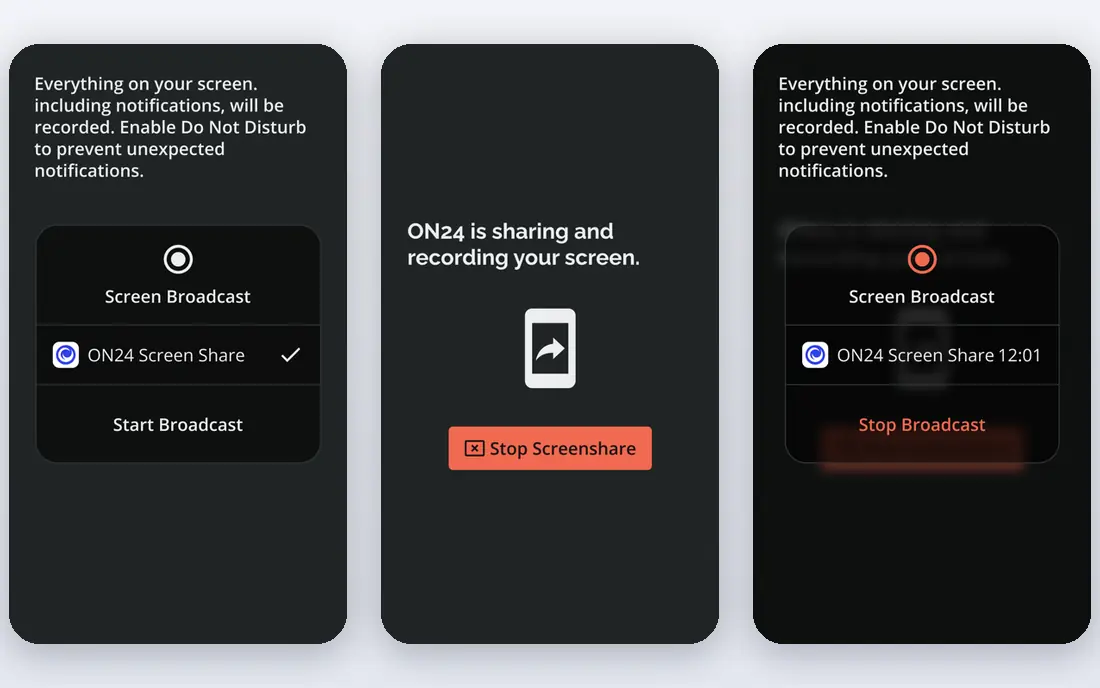
ON24 is aimed squarely at enterprise B2B marketing teams running webinars as pipeline engines. Where other systems report registrations and attendance, ON24 scores each attendee's engagement and pushes that data into Salesforce, HubSpot and Marketo so sales can act on it. The product spans live webinars, simulive, virtual conferences, breakout sessions and always-on content hubs, with AI features that turn a recording into derivative content.
In daily use, smaller teams should treat it as the thing to graduate into, not start with. From a buyer's view, if your webinar program has to produce measurable pipeline and your buying process runs through procurement anyway, ON24 is the benchmark. None of this includes a price tag you can read. ON24 is the enterprise end of this market, full stop. Pricing for ON24 is not stated here, so ask the vendor for current figures. ON24 has no permanent free option.
Downsides: Heavier console with a longer deployment than the self-serve tools.
Strengths: including per-attendee engagement scoring.
- AI tools that repurpose recordings into ebooks
- Blogs and video clips
- Quote-only pricing that lands at enterprise contract levels
Livestorm
Ideal for: B2B teams that want webinar pricing tied to real attendance
Livestorm is built with B2B teams that want webinar pricing tied to real attendance in mind. For teams running a handful of solid webinars a month instead of daily sessions, the pay-for-attendance model is fairer than a flat fee sized for your biggest day.
Honest limits: No just-in-time evergreen format.
Hosts and no-shows are free, and team members are unlimited on every tier, which makes the math friendly for marketing teams where five people touch one event. Entry price for Livestorm: From $3.00/attendee. A free plan is available with Livestorm.
- Native HubSpot sync on Pro with Salesforce and Marketo on Enterprise
- Pricing follows actual attendance, so quiet months cost less
- Advanced CRM integrations are gated to higher levels
WebinarJam
Ideal for: Coaches, consultants and course sellers running live sales webinars
WebinarJam is a good fit for Coaches, consultants and course sellers running live sales webinars. If your webinars exist to sell something, WebinarJam was made for you. WebinarJam manages live; scheduled automatic and evergreen delivery lives in EverWebinar, which is bundled from the Basic plan upward but missing on Starter.
From a buyer's view, pricing is public and straightforward, from $39 per month billed yearly for 100 attendees up to $379 for 5,000, with a $1 trial that runs 14 days at the 500-attendee Basic level. For everyday use, the system's entire identity is the live sales event: timed offer sidebars, countdown timers, one-click buy buttons inside the room. A Panic Button that moves a failing session to a backup room mid-broadcast. WebinarJam cost at the entry level: $39/month. On free options: Free trial (14 days).
Watch-outs: Session length caps of 1 to 4 hours by plan; No free plan.
- Attendee caps up to 5,000 on Enterprise
- Session replays with built-in hosting included on every plan
- Only the premium trial
EasyWebinar
Ideal for: Course creators and demand-gen teams running live plus automatic funnels
In short, EasyWebinar is for course creators and demand-gen teams running live plus automatic funnels. Course creators tend to land on EasyWebinar after outgrowing more straightforward tools. Worth adding: the pitch is consolidation: one subscription spans live launches, simulated-live replays with live chat, and evergreen funnels, plus a native CRM with lead scoring and an auto-dialer, in-webinar checkout, and multistreaming to YouTube, LinkedIn and Facebook.
Beyond that, the system does a lot, which means more setup than a clean single-purpose room. The smaller review base means fewer peer references. Starting cost for EasyWebinar: $44/month. As for free access: Free trial (7 days).
The main drawbacks: Launch level has no automatic webinars at all.
- Built-in EasyCRM with lead scoring plus in-webinar checkout
- LinkedIn and Facebook included
- The broader feature set means a steeper ramp-up time than Demio or Livestorm
Zoom Webinars
Ideal for: Firms already standardized on Zoom Workplace
Zoom Webinars is designed for firms already standardized on Zoom Workplace. You already know Zoom, but the webinar product is a different animal from the meeting you use daily. If you are buying a webinar product from scratch, the specialists above provide you more marketing features per dollar.
The confusion is the product's real cost. Zoom now sells three things under this roof: standard Webinars, the newer AI-powered Webinars Plus with backstage areas and pro layouts, and full Events for multi-session conferences. If your company already pays for Zoom and your audience already has the app, the path of least resistance wins. Zoom Webinars does not show a starting price in this comparison, so check the vendor site for current pricing. Zoom Webinars has no free plan.
Limits to weigh: Two confusingly similar products (Webinars and Webinars Plus) with different capabilities.
- Scales to 100,000 attendees on the same infrastructure as Zoom Meetings
- Familiar interface means near-zero attendee training
- Branding and production controls lag the specialists
Selection criteria
Pricing pages, product documentation and feature lists were the main sources, and every entry carries at least one honest drawback. Plan names, prices and limits change often. Treat the figures here as a starting point and verify them with the vendor. We ordered the tools by general fit, then by how clearly pricing is shown, then by free access. A buyer with unusual needs may reorder them.
Things to verify first
- Get a written quote from ON24 and Zoom Webinars; the list shows no starting price for them.
- Test the free plan from Livestorm against your real workload before relying on it.
- Use real work to test the free trial from Demio, GoTo Webinar, WebinarJam and EasyWebinar, rather than a demo project.
- Before choosing Demio, weigh its main limit: Attendee caps climb in price rapidly once you leave Starter.
- Ask EasyWebinar which support channels and response times come with the plan you would buy.
- Check how data leaves Livestorm: formats, limits and whether exports are available on every plan.
Frequently asked questions
Can I try these tools before paying?
Often, yes. Livestorm has a free plan and Demio, GoTo Webinar, WebinarJam and EasyWebinar offer a free trial. Use your own data and a real task during the test, and check what the free tier or trial limits before you rely on it.
What is the cheapest option for platform to host webinars in this list?
On published monthly entry prices, WebinarJam is the lowest here at $39/month. Entry price is only part of the cost, because seats, add-ons and billing terms can change the total.
Is Demio the right pick for everyone comparing platform to host webinars?
No single tool suits every team. Demio comes first because it fits marketing teams that want a no-download, interactive webinar room, while GoTo Webinar suits training teams and companies running multi-session virtual conferences and ON24 suits enterprise B2B marketing teams running webinars as pipeline engines. Match the tool to your own size, budget and workflow before deciding.
Which webinar product is a good match for lead generation?
The first pick on this list is Demio, because it suits marketing teams that want a no-download, interactive webinar room. GoTo Webinar is better for training teams and businesses running multi-session virtual conferences, and ON24 for enterprise B2B marketing teams running webinars as pipeline engines. Check price and limits against your own needs before choosing.
What is the best product to host webinars for small companies?
Demio comes first here and is built for marketing teams that want a no-download, interactive webinar room. Buyers with other needs may prefer GoTo Webinar (for training teams and firms running multi-session virtual conferences) or ON24 (for enterprise B2B marketing teams running webinars as pipeline engines). Compare costs and limits first.
Which options for platform to host webinars have a free plan?
Livestorm is the only tool in this list with a free plan. Free plans usually cap users, projects or features, so check the limits on the vendor page. Several others offer a trial instead.