Top 7 Platforms for B2B Marketing Picks for 2026, Compared

- 1
 Salesforce Account EngagementB2B marketing inside SalesforceVisit
- 2
 DemandbaseAccount-based GTM orchestrationVisit
- 3
 HubSpotThe all-in-one CRM and marketing systemVisit
- 4
 ActiveCampaignAutomation value for small B2B teamsVisit
- 5
 6sensePredictive ABM and buyer intentVisit
- Salesforce Account Engagement sits first on this list: B2B marketing inside Salesforce.
- 2 of 7 tools offer a free plan: HubSpot, Mailchimp.
- Before buying HubSpot, weigh this: professional at $800+ per month is a huge jump.
- Mailchimp is the one to check for straightforward email marketing for small B2B.
- The lowest published monthly entry price here is $9 per seat per month, billed annually, from HubSpot.
Direct answer
Salesforce Account Engagement comes first here, mainly for B2B marketing inside Salesforce. Demandbase is the stronger choice for account-based GTM orchestration, while HubSpot suits the all-in-one CRM and marketing product. Prices, free plans and limits for all 7 tools follow.
Quick comparison
| Product | Ideal for | Price from | Free version | |
|---|---|---|---|---|
| Salesforce Account Engagement | B2B marketing inside Salesforce | See website | No | Visit |
| Demandbase | Account-based GTM orchestration | See website | No | Visit |
| HubSpot | The all-in-one CRM and marketing system | $9 per seat a month, billed yearly (Starter) | Yes | Visit |
| ActiveCampaign | Automation value for small B2B teams | $15 a month, billed yearly (Starter) | Free trial (14 days) | Visit |
| 6sense | Predictive ABM and buyer intent | See website | No | Visit |
 Marketo Engage (Adobe) | Enterprise marketing automation | See website | No | Visit |
 Mailchimp | Straightforward email marketing for small B2B | $13 per month (Essentials) | Yes | Visit |
The 7 tools in detail
Short on time? The summary and table above give the quick view of 7 tools for platforms for B2B marketing, and the profiles that follow give the detail behind each entry.
Salesforce Account Engagement
Ideal for: B2B marketing inside Salesforce

Salesforce Account Engagement targets B2B marketing inside Salesforce. Pricing is quote-based and the product makes little sense without Salesforce CRM underneath.
Pricing for Salesforce Account Engagement is not stated here, so ask the vendor for current figures. Salesforce Account Engagement does not include a free plan.
Downsides: Weaker outside the Salesforce ecosystem.
- Solid for B2B lead lifecycle
- Native Salesforce CRM alignment
- Quote-based pricing
Demandbase
Ideal for: Account-based GTM orchestration
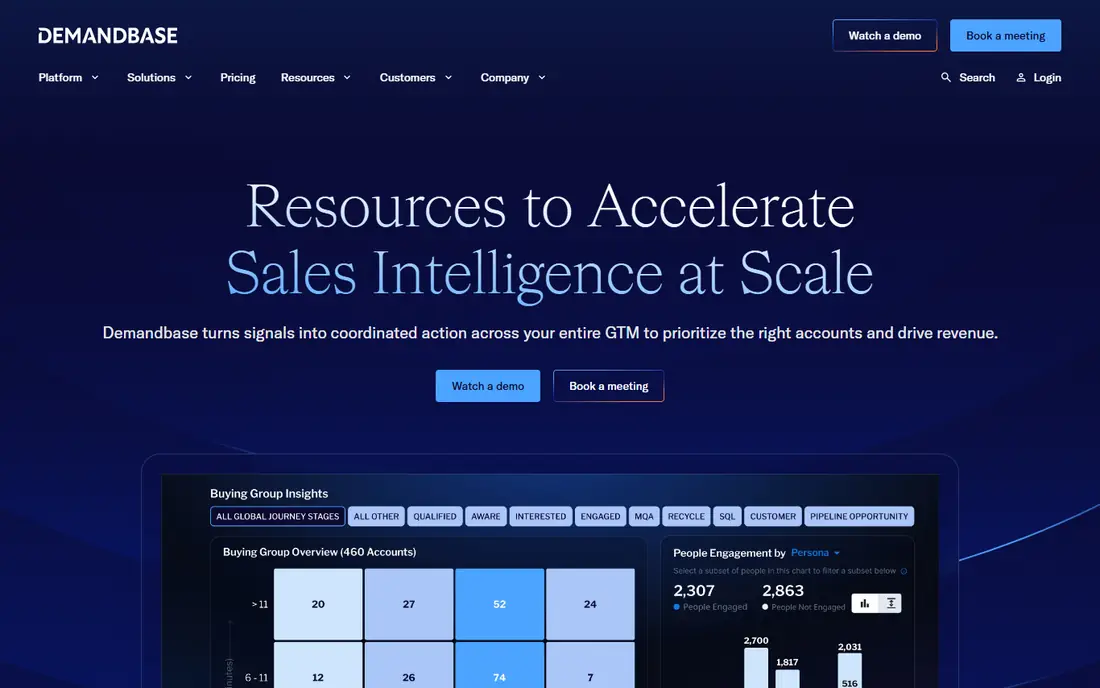
For account-based GTM orchestration, Demandbase is a natural candidate. It brings marketing, sales and advertising workflows into one account-centric system.
As for the details, pricing is quote-based and enterprise-grade; this is a six-figure decision for most buyers. Demandbase shows no starting price here, so confirm the cost on the vendor site. Demandbase has no free plan.
What to check first: Overkill below mid-market.
- Sales and marketing in one
- Account identification and intent
- Quote-based enterprise pricing
HubSpot
Ideal for: The all-in-one CRM and marketing system
HubSpot makes the most sense for the all-in-one CRM and marketing system. Marketing Hub Starter runs $9 a seat per month on annual billing (on a regular basis $20 a seat) with 1,000 marketing contacts, whereas the free plan includes entry-level email, forms and chat for up to two users.
Where it falls short: Marketing contacts drive the bill up quick.
From a buyer's view, the marketing-contact model is the thing to understand: only contacts you market to count toward premium levels, which keeps the bill honest. Professional jumps to $800 per month annual plus a $3,000 onboarding fee. HubSpot starts at: $9 per seat per month, billed annually. Free access exists with HubSpot.
- Contact model separates marketing from non-marketing contacts
- CRM and marketing in one database
- Onboarding fees on higher levels
ActiveCampaign
Ideal for: Automation value for small B2B teams
In short, ActiveCampaign is for automation value for small B2B teams. ActiveCampaign is an automation product that also sends email, instead of the reverse: branching conditions, goals, split tests and predictive sending arranged in a genuinely very good visual builder.
Points against: Starter caps automations at 5 actions.
More specifically, the catches are real: Starter limits each automation to five actions (the Plus level at $49 is the realistic entry point for serious automation), and since late 2025 new accounts are billed for all contacts including unsubscribed ones. From a buyer's view, starter is $15 per month billed yearly at 1,000 contacts, Plus $49, Professional $79, Enterprise $145, with a 14-day free trial and no free plan. What you pay to start with ActiveCampaign: $15 per month, billed annually. Free plan details: Free trial (14 days).
- Published pricing from $15 per month
- CRM included on higher levels
- Bills on all contacts including unsubscribed
6sense
Ideal for: Predictive ABM and buyer intent
In short, 6sense is for predictive ABM and buyer intent. The two compete straight; buyers should evaluate both on data quality in their specific segment, since intent data is only as decent as its coverage of your buyers. It connects with the major CRMs and marketing automation systems to push those insights into existing workflows.
For predictive ABM, 6sense is the reference alternative to Demandbase. As for the details, like Demandbase, it is quote-based and geared toward teams with real pipeline targets. 6sense shows no starting price here, so confirm the cost on the vendor site. 6sense has no free tier.
Trade-offs to know: Predictions need tuning.
- Decent Salesforce and HubSpot integrations
- Spots anonymous buying activity
- Quote-based pricing
Marketo Engage (Adobe)
Ideal for: Enterprise marketing automation
In short, Marketo Engage (Adobe) is for enterprise marketing automation. As an Adobe product it sits alongside analytics and content tools that enterprise marketing orgs already run. Everything about it is enterprise: quote-based pricing, a dedicated administrator as a practical requirement, and implementations measured in months.
As for the details, for the large B2B org running complicated multi-touch demand programs, Marketo remains the reference implementation. Also, teams under 50 marketers seldom justify it. No starting price is listed for Marketo Engage (Adobe) here; confirm pricing on the vendor site. Marketo Engage (Adobe) has no free tier.
Where it falls short: Quote-based pricing.
- Adobe ecosystem integration
- The deepest automation and lead management in the category
- Needs a dedicated admin
Mailchimp
Ideal for: Straightforward email marketing for small B2B
Think of Mailchimp for straightforward email marketing for small B2B. For the small B2B company whose marketing is a newsletter and a handful of automatic emails, it is quick and friendly. It is not a B2B automation product.
The main drawbacks: Weak for complicated B2B nurturing.
On top of that, lead scoring, CRM depth and multi-touch attribution are thin or absent. The free plan's shrinkage (from 2,000 contacts to 250) tells you where Intuit is taking it. More specifically, Mailchimp is the simple button: Essentials from $13 per month, Standard from $20, Premium from $350, with a free plan capped at 250 contacts and 500 sends per month. Mailchimp cost at the entry level: $13 per month. Mailchimp offers a free plan.
- Free plan for tiny lists
- Simple to start
- Bills on unsubscribed contacts too
How these tools were picked
Each tool was reviewed on what its vendor publishes: price, plan limits, core features and stated drawbacks. We did not run hands-on tests. Where a price is missing, the vendor does not list one publicly or ties it to a quote. Always confirm before budgeting. Position on the page reflects fit for a typical buyer first, with price clarity and free access breaking ties. Treat it as a guide, not a ruling.
A buyer's checklist
- Confirm the entry price on the vendor page. For Salesforce Account Engagement, Demandbase, 6sense and Marketo Engage (Adobe) that means a quote rather than a fixed price.
- Look at free plan limits closely: HubSpot and Mailchimp have one, and the caps decide whether it is usable for real work.
- Use real work to test the free trial from ActiveCampaign, rather than a demo project.
- Read the limits listed for Salesforce Account Engagement first: quote-based pricing.
- Pick one real project and run it in HubSpot first; a small pilot shows fit faster than a checklist.
- Ask Marketo Engage (Adobe) whether prices are locked for the first term and what happens at renewal.
Frequently asked questions
Which options for platforms for B2B marketing have a free plan?
HubSpot and Mailchimp offer a free plan in this list. Free plans usually cap users, projects or features, so check the limits on the vendor page. One other tool offers a trial instead.
How are the tools for platforms for B2B marketing ordered?
The order follows typical fit for platforms for B2B marketing, with Salesforce Account Engagement first and Mailchimp last, then price clarity and free access. It is editorial judgement, not a score, so another team could rank the tools differently.
Can I try these tools before paying?
Often, yes. HubSpot and Mailchimp have a free plan and ActiveCampaign offers a free trial. Use your own data and a real task during the test, and check what the free tier or trial limits before you rely on it.
Do these tools publish their prices?
Not all of them. Salesforce Account Engagement, Demandbase, 6sense and Marketo Engage (Adobe) publish no starting price, so expect a quote request for those. The rest, HubSpot included, show a starting price, though seats and billing terms still change the final cost.
What is the best product for B2B marketing?
Salesforce Account Engagement is the pick this page puts first, mainly for B2B marketing inside Salesforce. If your situation differs, Demandbase suits account-based GTM orchestration, and HubSpot suits the all-in-one CRM and marketing system. Compare price and limits before you decide.
What is account-based marketing (ABM)?
ABM is a strategy that treats individual high-value accounts as markets of one: marketing and sales coordinate personalized campaigns against a defined target account list, measured on pipeline and revenue per account instead of lead volume.