Best Platforms for HR Software Integrations

- Zapier and Make are the cheapest ways to connect HR software, from $12 to $19.99 a month, with free plans for small volumes.
- Workato, Tray.ai and Celigo are enterprise integration platforms with quote-based pricing and thousands of connectors.
- Rippling and BambooHR connect HR data from inside the HR system, with Rippling starting at $8 per employee per month.
- Count your integrations and your monthly volume before you choose, since most platforms bill by usage, not by seats.
Quick comparison
| Product | Ideal for | Price from | Free version | |
|---|---|---|---|---|
 Zapier | Connecting HR apps without code | $19.99 per month (Professional) | Yes | Visit |
 Make | Visual HR workflows across apps | $12 per month (Core, 10,000 credits) | Yes | Visit |
 Tray.ai | Enterprise HR automation at scale | $50 per month | Free trial (30 days) | Visit |
 Workato | Large teams that need governed integrations | quote only | No | Visit |
 Celigo | Mid-size teams that want prebuilt HR flows | quote only | Free trial (30 days) | Visit |
 Rippling | HR, IT and finance in one connected system | $8 per employee/month plus base fee | No | Visit |
 BambooHR | Core HR with a marketplace of integrations | quote only | Free trial | Visit |
The best platforms for HR software integrations
Zapier
Ideal for: Connecting HR apps without code
Zapier is the simplest way to connect HR software with the rest of a business. It links more than 9,000 apps, so a new hire in BambooHR can trigger a Slack message, a Google Workspace account and a payroll update, all without code. The free plan costs $0 forever with 100 tasks a month, unlimited Zaps, Tables and Forms, and two-step Zaps. Professional starts at $19.99 a month and adds multi-step Zaps, unlimited premium apps, webhooks and AI fields. Team at $69 a month adds 25 users, shared Zaps and folders, and single sign-on.
The billing unit is the task: every step in a Zap that completes an action uses tasks, and AI steps, code and connectors can use more than one task each. A new account gets a free 14 day trial of Professional with no credit card required. For an HR team that wants to connect its HR system with payroll, email, chat and spreadsheets quickly, Zapier is the fastest start here, as long as you count the tasks your busiest flows will use each month.
- Connects 9,000+ apps
- Free plan covers 100 tasks a month
- Free plan allows two-step Zaps only
- Task usage decides the real cost
Make
Ideal for: Visual HR workflows across apps

Make is a visual automation platform where HR workflows appear as a diagram, with modules for each app and lines showing how data moves between them. It connects 3,500 or more apps, with routers, filters, iterators and error handling built into the canvas, plus AI apps, an MCP server and AI agents on every plan. A new hire flow can check the HR system, create accounts, send a welcome email and update payroll in one scenario. The free plan covers 1,000 credits a month with no time limit, and Core costs $12 a month for 10,000 credits with unlimited active scenarios and scheduling down to the minute.
The limits are the credit model and the free plan caps: each module action counts as one credit, the free plan allows only 2 active scenarios with a 15 minute minimum interval between runs, and execution logs are kept for 7 days on free versus 30 on subscription plans. For an HR team that likes to see its integrations as a diagram and wants strong branching and error handling, Make is the most visual tool here, and its $12 entry price is the lowest subscription price in this list.
- Visual builder with routers and filters
- Free plan covers 1,000 credits a month
- Free plan allows 2 active scenarios
- Credits decide the monthly cost
Tray.ai
Ideal for: Enterprise HR automation at scale
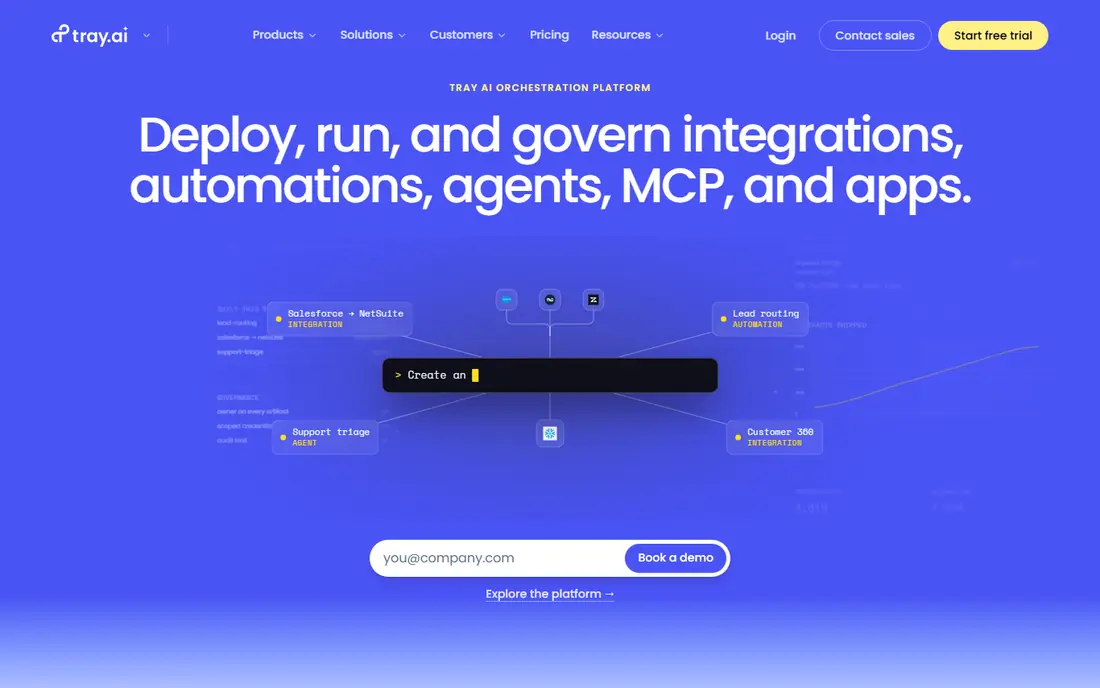
Tray.ai is an enterprise integration platform that connects HR software with the rest of the business through 6,000 or more apps, databases, APIs and services. Its iPaaS plans run Pro, Team and Enterprise tiers, with 3 workspaces on Pro, 20 on Team and unlimited on Enterprise, and the price is sized to expected usage with a quote. The AI Orchestration Platform starts at $50 a month with the Helix Builder Edition. There are no per-user, per-connection or per-runtime fees, so cost follows what you run, not how many people or systems you connect.
The free trial runs for 30 days with 1 million tasks on Tray iPaaS, with every capability and the full connector library, and no card or sales call is needed to start it. The trial is the right way to size a plan, since the quote is built on measured usage rather than an estimate. Tray also offers an Agent Gateway for MCP and a Merlin Agent Builder with ITSM and HR accelerators. For a larger HR and IT team that needs governed integrations at scale, Tray.ai is a strong enterprise pick, though small teams will find Zapier or Make simpler and cheaper.
- 6,000+ apps with no per-user fees
- 30 day trial with 1 million tasks
- IPaaS plans are quote-based
- Usage billing needs careful sizing
Workato
Ideal for: Large teams that need governed integrations
Workato is an enterprise integration and automation platform with 1,200 or more pre-built connectors. Its Standard edition covers application integration and process automation, recipe lifecycle management, dev, test and production environments, single sign-on and role-based access control, with 30 day log retention. Business MCP adds pre-built MCP servers, an AI and MCP gateway, data integration and an API platform, while Enterprise MCP adds data pipelines, event streams, document processing and AI features. Workato ONE adds an agent studio, a knowledge base and an employee assistant.
Pricing is quote only, with a usage dashboard that tracks task consumption and plan details so a team can forecast cost. There is no free plan, so evaluation runs through a demo and a sales conversation. For a large organisation that needs to connect HR, finance, sales and IT systems under one governed platform with audit trails and role-based access, Workato is a leading choice. Smaller teams should compare it against Tray.ai and Celigo before committing to an enterprise platform.
- 1,200+ pre-built connectors
- Dev, test and production environments
- No public price, so you need a quote
- No free plan for testing
Celigo
Ideal for: Mid-size teams that want prebuilt HR flows
Celigo is an integration platform that ships with a marketplace of prebuilt connectors, templates, AI agents and MCP servers for the applications a team already uses, so HR integrations can start from a template instead of a blank canvas. Editions run Standard, Professional and Enterprise: Standard covers the most critical integrations with role-based access and standard support, Professional adds an API builder, lookup cache, single sign-on and a sandbox, and Enterprise adds maximum performance with governance, security and the fastest support. Every edition includes file storage, support with service level agreements, multi-factor authentication and Celigo AI capabilities including Celigo Ora, which builds integrations from natural language.
Pricing is quote only, and the vendor says the fastest way to an accurate number is a short conversation with its team. A 30 day free trial is available through integrator.io, so a team can build before it buys. Celigo is ranked the number 1 iPaaS by users on G2, with a 4.7 out of 5 rating on Gartner Peer Insights. For a mid-size team that wants prebuilt HR flows and a marketplace rather than building every integration from scratch, Celigo is a practical enterprise option.
- Marketplace with prebuilt connectors and templates
- AI agents on every edition
- No public price, so you need a quote
- Editions differ mainly by scale and governance
Rippling
Ideal for: HR, IT and finance in one connected system
Rippling takes a different approach to HR integrations: instead of connecting separate systems, it puts HR, IT and finance in one platform with a single data model, so a new hire automatically gets payroll, devices, apps and access without a chain of integrations. Plans start at $8 per employee per month, with a monthly base fee, and the total depends on the products chosen. You pick the modules you need, such as HR, payroll, IT management or spend management, and Rippling gives a custom quote. The platform also integrates with hundreds of third-party apps, including accounting, single sign-on and communication tools, for the systems that stay outside Rippling.
The modular model means the headline $8 figure is not the full cost, since each product adds its own per employee charge plus the base fee. There is no free plan, and pricing depends on headcount and product mix. For a company that wants HR data to flow into IT and finance without building and maintaining integrations, Rippling removes the problem rather than solving it with a connector. Teams that already have a strong HR system and only need a few links will find Zapier or Make cheaper.
- HR, IT and finance share one data model
- Integrates with hundreds of apps
- A full quote is needed for a final figure
- Payroll pricing varies by products
BambooHR
Ideal for: Core HR with a marketplace of integrations
BambooHR is a core HR system for growing companies, with employee records, time off and benefits tracking, standard and custom reports, and workflows with approvals. Its integration story runs through its marketplace, which connects BambooHR with payroll, benefits, hiring, time tracking and communication tools, so a team can keep BambooHR as the system of record and link the tools around it. The Core plan covers the basics, Pro adds hiring and onboarding with an applicant tracking system, and Elite adds performance management, compensation planning and advanced analytics. Add-ons cover compliance training and HR data tools.
The pricing page does not publish prices, so a buyer needs a quote based on headcount, and the final figure will depend on the tier and add-ons chosen. A free trial is available for testing the product. BambooHR does not handle payroll itself in most markets, so payroll will need a connected local tool. For a growing company that wants a polished HR system of record with a marketplace of integrations around it, BambooHR is a solid choice, provided the quote still makes sense next to Rippling and Zoho People.
- Strong employee records and reporting
- Marketplace connects payroll, benefits and hiring tools
- No public price, so you need a quote
- Deeper features sit on higher tiers
How we chose
We compared the vendor pricing pages, plan feature lists and support documents for each tool on 2026-11-11. We checked the entry price on each pricing page, whether a free plan or trial exists, how many connectors each platform offers, and how each one links HR data with payroll, IT and finance. We did not claim hands-on testing. Tools were picked because they connect HR software with the rest of a business, either as integration platforms or as HR systems with strong integration ecosystems.
What to check before you buy
Check the billing unit first, because it decides the real cost. Zapier bills by tasks, Make and Tray.ai bill by credits or tasks used, and Workato and Celigo price by edition and usage, so count the volume your HR flows will run each month. Next, check the connector list for the exact HR system you use, including BambooHR, Workday, Rippling, Zoho People and your payroll tool, and confirm whether the connector is prebuilt or needs custom work. Check governance too: role-based access, audit logs and single sign-on matter once HR data moves between systems. Confirm data rules, including where employee data is stored and who can access it.
| Team size and budget | Best starting point |
|---|---|
| Small team, under $25 per month | Make Core at $12, or Zapier free for 100 tasks a month |
| Growing team, $25 to $100 per month | Zapier Professional from $19.99, or Tray.ai from $50 |
| Mid-size team, quote-based budget | Celigo, with a 30 day free trial first |
| Large team, enterprise budget | Workato, or Tray.ai Enterprise |
| HR, IT and finance in one system | Rippling from $8 per employee per month plus base fee |
| Core HR with integrations around it | BambooHR on a quote, with a free trial first |
Frequently asked questions
What is the best platform to integrate HR software?
It depends on your size. Zapier is best for small teams that want to connect HR apps quickly, with 9,000 or more apps and a free plan. Make is best for visual workflows at a low price, from $12 a month. Workato, Tray.ai and Celigo suit larger teams that need governed integrations at scale. Rippling suits companies that want HR, IT and finance in one system instead of many integrations.
How much does it cost to integrate HR software?
A small team can start at no cost with Zapier free for 100 tasks a month or Make free for 1,000 credits a month. Make Core costs $12 a month for 10,000 credits, and Zapier Professional starts at $19.99 a month. Tray.ai starts at $50 a month, while Workato and Celigo need a quote. Rippling starts at $8 per employee per month plus a base fee. The real cost depends on how many flows you run each month.
Do I need an iPaaS to connect my HR software?
Not always. If you only need a few links, such as new hires into Slack and payroll, Zapier or Make will cover it at a low price. An iPaaS such as Workato, Tray.ai or Celigo makes sense when you have many systems, high volumes, strict governance or on-premise apps to connect. If your HR system already connects to the tools you use, such as BambooHR through its marketplace, you may not need a separate platform at all.
Which HR systems work with Zapier and Make?
Both connect with the major HR tools, including BambooHR, Rippling, Zoho People, Workday, Gusto, Deel and Hibob, plus payroll, email, chat and spreadsheet apps. Zapier lists 9,000 or more apps and Make lists 3,500 or more, so most common HR tools are covered. Check the connector page for the exact HR system you use before you buy, and confirm whether the actions you need, such as creating an employee or updating a record, are supported.
What is the difference between Zapier and Workato?
Zapier is a simple connector for small and mid-size teams, with per-task pricing from $19.99 a month and a free plan. Workato is an enterprise integration platform with governed recipes, dev, test and production environments, data pipelines and AI features, priced by quote. Zapier suits a team that wants a few flows running today. Workato suits a large organisation that needs audit trails, role-based access and integrations across many departments.
Should I pick Rippling instead of an integration platform?
Pick Rippling if you want HR, IT and finance in one system with a single data model, so a new hire gets payroll, devices and access without a chain of integrations. It starts at $8 per employee per month plus a base fee, with a custom quote for the full figure. Pick Zapier or Make if you already have an HR system you like and only need a few links, since that costs far less.