Best Platforms for Microlearning in 2026: 8 Platforms Compared

- EdApp and TalentCards lead for mobile-first team training with short lessons.
- Axonify suits frontline teams that need daily reinforcement and knowledge checks.
- Blinkist and Headway suit individual learners who want book summaries in minutes.
- Microlearning works best for reinforcement and onboarding, not as a replacement for deep training.
Quick comparison
| Product | Ideal for | Price from | Free version | |
|---|---|---|---|---|
 EdApp | Mobile microlearning for teams | Free | Yes | Visit |
 Axonify | Daily reinforcement for frontline teams | See website | No | Visit |
 TalentCards | Card-based mobile training | See website | Free trial | Visit |
 7taps | Quick microlearning creation | Free | Yes | Visit |
 Blinkist | Book summaries in minutes | See website | Free trial | Visit |
 Headway | Book summaries with challenges | See website | Free trial | Visit |
 Qstream | Spaced reinforcement for teams | See website | No | Visit |
 Arist | Microlearning by text message | See website | Free trial | Visit |
The best platforms for microlearning
We compared microlearning platforms on lesson format, mobile experience, tracking, authoring and pricing. Short lessons only help if they are easy to create, easy to complete and easy to track, so we judged all three. Our pick for teams is EdApp, with Blinkist as the individual-learner alternative.
EdApp
Ideal for: Mobile microlearning for teams

EdApp offers mobile-first microlearning with authoring tools and tracking, designed for teams to create short lessons employees complete on phones. That mobile focus suits frontline and deskless workers. The free tier covers small teams, while advanced features and larger deployments need paid plans.
For most readers, the deciding question with EdApp is fit rather than raw feature count. Check the plan limits that matter to you, such as seats, usage caps and what happens when a trial ends, before you commit to a paid tier. If the free tier or trial covers your core task, use it for a full week of real work before paying, and keep an eye on renewal terms and cancellation steps. That short test usually tells you more than any feature list, and it keeps the choice grounded in how you actually work day to day.
- Mobile-first lessons
- Authoring tools
- Tracking
- Free tier limits
- Advanced features are paid
Axonify
Ideal for: Daily reinforcement for frontline teams

Axonify delivers daily microlearning with reinforcement and analytics, aimed at frontline teams in retail, logistics and manufacturing. Short daily sessions build retention over time. Pricing targets enterprises and implementation takes time, so smaller teams may prefer EdApp or TalentCards.
For most readers, the deciding question with Axonify is fit rather than raw feature count. Check the plan limits that matter to you, such as seats, usage caps and what happens when a trial ends, before you commit to a paid tier. If the free tier or trial covers your core task, use it for a full week of real work before paying, and keep an eye on renewal terms and cancellation steps. That short test usually tells you more than any feature list, and it keeps the choice grounded in how you actually work day to day.
- Daily microlearning
- Knowledge reinforcement
- Analytics
- Enterprise pricing
- Implementation takes time
TalentCards
Ideal for: Card-based mobile training
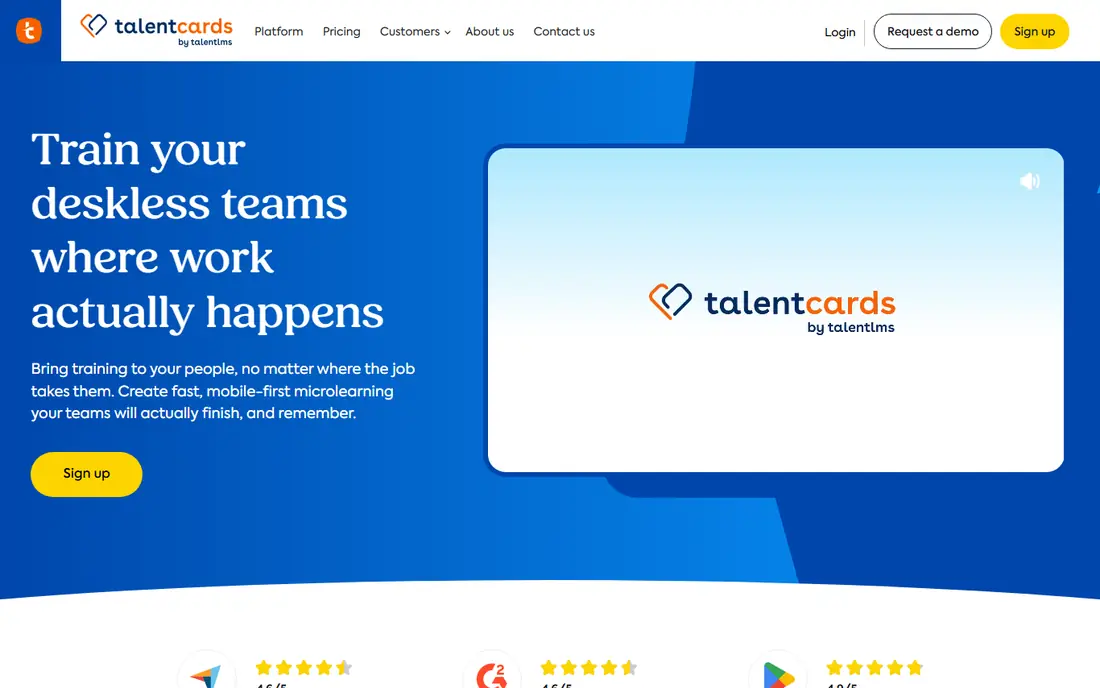
TalentCards delivers training as cards on mobile, with tracking for managers. That card format suits quick knowledge bites and onboarding checklists. Pricing scales with users, and authoring depth is moderate next to EdApp, but the simplicity helps teams launch fast.
For most readers, the deciding question with TalentCards is fit rather than raw feature count. Check the plan limits that matter to you, such as seats, usage caps and what happens when a trial ends, before you commit to a paid tier. If the free tier or trial covers your core task, use it for a full week of real work before paying, and keep an eye on renewal terms and cancellation steps. That short test usually tells you more than any feature list, and it keeps the choice grounded in how you actually work day to day.
- Card-based lessons
- Mobile delivery
- Tracking
- Pricing scales
- Authoring depth is moderate
7taps
Ideal for: Quick microlearning creation
7taps lets creators build microlearning lessons quickly and share them by link, with mobile delivery that works without an app install. That speed suits small teams and individual trainers. The free tier limits lessons, and analytics are lighter than enterprise platforms, so it fits lightweight use best.
For most readers, the deciding question with 7taps is fit rather than raw feature count. Check the plan limits that matter to you, such as seats, usage caps and what happens when a trial ends, before you commit to a paid tier. If the free tier or trial covers your core task, use it for a full week of real work before paying, and keep an eye on renewal terms and cancellation steps. That short test usually tells you more than any feature list, and it keeps the choice grounded in how you actually work day to day.
- Fast lesson creation
- Mobile delivery
- Sharing links
- Free tier limits
- Analytics are lighter
Blinkist
Ideal for: Book summaries in minutes
Blinkist condenses nonfiction books into short text and audio summaries, letting learners grasp key ideas in about fifteen minutes. That format suits individual professional development. It is not a team training platform, so organisations needing tracking and authoring should choose EdApp or Axonify instead.
For most readers, the deciding question with Blinkist is fit rather than raw feature count. Check the plan limits that matter to you, such as seats, usage caps and what happens when a trial ends, before you commit to a paid tier. If the free tier or trial covers your core task, use it for a full week of real work before paying, and keep an eye on renewal terms and cancellation steps. That short test usually tells you more than any feature list, and it keeps the choice grounded in how you actually work day to day.
- Book summaries in text and audio
- Curated lists
- Offline reading
- Not a team training platform
- Subscription needed for full access
Headway
Ideal for: Book summaries with challenges
Headway offers book summaries with reading challenges and audio versions, encouraging daily learning habits. That habit design suits individual learners who want consistent short learning. Full access needs a subscription, and summaries do not replace full books for deep topics, so treat them as introductions.
For most readers, the deciding question with Headway is fit rather than raw feature count. Check the plan limits that matter to you, such as seats, usage caps and what happens when a trial ends, before you commit to a paid tier. If the free tier or trial covers your core task, use it for a full week of real work before paying, and keep an eye on renewal terms and cancellation steps. That short test usually tells you more than any feature list, and it keeps the choice grounded in how you actually work day to day.
- Book summaries
- Reading challenges
- Audio versions
- Subscription needed
- Content is summary-only
Qstream
Ideal for: Spaced reinforcement for teams
Qstream uses scenario-based questions with spaced repetition to reinforce knowledge over time, with analytics for managers. That science-backed approach suits sales, healthcare and compliance training. Pricing targets enterprises and setup takes time, so smaller teams may prefer simpler tools.
For most readers, the deciding question with Qstream is fit rather than raw feature count. Check the plan limits that matter to you, such as seats, usage caps and what happens when a trial ends, before you commit to a paid tier. If the free tier or trial covers your core task, use it for a full week of real work before paying, and keep an eye on renewal terms and cancellation steps. That short test usually tells you more than any feature list, and it keeps the choice grounded in how you actually work day to day.
- Scenario-based questions
- Spaced repetition
- Analytics
- Enterprise pricing
- Setup takes time
Arist
Ideal for: Microlearning by text message
Arist delivers microlearning by text message and chat apps, reaching learners where they already communicate. That reach suits deskless teams with limited app access. Text format limits media depth compared with video-led platforms, and pricing varies, so check delivery channels for your workforce.
For most readers, the deciding question with Arist is fit rather than raw feature count. Check the plan limits that matter to you, such as seats, usage caps and what happens when a trial ends, before you commit to a paid tier. If the free tier or trial covers your core task, use it for a full week of real work before paying, and keep an eye on renewal terms and cancellation steps. That short test usually tells you more than any feature list, and it keeps the choice grounded in how you actually work day to day.
- Text-based microlearning
- Course delivery by SMS and chat
- Analytics
- Pricing varies
- Text format limits media depth
How we picked these
We compared official feature pages, pricing pages, app store listings, privacy policies and public reviews for each option below. We kept only products that exist and work now, that fit the topic directly, and whose official homepage we could confirm. Where a price was not published clearly, we wrote See website rather than guessing, and we favoured options with a free tier or trial where one exists.
Making microlearning actually stick
Keep lessons under ten minutes and focused on one idea. A micro-lesson that tries to cover a whole topic becomes a mini-lecture, which defeats the format. One idea, one example, one check of understanding is the right scope.
Space repetition over days, not hours. Short lessons work because they return to ideas at intervals, strengthening memory. A platform with spaced delivery or daily reinforcement beats a library of lessons nobody revisits.
Track completion and understanding, not just views. A lesson marked complete means little if the learner cannot apply it. Use quizzes, scenario questions and manager reports to check learning, and follow up where gaps appear.
Frequently asked questions
What are the best platforms for microlearning?
EdApp leads for mobile team training, TalentCards for card-based lessons, and Axonify for frontline reinforcement. Blinkist and Headway suit individual learners wanting book summaries.
Is microlearning effective?
Yes, for reinforcement, onboarding and just-in-time knowledge, especially with spaced repetition. It works less well as a sole method for deep or complex skills, which need longer training alongside it.
Is there free microlearning software?
EdApp and 7taps offer free tiers for small teams and creators. Enterprise platforms such as Axonify and Qstream are paid, with pricing by users or deployment.
How long should a microlearning lesson be?
Most effective lessons run two to ten minutes and cover a single idea with an example and a quick check. Shorter is usually better, provided the idea is complete.
Can microlearning replace traditional training?
No, it complements longer training by reinforcing and refreshing knowledge. Deep skills still need practice, coaching and longer courses, with microlearning keeping that learning alive between sessions.