Best Platforms to Build a Trading App in 2026: 7 Platforms Compared

- 1
 AlpacaDeveloper-first tradingVisit
- 2
 TradierActive-trader appsVisit
- 3
 DriveWealthGlobal investingVisit
- 4
 Interactive BrokersGlobal multi-assetVisit
- 5
 SnapTradeBrokerage connectionsVisit
- Alpaca suits developer-first trading apps, with a Trading API and Broker API for stocks, options and crypto, SDKs in Python, .NET, Go and Node, and commission-free stock and options trading through its API.
- Tradier suits active-trader apps, with more than 100 connected partner platforms, more than 1 billion API calls per month, and $0 trades with low per-contract rates.
- DriveWealth suits global investing apps, with brokerage-as-a-service APIs for US equities, ETFs, mutual funds, fixed income and options, including patented fractional trading.
- Interactive Brokers suits global multi-asset apps, with access to more than 175 markets, commissions starting at $0, and more than 5 million clients worldwide.
- SnapTrade suits apps that connect existing brokerage accounts, with one API for brokerage data and trading across more than 40 brokerages and 450 million investor accounts.
- Massive (Polygon) suits market-data apps, with REST and WebSocket APIs, flat files and SQL access to real-time and historical data direct from major exchanges.
- Finnhub suits data-rich apps, with a free real-time API for stocks, forex and crypto, plus 30 years of fundamentals and 15 years of earnings call transcripts.
- Note: trading involves risk, and this article is not financial advice. Check licensing, regulatory and compliance requirements for your market before launching.
Quick comparison
| Product | Ideal for | Price from | Free version | |
|---|---|---|---|---|
| Alpaca | Developer-first trading | See website | Yes, paper trading | Visit |
| Tradier | Active-trader apps | See website | Yes, 2 months free Pro | Visit |
| DriveWealth | Global investing | See website | No | Visit |
| Interactive Brokers | Global multi-asset | See website | No | Visit |
| SnapTrade | Brokerage connections | See website | See website | Visit |
 Massive (Polygon) | Market data | See website | See website | Visit |
 Finnhub | Data-rich apps | Free API | Yes | Visit |
The best platforms to build a trading app
Building a trading app needs three layers: execution (placing orders), market data (prices, quotes and history) and compliance (accounts, custody and reporting). Some platforms cover all three, while others specialize in one layer. The platforms below cover brokerage APIs, brokerage connections and market data, and we checked each platform's official homepage before listing it.
Alpaca
Ideal for: Developer-first trading
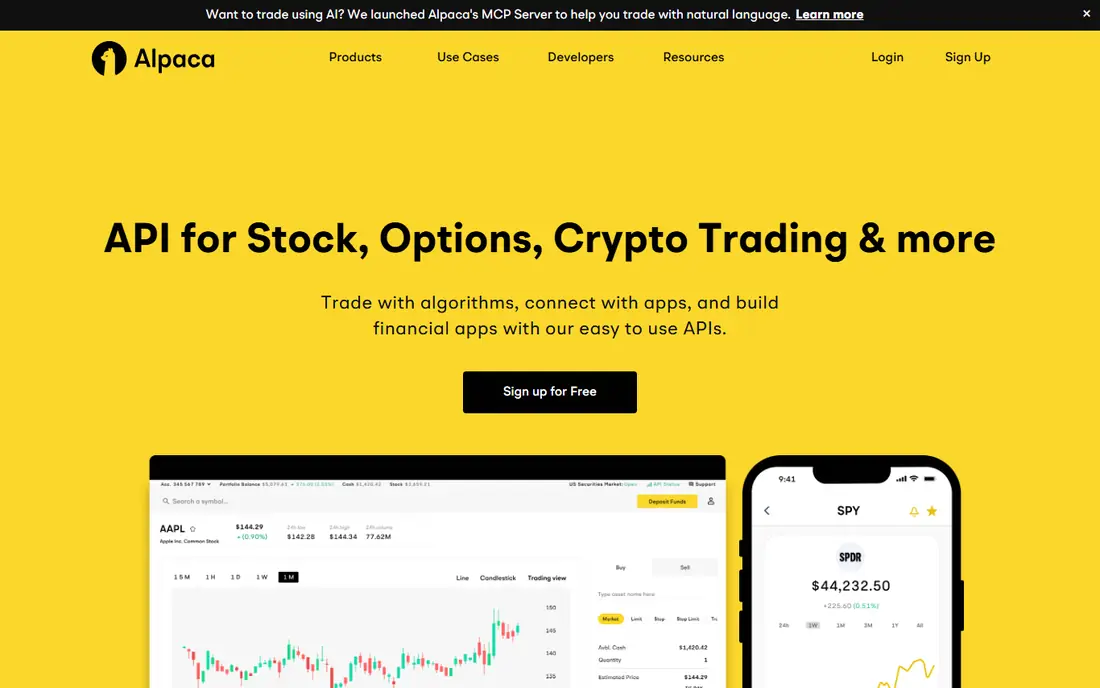
Alpaca is a developer-first API for stock, options and crypto trading, trusted by millions of traders and hundreds of fintechs and institutions. Its homepage highlights a Trading API for self-directed trading and a Broker API for embedding brokerage in your own product, with features including 24/5 trading, multi-leg options, stock lending, high-yield cash and sub-accounting for omnibus structures. SDKs cover Python, .NET, Go and Node, and paper trading lets developers test strategies before deploying.
Alpaca suits startups and fintechs building a trading app from scratch, since one API covers accounts, orders, data and clearing. Its Broker API reduces the work of becoming a broker, while its Trading API suits algo tools and personal trading apps. For apps that connect to users' existing brokerages instead, SnapTrade fits better, but for building a new brokerage product Alpaca leads.
- Developer-first API for stock, options and crypto trading
- Trading API and Broker API
- SDKs in Python, .NET/C#, Go, Node and more
- Backtest with free and advanced market data
- Commission-free stock and options trading through the Trading API
- Margin and short selling with up to 4X intraday and 2X overnight buying power
- Alpaca Clearing is a FINRA and SIPC member
- ISO 27001:2022 certified with SOC 2 Type II controls
- Commission-free trading applies to retail accounts with conditions
- Regulatory fees may apply
- Tokenized assets are not direct equity ownership
Tradier
Ideal for: Active-trader apps
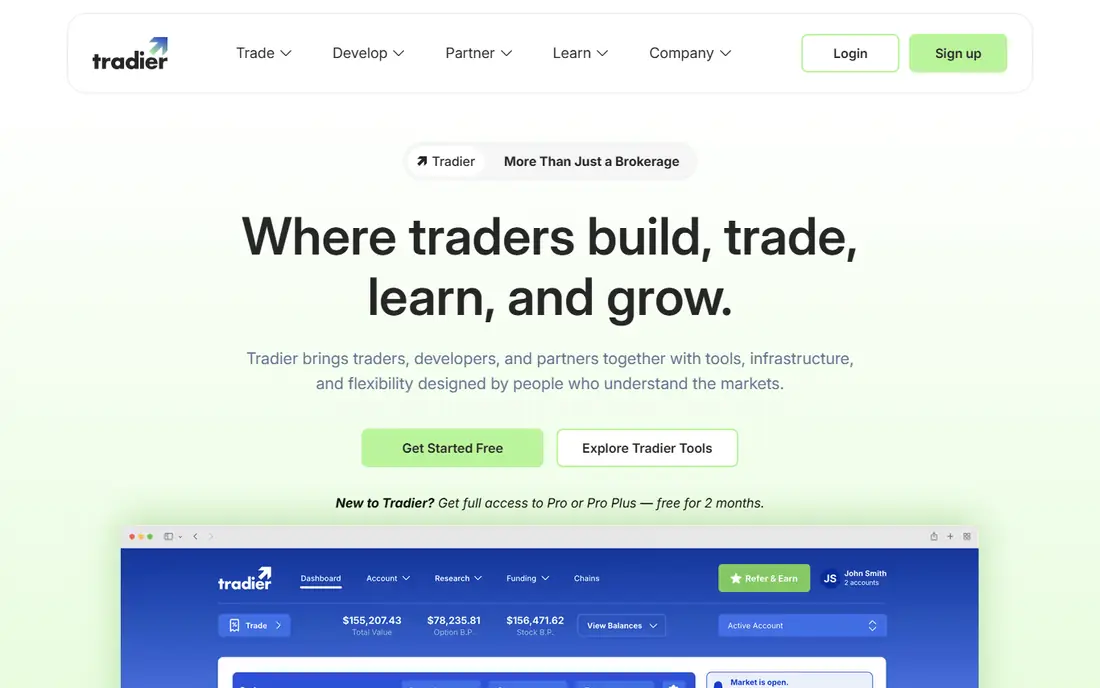
Tradier brings traders, developers and partners together with tools, infrastructure and flexibility designed by people who understand the markets. Its homepage notes more than 100 partner platforms already building with Tradier, more than 1 billion API calls per month, and APIs designed to support innovation from prototype to production. Traders get advanced charting, real-time data, complex order types and portfolio management reflected across all Tradier platforms in real time, while developers get an MCP server for use with Claude Code, Cursor and Gemini CLI.
Tradier suits apps for active traders, where order types, charting and speed matter more than global asset breadth. Its partner ecosystem shows proven integrations, and its transparent pricing helps founders model costs. For global fractional investing, DriveWealth fits better, but for US active-trader apps Tradier is a strong foundation.
- More than 100 connected partner platforms
- More than 1 billion API calls per month
- APIs designed from prototype to production
- Stocks, options, futures, forex and crypto
- $0 trades with low per-contract rates and transparent pricing
- Advanced charting, real-time data and complex order types
- MCP server for AI coding tools including Claude Code, Cursor and Gemini CLI
- 2 months free full access to Pro or Pro Plus for new customers
- Best for US-focused active trading
- Pricing details need a plans page visit
DriveWealth
Ideal for: Global investing
DriveWealth provides an API-based financial services technology platform that allows B2B clients' customers around the world to trade and invest from their phone. Its homepage highlights brokerage-as-a-service covering onboarding, funding, trading, digital statements and tax reporting, with a patented fractional trading solution that lets investors buy in dollar amounts rather than share quantities. Its institutional capability covers order routing, clearing, custody, stock loan, enhanced liquidity and NYSE Floor execution.
DriveWealth suits banks, broker-dealers, asset managers, digital wallets and consumer brands adding investing to an existing product, especially for global audiences. Its fractional investing suits apps targeting smaller investors and dollar-based portfolios. Solo developers may find Alpaca easier to start with, but for enterprise global investing DriveWealth is the established choice.
- Brokerage-as-a-service API platform for global investing
- Pioneered fractional share investing
- US equities, ETFs, mutual funds, fixed income and options
- More than 3,000 ETFs and more than 6,000 global mutual funds
- Instant account opening, funding and money movement with regulatory compliance
- Order routing, clearing, custody, stock loan and NYSE Floor execution
- Clients in the US, Latin America, EMEA and APAC
- Enterprise sales model, so no self-serve free tier
- Best for established companies rather than solo developers
Interactive Brokers
Ideal for: Global multi-asset
Interactive Brokers offers access to more than 175 markets in one platform, with commissions starting at $0, interest up to 3.38% on uninvested cash and margin costs up to 54% lower than typical rates. Its homepage notes more than 5 million clients worldwide, more than 4 million trades daily, client assets over $964 billion and nearly 50 years of innovation. Its platforms cover desktop, tablet and mobile, and its AI integration connects MCP-supporting AI platforms to an IBKR account for portfolio analysis, research and trade instructions.
Interactive Brokers suits trading apps that need global multi-asset coverage, from stocks and options to futures, forex and bonds across many markets. Its scale and capital strength suit serious trading products. For a simpler developer API, Alpaca or Tradier may be faster, but for global breadth Interactive Brokers is unmatched here.
- Access to more than 175 markets in one platform
- Commissions starting at $0
- More than 5 million clients worldwide and more than 4 million trades daily
- Client assets over $964 billion and total equity over $23 billion
- Institutional-grade tools on desktop, tablet and mobile
- AI integration through Model Context Protocol with ChatGPT, Claude, Grok and Perplexity
- Nasdaq-listed and S&P 500 member
- Platform breadth can overwhelm small teams
- API integration needs more setup than developer-first APIs
SnapTrade
Ideal for: Brokerage connections
SnapTrade connects brokerage accounts to your app or personal tools, giving access to investment data and trading where supported. Its homepage highlights one API for brokerage data and trading, with more than 40 brokerages, more than 450 million investor accounts, secure authentication, normalized data, webhooks and SDKs in Python, TypeScript, Ruby and C#. Use cases include portfolio analysis, holdings validation, portfolio sharing and embedded trading from users' existing brokerage accounts, avoiding the cost of becoming a broker.
SnapTrade suits portfolio trackers, dividend tools, tax tools and trading apps that work with users' existing accounts rather than opening new ones. Its normalized data removes the need to integrate each brokerage separately. For apps that open new brokerage accounts, Alpaca or DriveWealth fit better, but for connecting existing accounts SnapTrade is the most direct choice.
- One API for brokerage data and trading
- Connects more than 40 brokerages and 450 million investor accounts
- Secure authentication, normalized data, webhooks and SDKs
- Balances, holdings, orders and transactions in one format
- Trading in stocks, ETFs, crypto and options where supported
- SDKs in Python, TypeScript, Ruby and C#
- Connection success rates above 95%
- Trading depends on each connected brokerage's support
- Not a broker itself, so it cannot replace a brokerage API for new accounts
Massive (Polygon)
Ideal for: Market data
Massive, formerly Polygon, is a stock market API built by developers for developers, with a mission to modernize financial data access. Its homepage at polygon.io highlights flat files through S3, REST and WebSocket APIs and SQL queries, with direct connectivity to major exchanges, no middlemen and institutional-level data for trading apps, robo-advisors and research tools. It notes tick-level data, up to 20 years of history depending on plan, and AI tool integration that lets an agent read its documentation and set up the data layer.
Massive suits trading apps that need fast, reliable market data for charts, alerts, backtesting and research, especially when tick-level detail matters. Its exchange co-location reduces latency and failure points. Pair it with Alpaca, Tradier or Interactive Brokers for execution, since Massive itself provides data rather than order placement.
- Stock market API now branded Massive, at polygon.io
- REST and WebSocket APIs plus flat files and SQL access
- Real-time and historical data direct from major exchanges including NYSE, Nasdaq and Cboe
- Tick-level trades, quotes and aggregate bars with up to 20 years of history depending on plan
- Co-located in exchange datacenters with direct fiber cross-connects
- AI tool support through an llms.txt guide for Claude Code, Cursor, ChatGPT, Codex, Copilot and Gemini CLI
- Data only, so it needs a separate brokerage API for order execution
- Pricing varies by asset class and data depth
Finnhub
Ideal for: Data-rich apps
Finnhub offers real-time REST and WebSocket APIs for stocks, currencies and crypto, with institutional-grade fundamental and alternative data, and a free real-time API to get started. Its homepage highlights 30 years of financial statements and dividends data, analyst estimates with real-time earnings notifications, global ETF and mutual fund data, and alternative data including ESG data from company reports and earnings call transcripts. Enterprise clients get 99.99% uptime with an SLA, and the platform is built by former engineers of Bloomberg, Google and Tradeweb.
Finnhub suits trading apps that need fundamentals, estimates and transcripts alongside prices, such as research tools, screeners and earnings apps. Its free API makes it easy to prototype, while its deep history supports backtesting. For tick-level exchange data, Massive adds depth, but for a broad, free data start Finnhub is excellent.
- Free real-time API for stocks, forex and crypto
- Real-time REST and WebSocket APIs
- 30 years of financial statements and historical market data
- 15 years of earnings call transcripts with downloadable audio
- Analyst estimates with 15 years historical and 5 years future
- Global ETFs, mutual funds and indices
- Technical indicators, support and resistance and pattern recognition
- 99.99% uptime with SLA for enterprise clients
- Data only, so it needs a separate brokerage API for trading
- Real-time coverage varies by market, with 15-minute delayed LSE data
How we picked these
We compared official homepages, API coverage, asset classes, market data depth, compliance and pricing, favoring platforms that actively support building trading apps in 2026. We covered full brokerage APIs, brokerage connections and market data, because a trading app needs all three layers and no single platform fits every use case. We checked each platform's own site before listing it. This article is not financial advice, and trading involves risk, including possible loss.
How to choose a platform to build a trading app
Start with your business model. If you open new brokerage accounts for users, choose a brokerage API such as Alpaca, Tradier or DriveWealth, or Interactive Brokers for global breadth. If users bring existing accounts, choose SnapTrade to connect them without becoming a broker. If you only need data for charts, research or alerts, choose Massive or Finnhub and add execution later.
Next, check assets, markets and compliance. Confirm the platform supports the assets your users want, whether stocks, options, crypto, futures or forex, and the markets they trade in. Review licensing, custody, reporting and tax requirements for your jurisdiction early, since these shape your architecture and timeline more than any single API feature. Ask each provider about sandbox access, documentation quality and support before committing.
Finally, test with paper trading and real data. Use Alpaca's paper trading, Tradier's trial and Finnhub's free API to prototype order flows, data handling and error cases. Measure latency for quotes and order status, test failure modes such as rejected orders and partial fills, and confirm webhook and data reliability under load. A platform that feels fast in a demo but fails under real market conditions will cost users trust.
Frequently asked questions
What is the best platform to build a trading app?
Alpaca suits most developer-first trading apps, with a Trading API and Broker API for stocks, options and crypto. Tradier suits active-trader apps, DriveWealth suits global investing apps, and Interactive Brokers suits global multi-asset apps.
Do I need to become a broker to build a trading app?
No, brokerage APIs such as Alpaca and DriveWealth let you embed brokerage without becoming a broker yourself, while SnapTrade lets you connect users' existing brokerage accounts. You still need to meet regulatory and compliance requirements for your market.
What is the difference between a brokerage API and a market data API?
A brokerage API places orders and manages accounts, while a market data API such as Massive or Finnhub provides prices, quotes and history. Most trading apps need both, pairing a brokerage API with a data API for charts and research.
Can I build a trading app for free?
You can prototype for free with paper trading on Alpaca, a free API key from Finnhub, and trial access from Tradier. Production trading, real-time data and compliance usually involve fees, so budget for those before launch.
Which platform supports fractional trading?
DriveWealth pioneered fractional share investing with dollar-based trading, and Alpaca supports fractional trading through its API. Confirm fractional support for your assets and markets with each provider before building.
How long does it take to build a trading app?
A prototype with paper trading and basic data can take weeks, while a production app with accounts, compliance, funding and reporting takes months. Using a brokerage API shortens the path, but regulatory review and testing remain the longest steps.