Podcast Advertising Platform: 6 Tools Worth Comparing in 2026

- 1
 PodbeanLow-minimum self-serve podcast campaignsVisit
- 2
 TargetspotTargeted digital audio campaigns across publishersVisit
- 3
 AudioGoStraightforward self-serve audio ads for small firmsVisit
- 4
 AcastScale across a global podcast marketplaceVisit
- 5
 Libsyn AdsBuying host-read spots on a curated present listVisit
- This list starts with Podbean, which is built for low-minimum self-serve podcast campaigns.
- Neither Podbean nor Spotify Ad Studio, nor any of the other 4 tools, has a permanent free plan; trials and quotes are the norm.
- The main caution on Acast: pricing is custom and not published.
- Pricing for Targetspot, Acast and Libsyn Ads is quote-based, which adds a sales step before you can compare cost.
Direct answer
Podbean is the first pick on this list for low-minimum self-serve podcast campaigns. Targetspot is better for targeted digital audio campaigns across publishers, and AudioGo is better for simple self-serve audio ads for small firms. Details, prices and limits for the rest of the 6 tools are below.
Quick comparison
| Product | Ideal for | Price from | Free version | |
|---|---|---|---|---|
| Podbean | Low-minimum self-serve podcast campaigns | $200 minimum campaign budget | No | Visit |
| Targetspot | Targeted digital audio campaigns across publishers | See website | No | Visit |
| AudioGo | Straightforward self-serve audio ads for small firms | $250 minimum campaign budget | No | Visit |
| Acast | Scale across a global podcast marketplace | See website | No | Visit |
| Libsyn Ads | Buying host-read spots on a curated present list | See website | No | Visit |
 Spotify Ad Studio | Self-serve ads on Spotify podcasts and music | $250 per campaign minimum | No | Visit |
The best podcast advertising platform
Choosing podcast advertising platform usually comes down to price, fit and limits. This Ainotely guide sets 6 tools side by side on those three points, with the facts kept short and checkable.
Podbean
Ideal for: Low-minimum self-serve podcast campaigns
Podbean was built for low-minimum self-serve podcast campaigns. The marketplace contains more than 12,000 podcasts across hundreds of genres, which is enough breadth to find displays in most niches. Support is scaled for self-serve volumes, so expect email and docs instead of a dedicated rep.
And dynamic insertion on Podbean currently supports audio episodes only. For small firms and first-time podcast advertisers, the $200 floor is the headline feature. You can upload your own audio or have Podbean produce an ad with AI. The starting price for Podbean: $200 minimum campaign budget. Podbean has no free tier.
Downsides: Inventory is restricted to Podbean-hosted presents.
- Access to 12,000+ hosted podcasts across genres
- AI-generated ads and programmatic choices
- Smaller minimums mean less dedicated support
Targetspot
Ideal for: Targeted digital audio campaigns across publishers
In short, Targetspot is for targeted digital audio campaigns across publishers. Targetspot, now part of Azerion, is one of the oldest digital audio advertising products, founded in 2007. In practice, for podcast advertisers, Targetspot makes most sense as part of a broader audio strategy.
Where it is weaker: Podcast coverage is part of a wider audio buy.
Its strength is digital audio as a category instead of podcast inventory specifically: podcast spots, online radio and streaming audio bought together with live reporting and dynamic creative choices like weather-based targeting. In practice, Podcast-specific buyers may also find the inventory skewed toward radio and streaming instead of the host-read podcast spots that drive the highest trust. Targetspot works through sales teams and custom quotes, so there is no self-serve level and no published minimums. This comparison lists no price for Targetspot; ask the vendor. Targetspot does not include a free plan.
- Live reporting and analytics
- Long-running digital audio product with 150+ publisher relationships
- Not the entire story
AudioGo
Ideal for: Straightforward self-serve audio ads for small firms
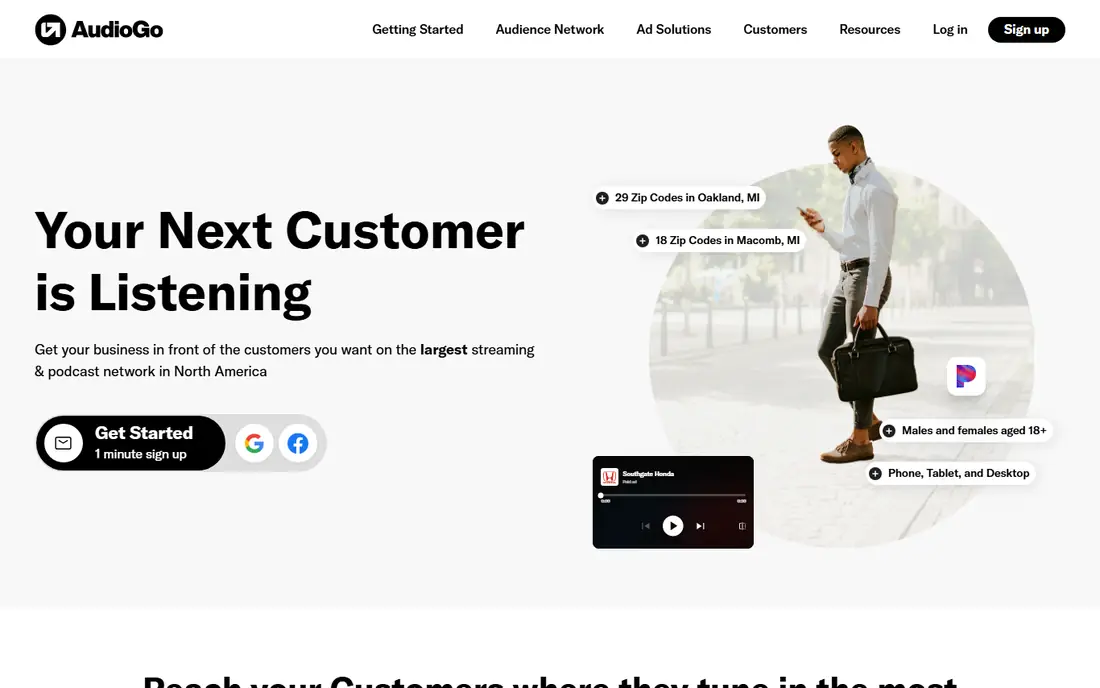
AudioGo serves straightforward self-serve audio ads for small firms. For a $250 minimum budget, any business can build an audio campaign in minutes: set your budget and schedule, upload an ad or pay $10 for a professionally recorded one, choose your audience from more than 1,000 targeting choices, and track performance in a personal dashboard. It fills a gap the big players leave open.
For everyday use, the $10 ad production service is genuinely useful for local companies that have never made an audio ad. The compromise is focus. AudioGo is an audio advertising product, not a podcast specialist, so you are buying across streaming, radio and podcasts together instead of picking individual presents. It also leans on your own targeting skill; a lazy setup will spend money on loosely matched listeners. The starting price for AudioGo: $250 minimum campaign budget. AudioGo has no free tier.
Drawbacks to consider: Broader audio (streaming, radio) instead of podcast-specific.
- Campaigns from $250 with 1,000+ targeting choices
- Runs on SiriusXM and AdsWizz network inventory
- Campaign quality relies on how carefully you target
Acast
Ideal for: Scale across a global podcast marketplace
Acast was built for scale across a global podcast marketplace. Acast is the closest thing podcast advertising has to a one-stop global shop. It runs a marketplace of more than 140,000 presents, sells both host-read partnership and dynamically inserted pre-produced ads, and lets advertisers either work with its sales team or launch campaigns themselves.
Where it falls short: Small budgets get less hand-holding.
In practice, advertisers spending a handful of hundred dollars per month may find the product works fine but the attention from a human account team goes to larger buyers. On top of that, host-read partnership on Acast run roughly $25 to $40 CPM based on its own advertiser guide, and targeted programmatic-style ads cost less, but every campaign is quoted individually. Worth adding: reporting is show-level, which means you can see exactly where your money went. More specifically, if you want a campaign that reaches listeners in numerous countries at once, Acast is typically the first name on the shortlist. Check the vendor site for Acast pricing; none is listed in this comparison. Acast does not include a free plan.
What Acast does well: Self-serve ad platform plus managed service.
- Huge global display network
- Location and interests
- Pricing is custom and not published
Libsyn Ads
Ideal for: Buying host-read spots on a curated present list
Libsyn Ads works best for buying host-read spots on a curated show list. Libsyn Ads runs the advertising marketplace for Libsyn, one of the oldest and largest podcast hosting businesses. Both host-read partnership and dynamic ads are available, with geo targeting down to city, state and DMA.
For everyday use, for advertisers who want everything automated, it will feel slow. Beyond that, Libsyn reports marketplace CPMs historically around $22 to $26. Its most widely used units are host-read ads baked into episodes, which remain the most requested format from advertisers. Each present is effectively its own negotiation, even inside the portal. Libsyn Ads does not show a starting price in this comparison, so check the vendor site for current pricing. Libsyn Ads has no permanent free option.
Where it shines: the most trusted ad format.
- Solid host-read inventory
- AI-transcribed air checks for verification
- Inventory is tied to the Libsyn network only
Spotify Ad Studio
Ideal for: Self-serve ads on Spotify podcasts and music
Spotify Ad Studio is a good fit for self-serve ads on Spotify podcasts and music. It is completely self-serve: pick your audience, set a budget beginning at $250, and Spotify will draft your script, record a voiceover and produce the ad at no additional charge. Your audio or video ad can then run across both music and podcast inventory with automatic placement.
That production offer matters more than it sounds. Also, most local firms never advertise on podcasts since hiring a voice actor and a studio feels like a project. Entry price for Spotify Ad Studio: $250 per campaign minimum. Spotify Ad Studio has no free plan.
Limits to weigh: Podcast ads currently serve US.
- One buy includes both podcasts and music
- $250 minimum per campaign with free voiceover and ad production
- Ads only run on Spotify, nowhere else
What went into this list
Ainotely looked at what each vendor publishes: pricing, plan limits, feature coverage for podcast advertising platform and stated drawbacks. No hands-on testing is claimed. Seat minimums, billing terms and add-ons can move the real cost, so the starting prices here are a guide and not a quote. We ordered the tools by general fit, then by how clearly pricing is shown, then by free access. A buyer with unusual needs may reorder them.
What to check before you buy
- Ask Targetspot, Acast and Libsyn Ads for a written quote, since no starting price is shown.
- Before choosing Podbean, weigh its main limit: inventory is limited to Podbean-hosted displays.
- Ask AudioGo about contract length, onboarding fees and user minimums before you sign.
- Confirm you can export your data from Podbean, so leaving later does not mean losing records.
- Before rolling out Spotify Ad Studio, verify the integrations your workflow depends on.
Frequently asked questions
How are the tools for podcast advertising platform ordered?
Podbean sits first and Spotify Ad Studio last because the order follows typical fit for podcast advertising platform, then price clarity and free access. It is a judgement call, so read each profile for fit and limits.
Do these tools publish their prices?
Not all of them. Targetspot, Acast and Libsyn Ads publish no starting price, so expect a quote request for those. The rest, Podbean included, show a starting price, though seats and billing terms still change the final cost.
How do I measure podcast ad performance?
Spotify's CTA cards add clickable links inside the app. For direct response, pair every campaign with a unique promo code or landing page so you can attribute sales cleanly.
Can small companies advertise on podcasts?
Yes. Spotify Ad Studio, AudioGo and Podbean all accept budgets of $200 to $250, produce the audio ad for you (Spotify free, AudioGo for $10) and deal with targeting in a self-serve dashboard. You no longer need an agency or a five-figure budget to test podcast ads.
What is a decent CPM for podcast ads?
Your actual CPM relies on audience quality, ad position and targeting. Mid-roll placements cost more than post-rolls since listener attention is higher.
Can I try these tools before paying?
Not by default. None of the tools, from Podbean to Spotify Ad Studio, lists a free plan or a free trial here, so ask each vendor for a demo before committing.