How to Pick Product Roadmap Software: 8 Tools Compared

- 1
 DragonboatOutcome-focused product portfoliosVisit
- 2
 Aha.End-to-end product managementVisit
- 3
 ProdPadLean product teams that hate bloatVisit
- 4
 ProductboardTurning customer feedback into roadmapsVisit
- 5
 CannyRoadmaps driven by user feedbackVisit
- Dragonboat sits first on this list: outcome-focused product portfolios.
- For agile teams bridging planning and roadmaps, Favro is worth a look.
- No starting price is shown for any of the 8 tools, Dragonboat and Favro included, so plan time for sales calls.
- Only Canny offers a free plan among these 8 tools.
Direct answer
Dragonboat comes first here, mainly for outcome-focused product portfolios. Aha. Is the stronger choice for end-to-end product management, while ProdPad suits lean product teams that hate bloat. The remaining 5 options are covered below with prices and limits.
Quick comparison
| Product | Ideal for | Price from | Free version | |
|---|---|---|---|---|
| Dragonboat | Outcome-focused product portfolios | See website | No | Visit |
| Aha. | End-to-end product management | See website | Free trial | Visit |
| ProdPad | Lean product teams that hate bloat | See website | Free trial | Visit |
| Productboard | Turning customer feedback into roadmaps | See website | Free trial | Visit |
| Canny | Roadmaps driven by user feedback | See website | Yes | Visit |
 airfocus | Prioritization-driven roadmapping | See website | Free trial | Visit |
 ProductPlan | Straightforward roadmaps without the ramp-up time | See website | Free trial | Visit |
 Favro | Agile teams bridging planning and roadmaps | See website | Free trial | Visit |
The full product roadmap software list
Ainotely compared 8 tools for product roadmap software. The goal is a practical shortlist: published prices, free plan facts, best-fit use cases and honest limits for every entry.
Dragonboat
Ideal for: Outcome-focused product portfolios
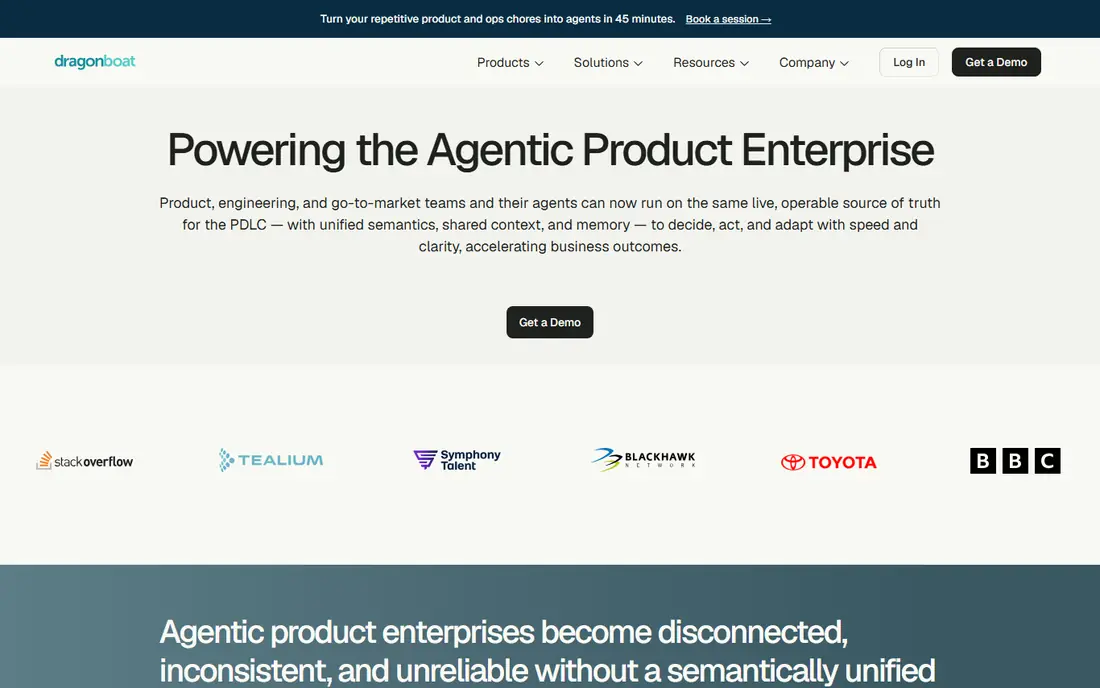
Think of Dragonboat for outcome-focused product portfolios. Dragonboat links roadmaps to outcomes: OKRs, portfolio planning and resource allocation for product organizations managing plenty of teams.
For everyday use, single teams will find it heavy. But product leaders coordinating portfolios around outcomes will value the alignment it enforces. Dragonboat shows no starting price here, so confirm the cost on the vendor site. No free plan comes with Dragonboat.
The main drawbacks: Enterprise positioning.
- OKR-aligned roadmapping
- Portfolio-level planning
- Less suited to single teams
Aha.
Ideal for: End-to-end product management

Aha. Was built for end-to-end product management. Aha. Is the full product management suite: strategy, idea management, roadmaps, releases and reporting in one deeply integrated system. Large product organizations standardize on it since it deals with the whole product lifecycle coherently.
Trade-offs to know: Ramp-up time.
Highlights: Proven at scale.
The depth brings a ramp-up time, and the pricing reflects the enterprise positioning. But teams that outgrow point tools will find Aha.'s completeness worth the investment. Aha. Shows no starting price here, so confirm the cost on the vendor site. On free options: Free trial.
- Strategy, roadmaps
- Deep functionality
- Premium pricing
ProdPad
Ideal for: Lean product teams that hate bloat

Pick ProdPad if this describes you: lean product teams that hate bloat. The philosophy presents in every screen: enough structure to be handy, never so much it slows you down.
Honest limits: Less visual polish than rivals.
Teams wanting beautiful board-ready visuals or enterprise depth should look elsewhere. ProdPad shows no starting price here, so confirm the cost on the vendor site. Free options: Free trial.
- Sensible pricing
- Decent idea management
- Smaller ecosystem
Productboard
Ideal for: Turning customer feedback into roadmaps
Think of Productboard for turning customer feedback into roadmaps. Product-led businesses find this workflow natural.
Watch-outs: Can be more than small teams need.
In daily use, the pricing targets established product organizations, and small teams may find it heavy. Pricing for Productboard is not stated here, so ask the vendor for current figures. As for free access: Free trial.
- A good match for product-led businesses
- Feedback insights feed prioritization straight
- Premium pricing
Canny
Ideal for: Roadmaps driven by user feedback
Canny is a good fit for Roadmaps driven by user feedback. Canny merges user feedback collection, public roadmaps and changelogs in one budget-friendly tool. SaaS businesses present users what is planned, let them vote, and announce releases, closing the feedback loop publicly.
Also, the free level handles the basics. But for SaaS teams wanting transparent, feedback-driven roadmaps, Canny gives the complete loop cheaply. Canny shows no starting price here, so confirm the cost on the vendor site. A free plan is available with Canny.
Points against: Less enterprise depth.
- Changelog included
- Budget-friendly with free level
- Light for complicated portfolios
airfocus
Ideal for: Prioritization-driven roadmapping
For Prioritization-driven roadmapping, airfocus is a natural candidate. airfocus begins from prioritization: score features with RICE, value-vs-effort or custom frameworks, then build roadmaps from the ranked list. Teams whose real problem is deciding what matters, not drawing timelines, find this focus refreshing.
Where it falls short: Smaller vendor.
More specifically, the visualizations are functional rather than beautiful. But disciplined prioritization beats pretty roadmaps that nobody believes, and airfocus enforces the discipline. Pricing for airfocus is not stated here, so ask the vendor for current figures. Trial and free access: Free trial.
- Very good prioritization frameworks
- Modular approach
- Roadmap visualization is functional
ProductPlan
Ideal for: Straightforward roadmaps without the ramp-up time
ProductPlan makes the most sense for straightforward roadmaps without the ramp-up time. ProductPlan does one thing well: visual roadmaps anyone can build in an afternoon.
More specifically, drag bars on a timeline, color by status, share with stakeholders. From a buyer's view, product managers needing feedback, scoring and delivery management will outgrow it. ProductPlan does not show a starting price in this comparison, so check the vendor site for current pricing. Free plan details: Free trial.
The main drawbacks: Restricted product management depth.
- Well suited to stakeholder communication
- Very quick to learn
- Straightforward by design
Favro
Ideal for: Agile teams bridging planning and roadmaps
Favro is designed for agile teams bridging planning and roadmaps. Favro's collections flex from kanban boards to timelines to roadmaps, suiting agile organizations that plan at several levels. Beyond that, product, engineering and leadership views link without separate tools.
In daily use, the modern interface keeps it quick. It is less product-management-specific than Productboard or Aha.: no feedback portals, lighter prioritization. But agile teams that plan collaboratively will find Favro's adaptability natural. Check the vendor site for Favro pricing; none is listed in this comparison. Free plan details: Free trial.
Honest limits: Less product-specific than dedicated tools.
- Adaptable collections from boards to roadmaps
- Quick and modern
- Needs setup thinking
How these tools were picked
The comparison looks at four things: starting price, free access, how well the feature set matches product roadmap software, and the main limit of each tool. Prices and plan limits come from vendor pages and can change, so confirm them on the vendor site before you buy. The order reflects how well each tool fits the most common buying scenario for product roadmap software, then price clarity, then free plan access. It is a starting point, not a verdict.
A buyer's checklist
- Confirm the entry price with every vendor: no tool from Dragonboat to Favro shows a fixed starting price.
- Test the free plan from Canny against your real workload before relying on it.
- Run a trial of Aha., ProdPad, Productboard and others with real work before paying for a year; your own workflow is the best test.
- Before choosing Dragonboat, weigh its main limit: enterprise positioning.
- Test the integrations you rely on with Productboard before committing; some connectors sit on upper tiers.
- Run a one or two week pilot of ProductPlan with the people who will use it every day.
Frequently asked questions
Which options for product roadmap software have a free plan?
Canny is the only tool in this list with a free plan. Free plans usually cap users, projects or features, so check the limits on the vendor page. Several others offer a trial instead.
Do these tools publish their prices?
No. None of the tools, from Dragonboat to Favro, shows a fixed starting price here, so budget time for quotes.
Should roadmaps be public?
SaaS firms increasingly share public roadmaps via tools like Canny to build trust. Internal roadmaps stay private for competitive reasons. Plenty of teams run both.
How are the tools for product roadmap software ordered?
Dragonboat sits first and Favro last because the order follows typical fit for product roadmap software, then price clarity and free access. It is a judgement call, so read each profile for fit and limits.
Is Dragonboat the right pick for everyone comparing product roadmap software?
No single tool suits every team. Dragonboat comes first because it fits outcome-focused product portfolios, while Aha. Suits end-to-end product management and ProdPad suits lean product teams that hate bloat. Match the tool to your own size, budget and workflow before deciding.
What is product roadmap software?
Tools for planning, visualizing and communicating what a product team will build and why: timelines, priorities, dependencies and the rationale, shared with stakeholders.