7 Best Project Management Software for Real Estate Development Options for 2026

- 1
 RedTeamExpanding commercial GCs who want Procore-class features without enterprise pricingVisit
- 2
 Fieldwire by HiltiField teams and subcontractors who require quick plans, tasks and punch listsVisit
- 3
 ProcoreLarge general contractors, developers and owners running complicated commercial projectsVisit
- 4
 CMiCLarge contractors that want ERP financials and project management on one databaseVisit
- 5
 JobTreadSmall to mid-size contractors who want one price and quick setupVisit
- RedTeam takes the first slot, best suited to expanding commercial GCs who want Procore-class features without enterprise pricing.
- What to know about Procore first: volume-based pricing puts it out of reach for small contractors.
- No starting price is shown for any of the 7 tools, RedTeam and Autodesk Forma included, so plan time for sales calls.
- Fieldwire by Hilti stands alone as the one tool in this list with a free plan.
Direct answer
This list puts RedTeam first for expanding commercial GCs who want Procore-class features without enterprise pricing. If your case is different, Fieldwire by Hilti suits field teams and subcontractors who require quick plans, tasks and punch lists and Procore suits large general contractors, developers and owners running complicated commercial projects.
Quick comparison
| Product | Ideal for | Price from | Free version | |
|---|---|---|---|---|
| RedTeam | Expanding commercial GCs who want Procore-class features without enterprise pricing | See website (volume-based, predictable) | No | Visit |
| Fieldwire by Hilti | Field teams and subcontractors who require quick plans, tasks and punch lists | See website (per-user pricing) | Yes | Visit |
| Procore | Large general contractors, developers and owners running complicated commercial projects | See website (volume-based pricing) | No | Visit |
| CMiC | Large contractors that want ERP financials and project management on one database | See website (custom quote) | No | Visit |
| JobTread | Small to mid-size contractors who want one price and quick setup | See website (one simple price, all features included) | No | Visit |
 Buildertrend | Home builders, remodelers and specialty contractors who require sales through closeout | See website (custom quote) | No | Visit |
 Autodesk Forma | Teams already invested in Autodesk design tools and BIM workflows | See website (custom quote) | No | Visit |
Every option for project management software for real estate development explained
If you are comparing project management software for real estate development, this page covers 7 tools in one place: what each is best for, what it costs to start, whether it has a free plan, and the main limit to know about.
RedTeam
Ideal for: Expanding commercial GCs who want Procore-class features without enterprise pricing
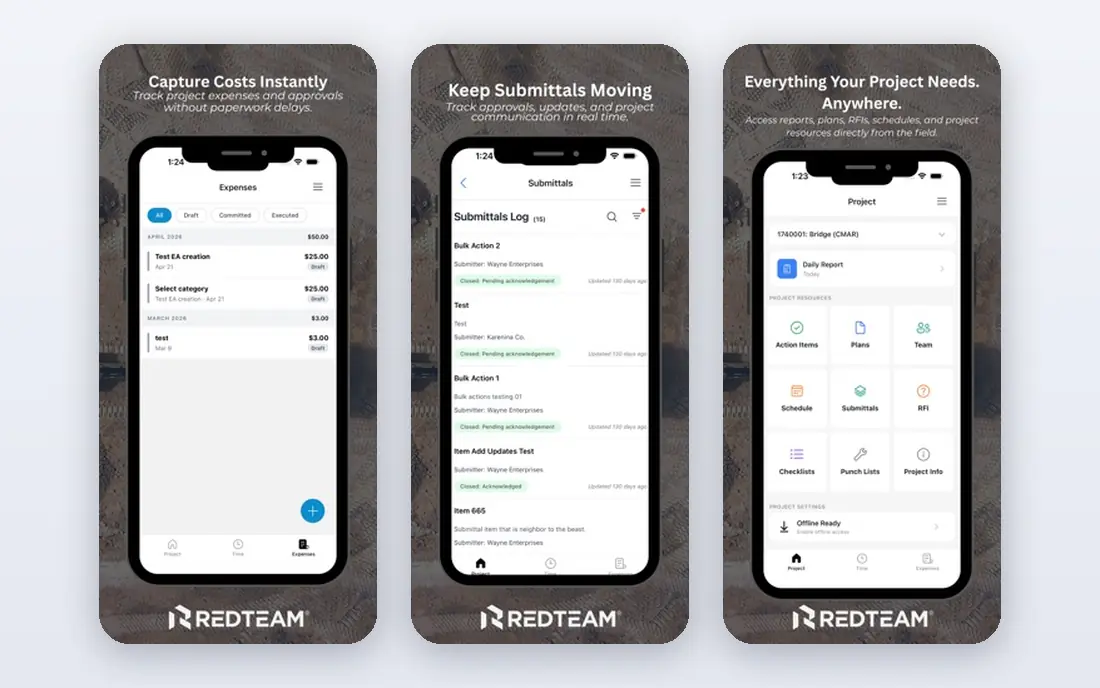
Where RedTeam fits: expanding commercial GCs who want Procore-class features without enterprise pricing. RedTeam is the mid-market commercial GC's alternative to Procore, and it says so openly.
From a buyer's view, the tradeoff is ecosystem: fewer integrations, fewer pre-built connectors and less market gravity than the giants. For everyday use, the product has two flavors, RedTeam Flex for full commercial management and RedTeam Go for smaller contractors, which lets businesses grow within the family. Pricing for RedTeam is not stated here, so ask the vendor for current figures. RedTeam has no permanent free option.
Best features of RedTeam: Pricing tied to project volume with a price-lock approach that avoids renewal surprises.
Where it is weaker: The brand is less known, which can matter when owners mandate a product.
- Change order control and field-to-finance integration
- Live job costing
- Smaller ecosystem and fewer external integrations than Procore
Fieldwire by Hilti
Ideal for: Field teams and subcontractors who require quick plans, tasks and punch lists
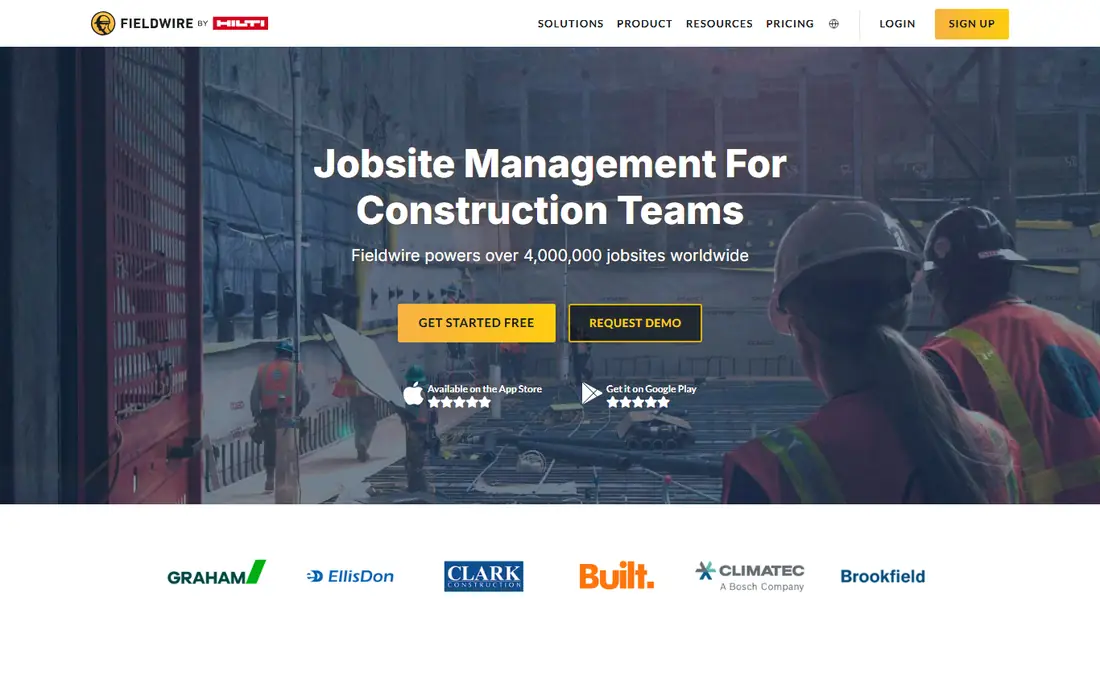
Fieldwire by Hilti is a good fit for field teams and subcontractors who require quick plans, tasks and punch lists. The limitation is scope.
Trade-offs to know: Not a full financial or estimating product, so it complements instead of replaces Procore-class tools.
Check the vendor site for Fieldwire by Hilti pricing; none is listed in this comparison. Fieldwire by Hilti offers a free plan.
- Field-first mobile experience that foremen actually adopt, with offline access
- Transparent per-user pricing with unlimited sheets and projects on premium plans
- Advanced features like RFIs and budgeting sit on higher levels
Procore
Ideal for: Large general contractors, developers and owners running complicated commercial projects

Procore is designed for large general contractors, developers and owners running complicated commercial projects. Its pricing model is unusual in a decent way for developers: you pay based on annual construction volume, not per user, which removes the usual resistance to inviting every stakeholder onto the product.
Worth adding: the honest caveat is scale. In practice, Procore is made for businesses with real project volume and dedicated project management staff. Procore does not show a starting price in this comparison, so check the vendor site for current pricing. No free plan comes with Procore.
Where it is weaker: The breadth needs real implementation effort and training to get value.
- Scheduling and analytics in one system
- The broadest construction system with project management, financials, BIM
- Volume-based pricing puts it out of reach for small contractors
CMiC
Ideal for: Large contractors that want ERP financials and project management on one database
Pick CMiC if this describes you: large contractors that want ERP financials and project management on one database. CMiC is the ERP-first choice, and that framing decides the sale.
On top of that, CMiC deployments are ERP projects with ERP timelines and consulting bills, and the product is overkill for anyone below the mid-market. No starting price is listed for CMiC here; confirm pricing on the vendor site. CMiC has no permanent free option.
Points against: ERP implementations are long and pricey, with consulting costs dwarfing the license.
- Project controls
- Project management
- The interface and UX reflect its ERP heritage instead of modern SaaS design
JobTread
Ideal for: Small to mid-size contractors who want one price and quick setup
JobTread is built with small to mid-size contractors who want one price and quick setup in mind. The product covers sales and estimating through project management to job finances, with a 30-day money-back guarantee on monthly subscriptions that lowers the risk of trying it.
The one frustration is that the "straightforward price" is not published on the website, so the simplicity stops at the pricing page. For a developer self-performing work or a GC running residential and light commercial jobs, JobTread hits the sweet spot between spreadsheet chaos and enterprise software. Check the vendor site for JobTread pricing; none is listed in this comparison. JobTread has no permanent free option.
Strengths: unlimited jobs. The main drawbacks: No published price on the site, so you still have to talk to sales.
- Job costing and change order tools
- One flat price with all features
- Less depth for large commercial programs than Procore or CMiC
Buildertrend
Ideal for: Home builders, remodelers and specialty contractors who require sales through closeout
Where Buildertrend fits: home builders, remodelers and specialty contractors who require sales through closeout. Buildertrend owns the residential side of this market. The acquisition of CoConstruct in 2021 consolidated the residential segment, and Buildertrend has since expanded into commercial work too, but its DNA is residential.
The main drawbacks: Pricing is quote-only and the full feature set can take months to adopt fully.
Pricing is quote-based and the 12-week onboarding program tells you this is a serious commitment, not a signup-and-go app. From a buyer's view, if your development work is residential, start here. Where Procore thinks for GCs and owners, Buildertrend thinks for the builder who also has to sell the job: CRM and lead tracking, estimates that link straight to job costing, selections management, change orders, client portals with live visibility and online payments. This comparison lists no price for Buildertrend; ask the vendor. Buildertrend has no free tier.
- Guided onboarding program with dedicated managers
- Financials and client portals
- Residential-first, so commercial developers get less fit
Autodesk Forma
Ideal for: Teams already invested in Autodesk design tools and BIM workflows
Autodesk Forma is designed for teams already invested in Autodesk design tools and BIM workflows. Autodesk Forma is the new name for Autodesk Construction Cloud, and buyers should use the current name going forward. The product merges Autodesk Build (project and field management), Takeoff (2D and 3D estimating), BIM Collaborate and Docs into one connected environment.
Also, the fit is design-led projects and teams with BIM maturity. On top of that, contractors who never touch a model will not get the headline benefits. The platform's enterprise DNA presents in both pricing and implementation. But for developers running complicated projects where design coordination drives cost, the BIM-native approach genuinely differentiates it from Procore. More specifically, the strategic advantage is obvious: if your architects and engineers already live in Revit and AutoCAD, the design-to-construction data flow is shorter here than anywhere else. This comparison lists no price for Autodesk Forma; ask the vendor. No free plan comes with Autodesk Forma.
Where it falls short: The rename from Autodesk Construction Cloud to Autodesk Forma is still rippling through documentation and partner content.
Strengths: docs and cost management that share one data environment.
- 400-plus integrations including ERPs and analytics tools
- Deep BIM and design-data integration no competitor can match
- Enterprise pricing and complexity for smaller teams
How these tools were picked
Ainotely used vendor pricing pages and product documentation as the base, then compared plans, free access and documented limits for 7 tools. Figures are shown as the vendors publish them. Billing terms, seat minimums and add-ons can change the real cost. We ordered the tools by general fit, then by how clearly pricing is shown, then by free access. A buyer with unusual needs may reorder them.
Things to verify first
- Ask each vendor, from RedTeam to Autodesk Forma, for a written quote; none of them publishes a starting price.
- Look at the free plan from Fieldwire by Hilti closely: its caps decide whether it is usable for real work.
- Read the limits listed for RedTeam first: smaller ecosystem and fewer external integrations than Procore.
- Ask Buildertrend how an export works before you move any records in; an easy exit lowers the risk.
- Pick one real project and run it in Fieldwire by Hilti first; a small pilot shows fit faster than a checklist.
Frequently asked questions
Do these tools publish their prices?
No. None of the tools, from RedTeam to Autodesk Forma, shows a fixed starting price here, so budget time for quotes.
Is RedTeam the right pick for everyone comparing project management software for real estate development?
No single tool suits every team. RedTeam comes first because it fits growing commercial GCs who want Procore-class features without enterprise pricing, while Fieldwire by Hilti suits field teams and subcontractors who need fast plans, tasks and punch lists and Procore suits large general contractors, developers and owners running complex commercial projects. Match the tool to your own size, budget and workflow before deciding.
How are the tools for project management software for real estate development ordered?
RedTeam sits first and Autodesk Forma last because the order follows typical fit for project management software for real estate development, then price clarity and free access. It is a judgement call, so read each profile for fit and limits.
Can I try these tools before paying?
Often, yes. Fieldwire by Hilti has a free plan. Use your own data and a real task during the test, and check what the free tier or trial limits before you rely on it.