8 Best QMS Software for Medical Devices in 2026

- 1
 MasterControlLarge medical device makers that need enterprise quality depthVisit
- 2
 Greenlight GuruMedical device companies from startup to scale-upVisit
- 3
 QualioLife sciences teams that want a fast, usable QMSVisit
- 4
 ETQ RelianceLarge regulated manufacturers with complex quality programsVisit
- 5
 Arena QMSDevice makers that want PLM and QMS connectedVisit
- Medical device QMS tools must support design controls, document control, training, CAPA, and audit readiness as one connected system.
- Startups often suit Qualio or Greenlight Guru, while larger manufacturers may need MasterControl, ETQ, or ComplianceQuest depth.
- Validation matters: confirm what the vendor validates, what you must validate, and how updates are handled before signing.
- A QMS that staff avoid using will fail an audit regardless of features, so usability and training workflows deserve real weight.
- Pricing is quote-based across this list, so budget for implementation and validation as well as licenses.
Quick comparison
| Product | Ideal for | Price from | Free version | |
|---|---|---|---|---|
| MasterControl | Large medical device makers that need enterprise quality depth | See website | No | Visit |
| Greenlight Guru | Medical device companies from startup to scale-up | See website | No | Visit |
| Qualio | Life sciences teams that want a fast, usable QMS | See website | No | Visit |
| ETQ Reliance | Large regulated manufacturers with complex quality programs | See website | No | Visit |
| Arena QMS | Device makers that want PLM and QMS connected | See website | No | Visit |
 Veeva Vault QMS | Life sciences companies already using Veeva Vault | See website | No | Visit |
 ComplianceQuest | Manufacturers that want AI-powered quality on Salesforce | See website | No | Visit |
 Intellect QMS | Midsize device and life sciences firms that want configurability | See website | No | Visit |
The best QMS software for medical devices
MasterControl
Ideal for: Large medical device makers that need enterprise quality depth
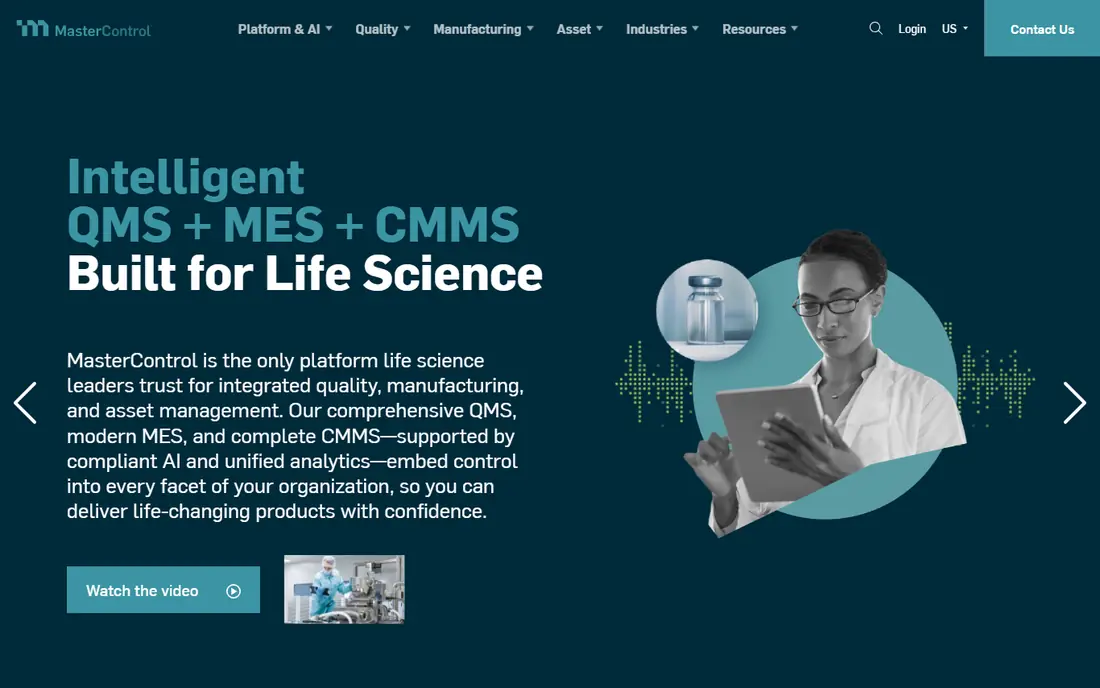
MasterControl is one of the most established quality management platforms for life sciences, covering document control, training management, CAPA, audits, change control, and supplier management in a validated cloud environment. Its strength is depth and track record: large device makers use it to run quality processes that must survive FDA inspections and ISO 13485 audits, with electronic signatures, audit trails, and version control built in. Training management ties document revisions to required retraining, so a changed procedure automatically reaches the people who must learn it. The trade-off is implementation: enterprise QMS rollouts take planning, configuration, and validation, and pricing is quote-based. For larger manufacturers that need proven depth, MasterControl remains a default shortlist entry.
- Deep document control, training, CAPA, and audit tools, long life sciences track record
- Enterprise implementation effort, pricing requires a quote
Greenlight Guru
Ideal for: Medical device companies from startup to scale-up
Greenlight Guru is a quality management system built specifically for the medical device industry, rather than a generic QMS adapted to it. Its design controls connect user needs, design inputs and outputs, verification and validation, and risk management in one traceable structure, which is exactly what auditors look for. Document control, training, CAPA, nonconformances, and supplier management sit alongside, with workflows shaped around device regulations including FDA quality system rules and ISO 13485. The company also publishes practical guidance for device teams, which helps smaller companies that lack a large quality department. Pricing is quote-based. For device startups and growing companies that want a QMS that already speaks their regulatory language, Greenlight Guru is one of the best fits available.
- Purpose-built for medical devices, design controls and risk built in, practical guidance
- Medical device focus may not suit other industries, pricing requires a quote
Qualio
Ideal for: Life sciences teams that want a fast, usable QMS
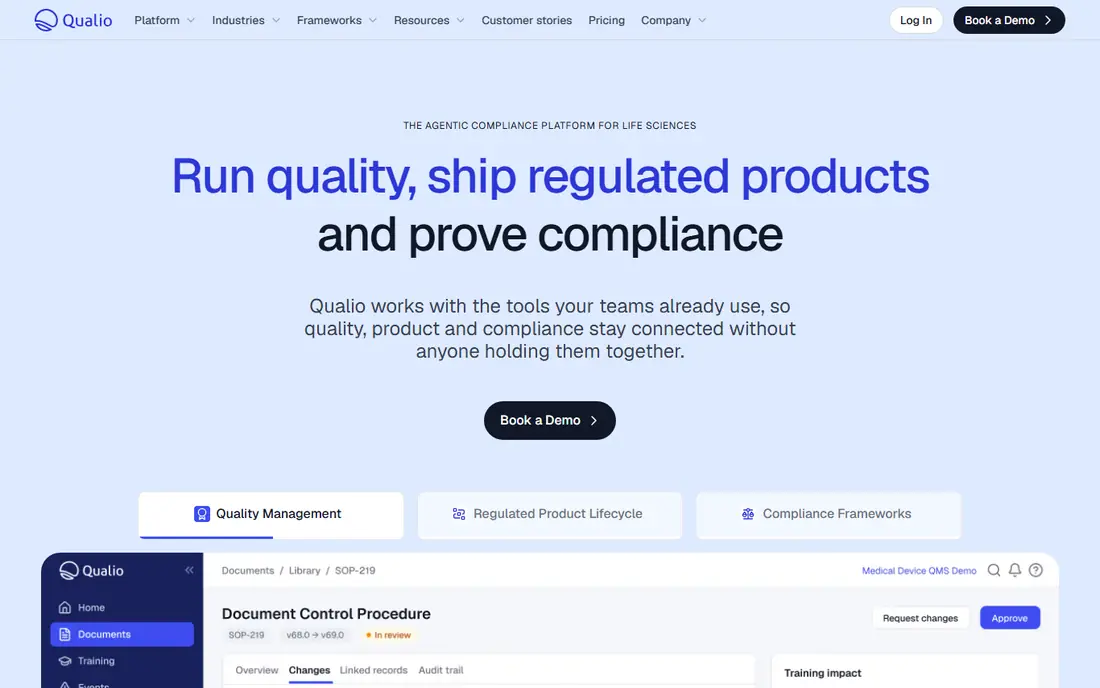
Qualio is a cloud-based quality management system for life sciences with document control, training, CAPA, audit management, change control, supplier management, risk management, and design controls, plus AI-powered regulatory monitoring across many frameworks. Its reputation rests on speed and usability: customers report going live in weeks rather than months, and reaching ISO 13485 certification with a small quality team. That matters, because a QMS that takes a year to implement delays the very product it is meant to support. Qualio suits startups and midsize device and biotech companies that need audit readiness without enterprise complexity. Larger manufacturers with very complex multi-site needs may still prefer MasterControl or ETQ. For teams that value a fast start and an interface staff will actually use, Qualio is a strong choice.
- Quick implementation, clear interface, document control, training, CAPA, design controls
- Less enterprise depth than MasterControl or ETQ, pricing requires a quote
ETQ Reliance
Ideal for: Large regulated manufacturers with complex quality programs
ETQ Reliance is a quality management platform used by large manufacturers in life sciences and other regulated industries, covering document control, CAPA, audits, nonconformances, complaints, risk, training, and supplier quality. Its breadth suits organizations running quality across many sites, products, and business units, with configurable workflows that adapt to each site's needs while keeping central oversight. ETQ's analytics help quality leaders spot trends in complaints and nonconformances before they become systemic problems. The scope means implementation planning matters: configuration, migration, and validation should be scoped with the vendor. Pricing is quote-based. For large device makers with complex, multi-site quality programs, ETQ Reliance offers the depth to match.
- Broad quality application suite, strong CAPA and audit tools, configurability
- Enterprise scope needs implementation planning, pricing requires a quote
Arena QMS
Ideal for: Device makers that want PLM and QMS connected
Arena combines product lifecycle management and quality management in a cloud system, which suits device makers whose quality problems start in engineering change. When a design change, a bill of materials update, and a quality record live in one system, traceability improves and the gap between engineering and quality narrows. Arena's QMS covers document control, training, CAPA, nonconformances, and audits, with change management and supplier collaboration built in. Customers cite fast migration and high adoption, and the platform integrates with CAD and ERP systems. Device companies that only need a QMS, without PLM, may find the extra scope unnecessary. For teams where design and quality must stay in step, Arena's combined approach is a genuine advantage.
- Product record plus quality in one system, change management, BOM control
- PLM heritage means quality-only buyers may find extra scope, pricing requires a quote
Veeva Vault QMS
Ideal for: Life sciences companies already using Veeva Vault
Veeva Vault QMS is part of the Veeva Vault platform used widely across life sciences for content, regulatory, clinical, and quality processes. Its QMS covers quality events, CAPA, audits, change control, and document management, with the advantage that quality records sit alongside regulatory and product content in the same Vault. That unification helps large life sciences companies that already run Vault for other functions, because data, permissions, and audit trails stay consistent. Veeva's scale suits global organizations with many sites and products. Companies outside the Veeva ecosystem can still adopt Vault QMS, but they gain less from the platform effect. Pricing is enterprise and quote-based. For life sciences organizations standardized on Veeva, Vault QMS is the natural quality choice.
- Unified Vault platform, strong content and quality integration, global scale
- Best value inside the Veeva ecosystem, enterprise pricing
ComplianceQuest
Ideal for: Manufacturers that want AI-powered quality on Salesforce
ComplianceQuest unifies quality, product lifecycle, safety, and supplier management in an AI-powered platform built on Salesforce, covering document and learning management, complaints, CAPA, risk, audits, and batch records. Its AI features help automate routine quality tasks and surface insights across processes, and its selection by the US Food and Drug Administration to modernize its enterprise quality environment is a notable endorsement. Because it runs on Salesforce, organizations already using Salesforce gain integration and administration advantages, while others take on a platform dependency. Pricing is enterprise and quote-based. For manufacturers that want a broad, AI-assisted quality platform and are comfortable with Salesforce, ComplianceQuest is a strong option.
- Quality, product, safety, and supplier processes in one platform, AI features, Salesforce base
- Salesforce dependency, enterprise pricing
Intellect QMS
Ideal for: Midsize device and life sciences firms that want configurability
Intellect QMS is a configurable quality management platform for life sciences and manufacturing, covering document control, training, CAPA, nonconformances, audits, change control, and supplier management with no-code workflow configuration. That configurability appeals to midsize firms whose quality processes do not fit a rigid template: workflows can be shaped to the company's actual procedures without custom code. Intellect supports FDA and ISO-aligned quality processes, with validation support for regulated deployments. Its public profile is smaller than MasterControl or ETQ, so buyers should check references in their specific device category. Pricing is quote-based. For midsize device companies that want a QMS they can shape themselves without enterprise cost, Intellect is worth evaluating.
- Configurable no-code workflows, document control, CAPA, training, audits
- Smaller profile than the largest vendors, pricing requires a quote
How we picked these
We looked for QMS tools with genuine medical device and life sciences fit: design controls, document control with training, CAPA, risk, and audit support, not generic workflow tools with a quality label. We balanced enterprise platforms with startup-friendly options and one PLM-plus-QMS system, because device companies range from two-person startups to global manufacturers. We compared official feature pages, documentation, and public reviews, and we left out tools without clear medical device or life sciences positioning. Where a vendor did not publish a current price, we wrote "See website" rather than repeat a third-party figure.
Validation and audit readiness checklist
Before buying, ask each vendor what is validated out of the box and what validation work falls to you, because that answer shapes your timeline and budget. Confirm electronic signature and audit trail behavior, data retention and export, and how software updates are validated and communicated. Test the audit scenario: can you produce a complete design history file, a training record for one employee, and a closed CAPA with linked evidence in minutes, without help from the vendor? Check how document changes trigger retraining, and how supplier records link to incoming quality issues. Finally, involve your quality and regulatory lead in the trial, not just IT, because the people who will face the auditor should judge whether the system tells the product's quality story clearly.
Frequently asked questions
What is QMS software for medical devices?
It is software that manages the quality system a device maker needs for regulations: design controls, document control, training, risk management, CAPA, complaints, audits, and supplier control, with traceability across all of them.
What regulations do medical device QMS tools support?
Commonly FDA quality system regulation, ISO 13485, and EU medical device regulation, among others. The tool supports compliance work, but the company remains responsible for meeting the regulations.
What are design controls in a QMS?
Design controls are the structured process linking user needs to design inputs, outputs, verification, validation, and risk management, with a design history file showing each step. Device QMS tools keep that chain traceable.
How long does QMS implementation take?
Small teams using a startup-friendly QMS can go live in weeks, while enterprise rollouts with migration and validation can take months. Scope validation work explicitly in the project plan.
Can a QMS help with an FDA inspection?
Yes, by keeping records organized, traceable, and retrievable, which is what inspectors ask for. No software guarantees an inspection outcome, and procedures and staff training matter as much as the tool.
Do I need a QMS before building a medical device?
Quality processes should start early, especially design controls and risk management, because retrofitting them late is costly. Many startups adopt a light QMS early and expand it as they approach regulatory submission.