Best Qualitative Analysis Software (2026): 6 Options Compared

- Quirkos is the opening pick, best for beginners and students.
- Only Taguette offers a free plan among these 6 tools.
- The main caution on Quirkos: less depth for complicated projects.
- For collaborative cloud analysis, Dedoose is worth a look.
Direct answer
Start with Quirkos if you need beginners and students. Alternatives: Taguette for free open source QDA, and Dovetail for UX research teams. The other 3 tools in the list cover narrower or pricier cases.
Quick comparison
| Product | Ideal for | Price from | Free version | |
|---|---|---|---|---|
 Quirkos | Beginners and students | See website | No | Visit |
 Taguette | Free open source QDA | Free (open source) | Yes | Visit |
 Dovetail | UX research teams | See website | No | Visit |
 NVivo | Thorough academic research | See website | No | Visit |
 QDA Miner | Text mining plus coding | See website | No | Visit |
 Dedoose | Collaborative cloud analysis | See website | No | Visit |
The full qualitative analysis software list
This Ainotely guide covers 6 options for qualitative analysis software. Each profile lists a starting price, free plan details, strengths and drawbacks, so you can drop poor fits quickly.
Quirkos
Ideal for: Beginners and students

Quirkos targets beginners and students. Quirkos is the friendly face of qualitative analysis. Worth adding: pricing is low-cost, with student-friendly terms.
Downsides: Smaller ecosystem.
But as a teaching tool and a first QDA purchase, Quirkos's approachability is unmatched. From a buyer's view, the visual, bubble-based interface makes coding easy-to-learn for students and newcomers who find NVivo intimidating. It handles the essentials (coding, queries, visualizations, reports) without the overwhelming choices. Quirkos shows no starting price here, so confirm the cost on the vendor site. There is no free plan with Quirkos.
- Very easy to learn
- Budget-friendly
- Less depth for complicated projects
Taguette
Ideal for: Free open source QDA
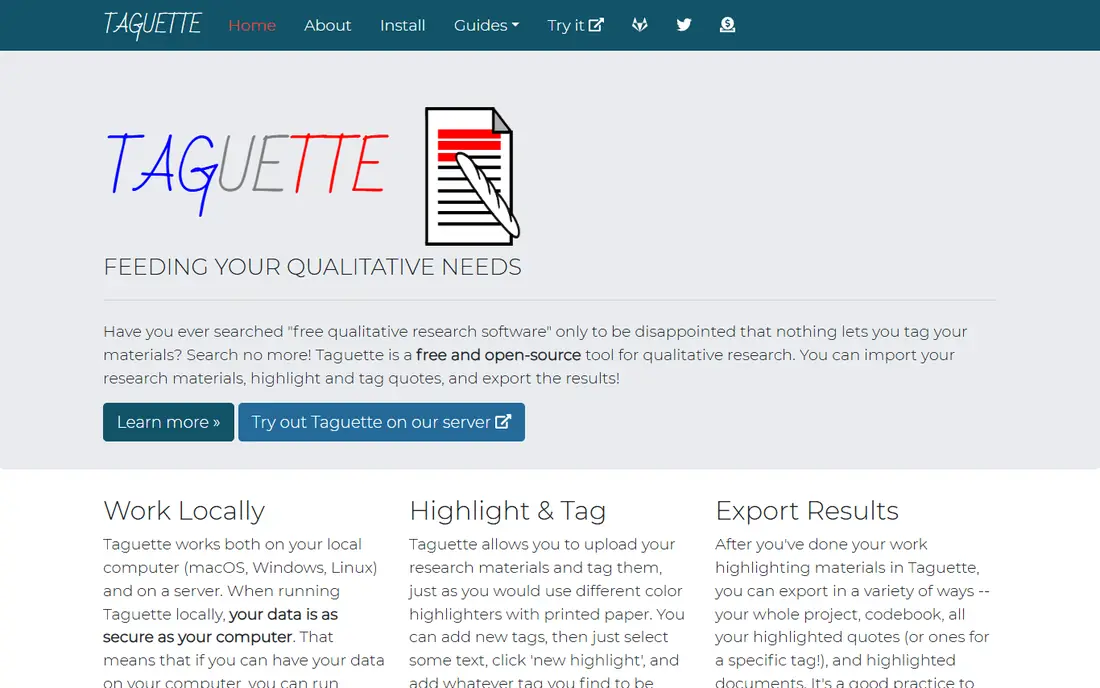
Taguette is aimed squarely at free open source QDA. Researchers with no budget, students, and teams in low-resource settings get real QDA capability for zero cost.
The main drawbacks: Entry-level features.
It does not match the analytical depth, visualizations, or AI features of commercial tools. As for the details, every researcher should know Taguette exists before assuming QDA software must be pricey. Taguette pricing: Free. Taguette has a free plan.
- Includes coding basics well
- Open source
- Self-hosting for full control
Dovetail
Ideal for: UX research teams

For UX research teams, Dovetail is a natural candidate. Dovetail brings consumer-grade design to research repositories. Worth adding: pricing targets business teams, not students or solo academics.
But for product and UX teams turning user research into organizational knowledge, Dovetail is purpose-built in a way the academic tools are not. UX teams store interviews, code insights, and build searchable knowledge bases that the entire product organization can use. This comparison lists no price for Dovetail; ask the vendor. There is no free plan with Dovetail.
Limits to weigh: Priced for business teams.
- Beautiful modern interface
- Excellent repository features
- Less for academic research
NVivo
Ideal for: Thorough academic research
Choose NVivo for full academic research. NVivo, now part of Lumivero, remains the most fully-featured qualitative data analysis software available. It codes interviews, surveys, audio, video, images, and social media data, with queries that find patterns across all of it.
Honest limits: Interface can overwhelm.
Universities teach it, which means a large community, plenty of tutorials, and graduates who already know it. The price and complexity are the barriers. But for dissertations, funded research projects, and institutional work where analytical depth matters, NVivo is still the benchmark. NVivo shows no starting price here, so confirm the cost on the vendor site. No free plan comes with NVivo.
- Manages all data types
- Deepest feature set
- Pricey
QDA Miner
Ideal for: Text mining plus coding
QDA Miner works best for text mining plus coding. Alongside standard coding, it provides clustering, concept mapping, and statistical analysis of text, which fits researchers working with large document collections. Integration with WordStat (statistical text analysis) and SimStat extends the analytical range further.
Points against: Interface is dated.
But for researchers who require both human coding and computational text analysis in one workflow, QDA Miner occupies a unique position. It is the power tool for text-heavy projects. Check the vendor site for QDA Miner pricing; none is listed in this comparison. QDA Miner has no permanent free option.
- Merges coding with text mining
- Powerful for large text datasets
- Ramp-up time
Dedoose
Ideal for: Collaborative cloud analysis
Dedoose was built for collaborative cloud analysis. But for team-based projects, particularly in evaluation and applied research, Dedoose's collaboration-first design beats retrofitting desktop software for teamwork.
Limits to weigh: Fewer advanced features than desktop giants.
No starting price is listed for Dedoose here; confirm pricing on the vendor site. Dedoose does not include a free plan.
- A good match for teams
- Budget-friendly monthly pricing
- Needs internet
How these tools were picked
Ainotely looked at what each vendor publishes: pricing, plan limits, feature coverage for qualitative analysis software and stated drawbacks. No hands-on testing is claimed. Where a price is missing, the vendor does not list one publicly or ties it to a quote. Always confirm before budgeting. The order reflects how well each tool fits the most common buying scenario for qualitative analysis software, then price clarity, then free plan access. It is a starting point, not a verdict.
What to check before you buy
- Ask Quirkos, Dovetail, NVivo and others for a written quote, since no starting price is shown.
- Look at the free plan from Taguette closely: its caps decide whether it is usable for real work.
- Read the limits listed for Quirkos first: less depth for complex projects.
- Look at the help docs and support options for Taguette before you commit.
- Before rolling out Dedoose, verify the integrations your workflow depends on.
Frequently asked questions
Do these tools publish their prices?
Not all of them. Quirkos, Dovetail, NVivo and others publish no starting price, so expect a quote request for those. The rest, Taguette included, show a starting price, though seats and billing terms still change the final cost.
Can I try these options before paying?
Often, yes. Taguette has a free plan. Use your own data and a real task during the test, and check what the free tier or trial limits before you rely on it.
What is the best qualitative analysis software for students?
The first pick on this list is Quirkos, because it suits beginners and students. Taguette is better for free open source QDA, and Dovetail for UX research teams. Check price and limits against your own needs before choosing.
Is there free qualitative analysis software?
Yes: Taguette is free and open source, including the coding fundamentals well. Some commercial tools offer free trials or restricted free levels. As for the details, for plenty of student and small projects, Taguette is genuinely sufficient. The premium tools earn their price on large, complicated, or collaborative projects.
Is Quirkos the right pick for everyone comparing qualitative analysis software?
No single tool suits every team. Quirkos comes first because it fits beginners and students, while Taguette suits free open source QDA and Dovetail suits UX research teams. Match the tool to your own size, budget and workflow before deciding.
Which options for qualitative analysis software have a free plan?
Taguette is the only tool in this list with a free plan. Free plans usually cap users, projects or features, so check the limits on the vendor page.