Best Rated SEO Platform for B2B in 2026: 7 Platforms Compared

- Semrush and Ahrefs are the strongest all-in-one suites, with keyword, backlink and audit data in one place.
- BrightEdge and Conductor suit enterprises that need forecasting, share of voice and executive reporting.
- Screaming Frog is the best technical crawler for site audits, with a useful free tier.
- Surfer SEO helps content teams optimize pages for target keywords without guesswork.
Quick comparison
| Product | Ideal for | Price from | Free version | |
|---|---|---|---|---|
 Semrush | All-in-one B2B SEO suite | See website | Free trial | Visit |
 Ahrefs | Backlink and keyword data depth | See website | Free trial | Visit |
 Moz Pro | Accessible SEO suite for teams | See website | Free trial | Visit |
 BrightEdge | Enterprise SEO with forecasting | See website | No | Visit |
 Conductor | Enterprise SEO and content insight | See website | No | Visit |
 Screaming Frog SEO Spider | Technical site crawling | Free | Yes | Visit |
 Surfer SEO | Content optimization for target keywords | See website | Free trial | Visit |
The best rated SEO platforms for B2B
B2B SEO differs from consumer SEO: fewer, higher-value keywords, longer sales cycles, and content that must convince committees, not just individuals. The platforms below handle keyword research, technical audits, rank tracking and content optimization for that world, with reporting that ties rankings to pipeline rather than just traffic. We compared them on B2B-relevant features, data quality and price.
Semrush
Ideal for: All-in-one B2B SEO suite

Semrush is the most complete all-in-one SEO suite for B2B teams, covering keyword research, site audits, backlink analysis, rank tracking and content optimization. Its database is large, its reports are flexible, and its content tools help writers target keywords with data rather than instinct. Most B2B teams can run their whole SEO program from it.
Pricing rises with projects, tracked keywords and users, so larger teams need a higher tier. Its interface is also deep, with many tools to learn. For teams that want one platform for most SEO work, Semrush is the safest all-rounder.
For readers focused on all-in-one B2B SEO suite, Semrush is worth a trial before deciding, since the free tier or trial shows its real feel fast. Check the current plan details on the vendor site, since prices and limits change, and confirm that the version you need works on your devices.
- Keyword, backlink and audit data
- Rank tracking
- Content tools
- Pricing rises with projects
- Interface is deep
Ahrefs
Ideal for: Backlink and keyword data depth
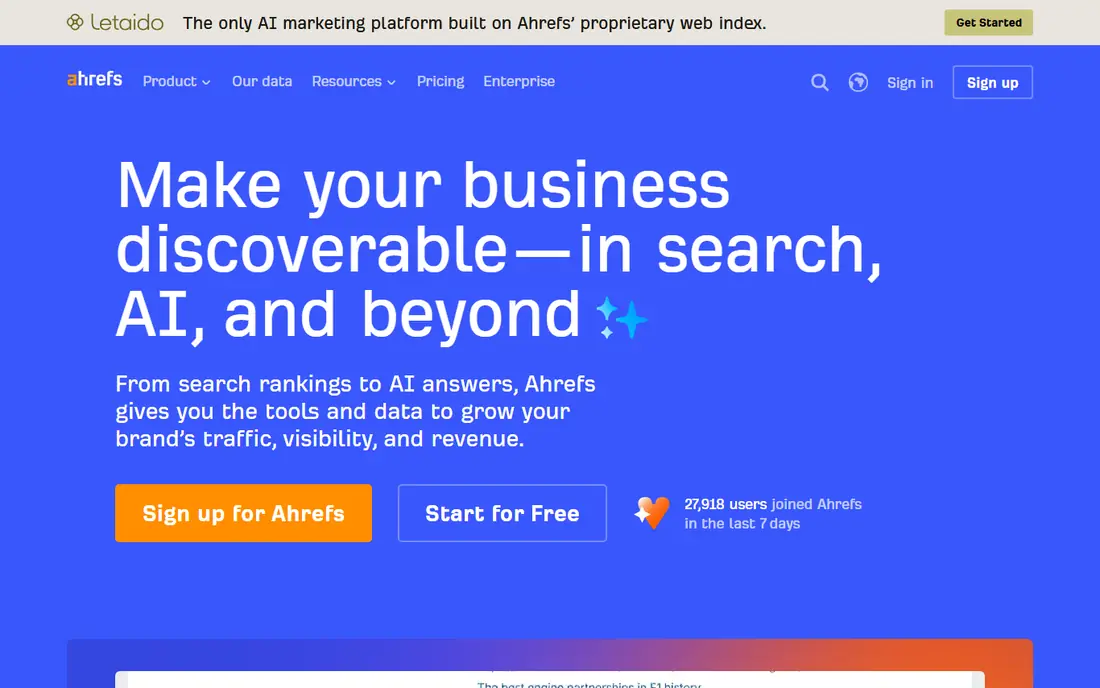
Ahrefs is known for the depth of its backlink index and keyword data, which B2B teams use for competitor research and link building. Its Site Audit finds technical issues, its Rank Tracker follows target keywords, and its Content Explorer surfaces topics that earn links. Data quality is its main strength.
There is no permanent free plan, only trials and limited free tools, and pricing scales with user tiers. Its content optimization tools are lighter than Surfer. For research-driven B2B SEO, Ahrefs data is hard to beat.
We would shortlist Ahrefs for backlink and keyword data depth, and compare it directly with the two options nearest it in price before paying. Check the current plan details on the vendor site, since prices and limits change, and confirm that the version you need works on your devices.
- Strong backlink index
- Keyword explorer
- Site audit and rank tracking
- No permanent free plan
- Pricing is per user tiers
Moz Pro
Ideal for: Accessible SEO suite for teams

Moz Pro is an accessible SEO suite with keyword research, rank tracking, site crawls and its well-known domain authority metric. Its interface is friendly for teams new to SEO, and its learning resources help beginners understand the work. Smaller B2B teams often find it easier to adopt than deeper suites.
Its data depth trails Semrush and Ahrefs, especially on backlinks, and some features feel older. Larger enterprises may outgrow it. For teams that want a clear, learnable SEO suite, Moz Pro is a solid choice.
If accessible SEO suite for teams is your main need, Moz Pro deserves a place on a shortlist, provided you test the catch described above first. Check the current plan details on the vendor site, since prices and limits change, and confirm that the version you need works on your devices.
- Keyword research and rank tracking
- Site crawl
- Domain authority metric
- Data depth trails Semrush and Ahrefs
- Some features feel older
BrightEdge
Ideal for: Enterprise SEO with forecasting
BrightEdge is an enterprise SEO platform with share-of-voice tracking, forecasting and executive reporting that suits large B2B organizations. Its data helps leaders see how search visibility translates to pipeline, and its AI search tracking covers new answer-engine surfaces. Large teams use it for governance across many sites.
Pricing is enterprise level, and setup needs onboarding and training. Smaller teams will find it more than they need. For enterprises that need forecasting and board-level reporting, BrightEdge is a leading platform.
Our view is that BrightEdge earns its place here for enterprise SEO with forecasting, even with the limits noted above. Check the current plan details on the vendor site, since prices and limits change, and confirm that the version you need works on your devices.
- Share of voice and forecasting
- Enterprise reporting
- AI search tracking
- Enterprise pricing
- Setup needs onboarding
Conductor
Ideal for: Enterprise SEO and content insight
Conductor combines search data with content insight, helping enterprise teams see which pages and topics drive results and what to create next. Its workflow tools coordinate large content teams, and its reporting suits leadership reviews. B2B organizations with big content programs benefit most.
Pricing is enterprise level, and it fits larger content teams better than small ones. Smaller teams may prefer an all-in-one suite. For enterprises managing content at scale, Conductor adds insight that raw rank data misses.
For readers focused on enterprise SEO and content insight, Conductor is worth a trial before deciding, since the free tier or trial shows its real feel fast. Check the current plan details on the vendor site, since prices and limits change, and confirm that the version you need works on your devices.
- Content and search insight
- Workflow tools
- Enterprise reporting
- Enterprise pricing
- Best for larger content teams
Screaming Frog SEO Spider
Ideal for: Technical site crawling
Screaming Frog SEO Spider is the standard technical crawler for site audits. It crawls a site and reports broken links, duplicate content, missing metadata, redirect chains and other issues that hurt rankings. Its free tier covers up to 500 URLs, and the paid license adds scheduling and integrations.
The free tier limit means larger sites need the paid license, and its interface is technical rather than friendly. It also covers crawling, not keyword research or rank tracking. For technical B2B audits, it is an essential tool.
We would shortlist Screaming Frog SEO Spider for technical site crawling, and compare it directly with the two options nearest it in price before paying. Check the current plan details on the vendor site, since prices and limits change, and confirm that the version you need works on your devices.
- Deep technical crawls
- Finds broken links and duplicate content
- Integrations
- Free tier limited to 500 URLs
- Interface is technical
Surfer SEO
Ideal for: Content optimization for target keywords
Surfer SEO helps content teams optimize pages for target keywords, with a content editor that scores drafts against top-ranking pages on structure, terms and length. Its SERP analysis shows what competitors cover, and its audit tool finds pages to improve. B2B writers use it to brief and edit with data.
The subscription costs money, and it works best beside a keyword research tool such as Semrush or Ahrefs. It also cannot fix weak strategy with optimization alone. For content-led B2B SEO, Surfer makes optimization concrete.
If content optimization for target keywords is your main need, Surfer SEO deserves a place on a shortlist, provided you test the catch described above first. Check the current plan details on the vendor site, since prices and limits change, and confirm that the version you need works on your devices.
- Content editor with data-backed guidance
- SERP analysis
- Audit tools
- Subscription cost
- Needs a keyword tool beside it for research
How we picked these
We compared official feature pages, pricing pages, app store listings, privacy policies and public reviews for each option below. We checked that each product is still available and that its stated plans match what the vendor publishes. We did not run hands-on tests, so our picks rest on documented features, pricing and the fit for the reader described in each section, not on lab results. Where a price could not be confirmed on the vendor site at the time of writing, we wrote See website rather than guessing. We also looked at how each option handles the everyday details that decide whether a tool gets used: setup time, device support, what happens when you cancel or downgrade, and whether help is available when something breaks. A product that looks strong on a feature list but is hard to set up, hard to leave, or poorly supported will cost more in time than it saves, so we weighed those practical points alongside price and features. Where reviewers or users reported a recurring problem, we noted it in the honest catch for that product, rather than leaving it out because the vendor page did not mention it.
How to choose an SEO platform for B2B
Start with your sales motion. If deals come from a small set of high-intent keywords, prioritize rank tracking and content tools for those terms over a huge keyword database. Check technical audit depth, since B2B sites often have complex structures, gated content and many pages. Look at reporting: can you show rankings, traffic and conversions by segment to leadership, or only raw traffic? Finally, trial the tool on your own site for two weeks, because database freshness and interface speed vary more than feature lists suggest.
A final check before you commit
Run a short trial on a real task before you pay for a year or move a whole team. Use the free plan or trial to complete one full job, from setup to export or delivery, and note where you got stuck. Check the cancellation path too: can you leave and keep your data, or does leaving mean starting over? Read the pricing page for renewal rates, not just the first-year offer, and confirm what support you get on the plan you will actually buy. Finally, ask one current user about the worst part of the product, since that answer tells you more than any feature list. If the trial feels good on a real task and the exit path is clear, the choice is much safer.
Frequently asked questions
What is the best SEO platform for B2B?
Semrush and Ahrefs are the best all-in-one platforms for most B2B teams, covering keywords, backlinks, audits and rank tracking. BrightEdge and Conductor suit enterprises needing forecasting and executive reporting.
How is B2B SEO different from B2C SEO?
B2B SEO targets fewer, higher-value keywords, longer buying cycles and multiple decision makers. Content must address research, comparison and procurement stages, and success is measured by pipeline and revenue, not just traffic.
What does an SEO platform do?
An SEO platform researches keywords, audits technical issues, tracks rankings, analyzes backlinks and competitors, and helps optimize content. All-in-one suites combine these, while specialist tools focus on one area such as crawling or content.
Is Screaming Frog free?
Screaming Frog offers a free tier that crawls up to 500 URLs, which suits small sites. The paid license removes the limit and adds features such as scheduling, integrations and larger crawls.
How much does Semrush cost?
Semrush pricing varies by plan and is published on its site, with higher tiers adding more projects, keywords and users. B2B teams should compare the plan limits against their site count and tracking needs before buying.