Best Real Estate Management Software Brands

- 1
 AppFolioLarge management companiesVisit
- 2
 BuildiumSmall to mid-size managersVisit
- 3
 Yardi BreezeLow-cost per-unit accountingVisit
- 4
 Rent ManagerMixed portfolios of every typeVisit
- 5
 TenantCloudSelf-managing landlordsVisit
- AppFolio and Yardi Breeze lead on per-unit pricing for larger portfolios, while Buildium and TenantCloud give small operators flat monthly bills that are easier to predict.
- Monthly minimums decide the real cost: Yardi Breeze charges at least $100 a month, DoorLoop $199, and Propertyware $250.
- Only Hemlane offers a free plan, while Buildium and TenantCloud offer 14-day trials and the rest sell through demos and quotes.
- Rent Manager no longer publishes rates, so buyers must request a quote and budget for an implementation fee equal to twice the monthly subscription.
- The cheapest headline rate is rarely the cheapest bill, so run the math at your exact unit count before you choose.
Quick comparison
| Product | Ideal for | Price from | Free version | |
|---|---|---|---|---|
| AppFolio | Large management companies | $1.49 per unit/month (Core, 50-unit minimum) | No | Visit |
| Buildium | Small to mid-size managers | $65 per month (Essential) | Free trial (14 days) | Visit |
| Yardi Breeze | Low-cost per-unit accounting | $1 per unit/month (Breeze residential, $100 monthly minimum) | No | Visit |
| Rent Manager | Mixed portfolios of every type | quote only | No | Visit |
| TenantCloud | Self-managing landlords | $15 per month (Starter, billed annually) | Free trial (14 days) | Visit |
 DoorLoop | Growing landlords who want AI help | $2.50 per unit/month (One, billed annually, $199 monthly minimum) | No | Visit |
 Hemlane | Landlords who want repair help | $2 per unit/month plus $28 platform fee (Basic) | Yes | Visit |
 Propertyware | Single-family portfolios at scale | $1 per unit/month (Basic, $250 monthly minimum) | No | Visit |
Best Real Estate Management Software Brands
AppFolio
Ideal for: Large management companies
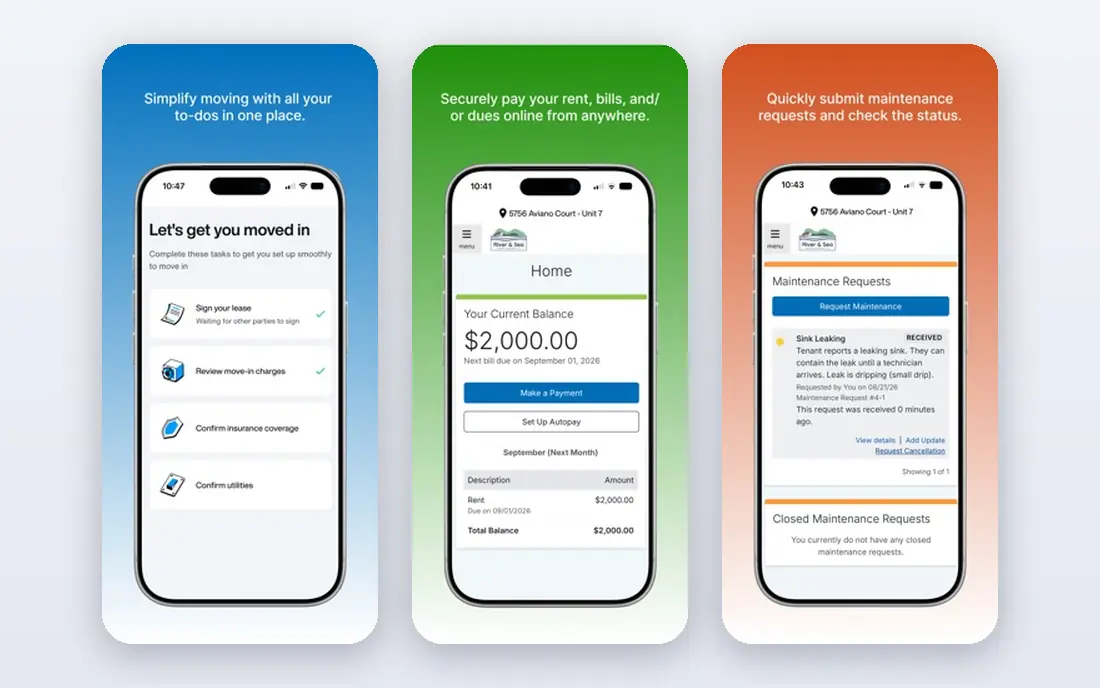
AppFolio lists three plans: Core from $1.49 per unit per month, Plus from $3.20, and Max from $5.00. Core covers accounting, leasing, maintenance, online payments, and owner and tenant portals. Plus adds affordable and student housing tools, advanced budgeting, custom fields, and read-only API access. Max adds a leasing CRM, broader accounting automation, read and write API access, and a dedicated customer success manager. Every plan includes the Realm-X AI assistant and messaging tools.
The catch is the floor under the headline rate. Core needs at least 50 units, and every plan carries a minimum spend that AppFolio does not publish in dollars. Third-party reports put the Core floor near $280 to $298 a month, which means a 50-unit portfolio pays close to $5.96 per unit in practice, not $1.49. AppFolio fits management companies with a few hundred units or more. Smaller operators should get a written quote first and compare the monthly floor with Buildium or Yardi Breeze.
- Full accounting, leasing, maintenance and portals in one system
- AI assistant included on every plan
- 50-unit minimum and an unpublished minimum spend make it costly for small portfolios
Buildium
Ideal for: Small to mid-size managers
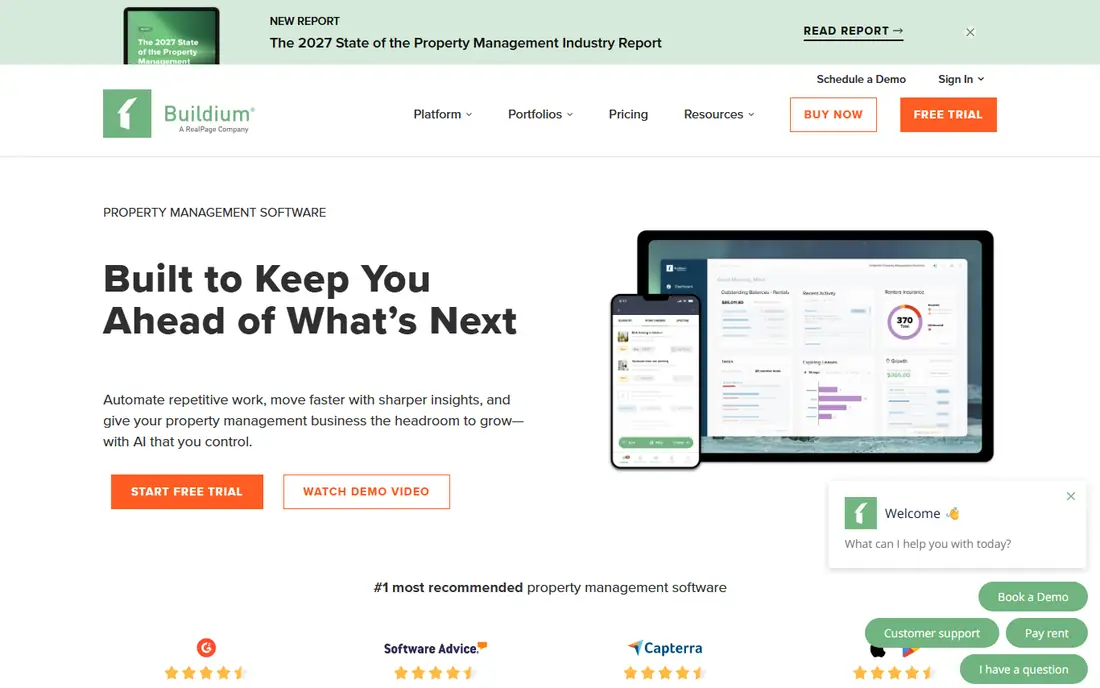
Buildium sells three plans: Essential from $65 a month, Growth from $202 a month, and Premium from $420 a month, according to the pricing FAQ on its own site. Essential covers rent collection, accounting, tenant screening, maintenance, leasing, and resident portals. Growth adds eSignatures, reduced payment fees, bank reconciliation, and analytics. Premium adds the open API, priority support, and unlimited incoming ACH payments. A 14-day free trial comes loaded with sample data, and no card is needed to start it.
Buildium suits independent landlords and management firms that want one predictable monthly bill. Essential is only sold up to 40 units, so a growing portfolio must move to Growth at $202 a month. Payment fees also add up: incoming ACH costs $2.35 per transaction on Essential, $1.35 on Growth, and is free for 12 months on Premium. At 100 rent payments a month, Essential adds $235 in transaction fees, which can exceed the subscription itself.
- Flat monthly pricing that is easy to budget
- 14-day free trial with no card required
- Essential stops at 40 units, and lower plans charge per-transaction payment fees
Yardi Breeze
Ideal for: Low-cost per-unit accounting
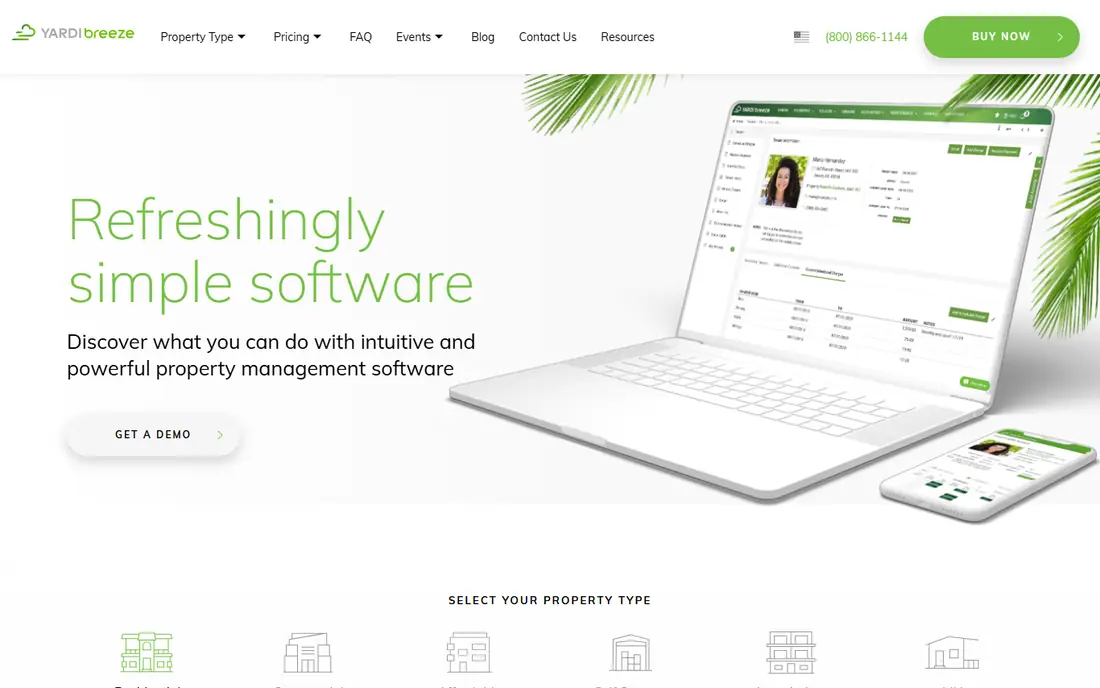
Yardi Breeze is the small-portfolio product from Yardi, a company that has sold property software since 1984. Residential Breeze starts at $1 per unit per month with a $100 monthly minimum on an annual agreement. Commercial Breeze starts at $2 per unit, and affordable housing starts at $3 per unit on Breeze Premier. The platform covers property accounting, owner reporting, maintenance, online applications, online payments, vacancy tracking, and portals for tenants and owners. Yardi charges no separate onboarding, training, or support fees.
The $100 minimum is the real price for anyone under 100 units. A 20-unit landlord pays $100 a month, which works out to $5 per unit, not $1. Breeze Premier carries a $400 monthly minimum and adds utility billing, automated income verification, and expanded reporting. There is no free trial, only a demo, and some Premier tiers are quote only. Breeze fits operators with 100 or more residential units who want Yardi accounting depth without the complexity of the enterprise Voyager platform.
- Lowest published per-unit rate on this list
- No onboarding, training, or support fees
- $100 monthly minimum means small portfolios pay far above $1 per unit
- No free trial
Rent Manager
Ideal for: Mixed portfolios of every type
Rent Manager, from London Computer Systems, is an all-in-one platform that covers accounting, reporting, marketing and leasing, maintenance, and business operations in one database. It handles cash and accrual accounting at the same time, offers more than 450 reports, and includes mobile tools through the rmAppSuite Pro app for field staff. The platform fits mixed portfolios, including manufactured housing, RV parks, commercial property, and single-family rentals side by side. An open API connects it with other property technology, and a tenant call center service is available as an add-on.
Pricing is the weak point. Rent Manager no longer publishes rates on its site, so every buyer needs a direct quote for current pricing, minimums, and onboarding charges. Third-party reports from before the change put Basic near $1.00 per unit per month with a $200 monthly minimum, Plus near $1.50 with a $300 minimum, and Premium near $2.25 to $2.50 with a $450 minimum, plus an implementation fee equal to twice the monthly subscription. Treat those figures as background only. Ask for the full quote in writing, including add-on fees for the call center, website work, and integrations, before you judge the cost.
- Covers single-family, multifamily, commercial, manufactured housing, and RV parks
- More than 450 built-in reports
- No published prices, so buyers must request a quote
- Implementation fee reported at twice the monthly subscription
TenantCloud
Ideal for: Self-managing landlords
TenantCloud is a cloud platform built for landlords who manage their own rentals. Starter costs $15 a month billed annually, or $180 a year, and covers online rent collection, maintenance, listings, applications, screening, and eSignatures. Growth costs $29.17 a month billed annually and adds a lease builder, move-in and move-out inspections, a message board, and expanded reporting. Pro costs $50 a month billed annually and adds tax reports, bank reconciliation, and a separate owner portal. Business starts at $100 a month with custom pricing. Every plan includes a 14-day free trial, and tenant screening reports are charged to the applicant.
Two facts need attention. First, the pricing page shows more than one monthly figure for Starter, $18 in one block and $25 in another, so confirm the rate at checkout and use the $15 annual figure as the baseline. Second, TurboTenant acquired TenantCloud in August 2026, and TurboTenant says landlords keep the same plan and price while accounts move to its platform. That migration is a real open question for long-term buyers. TenantCloud still fits self-managing landlords with a modest lease count who want accounting tied to rent collection at a low flat price.
- Lowest flat monthly starting price on this list
- Unlimited properties and units on every plan
- Active leases are capped at 10 on Starter, 30 on Growth, and 60 on Pro
DoorLoop
Ideal for: Growing landlords who want AI help
DoorLoop rebuilt its pricing in 2026 around three plans that each include the complete platform. DoorLoop One starts at $2.50 per unit per month billed annually, dropping to $1.50 per unit above 100 units, with a $199 monthly minimum. Connect starts at $4.00 per unit with a $299 minimum and adds a Receptionist Agent that answers tenant calls, texts, and portal messages around the clock, plus free incoming ACH payments. Multiply starts at $5.00 per unit with a $399 minimum, is invite only, and adds Maintenance Ops and Lease Renewal agents. Every plan includes accounting, leasing, maintenance, payments, portals, a company website, unlimited users, unlimited storage, and full API access.
The minimum is the number that matters most. On yearly billing, One stays at $199 a month until about 80 units, so a 10-unit landlord pays $19.90 per unit in practice. Incoming ACH costs $1.50 per payment on One and is free on Connect and Multiply, while tenant screening reports cost $35. DoorLoop fits portfolios of roughly 80 units and up that want deep accounting plus AI agents for routine tenant work. Smaller landlords should compare the $199 floor with Buildium Essential or TenantCloud Starter before signing.
- Full platform, API, and unlimited users on every plan
- AI agents answer tenants and run maintenance and renewals
- $199 monthly minimum makes it costly below about 80 units
- No free plan
Hemlane
Ideal for: Landlords who want repair help
Hemlane pairs software with people. The Starter plan is free and covers listings on major rental sites, tenant screening, rental accounting with bank sync, and cash flow reporting. Basic costs $2 per unit per month plus a $28 monthly platform fee, about $30 a month for one unit, and adds lease tracking, eSignatures, rent collection, and tenant messaging. Essential costs $20 per unit plus the $28 fee and adds end-to-end repair coordination with 24/7 emergency support and state-specific leases. Complete costs $58 per unit plus the fee and adds a property management assistant, a vetted repair network, and local leasing and turnover help. ACH transactions carry no fee, while card transactions cost 3 percent.
The per-unit math on the higher tiers deserves a close look. At 10 units, Basic costs about $48 a month, Essential about $228, and Complete about $608, all before tax. Tenant placement is a separate add-on from $695. Accounting is lighter than on Buildium or AppFolio, with no Xero integration and no one-click Schedule E export reported in comparisons. Hemlane fits landlords who want a free starting point and are willing to pay per unit for repair coordination and human help as the portfolio grows.
- Free Starter plan
- 24/7 repair coordination and a vetted repair network on higher plans
- $0 ACH fees
- $28 platform fee on every plan, and Essential and Complete costs climb fast per unit
Propertyware
Ideal for: Single-family portfolios at scale
Propertyware, a RealPage company, is built for single-family rental management at scale. Basic starts at $1.00 per unit per month with a $250 monthly minimum, Plus at $1.50 with a $350 minimum, and Premium at $2.00 with a $450 minimum, according to pricing pages and comparisons that cite its published rates. Each plan adds a one-time implementation fee equal to twice the monthly subscription. Billable units move in steps of 50. The platform covers marketing websites, lead tracking, listing syndication, applications, screening, eSignatures, payments, portals, text messaging, inspections, work orders, and bank reconciliation. Its open API, custom fields, and multi-location management suit operators running scattered-site homes across several markets.
The minimums set the real entry cost. At $1 a unit, the $250 Basic minimum is the bill for 250 units, so a smaller landlord pays the minimum and gains nothing from the low per-unit rate. Commercial lease structures are not its strength, since the product is shaped around single-family residential work. Screening and payment transaction fees also apply on top of the subscription. Propertyware fits mid-market firms with 250 or more single-family homes that want deep customization and portfolio-level reporting.
- Open API with two-way data exchange
- Custom fields and unlimited custom reports for single-family portfolios
- $250 monthly minimum plus an implementation fee equal to twice the monthly subscription
How we chose
We compared the vendor pricing pages, feature pages, and plan documents for eight brands, and read each homepage on 12 November 2026. We recorded the lowest published starting price for each brand, the monthly minimum behind it, the free plan or trial terms, and the plan limits that change the real cost. We did not test any product hands-on, and we did not use ratings, awards, or customer counts in the ranking. Where a vendor hides its price, we say quote only instead of repeating an old figure as current. Prices change, so confirm the current rate on the vendor pricing page before you sign.
What to check before you buy
Work out your true monthly bill at your exact unit count, not the headline rate. Multiply the per-unit price by your units, then compare that total with the monthly minimum and take the higher number. Add transaction fees for rent collection, screening, and eSignatures, and ask about implementation or onboarding fees in writing. Check whether the plan you need includes the API, the owner portal, and the reports you use every month. Ask how long migration takes, what data you can export if you leave, and whether screening and payment coverage work in your state.
| Portfolio size | Best starting point | Why it fits | Watch the cost | | 1 to 10 units | TenantCloud Starter, Hemlane Starter | Lowest entry cost, free option on Hemlane | TenantCloud caps Starter at 10 leases | | 11 to 40 units | Buildium Essential, TenantCloud Growth | Flat monthly bills, full leasing and accounting | Buildium Essential stops at 40 units | | 41 to 100 units | Buildium Growth, Yardi Breeze | Real accounting depth at a fair monthly total | Yardi Breeze $100 minimum; Buildium Growth from $202 | | 101 to 250 units | Yardi Breeze, Propertyware Basic, AppFolio Core | Per-unit rates finally beat the minimums | Propertyware $250 minimum; AppFolio 50-unit minimum | | 250 units and up | AppFolio Core or Plus, Propertyware, Rent Manager | Volume pricing, API access, custom reporting | AppFolio minimum spend; Rent Manager quote only |
Frequently asked questions
Which real estate management software is cheapest for a small landlord?
Hemlane Starter is free, and TenantCloud Starter costs $15 a month billed annually, which makes them the cheapest entry points on this list. Buildium Essential starts at $65 a month. Per-unit brands carry minimums: Yardi Breeze charges at least $100 a month, DoorLoop $199, and Propertyware $250, so a small portfolio pays the minimum, not the headline rate.
What does per-unit pricing really cost at 50 units?
At 50 units, Yardi Breeze costs $100 a month because of its minimum, DoorLoop One costs $199, and Propertyware Basic costs $250. AppFolio Core lists $74.50 at $1.49 per unit, but a reported minimum spend near $280 to $298 would lift the real bill. Buildium Essential costs $65 a month at that size, though it stops at 40 units, so Growth at $202 is the next step.
Do any of these brands offer a free plan?
Only Hemlane offers a free plan, through its Starter tier, which covers listings, screening, and basic accounting. Buildium and TenantCloud offer 14-day free trials instead of a free plan. AppFolio, Yardi Breeze, Rent Manager, DoorLoop, and Propertyware sell through demos and quotes, with no free plan and no free trial listed on their sites.
Which brand is best for single-family rentals at scale?
Propertyware is the clearest fit, since it is built for scattered-site single-family portfolios, with custom fields, multi-location management, and an open API. AppFolio Core also works well at 250 units and up, with deeper leasing tools and AI workflows. Rent Manager suits mixed portfolios that combine single-family homes with multifamily, commercial, or manufactured housing in one database.
Should I worry about TenantCloud after the TurboTenant acquisition?
TurboTenant acquired TenantCloud in August 2026 and says landlords keep the same plan and price while accounts move to its platform. That promise covers the near term, but the roadmap, support terms, and feature set may change as the migration proceeds. If you choose TenantCloud, confirm your plan terms in writing, check the migration timeline, and export your leases and transaction history regularly.