Best Recruiting Tools in 2026: 8 Tools Compared

- 1
 GreenhouseStructured hiring at scaleVisit
- 2
 LeverCRM-style sourcing and hiringVisit
- 3
 WorkableValue for growing teamsVisit
- 4
 LinkedIn RecruiterSourcing on LinkedInVisit
- 5
 Indeed HiringHigh-volume hourly hiringVisit
- Greenhouse and Lever lead for structured hiring at scale, with Greenhouse strongest on structured interviews and Lever on CRM-style sourcing.
- Workable and JazzHR offer the best value for small and mid-size teams that need full hiring without enterprise cost.
- LinkedIn Recruiter suits teams that source heavily on LinkedIn, while Indeed Hiring suits high-volume hourly hiring.
- Breezy and Recruitee fill the middle ground with friendly interfaces and solid automation.
Quick comparison
| Product | Ideal for | Price from | Free version | |
|---|---|---|---|---|
| Greenhouse | Structured hiring at scale | See website | No | Visit |
| Lever | CRM-style sourcing and hiring | See website | No | Visit |
| Workable | Value for growing teams | See website | Free trial | Visit |
| LinkedIn Recruiter | Sourcing on LinkedIn | See website | No | Visit |
| Indeed Hiring | High-volume hourly hiring | See website | Yes | Visit |
 JazzHR | Affordable small-team hiring | See website | Free trial | Visit |
 Breezy | Friendly visual hiring | Free | Yes | Visit |
 Recruitee | European hiring and automation | See website | Free trial | Visit |
The best recruiting tools
Recruiting tools, also called applicant tracking systems, manage job postings, applications, interviews, offers and hiring analytics in one place. The eight tools below cover startups through enterprises, and they differ in sourcing strength, interview structure, automation and price. We compared official product pages, pricing pages and documentation.
Greenhouse
Ideal for: Structured hiring at scale
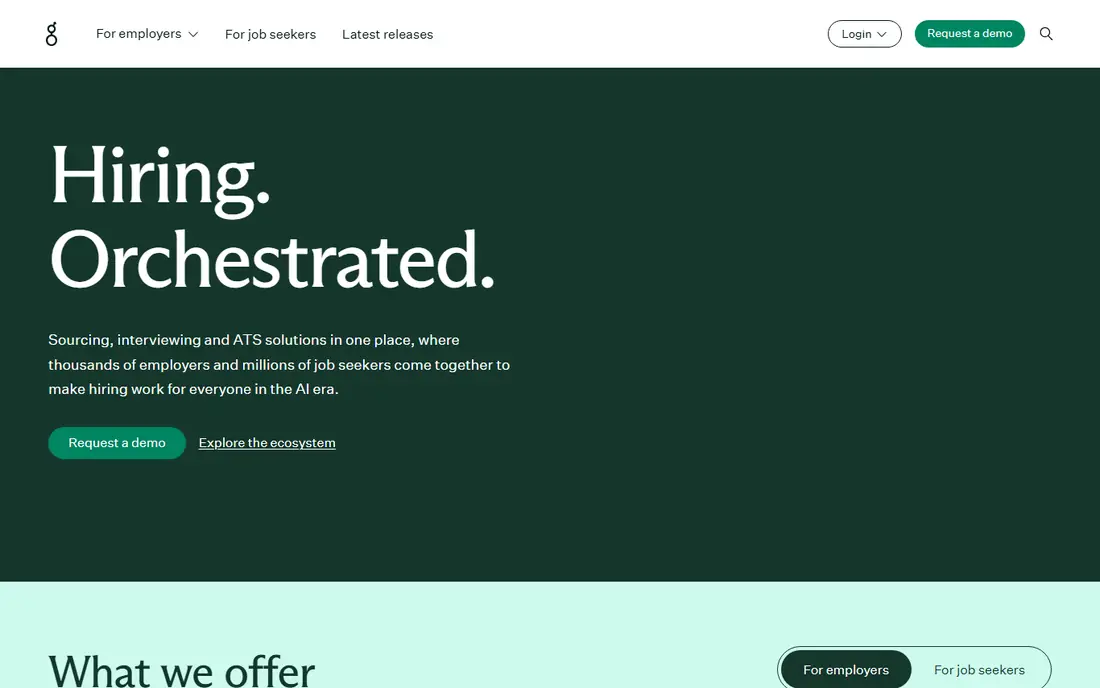
Greenhouse is the standard for structured hiring: define scorecards, interview plans and hiring stages, then evaluate every candidate consistently, with reports that reveal bias and bottlenecks. Its integrations cover HR, sourcing and assessment tools cleanly.
Pricing is quoted and setup rewards care, since structured hiring only works when teams actually use the scorecards. For a company hiring at scale that wants fair, consistent decisions, Greenhouse is the leading choice.
- Strong structured interviews and scorecards
- Good reporting and integrations
- Scales well
- Pricing is quoted
- Setup takes care for best results
Lever
Ideal for: CRM-style sourcing and hiring

Lever treats recruiting like sales, with a CRM for candidate relationships, sourcing, nurture campaigns and pipeline management alongside traditional applicant tracking. That approach suits teams that proactively source passive candidates rather than waiting for applications.
Pricing is quoted, and the interface packs a lot in. For a team whose hiring depends on sourcing and relationships, Lever is a strong and popular alternative to Greenhouse.
- CRM approach to candidate relationships
- Strong sourcing and nurture tools
- Good automation
- Pricing is quoted
- Interface can feel busy
Workable
Ideal for: Value for growing teams

Workable gives growing teams a full hiring toolkit: job postings to many boards, AI sourcing and screening, interview scheduling, offer management and reports, at a price below enterprise rivals. Its interface is friendly, and setup is fast.
Enterprise depth trails Greenhouse, and advanced features need higher plans. For a small or mid-size team that needs complete hiring without enterprise cost, Workable is excellent value.
- Full hiring toolkit at a fair price
- AI sourcing and screening
- Easy job posting to many boards
- Less depth than Greenhouse for enterprise
- Some features need higher plans
LinkedIn Recruiter
Ideal for: Sourcing on LinkedIn
LinkedIn Recruiter gives access to LinkedIn's candidate pool with powerful search filters, saved searches, alerts and InMail outreach, making it the default sourcing tool for professional roles. Most recruiters use it alongside an ATS rather than instead of one.
It is expensive per seat and not a complete ATS on its own. For a team that sources heavily on LinkedIn, Recruiter is close to essential, and its value shows in candidate quality and response rates.
- Access to LinkedIn's full candidate pool
- Powerful search filters
- InMail outreach built in
- Expensive per seat
- Not a full applicant tracking system alone
Indeed Hiring
Ideal for: High-volume hourly hiring
Indeed Hiring uses Indeed's huge job seeker audience for high-volume and hourly hiring, with sponsored jobs, screening questions and interview scheduling built in. For retail, hospitality, warehouse and healthcare roles, its reach is unmatched.
It is less structured than Greenhouse for complex professional hiring, and applicant quality varies by market. For volume hiring where speed and reach matter most, Indeed is a practical choice.
- Huge job seeker reach
- Sponsored jobs and screening
- Good for hourly and high-volume roles
- Less structured than Greenhouse
- Quality varies by role and market
JazzHR
Ideal for: Affordable small-team hiring
JazzHR offers small teams a full hiring system at a low price: job postings, applicant tracking, interview scheduling, e-signatures and reports, with collaboration tools for hiring managers. Its simplicity suits teams hiring their first recruiters.
Enterprise depth trails larger rivals, and the interface is practical rather than beautiful. For a small business that needs real hiring software without enterprise cost, JazzHR is strong value.
- Low price with full hiring features
- Easy posting and collaboration
- Good for small teams
- Less depth for enterprise
- Interface is functional rather than polished
Breezy
Ideal for: Friendly visual hiring
Breezy makes hiring visual: drag candidates through pipeline stages, automate messages and scheduling, and collaborate with hiring managers from a clean, friendly interface. Its free plan covers small teams getting started.
Enterprise depth is lighter than Greenhouse, and advanced features need higher plans. For a team that wants hiring to feel simple and visual, Breezy is a pleasant and capable choice.
- Visual drag-and-drop pipelines
- Free plan for small teams
- Good automation and scheduling
- Less enterprise depth
- Some features need higher plans
Recruitee
Ideal for: European hiring and automation
Recruitee, now part of Tellent, offers automation, workflows, a career site builder and solid applicant tracking, with strength for European teams and multilingual hiring. Its automation handles routine tasks so recruiters focus on candidates.
Its US presence is smaller than Workable or Greenhouse, and higher pricing is quoted. For a European or international team that wants automation-rich hiring, Recruitee is a strong option.
A further metric worth tracking is source quality, not just source volume. Measure which channels produce hires who stay and perform, not just which produce the most applications, since a flood of poor applications costs recruiter time and slows hiring. That quality view helps you shift budget from noisy boards to sources that actually deliver good hires.
- Strong automation and workflows
- Good for European teams
- Career site builder included
- Smaller US presence than rivals
- Pricing is quoted on higher plans
How we picked these
We compared official product pages, pricing pages and documentation, focusing on sourcing, applicant tracking, interview structure, automation, analytics and integrations. We favored tools that are actively sold today and serve a clear team size.
We also weighed total hiring cost: job board spend, recruiter time and time-to-hire matter more than license price alone. A tool that fills roles faster often pays for itself even at a higher license cost.
How to choose a recruiting tool that fills roles faster
Start with your bottleneck. If sourcing is slow, prioritize LinkedIn Recruiter, Lever or Workable's AI sourcing. If interviews are inconsistent, prioritize Greenhouse's structured scorecards. If admin eats recruiter time, prioritize automation and scheduling. Buying for the wrong bottleneck wastes money.
Trial with a real open role
Post a real job, source real candidates, run real interviews and make a real offer during the trial. That test reveals workflow friction, candidate experience and reporting quality that a demo hides. If the trial only shows dashboards, it has not tested hiring.
Protect candidate experience
Candidates judge your company by your hiring process: slow replies, confusing scheduling and ghosting damage your brand. Choose a tool with fast communication, easy scheduling and clear status updates, and set response time standards for every stage.
Measure time-to-hire and quality, not just cost
Track time-to-fill, candidate satisfaction, hiring manager satisfaction and new hire retention by source. A cheap tool that fills roles slowly or badly costs more in lost productivity than a pricier tool that hires well. Review those metrics quarterly. Also ask vendors about data ownership and export options, since candidate data built over years should remain yours if you ever switch systems. Finally, train hiring managers on the new tool before launch, since a system managers will not use cannot improve hiring no matter how good its features are. Short training sessions beat long manuals here.
If you are still unsure, start with a free plan and move to a paid plan only when you hit its limits.
Frequently asked questions
What is the best recruiting tool?
Greenhouse leads for structured hiring at scale, Lever for CRM-style sourcing, Workable and JazzHR for value, and LinkedIn Recruiter for sourcing. The best pick depends on your hiring volume, sourcing style and budget.
What is the best free recruiting tool?
Breezy and Workable offer free plans or trials for small teams, and Indeed Hiring offers free job posting options. Free plans suit small teams, while growing teams usually need paid plans for automation and volume.
Is Greenhouse or Lever better?
Greenhouse is stronger for structured interviews, scorecards and consistent evaluation, while Lever is stronger for sourcing, nurturing and CRM-style candidate relationships. Many teams choose based on whether their bottleneck is evaluation or sourcing.
Do I need LinkedIn Recruiter if I have an ATS?
If you source professional roles on LinkedIn heavily, Recruiter's search and InMail access add real value beyond an ATS alone. Teams that rely on inbound applications may not need it, so weigh it against your sourcing mix.
How much do recruiting tools cost?
Small-team tools start at low monthly prices or free plans, mid-market tools are typically monthly per job or per user, and enterprise tools like Greenhouse and Lever are quoted. Price at your hiring volume and job count, not just the entry tier.
How do I improve candidate experience?
Reply quickly at every stage, schedule easily, explain next steps clearly, and never ghost candidates after interviews. A simple status update, even a rejection with thanks, protects your employer brand and keeps strong candidates open to future roles.