Which Recruitment CRM Software Fits You? 6 Tools Compared

- 1
 ManatalSmall teams that want AI sourcing features at a startup priceVisit
- 2
 Zoho RecruitSolo recruiters and budget teams that want a free or cheap startVisit
- 3
 VincereAgencies that want one operating system for front and back officeVisit
- 4
 BullhornLarge staffing and recruiting businesses that require an enterprise-grade productVisit
- 5
 CrelateUS staffing businesses that want transparent pricing and solid complianceVisit
- Number one here is Manatal, a fit for small teams that want AI sourcing features at a startup price.
- The cheapest monthly starting price in the list is $15/user/month, offered by Manatal.
- Just one of the 6 tools, Zoho Recruit, has a free plan.
- A fair warning about Zoho Recruit: the staffing-agency edition pricing differs from the corporate plans shown.
Direct answer
Start with Manatal if you need small teams that want AI sourcing features at a startup price. Alternatives: Zoho Recruit for solo recruiters and budget teams that want a free or cheap start, and Vincere for agencies that want one operating system for front and back office. The remaining 3 options are covered below with prices and limits.
Quick comparison
| Product | Ideal for | Price from | Free version | |
|---|---|---|---|---|
| Manatal | Small teams that want AI sourcing features at a startup price | $15/user/month (Professional, billed annually; $19 per month) | Free trial | Visit |
| Zoho Recruit | Solo recruiters and budget teams that want a free or cheap start | $25/recruiter/month (Standard, billed annually; Enterprise $50) | Yes | Visit |
| Vincere | Agencies that want one operating system for front and back office | See website (custom quote) | Free trial | Visit |
| Bullhorn | Large staffing and recruiting businesses that require an enterprise-grade product | See website (all plans custom-quoted) | No | Visit |
| Crelate | US staffing businesses that want transparent pricing and solid compliance | $85/user/month (Essentials, billed annually; Business $119) | Free trial | Visit |
 Recruit CRM | Small to mid-sized agencies that want published plans and quick setup | See website (plan prices render on the vendor pricing page; not captured in text) | Free trial (30 days) | Visit |
Recruitment CRM Software compared in detail
Ainotely put together this guide to recruitment CRM software for readers who want a clear shortlist without reading every vendor page. It compares 6 tools on starting price, free plans, who each one suits and where each one falls short.
Manatal
Ideal for: Small teams that want AI sourcing features at a startup price
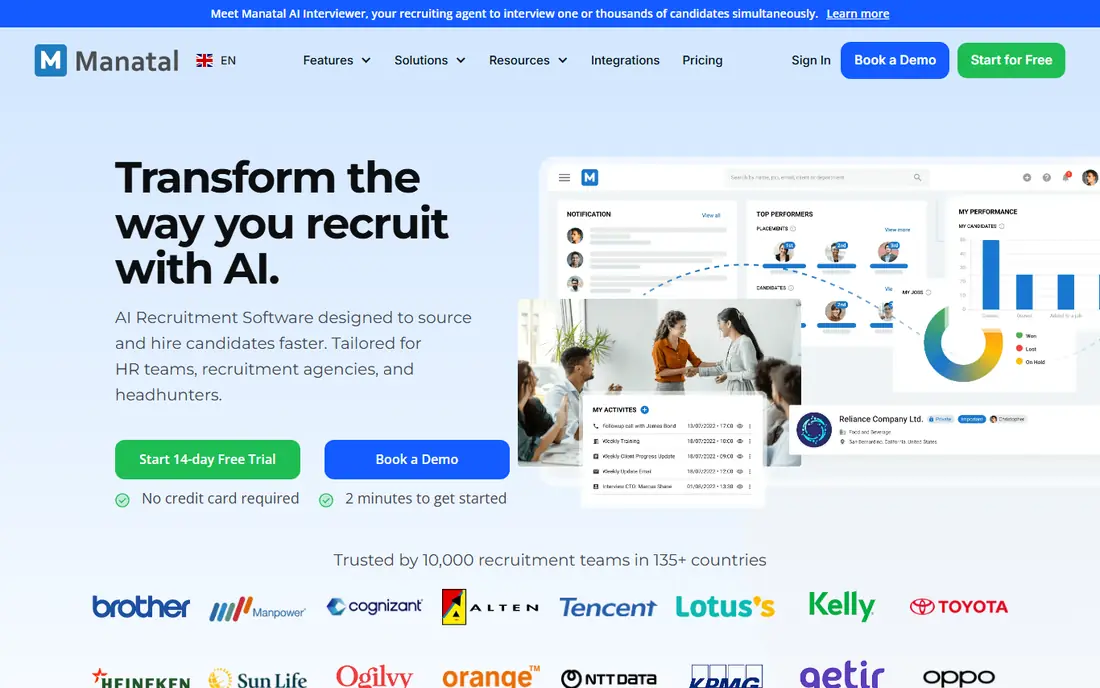
Manatal is built with small teams that want AI sourcing features at a startup price in mind. For small agencies and startups, though, Manatal provides agency-grade AI features at a price the incumbents cannot match. Fifteen jobs per account on Professional is tight for a busy desk, and 10,000 candidates will bind a firm with a large legacy database.
Honest limits: Professional caps at 15 jobs and 10,000 candidates per account.
The free trial lets a team test it on real requisitions. On top of that, Manatal's pricing page is refreshingly plain: Professional at $15 per user a month billed yearly, Enterprise at $35, Enterprise Plus at $55, with monthly billing a handful of dollars higher. For that you get AI-powered candidate matching, resume enrichment, a Chrome sourcing extension and access to a large candidate database. The caps are the thing to model. What you pay to start with Manatal: $15/user/month. On free options: Free trial.
- AI candidate recommendations
- Enrichment and a sourcing database included
- Advanced reporting and SSO sit on the $55 Enterprise Plus level
Zoho Recruit
Ideal for: Solo recruiters and budget teams that want a free or cheap start

Zoho Recruit makes the most sense for solo recruiters and budget teams that want a free or cheap start. The staffing agency edition exists but carries its own pricing. It is the right pick for cost-first buyers and corporate HR, less so for a staffing firm scaling past ten recruiters.
Zoho Recruit is the price disruptor. On top of that, the corporate pricing page lists a free edition for a single recruiter, Standard at $25 per recruiter a month and Enterprise at $50, all billed yearly. If you already run Zoho CRM or Zoho Desk, the native integrations are a bonus. On cost, Zoho Recruit starts like this: $25/recruiter/month. A free plan is available with Zoho Recruit.
What users get: A genuinely free edition.
Where it falls short: The staffing-agency edition pricing differs from the corporate plans shown.
- Deep integration with the rest of the Zoho suite
- Not just a trial
- The interface and workflow depth trail the agency specialists
Vincere
Ideal for: Agencies that want one operating system for front and back office

Pick Vincere if this describes you: agencies that want one operating system for front and back office. Vincere aims to be the only system a staffing agency needs. Pure perm shops will find more straightforward tools do the job with less setup.
Onboarding takes longer than with Recruit CRM or Manatal, and pricing is entirely quote-based. In daily use, breadth has a cost in complexity. From a buyer's view, the analytics go deeper than most rivals at this price point. Pricing for Vincere is not stated here, so ask the vendor for current figures. Free options: Free trial.
Points against: Custom pricing with no public numbers.
- Capable analytics for desk-level performance
- Invoicing and reporting in one system
- The breadth means a longer ramp-up time than single-purpose tools
Bullhorn
Ideal for: Large staffing and recruiting businesses that require an enterprise-grade product
Think of Bullhorn for large staffing and recruiting businesses that require an enterprise-grade system. Bullhorn is the product the biggest staffing businesses standardize on.
Downsides: Custom pricing means a sales process for every deal.
For businesses placing hundreds of candidates per month, the depth is the point: every desk works from the same data model. Under 20 seats, the lighter tools below do the same core job for a fraction of the price. Pricing for Bullhorn is not stated here, so ask the vendor for current figures. Bullhorn does not include a free plan.
- An ecosystem of integrations few rivals match
- Capable automation and reporting for high-volume desks
- Implementation is a project, not a signup, with costs to match
Crelate
Ideal for: US staffing businesses that want transparent pricing and solid compliance
Choose Crelate for US staffing businesses that want transparent pricing and capable compliance. Crelate is the transparent pick in a category that hates publishing prices. As for the details, essentials is a two-user starter, so a five-person agency is really shopping at $119 per user.
Read the level ladder before you buy. In daily use, the vendor's own pricing page lists Essentials at $85 per user a month and Business at $119, with Business Plus and Platform levels on custom quotes. From a buyer's view, the AI assistant, automation and premium portals that headline Crelate's marketing live on Business Plus, which has no public price. Crelate starts at: $85/user/month. On free options: Free trial.
What to check first: The AI features Crelate markets sit on the quote-only Business Plus level.
- SOC 2 Type II and ISO 27001 certifications with GDPR and CCPA compliance
- Published pricing with no sales call required
- Essentials caps at 2 users and 20,000 contacts, so real teams start at Business
Recruit CRM
Ideal for: Small to mid-sized agencies that want published plans and quick setup
Pick Recruit CRM if this describes you: small to mid-sized agencies that want published plans and quick setup. One login includes candidate tracking, client management, job multiposting, email sequencing and a hiring-manager portal.
The pricing page lays out Pro, Business and Enterprise levels with a 30-day free trial, and the vendor's FAQ confirms the trial terms. Also, for small settled teams the core tracking is solid and the 24/7 chat support gets decent marks. No starting price is listed for Recruit CRM here; confirm pricing on the vendor site. Free plan details: Free trial (30 days).
Where it is weaker: Record caps per plan (10,000 candidates per user on Pro) can bind expanding databases.
Upsides: AI sourcing.
- ATS plus CRM in one interface with no separate modules to buy
- Credit-based extras for enrichment and automation rather than forced upgrades
- AI matching and automation are metered by credits, so heavy users face a second bill
Selection criteria
For each of the 6 tools we noted price, free plan or trial, fit for recruitment CRM software and the main limit, using vendor pages and documentation. Seat minimums, billing terms and add-ons can move the real cost, so the starting prices here are a guide and not a quote. The order reflects how well each tool fits the most common buying scenario for recruitment CRM software, then price clarity, then free plan access. It is a starting point, not a verdict.
A buyer's checklist
- Ask Vincere, Bullhorn and Recruit CRM for a written quote, since no starting price is shown.
- Test the free plan from Zoho Recruit against your real workload before relying on it.
- Take the trial from Manatal, Vincere, Crelate and Recruit CRM and push a live task through it before you pay.
- Before choosing Manatal, weigh its main limit: professional caps at 15 jobs and 10,000 candidates per account.
- Confirm the exact Vincere plan that includes your must-have features.
- Compare total cost, not headline price: for Recruit CRM, add extra seats, add-ons and any usage-based charges.
Frequently asked questions
Do these tools publish their prices?
Not all of them. Vincere, Bullhorn and Recruit CRM publish no starting price, so expect a quote request for those. The rest, Manatal included, show a starting price, though seats and billing terms still change the final cost.
What is the difference between a recruitment CRM and an ATS?
An ATS tracks job applicants through hiring stages. A recruitment CRM runs the relationships around hiring: candidates you may place later, client contacts, and the outreach that keeps both warm.
Which options for recruitment CRM software have a free plan?
Zoho Recruit is the only tool in this list with a free plan. Free plans usually cap users, projects or features, so check the limits on the vendor page. Several others offer a trial instead.
Can I try these options before paying?
Often, yes. Zoho Recruit has a free plan and Manatal, Vincere, Crelate and Recruit CRM offer a free trial. Use your own data and a real task during the test, and check what the free tier or trial limits before you rely on it.
Is Manatal the right pick for everyone comparing recruitment CRM software?
No single tool suits every team. Manatal comes first because it fits small teams that want AI sourcing features at a startup price, while Zoho Recruit suits solo recruiters and budget teams that want a free or cheap start and Vincere suits agencies that want one operating system for front and back office. Match the tool to your own size, budget and workflow before deciding.
What should I check before signing a recruitment CRM contract?
Record caps, credit metering on AI and outreach features, data export terms, and contract length. In practice, get a data-export sample before you commit: your candidate database is your business.