Best Resource Management Software in 2026: 8 Options Compared

- 1
 FloatVisual team schedulingVisit
- 2
 Resource GuruSimple small-team schedulingVisit
- 3
 RunnForecasting for project teamsVisit
- 4
 monday.comVisual workload managementVisit
- 5
 WrikeMultiple resource viewsVisit
- Our pick for most people is Float, because it covers the core needs of this category well without the highest price or the steepest learning curve.
- The cheapest way to start is often Resource Guru or a free tier, but check what the free plan actually allows before you rely on it for daily work.
- Prices and free tiers change often, so confirm the current plan on the official site before you pay, especially for per-user and per-seat pricing.
- The best choice depends on your main use case, not on the longest feature list, so shortlist two options and trial them with a real task.
Quick comparison
| Product | Ideal for | Price from | Free version | |
|---|---|---|---|---|
| Float | Visual team scheduling | $7 per scheduled person per month | Free trial | Visit |
| Resource Guru | Simple small-team scheduling | See website | Free trial | Visit |
| Runn | Forecasting for project teams | See website | Free trial | Visit |
| monday.com | Visual workload management | $9 per user per month | Yes | Visit |
| Wrike | Multiple resource views | $10 per user per month | Yes | Visit |
 ClickUp | All-in-one work and resourcing | $7 per user per month | Yes | Visit |
 Asana | Task tracking with workload | $10.99 per user per month | Yes | Visit |
 Smartsheet | Spreadsheet-style planning | See website | Free trial | Visit |
The best best resource management software
We compared official feature pages, pricing pages, app store listings, privacy policies, and public reviews to build this list. Each option below is a real product that works today, with a clear strength and an honest trade-off, so you can match the choice to your budget and your main task. Use the comparison table to shortlist, then read the full entries for the options that fit your situation.
Float
Ideal for: Visual team scheduling
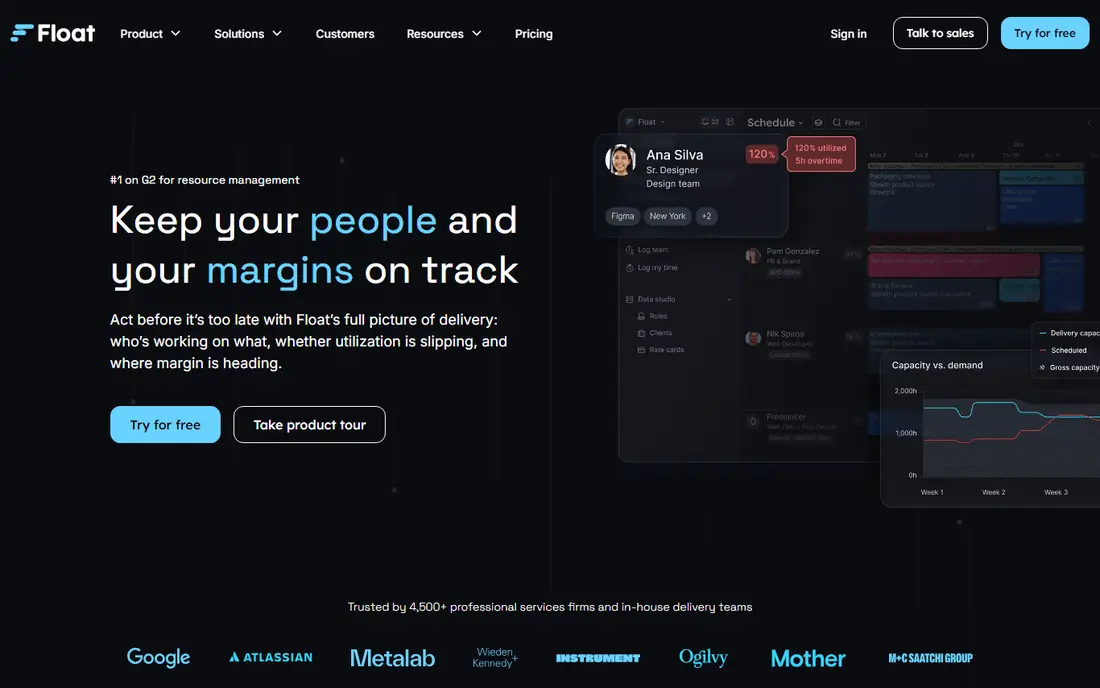
Float shows who is booked, who is free, and who is overloaded on one visual timeline. It suits agencies and professional services teams that plan people week by week and need capacity answers fast. For someone whose main need is visual team scheduling, that focus matters because it shapes the daily experience, from setup to the features you will actually use each week. On pricing, the starting point is $7 per scheduled person per month, with a free option listed as Free trial. That makes it worth checking the full pricing page before you commit, since the plan that looks cheapest can miss a feature you need, while a higher plan may include tools you would otherwise buy separately. The trade-off to weigh is this: not a full project management tool; finance features need higher plans. If that trade-off does not block your main task, this option deserves a place on your shortlist, and a short trial with a real project will tell you more than any feature list.
- Clear drag-and-drop schedule
- Time-off and capacity views
- Pay only for scheduled people
- Not a full project management tool
- Finance features need higher plans
Resource Guru
Ideal for: Simple small-team scheduling
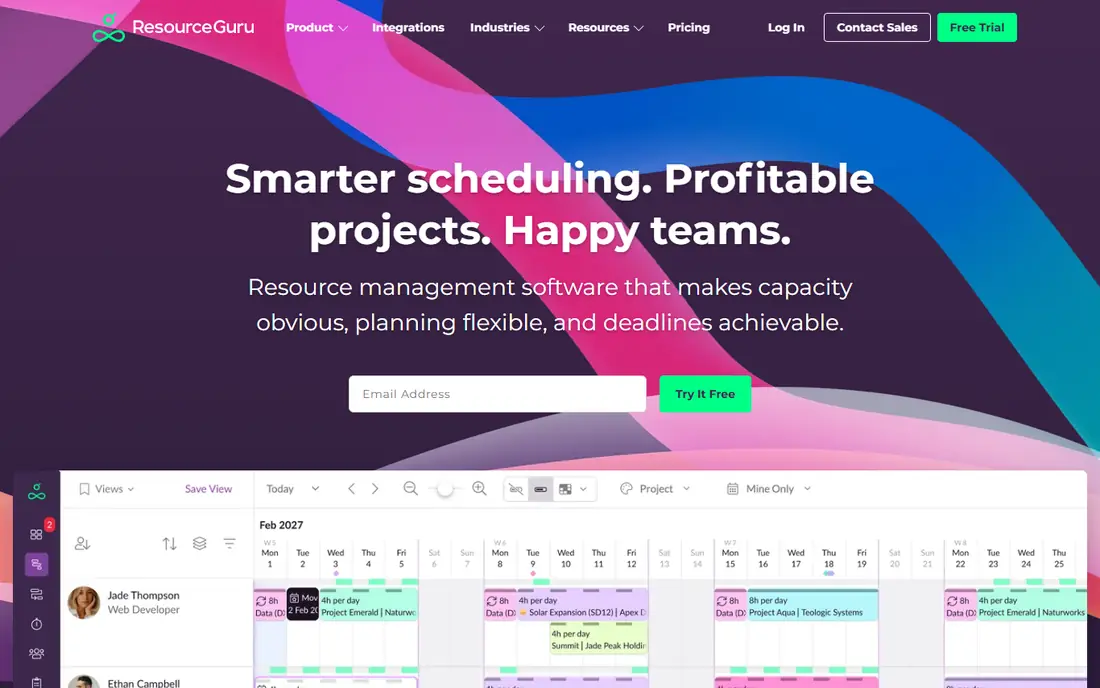
Resource Guru is a straightforward scheduler for people, equipment, and rooms, with clash warnings when a booking overlaps. It suits small teams that want a clear calendar without a heavy enterprise system. For someone whose main need is simple small-team scheduling, that focus matters because it shapes the daily experience, from setup to the features you will actually use each week. On pricing, the starting point is See website, with a free option listed as Free trial. That makes it worth checking the full pricing page before you commit, since the plan that looks cheapest can miss a feature you need, while a higher plan may include tools you would otherwise buy separately. The trade-off to weigh is this: reporting is basic; limited project finance tools. If that trade-off does not block your main task, this option deserves a place on your shortlist, and a short trial with a real project will tell you more than any feature list.
- Easy visual scheduling
- Clash alerts
- Equipment and room booking
- Reporting is basic
- Limited project finance tools
Runn
Ideal for: Forecasting for project teams
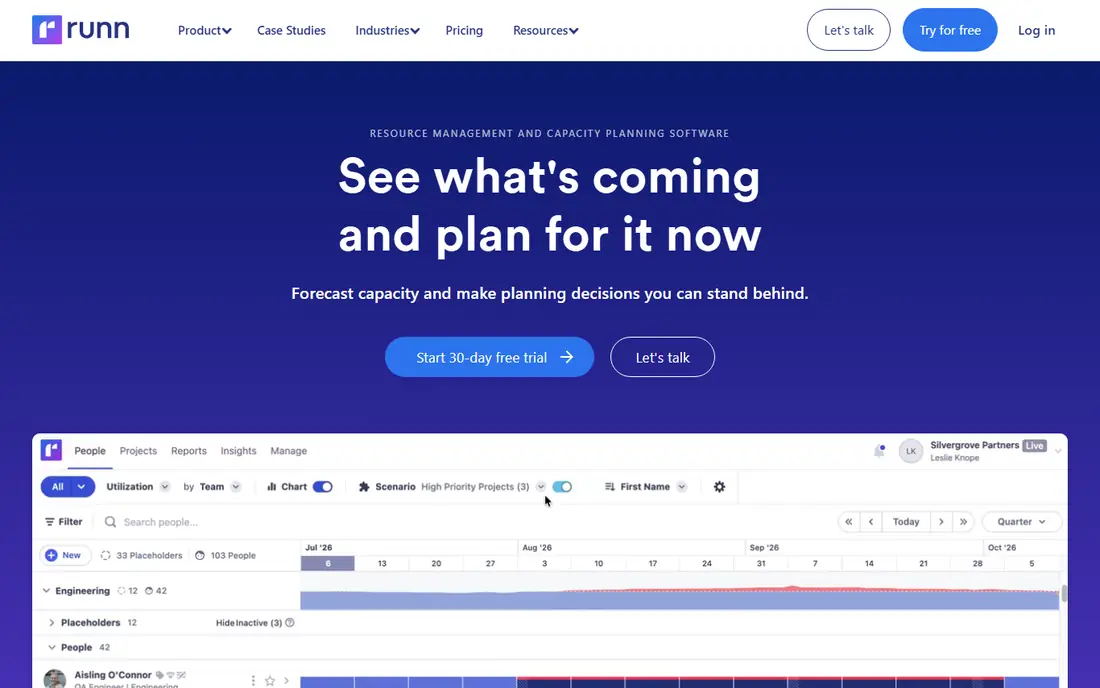
Runn combines resource planning with forecasting, so managers can see future capacity gaps before they become missed deadlines. It suits project-based teams that plan weeks ahead. For someone whose main need is forecasting for project teams, that focus matters because it shapes the daily experience, from setup to the features you will actually use each week. On pricing, the starting point is See website, with a free option listed as Free trial. That makes it worth checking the full pricing page before you commit, since the plan that looks cheapest can miss a feature you need, while a higher plan may include tools you would otherwise buy separately. The trade-off to weigh is this: smaller integration list than larger platforms; pricing needs a quote on some tiers. If that trade-off does not block your main task, this option deserves a place on your shortlist, and a short trial with a real project will tell you more than any feature list.
- Capacity forecasting and utilisation views
- Placeholder planning
- Time tracking
- Smaller integration list than larger platforms
- Pricing needs a quote on some tiers
monday.com
Ideal for: Visual workload management
monday.com is a work platform whose workload views help managers balance tasks across a team. It suits teams that already manage projects in boards and want resourcing in the same place. For someone whose main need is visual workload management, that focus matters because it shapes the daily experience, from setup to the features you will actually use each week. On pricing, the starting point is $9 per user per month, with a free option listed as Yes. That makes it worth checking the full pricing page before you commit, since the plan that looks cheapest can miss a feature you need, while a higher plan may include tools you would otherwise buy separately. The trade-off to weigh is this: resource features sit inside a wider platform; costs rise with seats. If that trade-off does not block your main task, this option deserves a place on your shortlist, and a short trial with a real project will tell you more than any feature list.
- Flexible boards and workload views
- Many integrations
- Automations
- Resource features sit inside a wider platform
- Costs rise with seats
Wrike
Ideal for: Multiple resource views
Wrike gives managers several ways to view capacity, from workload charts to calendars, alongside task management. It suits larger teams that need structured planning and approvals. For someone whose main need is multiple resource views, that focus matters because it shapes the daily experience, from setup to the features you will actually use each week. On pricing, the starting point is $10 per user per month, with a free option listed as Yes. That makes it worth checking the full pricing page before you commit, since the plan that looks cheapest can miss a feature you need, while a higher plan may include tools you would otherwise buy separately. The trade-off to weigh is this: resource planning can feel complex for small teams; advanced features need higher plans. If that trade-off does not block your main task, this option deserves a place on your shortlist, and a short trial with a real project will tell you more than any feature list.
- Workload, calendar, and table views
- Time tracking
- Approval workflows
- Resource planning can feel complex for small teams
- Advanced features need higher plans
ClickUp
Ideal for: All-in-one work and resourcing
ClickUp bundles task management with workload views, so capacity planning lives next to the work itself. It suits teams that want one tool for tasks and resourcing and are willing to spend time setting it up. For someone whose main need is all-in-one work and resourcing, that focus matters because it shapes the daily experience, from setup to the features you will actually use each week. On pricing, the starting point is $7 per user per month, with a free option listed as Yes. That makes it worth checking the full pricing page before you commit, since the plan that looks cheapest can miss a feature you need, while a higher plan may include tools you would otherwise buy separately. The trade-off to weigh is this: depth can overwhelm new users; resource views need setup. If that trade-off does not block your main task, this option deserves a place on your shortlist, and a short trial with a real project will tell you more than any feature list.
- Tasks, docs, goals, and workload views in one app
- Generous free tier
- Depth can overwhelm new users
- Resource views need setup
Asana
Ideal for: Task tracking with workload
Asana helps teams track tasks and deadlines, and its workload view shows who is overbooked. It suits teams that already plan work in Asana and want capacity insight without a separate scheduler. For someone whose main need is task tracking with workload, that focus matters because it shapes the daily experience, from setup to the features you will actually use each week. On pricing, the starting point is $10.99 per user per month, with a free option listed as Yes. That makes it worth checking the full pricing page before you commit, since the plan that looks cheapest can miss a feature you need, while a higher plan may include tools you would otherwise buy separately. The trade-off to weigh is this: workload planning needs a paid tier; no built-in time tracking on basic plans. If that trade-off does not block your main task, this option deserves a place on your shortlist, and a short trial with a real project will tell you more than any feature list.
- Clear task and timeline views
- Workload feature on paid plans
- Strong integrations
- Workload planning needs a paid tier
- No built-in time tracking on basic plans
Smartsheet
Ideal for: Spreadsheet-style planning
Smartsheet suits teams that like spreadsheets but need shared planning, with a resource management add-on for allocation and reporting. It works best for organisations already committed to the Smartsheet way of working. For someone whose main need is spreadsheet-style planning, that focus matters because it shapes the daily experience, from setup to the features you will actually use each week. On pricing, the starting point is See website, with a free option listed as Free trial. That makes it worth checking the full pricing page before you commit, since the plan that looks cheapest can miss a feature you need, while a higher plan may include tools you would otherwise buy separately. The trade-off to weigh is this: resource management is a paid add-on; interface can feel dense. If that trade-off does not block your main task, this option deserves a place on your shortlist, and a short trial with a real project will tell you more than any feature list.
- Familiar spreadsheet layout
- Resource management add-on
- Portfolio views
- Resource management is a paid add-on
- Interface can feel dense
How we picked these
We compared official feature pages and pricing pages, app store listings where relevant, privacy policies, and public reviews, and we only listed products that exist and work today and truly fit the topic. We mixed well-known leaders with strong smaller options, and we favoured products with clear pricing, clear free-tier terms, and a clear audience, rather than tools that try to cover every use case at once. We did not claim hands-on testing that did not happen. Instead, we weighed what each product is built for, who it fits best, what it costs to start, and where it falls short, so the pros and cons reflect real trade-offs you will meet in daily use. If a price could not be verified from an official source, we listed it as See website rather than guessing.
What to check before you choose
Start with how you plan today: a weekly schedule, a project forecast, or a task board. A pure scheduler like Float is fastest for weekly staffing, while a work platform suits teams that want tasks and capacity together. Check whether pricing counts every user or only scheduled people, and whether time-off, holidays, and part-time hours are handled well. Also check support options, since help quality matters when something goes wrong at a busy moment. Look for clear documentation, a responsive support channel, and a way to export your data if you later switch. A tool that is easy to leave is often easier to trust, because you are not locked in by your own files. Finally, trial with a real task, not just a demo. Set up the exact workflow you will use, invite the people who will use it, and test on the devices you own. A week of real use reveals friction that a feature list hides, and it gives you a fair basis to compare your top two options before you pay.
Frequently asked questions
What is resource management software?
It is software that shows who is available, who is booked, and how much capacity your team has, so managers can assign work without overloading people. Some tools focus only on scheduling, while others add forecasting and time tracking.
Which tool is best for small teams?
Resource Guru and Float are strong for small teams because setup is fast and the schedule is easy to read. Larger work platforms make sense once you also need task management and reporting.
Do I need a separate tool if I use monday.com or Asana?
Not always. Both offer workload views that suit many teams, but a dedicated scheduler gives deeper capacity, forecasting, and utilisation reporting for agencies and services firms.
How much does resource management software cost?
Entry prices in this list range from free tiers to about $7 to $11 per user per month, with enterprise and add-on pricing often quoted on request. Check whether you pay for all users or only scheduled people.