8 Best Retail ERP Software Tools for 2026

- 1
 NetSuiteRetailers that need a complete cloud ERP at scaleVisit
- 2
 Dynamics 365 Business CentralRetailers already using Microsoft toolsVisit
- 3
 SAP Business OneMidsize retailers that want SAP depth without SAP scaleVisit
- 4
 OdooRetailers that want modular, flexible ERP at a lower costVisit
- 5
 AcumaticaGrowing retailers that want a true cloud ERPVisit
- Retail ERP earns its keep by keeping inventory, orders, stores, and accounting on one record across every channel.
- Large retailers suit NetSuite, SAP Business One, or Dynamics 365 Business Central; growing brands suit Odoo, Acumatica, or Cin7.
- POS integration is the feature to test hardest: a retail ERP that fights the checkout will frustrate staff and customers daily.
- Multi-location and omnichannel features matter most when stock must move between stores, warehouses, and online orders.
- Implementation cost rivals license cost for ERP, so budget for setup, migration, and training, not just the subscription.
Quick comparison
| Product | Ideal for | Price from | Free version | |
|---|---|---|---|---|
| NetSuite | Retailers that need a complete cloud ERP at scale | See website | No | Visit |
| Dynamics 365 Business Central | Retailers already using Microsoft tools | See website | No | Visit |
| SAP Business One | Midsize retailers that want SAP depth without SAP scale | See website | No | Visit |
| Odoo | Retailers that want modular, flexible ERP at a lower cost | See website | No | Visit |
| Acumatica | Growing retailers that want a true cloud ERP | See website | No | Visit |
 Brightpearl | Omnichannel retailers and brands selling across channels | See website | No | Visit |
 Cin7 | Inventory-led retailers and wholesalers | $349 per month | No | Visit |
 Epicor | Retailers and distributors with manufacturing or distribution depth | See website | No | Visit |
The best retail ERP software
NetSuite
Ideal for: Retailers that need a complete cloud ERP at scale
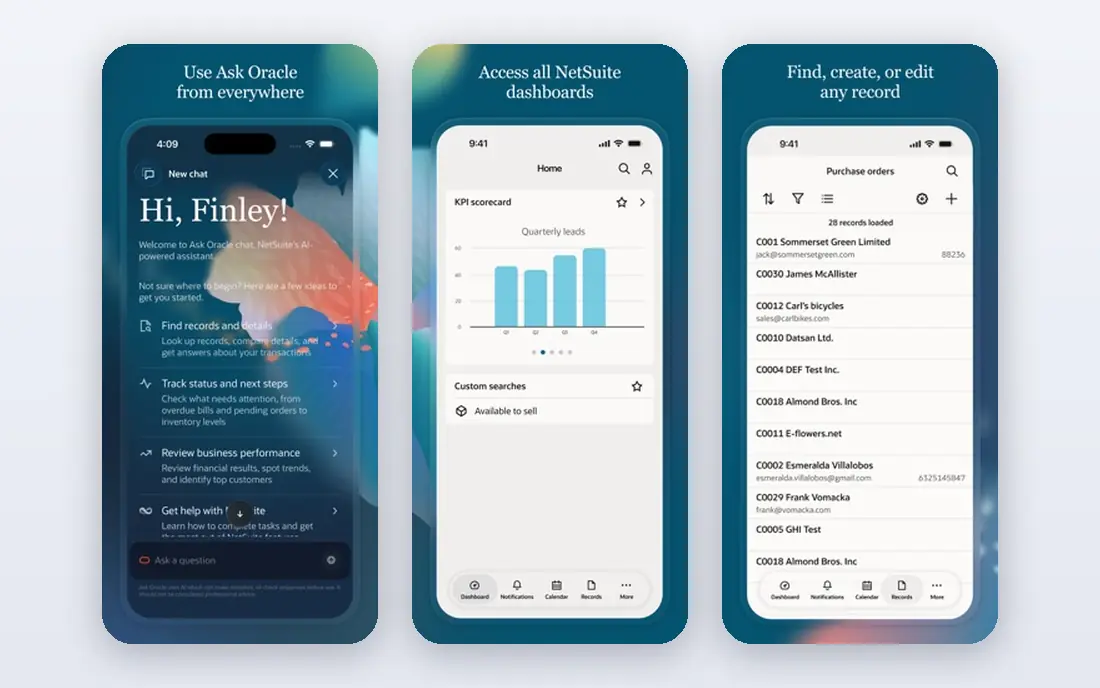
NetSuite, from Oracle, is a cloud ERP covering financials, inventory, order management, CRM, and e-commerce, with retail features for point of sale, omnichannel orders, and multi-location stock. Its strength is breadth in one system: a growing retailer can run accounting, purchasing, warehousing, and online and store sales without stitching separate tools, and real-time dashboards show performance across channels. SuiteCommerce connects online storefronts to the same inventory and order records as stores. The trade-offs are cost and implementation: NetSuite is priced and implemented as an enterprise system, and small retailers will find it more than they need. For retailers scaling from dozens to hundreds of locations, or from one channel to many, NetSuite is a proven platform.
- Full ERP breadth, strong financials, omnichannel order management
- Enterprise pricing and implementation, complexity for small retailers
Dynamics 365 Business Central
Ideal for: Retailers already using Microsoft tools
Dynamics 365 Business Central is Microsoft's ERP for small and midsize businesses, covering financials, supply chain, inventory, purchasing, sales, and project management, with a large partner ecosystem adding retail and POS capabilities. Its advantage for Microsoft-centric retailers is integration: Outlook, Teams, Excel, and Power BI connect naturally, and staff already familiar with Microsoft tools face a shorter learning curve. Inventory and warehouse features handle multi-location stock, and the partner network provides retail-specific POS and e-commerce extensions. POS is typically delivered through a partner solution rather than built in, so buyers should evaluate the combined package. Pricing is per user per month with partner implementation costs. For retailers standardized on Microsoft, Business Central is a natural ERP choice.
- Strong financials and supply chain, Microsoft 365 integration, partner ecosystem
- Retail POS needs partner add-ons, implementation varies by partner
SAP Business One
Ideal for: Midsize retailers that want SAP depth without SAP scale
SAP Business One brings SAP's ERP discipline to small and midsize businesses, covering financials, sales, purchasing, inventory, production, and CRM in one system. For retail, its inventory and warehouse management, multi-location support, and financial controls suit businesses that need rigor as they grow, and its partner ecosystem adds POS and e-commerce integrations. Business One has a long track record with distributors and retailers, and it scales from a single company to multi-subsidiary operations. Implementation takes planning and partner involvement, and retail-specific features often arrive through add-ons, so the total package should be scoped carefully. Pricing is quote-based. For midsize retailers that want a serious ERP foundation, Business One is a respected option.
- Deep financials and inventory, strong partner network, proven at scale
- Implementation effort, partner-dependent retail features
Odoo
Ideal for: Retailers that want modular, flexible ERP at a lower cost
Odoo is a modular business platform with apps for sales, POS, inventory, purchasing, accounting, manufacturing, and e-commerce that share one database. For retail, that modularity is practical: a business can start with POS, inventory, and accounting, then add e-commerce, warehouse management, or CRM as it grows, without re-platforming. The POS app runs in stores and syncs with inventory, and the website and e-commerce apps connect online sales to the same stock. Odoo's open source roots keep licensing costs lower than traditional ERP, though implementation, hosting, and customization still need budget. App quality varies across the large module catalog, so buyers should test the exact modules they plan to use. For cost-conscious retailers that want flexibility, Odoo is a compelling choice.
- Modular apps, integrated POS, e-commerce, and inventory, open source roots
- Module quality varies, implementation still needs planning
Acumatica
Ideal for: Growing retailers that want a true cloud ERP
Acumatica is a cloud ERP with a retail and commerce edition covering point of sale, omnichannel storefront connectors, inventory, order management, and financials in one platform. Its unified commerce approach keeps online and in-store sales on the same inventory and customer records, which is the core retail ERP promise. Acumatica emphasizes usability and unlimited users, which changes the cost conversation for retailers with many store staff, since pricing is based on resources used rather than per-user seats. AI-powered automation handles routine workflows, and integrations cover major e-commerce and marketplace platforms. Implementation runs through partners, so the partner's retail experience matters as much as the software. For growing retailers that want cloud ERP without per-seat pricing pressure, Acumatica is worth evaluating.
- Retail and commerce management, unlimited users model, strong usability
- Partner-led implementation, pricing requires a quote
Brightpearl
Ideal for: Omnichannel retailers and brands selling across channels
Brightpearl, now part of Sage, is a retail operating system built for omnichannel brands, covering inventory, order management, purchasing, warehousing, CRM, and accounting across online stores, marketplaces, and physical retail. Its strength is channel coherence: orders from Shopify, Amazon, and other channels flow into one inventory and fulfillment workflow, with accounting that reflects the same transactions. That focus suits brands whose complexity comes from channels rather than manufacturing, and whose pain is overselling or manual reconciliation between systems. Brightpearl's accounting depth is stronger than many inventory-first tools, which reduces reliance on separate finance software. Pricing is quote-based. For omnichannel retailers drowning in channel reconciliation, Brightpearl is a focused and proven choice.
- Omnichannel order and inventory focus, strong accounting, channel integrations
- Retail focus means less manufacturing depth, pricing requires a quote
Cin7
Ideal for: Inventory-led retailers and wholesalers
Cin7 is inventory management software and small business ERP covering order management, stock visibility, manufacturing, and sales logistics, with real-time inventory across every product and component. Retailers can manage e-commerce and in-store orders together, track performance across channels, and connect accounting through Xero and QuickBooks integrations. Manufacturing tools cover materials, assemblies, and production tracking, which suits brands that both make and sell products. Pricing starts at $349 per month, according to the vendor site, with plans accommodating multiple e-commerce and app integrations. Cin7's ERP breadth is lighter than NetSuite or Business Central, so very large retailers may outgrow it. For inventory-led retailers and wholesalers that need control without enterprise ERP cost, Cin7 is a strong fit.
- Real-time multi-channel inventory, order management, accounting integrations
- ERP breadth is lighter than NetSuite, pricing starts at a real monthly commitment
Epicor
Ideal for: Retailers and distributors with manufacturing or distribution depth
Epicor provides ERP for retail, distribution, and manufacturing, with industry editions shaped around the needs of each sector. For retailers that also distribute or manufacture, that depth matters: inventory, warehouse management, purchasing, and production planning sit alongside sales and financials in one system, rather than in separate tools that must be reconciled. Epicor's long history with distributors and manufacturers gives it credibility for complex supply chains, and its cloud and on-premises options suit different IT policies. Implementation is an enterprise project, and pricing is quote-based. For a pure-play small retailer, Epicor will be more system than needed. For retailers with distribution or manufacturing behind the storefront, Epicor's combined depth is a real advantage.
- Deep distribution and manufacturing, strong inventory, industry editions
- Enterprise scope and implementation, pricing requires a quote
How we picked these
We looked for ERP systems with genuine retail capability: inventory, POS or store integration, omnichannel orders, and accounting, not generic ERPs with a retail label. We balanced enterprise platforms with mid-market and inventory-led options, because retail ranges from single stores to global chains. We compared official feature pages, pricing pages, documentation, and public reviews, and we left out POS-only tools and inventory-only tools that lack accounting and ERP breadth. Where a vendor did not publish a current price, we wrote "See website" rather than repeat a third-party figure.
What to test before choosing a retail ERP
Run your busiest sales day through the trial: a store sale, an online order, a marketplace order, a return, and a stock transfer between locations, and check that inventory and accounting agree at the end. Test the POS experience with real store staff, because a slow or confusing checkout will be rejected no matter how good the back office is. Check how the system handles promotions, gift cards, and partial fulfillments, which are where retail ERPs most often disappoint. Ask about data migration from your current POS and accounting tools, and about support during peak seasons. Finally, get implementation costs in writing: for ERP, the implementation quote is as important as the license price.
Frequently asked questions
What is retail ERP software?
It is software that unifies inventory, point of sale, order management, purchasing, warehousing, and accounting for a retailer, so every channel works from the same stock and financial records.
How is retail ERP different from a POS system?
A POS system handles checkout. A retail ERP handles checkout plus inventory, purchasing, warehousing, accounting, and reporting across all channels and locations.
Do small retailers need ERP software?
A single store can run on a POS plus accounting software. ERP becomes valuable when channels, locations, or product counts grow to the point where stock and finance reconciliation becomes a regular problem.
Can retail ERP handle online and in-store sales together?
Yes, that is its core job. Omnichannel order and inventory management keeps stock accurate across stores, websites, and marketplaces, and supports fulfillment from any location.
How long does retail ERP implementation take?
Small retailers using a focused tool can go live in weeks, while enterprise ERP rollouts take months. Scope data migration, POS rollout, and training explicitly in the plan.
What does retail ERP cost?
Licensing ranges from a few hundred dollars per month for inventory-led tools to quote-based enterprise pricing, plus implementation, migration, and training costs that can rival the license itself.