Best Risk Management Software in 2026: 8 Platforms Compared

- 1
 LogicGate Risk CloudConfigurable enterprise GRCVisit
- 2
 MetricStreamLarge regulated GRCVisit
- 3
 ArcherRegulated enterprisesVisit
- 4
 AuditBoard (Optro)Audit-led GRCVisit
- 5
 OneTrustData and AI governanceVisit
- LogicGate Risk Cloud suits enterprises that want configurable GRC with fast implementation, averaging 96 days on its homepage.
- MetricStream suits large, regulated enterprises with deep GRC, cyber and audit coverage across many countries.
- Archer suits highly regulated firms, especially banks, with regulatory change intelligence and audit lineage.
- AuditBoard, now Optro, suits audit-led teams that want GRC intelligence trusted by more than half of the Fortune 500.
- OneTrust suits data, privacy and AI governance, connecting privacy, data, AI and technology risk in one system.
- Resolver suits risk intelligence and incident management, with enterprise risk, investigations and business continuity tools.
- ServiceNow suits organizations already on ServiceNow that want GRC inside a wider workflow platform.
- Riskonnect suits integrated risk, claims and resilience programs, with customers from hotels to the US Army.
- All of these platforms price by quote, so request demos at your program size and compare implementation cost, not just license fees.
Quick comparison
| Product | Ideal for | Price from | Free version | |
|---|---|---|---|---|
| LogicGate Risk Cloud | Configurable enterprise GRC | See website | No | Visit |
| MetricStream | Large regulated GRC | See website | No | Visit |
| Archer | Regulated enterprises | See website | No | Visit |
| AuditBoard (Optro) | Audit-led GRC | See website | No | Visit |
| OneTrust | Data and AI governance | See website | No | Visit |
 Resolver | Risk intelligence | See website | No | Visit |
 ServiceNow GRC | Workflow platform GRC | See website | No | Visit |
 Riskonnect | Integrated risk and claims | See website | No | Visit |
The best risk management software
Risk management software, often called GRC software, tracks risks, controls, incidents, third parties, audits and compliance in one system instead of spreadsheets. The platforms below serve different strengths: some lead on configurability, some on regulatory depth, some on audit and some on data governance. We checked each official homepage before listing it.
LogicGate Risk Cloud
Ideal for: Configurable enterprise GRC
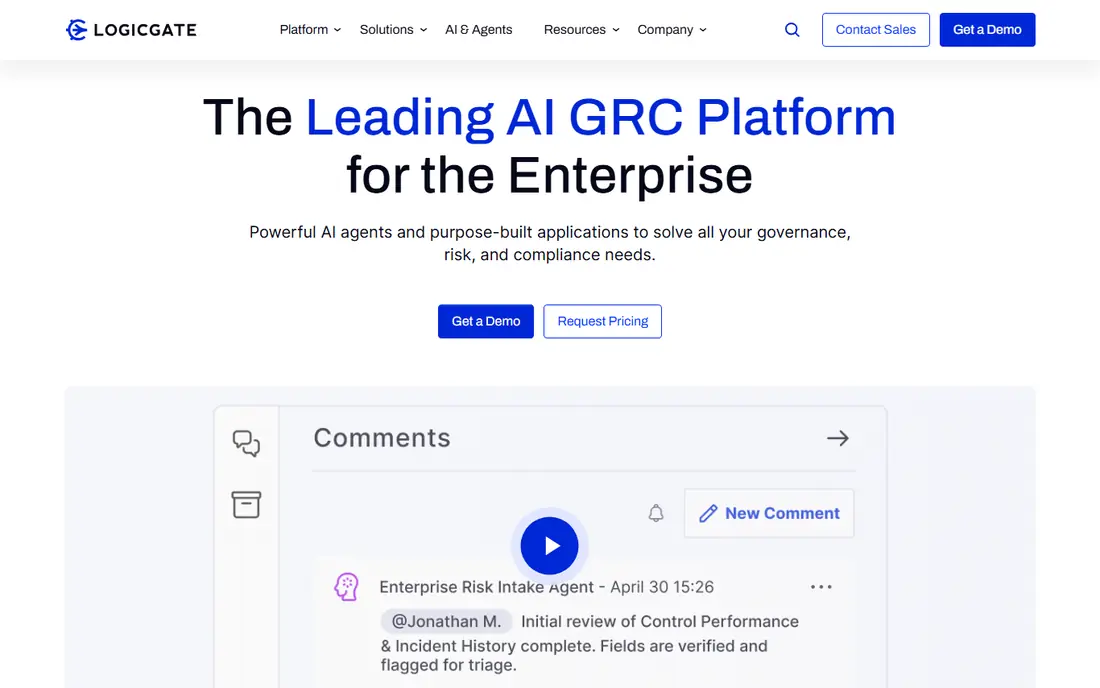
LogicGate Risk Cloud is an AI GRC platform with purpose-built applications for enterprise risk, third-party risk, cyber risk and compliance. Its homepage notes recognition as a Leader in the Gartner Magic Quadrant for GRC Tools and in the Forrester Wave for third-party risk management in Q1 2026, plus G2 Leader recognition for 29 consecutive quarters, more than 20,000 active users, 98 percent support satisfaction and average annual savings above 250,000 USD reported by customers. Its no-code graph database gives a multi-hop view of how controls, assets and risks relate.
LogicGate suits enterprises that want to configure GRC to their own program rather than adapt to a fixed model. Automated control testing moves teams from ad-hoc checks to continuous compliance, with notifications when issues arise. The trade-off is scoping: with many applications available, define your first use cases clearly so implementation stays within its fast average timeline.
- No-code graph database connecting controls, assets and risks
- Automated control testing
- Average implementation of 96 days versus a 6 to 12 month industry average
- Enterprise pricing by quote
- Breadth of 30-plus applications needs scoping to avoid overbuying
MetricStream
Ideal for: Large regulated GRC
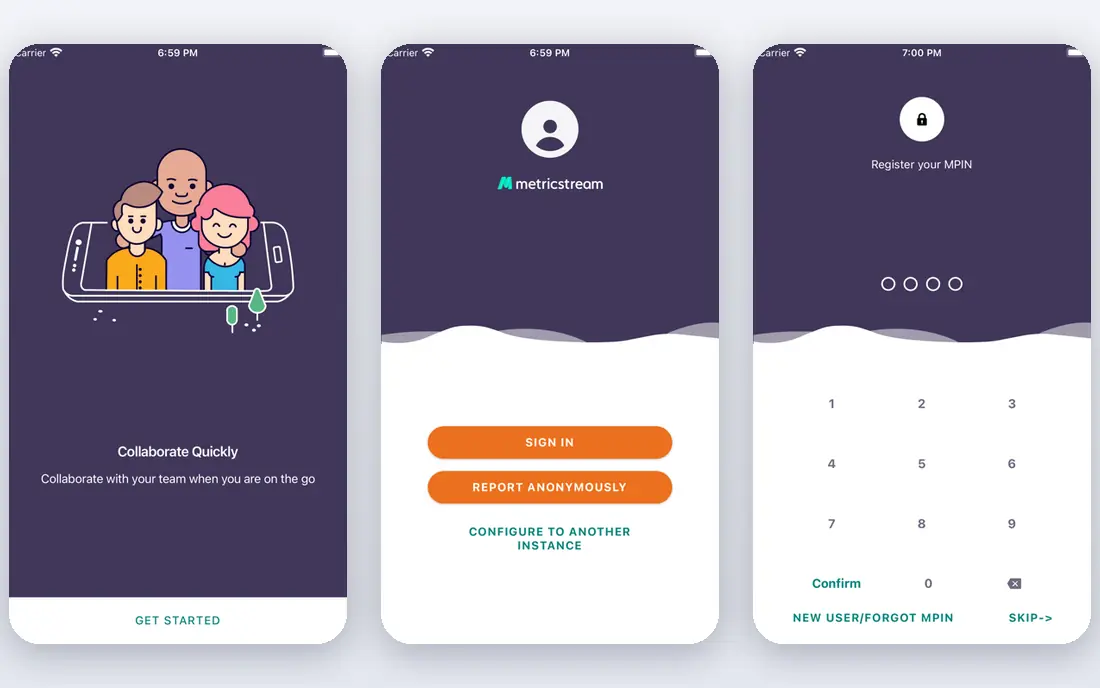
MetricStream offers GRC software where AI anticipates emerging risks, recommends actions and executes approved actions within guardrails. Its homepage cites customers including Standard Chartered, Zurich Insurance Group, Blue Cross Blue Shield of Michigan, Shell and dnata, with more than 1 million users across 35-plus countries, payback in under 6 months stated on its site, and 500-plus dedicated GRC experts. Chartis Research places MetricStream first across all seven GRC categories assessed, according to its homepage.
MetricStream suits large, regulated enterprises that need one data model across risk, audit, third-party, compliance, cyber and policy programs. Its depth in banks, insurers and energy companies shows it handles complex, multi-country programs. Smaller companies may find it more platform than they need, but for global regulated firms MetricStream is a leading choice.
- Purpose-built for governance, risk, compliance, cyber and audit
- More than 1 million users across hundreds of Fortune 500 and Global 1000 organizations
- 25-plus years of expertise
- Enterprise scale and pricing
- Implementation needs dedicated resources
Archer
Ideal for: Regulated enterprises
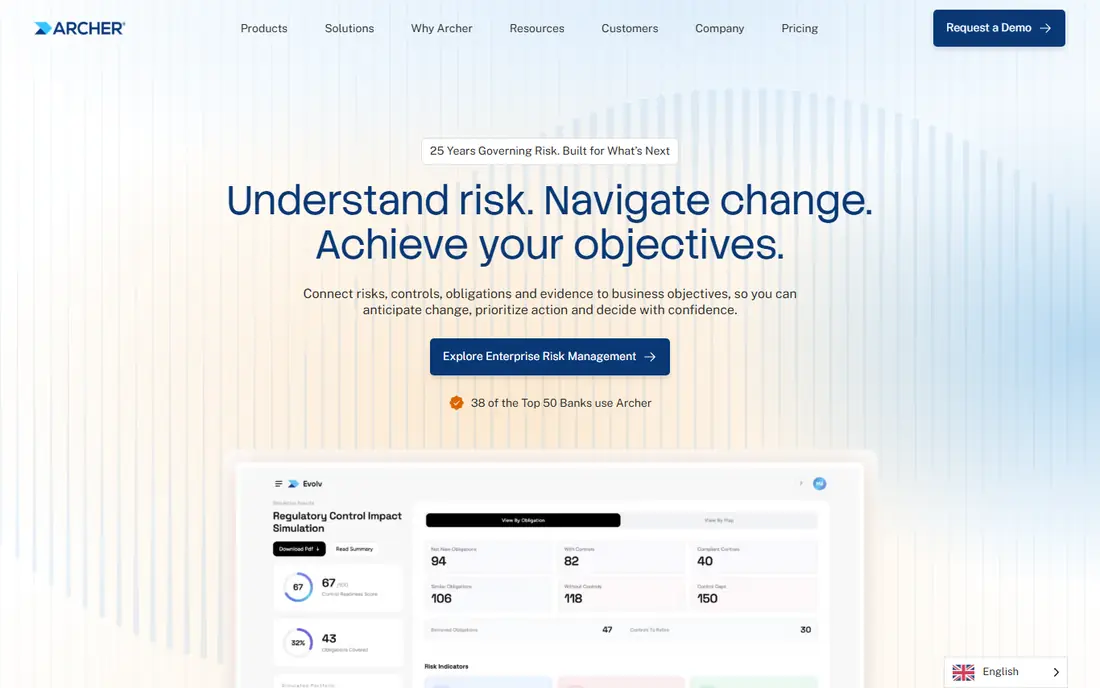
Archer helps highly regulated enterprises stay ahead of regulatory change with AI-powered insights and full audit lineage from source to obligation, control and evidence. Its homepage notes 38 of the top 50 banks use Archer, more than 50 percent of customers are in the Fortune 500, and Archer Evolv monitors more than 22 million authoritative regulatory sources, extracts obligations with compliance-trained AI and maps them to controls and policies. Its foundation covers audit, ESG, regulatory and corporate compliance, enterprise and operational risk, IT and security risk, third-party risk and resilience.
Archer suits banks, insurers and other regulated firms where regulatory change is the main risk driver. Its lineage from regulation to evidence matters during audits, since every obligation traces to a source. The trade-off is enterprise cost and complexity, but for regulated firms that audit burden justifies the investment.
- 25-plus years of regulatory intelligence
- Used by 38 of the top 50 banks and more than 1,500 organizations
- Archer Evolv adds AI regulatory change intelligence
- Enterprise pricing
- Regulatory depth may exceed simpler risk programs
AuditBoard (Optro)
Ideal for: Audit-led GRC
AuditBoard, now Optro, offers a GRC intelligence platform where AI agents start work at the review stage, managing risk in real time, uncovering insights and supporting smarter decisions. Its homepage notes trust from more than half of the Fortune 500, a Leader position in the Forrester Wave for Governance, Risk and Compliance Platforms in Q2 2026, and a Leader position in the 2025 Gartner Magic Quadrant for GRC Tools. Its agents work continuously with humans in control, and every decision is logged, traceable and reviewable with audit trails regulators can verify.
Optro suits audit, risk, infosec and compliance teams that want intelligence across all four areas in one platform. Its practitioner-built roots show in audit workflows and evidence handling. The rebrand is worth noting when searching: AuditBoard's site now presents Optro, but the platform and customer base are the same. For audit-led GRC programs, Optro is a top choice.
- GRC intelligence platform trusted by more than half of the Fortune 500
- Named a Leader in the Forrester Wave for GRC Platforms Q2 2026
- AI agents with full audit trails
- Rebrand from AuditBoard to Optro may confuse buyers
- Enterprise pricing by quote
OneTrust
Ideal for: Data and AI governance
OneTrust offers an AI-ready governance platform that connects privacy, data, AI and technology risk, with tools to define purpose, automate assessments, enforce controls and monitor new risks across domains. Its homepage highlights AI governance, consent and preferences, data use governance, tech risk and compliance, and third-party management, with AI-assisted assessments showing risk summaries, key findings and real-time monitoring. More than half of the Fortune 500 choose OneTrust, according to its site.
OneTrust suits organizations where data, privacy and AI risk dominate the risk register, especially companies deploying AI systems at scale. Its continuous view of how data and AI are used helps prevent issues before they escalate, rather than catching them in annual reviews. For pure enterprise risk or operational risk, a broader GRC platform may fit better, but for data and AI governance OneTrust leads.
- Connects privacy, data, AI and technology risk in one continuous system
- Used by more than half of the Fortune 500
- Named a Visionary in the 2026 Gartner Magic Quadrant for AI Governance Platforms
- Data and AI focus means enterprise risk depth varies by module
- Enterprise pricing by quote
Resolver
Ideal for: Risk intelligence
Resolver brings scattered risk and incident data together so teams work with complete information, with tools to demonstrate how risk, compliance, threats and incidents are managed, foster stakeholder alignment with clear visualizations, and quantify the impact of risk strategies. Its homepage lists enterprise risk management, internal audit, internal controls, third-party risk, business continuity, IT risk, risk events, incident management, investigations, security risk and command center tools. Customer stories include JetBlue reducing pilferage incidents and Motusbank cutting training time with self-explanatory forms.
Resolver suits organizations that need risk intelligence plus incident and investigation handling, such as retailers, banks and public sector bodies. Its strength is turning incident data into decisions fast, with reporting efficiency gains stated on its site. For teams that only need control testing and compliance, a narrower GRC tool may be simpler, but for incident-heavy programs Resolver is a strong fit.
- Complete risk and incident data in one place
- Covers enterprise risk, investigations, business continuity and security risk
- Clear visualizations for stakeholders
- Breadth across investigations and security may exceed pure GRC needs
- Pricing by quote
ServiceNow GRC
Ideal for: Workflow platform GRC
ServiceNow's AI platform unifies digital business transformation, letting teams build apps fast, automate processes and deliver employee and customer experiences. Its GRC products sit inside that platform, connecting risk, compliance and audit to IT workflows, service management and automation that many large companies already run on ServiceNow. The platform is recognized across many Gartner Magic Quadrants, including AI governance and business orchestration, and Forrester's Wave for GRC platforms.
ServiceNow GRC suits organizations already invested in ServiceNow for IT and employee workflows, since GRC data then flows with incidents, changes and service requests without a separate system. That integration reduces duplicate work and improves response times. Companies without ServiceNow should compare the full platform cost against a standalone GRC tool, since ServiceNow's value grows with wider adoption.
- GRC inside a unified AI platform for digital workflows
- Strong integration with IT service management
- Recognized in Forrester Wave for GRC platforms
- GRC is one product family inside a large platform
- Licensing and implementation need ServiceNow expertise
Riskonnect
Ideal for: Integrated risk and claims
Riskonnect offers risk management software covering integrated risk, claims and resilience, with customer stories from IHG on claims visibility, Wendy's on loss reduction of more than 5 percent, BT on governance code readiness, Transport for London on risk culture, and the US Army on identifying opportunities alongside threats. Its homepage also highlights a monthly educational webinar series with CPE credits from industry experts.
Riskonnect suits organizations that combine enterprise risk with insurance claims, safety or resilience programs, where one system for risk and claims saves reconciliation work. Its customer range, from hotels to armies, shows flexibility across sectors. For a pure GRC control-testing program, a specialist such as LogicGate or MetricStream may fit better, but for integrated risk and claims Riskonnect is a leading option.
- Integrated risk, claims and resilience programs
- Customers include IHG, Wendy's, BT, Transport for London and the US Army
- Practical webinar and CPE education program
- Claims and insurance depth may exceed pure enterprise risk needs
- Pricing by quote
How we picked these
We compared official homepages, program coverage and analyst recognition, favoring platforms that are actively developed and used by large enterprises. We covered configurable GRC, regulated GRC, audit-led GRC, data and AI governance, risk intelligence, workflow-platform GRC and integrated risk and claims, because the best tool depends on which risk domain dominates your program. We checked each vendor's own site before listing it.
How to choose risk management software
Start with your dominant risk domain. Enterprise and third-party risk programs suit LogicGate or MetricStream, regulated firms suit Archer, audit-led programs suit Optro, data and AI programs suit OneTrust, incident-heavy programs suit Resolver, and claims-linked programs suit Riskonnect. A platform that leads in your domain will serve you better than a general tool that covers everything thinly.
Next, test with your real risk register. Import a sample of risks, controls and third parties, run an assessment cycle and produce a board report in trial. Check how easily controls map to frameworks, how evidence is collected, and whether reporting gives executives a clear view without manual spreadsheet work. Implementation time matters: LogicGate's 96-day average is a useful benchmark to ask other vendors to match.
Finally, compare total cost and ownership. License fees are only part of the cost: implementation, integration, data migration and ongoing administration add up. Ask each vendor for a total first-year cost at your user count and module set, plus the team size needed to run the platform. A platform your risk team can configure without heavy consulting will cost less over time than one that needs constant vendor help.
Frequently asked questions
What is the best risk management software for enterprises?
LogicGate and MetricStream lead for large enterprises, with Archer leading for highly regulated firms and Optro leading for audit-led programs. The best choice depends on your dominant risk domain, regulatory load and whether you need data and AI governance alongside traditional GRC.
What is GRC software?
GRC software covers governance, risk and compliance in one system: it tracks risks, controls, incidents, third parties, audits and regulations, replacing spreadsheets with workflows, evidence and reporting. Modern GRC platforms add AI agents for evidence review, control testing and regulatory change tracking.
How much does risk management software cost?
Enterprise GRC platforms price by quote, based on users, modules and implementation scope, so there is no single price. Request quotes at the same user count and module set, and include implementation, integration and administration costs in the comparison.
Can risk management software replace spreadsheets?
Yes, for most programs. GRC platforms centralize risk registers, control libraries, evidence and reporting, with workflows and audit trails that spreadsheets cannot match. Migration takes effort, but teams usually gain faster reporting, clearer ownership and better audit readiness.
What is third-party risk management software?
Third-party risk management software assesses and monitors vendors, suppliers and partners for security, compliance, financial and operational risk. LogicGate was named a Leader in the Forrester Wave for third-party risk management in Q1 2026, and Archer, MetricStream and OneTrust also offer strong third-party modules.
Do I need AI in risk management software?
AI helps with evidence review, control testing, regulatory change tracking and risk insights, especially at scale, but it should keep humans as final approvers. Platforms such as LogicGate, MetricStream, Optro and Archer all stress human-in-the-loop AI with audit trails, which matters for regulator trust.