Best Sales Tax Software For Ecommerce in 2026: 8 Products Compared

- Avalara is our pick for most buyers who want a proven option with broad coverage.
- TaxJar and Vertex stand out for buyers who need depth in one area rather than a general tool.
- Free and trial options exist, including TaxJar, so you can test before paying.
- Prices vary widely, and several vendors do not publish a flat rate, so check the pricing page for the plan you would actually buy.
Quick comparison
| Product | Ideal for | Price from | Free version | |
|---|---|---|---|---|
 Avalara | ecommerce sellers in many states | See website | No | Visit |
 TaxJar | small and midsize online sellers | See website | Free trial | Visit |
 Vertex | larger companies with complex tax needs | See website | No | Visit |
 Sovos | companies with global and US tax duties | See website | No | Visit |
 Stripe Tax | sellers already processing with Stripe | See website | No | Visit |
 TaxCloud | sellers that want low-cost calculation | See website | Free | Visit |
 Anrok | SaaS and digital sellers with tax complexity | See website | No | Visit |
 Numeral | ecommerce brands selling across states and countries | See website | No | Visit |
The best sales tax software for ecommerce
These are the eight options we would shortlist for sales tax software for ecommerce.
This is not financial advice. Prices and tax rules change, so confirm current pricing and terms on the vendor website before you buy.
Avalara
Ideal for: ecommerce sellers in many states

Avalara stands out for ecommerce sellers in many states. Avalara is the most complete option for sellers with nexus in many states and complex product tax rules. Its strengths include sales tax calculation at checkout, filing and remittance services, and nexus tracking. For buyers comparing sales tax software for ecommerce, that mix matters in daily use, from first setup through routine tasks and reporting. Pricing is listed as See website because the vendor does not publish a single flat rate we could verify, and the free option is No.
The honest catch is pricing is quote based, and setup needs tax configuration. Those limits matter more for larger or more complex teams than for small ones, so check them against your real workload. We would still keep Avalara on a shortlist for ecommerce sellers in many states, because its core strengths line up with what buyers in this category ask for first. Compare its pricing page with two other options on this list, and confirm that any feature you depend on is in the plan you would actually buy.
- Sales tax calculation at checkout
- Filing and remittance services
- Nexus tracking
- Pricing is quote based
- Setup needs tax configuration
TaxJar
Ideal for: small and midsize online sellers
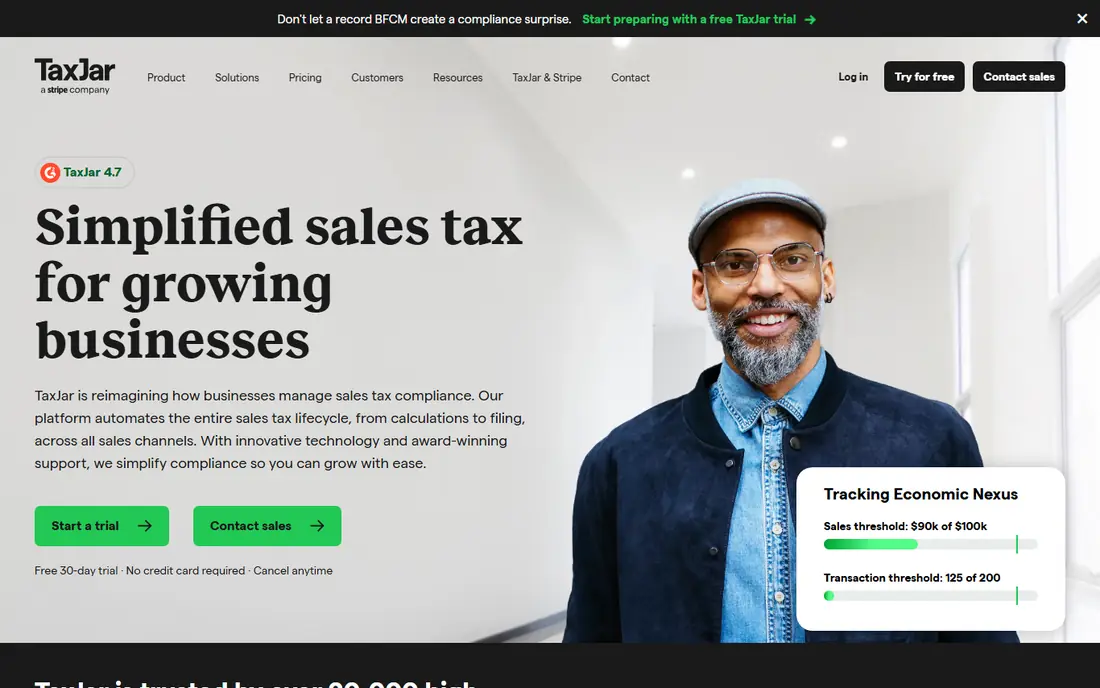
For small and midsize online sellers, TaxJar is a strong fit. TaxJar is a practical choice for online sellers who want calculation plus filing without enterprise setup. Its strengths include sales tax calculation and reporting, auto-filing in many states, and integrations with ecommerce platforms. For buyers comparing sales tax software for ecommerce, that mix matters in daily use, from first setup through routine tasks and reporting. Pricing is listed as See website because the vendor does not publish a single flat rate we could verify, and the free option is a free trial.
No tool is perfect, and TaxJar is no exception, with auto-filing fees add up and some advanced features need higher plans. Those limits matter more for larger or more complex teams than for small ones, so check them against your real workload. We would still keep TaxJar on a shortlist for small and midsize online sellers, because its core strengths line up with what buyers in this category ask for first. Compare its pricing page with two other options on this list, and confirm that any feature you depend on is in the plan you would actually buy.
- Sales tax calculation and reporting
- Auto-filing in many states
- Integrations with ecommerce platforms
- Auto-filing fees add up
- Some advanced features need higher plans
Vertex
Ideal for: larger companies with complex tax needs

We put Vertex on this list because it covers larger companies with complex tax needs well. Vertex suits larger companies that need tax calculation inside ERP and ecommerce systems. Its strengths include tax calculation for ecommerce and ERP, exemption certificate management, and detailed reporting. For buyers comparing sales tax software for ecommerce, that mix matters in daily use, from first setup through routine tasks and reporting. Pricing is listed as See website because the vendor does not publish a single flat rate we could verify, and the free option is No.
Before you buy, weigh enterprise pricing against implementation takes time. Those limits matter more for larger or more complex teams than for small ones, so check them against your real workload. We would still keep Vertex on a shortlist for larger companies with complex tax needs, because its core strengths line up with what buyers in this category ask for first. Compare its pricing page with two other options on this list, and confirm that any feature you depend on is in the plan you would actually buy.
- Tax calculation for ecommerce and ERP
- Exemption certificate management
- Detailed reporting
- Enterprise pricing
- Implementation takes time
Sovos
Ideal for: companies with global and US tax duties
Sovos stands out for companies with global and US tax duties. Sovos covers US sales tax alongside global tax duties for companies selling across borders. Its strengths include sales tax calculation and filing, global VAT and e-invoicing tools, and compliance reporting. For buyers comparing sales tax software for ecommerce, that mix matters in daily use, from first setup through routine tasks and reporting. Pricing is listed as See website because the vendor does not publish a single flat rate we could verify, and the free option is No.
The honest catch is enterprise pricing, and can be broad for small sellers. Those limits matter more for larger or more complex teams than for small ones, so check them against your real workload. We would still keep Sovos on a shortlist for companies with global and US tax duties, because its core strengths line up with what buyers in this category ask for first. Compare its pricing page with two other options on this list, and confirm that any feature you depend on is in the plan you would actually buy.
- Sales tax calculation and filing
- Global VAT and e-invoicing tools
- Compliance reporting
- Enterprise pricing
- Can be broad for small sellers
Stripe Tax
Ideal for: sellers already processing with Stripe
For sellers already processing with Stripe, Stripe Tax is a strong fit. Stripe Tax adds tax calculation to Stripe payments, which keeps checkout and tax in one flow. Its strengths include tax calculation inside Stripe checkout, filing support in many regions, and registration tools. For buyers comparing sales tax software for ecommerce, that mix matters in daily use, from first setup through routine tasks and reporting. Pricing is listed as See website because the vendor does not publish a single flat rate we could verify, and the free option is No.
No tool is perfect, and Stripe Tax is no exception, with fees apply per transaction and filing coverage varies by location. Those limits matter more for larger or more complex teams than for small ones, so check them against your real workload. We would still keep Stripe Tax on a shortlist for sellers already processing with Stripe, because its core strengths line up with what buyers in this category ask for first. Compare its pricing page with two other options on this list, and confirm that any feature you depend on is in the plan you would actually buy.
- Tax calculation inside Stripe checkout
- Filing support in many regions
- Registration tools
- Fees apply per transaction
- Filing coverage varies by location
TaxCloud
Ideal for: sellers that want low-cost calculation
We put TaxCloud on this list because it covers sellers that want low-cost calculation well. TaxCloud offers calculation with a free tier, which suits smaller sellers watching costs. Its strengths include sales tax calculation for online stores, filing services in many states, and integrations with major platforms. For buyers comparing sales tax software for ecommerce, that mix matters in daily use, from first setup through routine tasks and reporting. Pricing is listed as See website because the vendor does not publish a single flat rate we could verify, and the free option is Free.
Before you buy, weigh filing fees may apply against interface is simpler than rivals. Those limits matter more for larger or more complex teams than for small ones, so check them against your real workload. We would still keep TaxCloud on a shortlist for sellers that want low-cost calculation, because its core strengths line up with what buyers in this category ask for first. Compare its pricing page with two other options on this list, and confirm that any feature you depend on is in the plan you would actually buy.
- Sales tax calculation for online stores
- Filing services in many states
- Integrations with major platforms
- Filing fees may apply
- Interface is simpler than rivals
Anrok
Ideal for: SaaS and digital sellers with tax complexity
Anrok stands out for SaaS and digital sellers with tax complexity. Anrok is built for SaaS and digital sellers, with nexus monitoring shaped to subscription revenue. Its strengths include sales tax calculation for SaaS, nexus monitoring, and filing services. For buyers comparing sales tax software for ecommerce, that mix matters in daily use, from first setup through routine tasks and reporting. Pricing is listed as See website because the vendor does not publish a single flat rate we could verify, and the free option is No.
The honest catch is SaaS focus limits physical goods use, and pricing is quote based. Those limits matter more for larger or more complex teams than for small ones, so check them against your real workload. We would still keep Anrok on a shortlist for SaaS and digital sellers with tax complexity, because its core strengths line up with what buyers in this category ask for first. Compare its pricing page with two other options on this list, and confirm that any feature you depend on is in the plan you would actually buy.
- Sales tax calculation for SaaS
- Nexus monitoring
- Filing services
- SaaS focus limits physical goods use
- Pricing is quote based
Numeral
Ideal for: ecommerce brands selling across states and countries
For ecommerce brands selling across states and countries, Numeral is a strong fit. Numeral handles registration and filing for brands selling across many jurisdictions. Its strengths include sales tax registration and filing, international VAT support, and dashboard for compliance status. For buyers comparing sales tax software for ecommerce, that mix matters in daily use, from first setup through routine tasks and reporting. Pricing is listed as See website because the vendor does not publish a single flat rate we could verify, and the free option is No.
No tool is perfect, and Numeral is no exception, with newer vendor and pricing is quote based. Those limits matter more for larger or more complex teams than for small ones, so check them against your real workload. We would still keep Numeral on a shortlist for ecommerce brands selling across states and countries, because its core strengths line up with what buyers in this category ask for first. Compare its pricing page with two other options on this list, and confirm that any feature you depend on is in the plan you would actually buy.
- Sales tax registration and filing
- International VAT support
- Dashboard for compliance status
- Newer vendor
- Pricing is quote based
How we picked these
We started from the vendor official website, pricing page, and app store listing for each product, then checked public reviews for recurring strengths and complaints. We kept only products that exist and work in October 2026 and that truly fit the topic, and we left out products that only partly matched. Where we could not verify a price from the vendor, we wrote See website rather than guessing.
We also weighed who each product serves best, what it does well, and where it falls short. That is why the list mixes large, well-known vendors with smaller specialists, and why the pros and cons for each product are specific rather than generic.
How to choose the right sales tax software for ecommerce
Start with the job, not the feature list
Write down the one job you need done every week, then check that job first in a trial. A long feature list does not help if the core workflow feels slow or confusing for the people who will use it daily. Ask who will own the tool, how often they will use it, and what happens when something goes wrong.
Check pricing, limits, and integrations
Read the pricing page for the exact plan you would buy, and note per-user fees, usage limits, and add-on costs. Confirm that the tool connects to the systems you already use, such as your accounting software, CRM, or calendar. If an integration is essential, test it during the trial rather than assuming it works.
Test support before you commit
Use the trial to contact support with a real question, and note how fast and how clearly they answer. Check the privacy policy for how your data is handled, and check contract terms for renewal and cancellation. A short trial with real data tells you more than a demo with sample data.
Frequently asked questions
What is the best sales tax software for ecommerce for small businesses?
For most small businesses, Avalara is a good starting point because it covers the core job well, while TaxJar suits teams that need more depth in one area. Start with the job you do every week, then test two options side by side before you commit.
Is there a free sales tax software for ecommerce option?
Yes, in some cases. TaxJar offer a free plan or a free trial, though free tiers usually have limits on users, volume, or features. Check what is included before you rely on a free plan for daily work.
How much does sales tax software for ecommerce cost?
Costs vary widely in this category, and several vendors do not publish a flat rate, which is why some entries here say See website. Read the pricing page for the plan you would buy, and add up per-user fees, usage charges, and any add-ons.
What should I check before buying sales tax software for ecommerce?
Check the core workflow in a trial, confirm integrations with the systems you already use, and read the pricing and privacy pages carefully. Also check support quality, contract terms, and whether the plan you need includes the features you depend on.
Can I switch from another tool to one of these?
In most cases, yes, but plan the move carefully. Export your data from the old tool, test imports in the new tool with a small set of records, and train the team before the full switch. Ask the new vendor about migration help during the trial.