Best Sales Training Companies in 2026: 7 Companies Compared

- 1
 Sandler TrainingTeams that want a proven selling systemVisit
- 2
 RAIN GroupTeams focused on consultative sellingVisit
- 3
 Richardson Sales PerformanceLarge teams needing custom programsVisit
- 4
 Winning by DesignSaaS companies building revenue teamsVisit
- 5
 Force ManagementTeams adopting value based sellingVisit
- Our pick for most people is Sandler Training, which stands out for teams that want a proven selling system.
- RAIN Group is the strongest alternative if you want teams focused on consultative selling, and it is worth comparing side by side with our top pick.
- 1 of the 7 options here offer a free plan, so you can test the core features before paying anything.
- Prices vary widely, and several options use quote based pricing, so check the official pricing page for your team size before you decide.
- The right choice depends on your budget, your must have features, and how much setup time you can spare, so use the buying guide below to narrow the list to two or three finalists.
Quick comparison
| Product | Ideal for | Price from | Free version | |
|---|---|---|---|---|
| Sandler Training | Teams that want a proven selling system | See website | No | Visit |
| RAIN Group | Teams focused on consultative selling | See website | No | Visit |
| Richardson Sales Performance | Large teams needing custom programs | See website | No | Visit |
| Winning by Design | SaaS companies building revenue teams | See website | No | Visit |
| Force Management | Teams adopting value based selling | See website | No | Visit |
 Gong Academy | Teams that already use Gong | See website | No | Visit |
 HubSpot Academy | Small teams that want free sales courses | Free | Yes | Visit |
The best sales training companies
We compared 7 options for best sales training companies, looking at features, pricing, free plans, and honest weaknesses, so you can choose with confidence. The list below mixes well known leaders with smaller options that punch above their weight, and every product block sets out who it fits best and where it falls short.
Sandler Training
Ideal for: Teams that want a proven selling system
Sandler Training teaches a structured selling system built around prospect psychology, upfront contracts, and pain based discovery. Local training centers worldwide deliver it in person and online, with reinforcement programs designed to keep habits alive after the course.
Pricing is quoted, and experience can vary by local trainer, so ask for references from similar companies. Sandler fits teams that want a full system, not just a few tactics, and are willing to commit to ongoing practice.
Before you commit to Sandler Training, weigh the trade offs in the pros and cons above against your own priorities, and ask for a demo or a clear quote for your size. With no free plan, the sales conversation matters more, so pin down the total cost, the setup help included, and the contract terms before you sign.
- Well known selling system
- Local trainers worldwide
- Reinforcement programs
- Pricing is quote based
- Quality varies by local trainer
RAIN Group
Ideal for: Teams focused on consultative selling
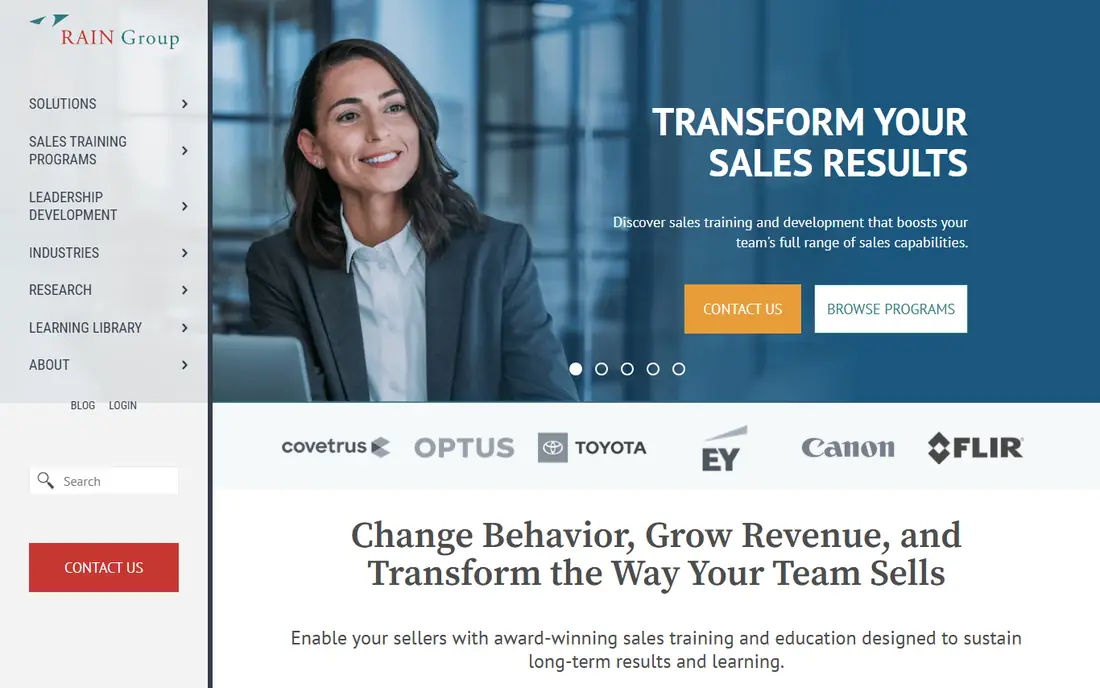
RAIN Group builds its training on research into how buyers actually buy, with an emphasis on consultative selling and value based conversations. Delivery mixes virtual and in person sessions, and the content library covers prospecting through negotiation.
The focus is enterprise teams, and pricing is quoted rather than published. Companies that want a research grounded method and can invest in a full program will find it a strong fit.
Before you commit to RAIN Group, weigh the trade offs in the pros and cons above against your own priorities, and ask for a demo or a clear quote for your size. With no free plan, the sales conversation matters more, so pin down the total cost, the setup help included, and the contract terms before you sign.
- Research backed consultative approach
- Virtual and in person delivery
- Strong content library
- Enterprise focus
- Pricing is quote only
Richardson Sales Performance
Ideal for: Large teams needing custom programs
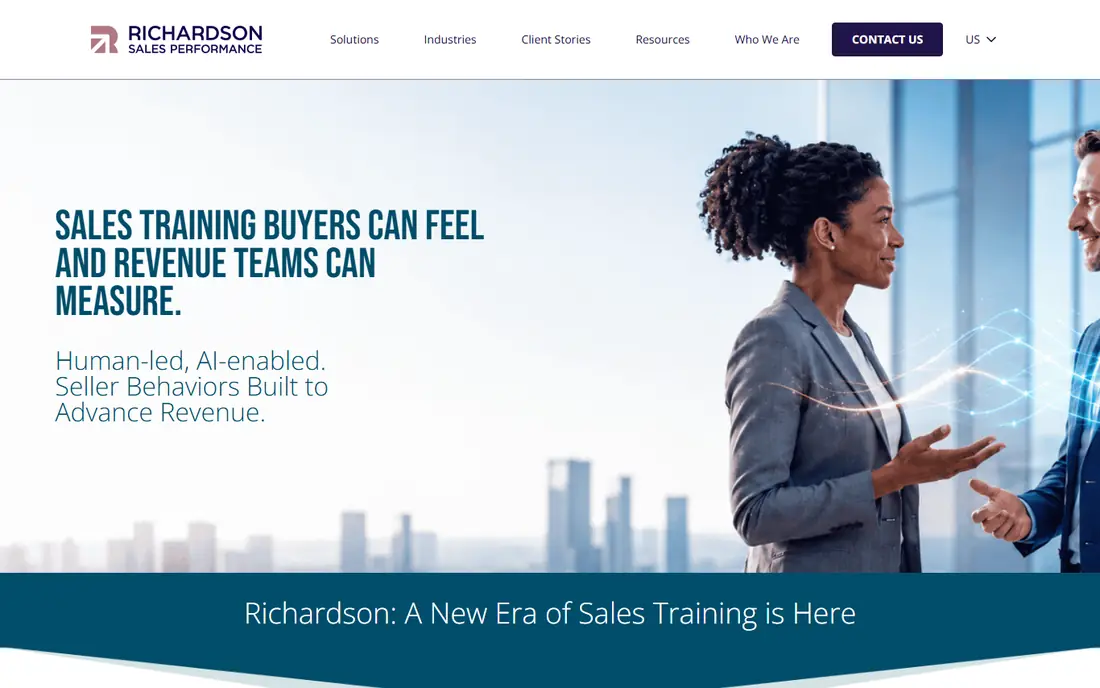
Richardson designs custom sales training for large organizations, covering prospecting, discovery, negotiation, and sales management. Global delivery and a broad curriculum suit companies with teams in many regions.
Small teams will likely find it more than they need, and pricing is quoted. For large companies that want a program shaped to their sales process, Richardson is a natural shortlist candidate.
Before you commit to Richardson Sales Performance, weigh the trade offs in the pros and cons above against your own priorities, and ask for a demo or a clear quote for your size. With no free plan, the sales conversation matters more, so pin down the total cost, the setup help included, and the contract terms before you sign.
- Custom programs for large teams
- Broad skill coverage
- Global delivery
- Quote based pricing
- Less suited to small teams
Winning by Design
Ideal for: SaaS companies building revenue teams
Winning by Design focuses on SaaS and recurring revenue companies, with frameworks for sales, customer success, and revenue operations. Its playbooks suit startups and scale ups building repeatable revenue processes.
Companies outside SaaS will find parts of the method less relevant. For SaaS teams, the focus is a strength, since examples and metrics match how subscription businesses actually sell.
Before you commit to Winning by Design, weigh the trade offs in the pros and cons above against your own priorities, and ask for a demo or a clear quote for your size. With no free plan, the sales conversation matters more, so pin down the total cost, the setup help included, and the contract terms before you sign.
- SaaS focused revenue methods
- Playbooks and frameworks
- Strong community
- SaaS focus limits fit for other industries
- Pricing is quote based
Force Management
Ideal for: Teams adopting value based selling
Force Management is known for Command of the Message, a method that helps teams sell value in complex B2B deals. Programs align sales and executive teams around a shared language for discovery, differentiation, and negotiation.
Programs are intensive and premium priced, so they suit teams ready to commit. Companies with long, complex sales cycles tend to see the most value from the method.
Before you commit to Force Management, weigh the trade offs in the pros and cons above against your own priorities, and ask for a demo or a clear quote for your size. With no free plan, the sales conversation matters more, so pin down the total cost, the setup help included, and the contract terms before you sign.
- Command of the Message method
- Strong for complex B2B sales
- Executive alignment
- Premium pricing
- Intensive programs need commitment
Gong Academy
Ideal for: Teams that already use Gong
Gong Academy turns real sales call data into training, using patterns from actual conversations to teach what works. Teams that already use Gong get the most, since coaching links directly to their own calls and pipeline.
Standalone value is narrower for non Gong users. For Gong customers, the link between training and real call data is a genuine advantage over generic courses.
Before you commit to Gong Academy, weigh the trade offs in the pros and cons above against your own priorities, and ask for a demo or a clear quote for your size. With no free plan, the sales conversation matters more, so pin down the total cost, the setup help included, and the contract terms before you sign.
- Built on real call data
- Practical coaching
- Ties to Gong platform
- Most valuable for Gong customers
- Narrower standalone offering
HubSpot Academy
Ideal for: Small teams that want free sales courses
HubSpot Academy offers free, self paced sales courses and certifications covering inbound selling, prospecting, and sales management. Small teams and new reps can learn solid fundamentals without a budget, and certificates add credibility.
Free courses cannot match the depth or coaching of paid programs, and there is no custom team training. As a starting point or a supplement, though, HubSpot Academy is hard to beat on value.
Before you commit to HubSpot Academy, weigh the trade offs in the pros and cons above against your own priorities, and use the free plan to test it with a real task. Free access makes it easy to check the core experience, but watch for the limits that matter to you, such as the drawbacks noted above, before you build a routine around it.
- Free courses and certifications
- Practical inbound sales content
- Self paced
- Less deep than paid programs
- No custom team coaching
How we picked these
We compared official feature pages, pricing pages, app store listings, privacy policies, and public reviews for each option, and we checked that every product website listed here loads and belongs to that product. We did not claim hands-on testing we did not do, and we favored products that are clearly available now, with pricing or free plan details we could verify or honestly mark as quote based.
We also weighed fit for the topic over raw popularity. A famous product that only partly covers the need lost ground to a smaller option built for the job, and we kept an eye on pricing at realistic team or household sizes rather than headline discounts that few buyers actually get.
How to pick a sales training partner that changes behavior
Start with your must have features
Write down the three features you cannot do without, then score each finalist against that short list. A long feature list looks impressive, but most buyers use a small set of features daily, and the product that nails those three will serve you better than a broader tool with a weak core. Check the free plan or trial limits against your real workload, not a demo, so you learn about caps before you commit.
Compare total cost, not just the headline price
Look at the price at your actual size, including per user fees, add ons, and payment or transaction charges. A free plan can be the cheapest start, but it can also cost time if it lacks a feature you need every week. Ask what happens when you grow: does the next tier jump sharply, and does the product still fit at that size?
Test before you commit
Run a short trial with a real task from your daily work, not a sample project. Invite the people who will use the product every day, and watch where they get stuck. A tool that feels easy in a sales demo but confusing in daily use will cost you adoption, so trust the trial more than the brochure.
Check support and the exit route
Look at how you get help when something breaks: live chat, email, phone, or community forums, and whether support hours match your working hours. Also check how you export your data if you leave, since a tool that locks your work inside is a long term risk. A clear export path and responsive support are worth more than a small price difference.
Frequently asked questions
What do sales training companies actually teach?
They teach prospecting, discovery, objection handling, negotiation, and closing, often built around a named method. Good programs mix workshops with coaching and practice, rather than a single day of slides. The method matters less than whether reps keep using it after training ends.
How much does sales training cost?
Costs vary widely, from self paced courses under a few hundred dollars to enterprise programs quoted per team. Ask what is included: coaching, materials, reinforcement, and measurement. A cheap course with no follow up often costs more in wasted time than a pricier program that sticks.
Is online sales training effective?
It can be, especially when it includes live practice, role play, and manager coaching. Pure video courses suit motivated self learners but rarely change a whole team. Blended programs that mix online learning with live sessions tend to work best.
How do I measure sales training results?
Track leading measures such as meetings booked and pipeline created, plus lagging measures such as win rate and revenue. Agree on the baseline before training starts, and give the program at least a quarter to show movement.
Which sales training company is best for small teams?
Small teams suit flexible providers with self paced or virtual options and per person pricing. Large enterprise firms may require minimums that small teams cannot meet. Start with a pilot group before rolling a program out company wide.