Best Search Visibility Software in 2026: 8 Tools Compared

- 1
 SemrushAll-in-one search visibilityVisit
- 2
 AhrefsRank tracking and competitor researchVisit
- 3
 SE RankingValue for agencies and small teamsVisit
- 4
 Moz ProBeginner-friendly SEO visibilityVisit
- 5
 BrightEdgeEnterprise content and searchVisit
- Semrush and Ahrefs lead for teams that need rankings, competitors and AI visibility in one suite.
- SE Ranking offers strong value for agencies, with transparent pricing and an AI search add-on.
- BrightEdge and Conductor suit large enterprises with content and reporting needs.
- Free tiers are limited here, so use trials with your real keywords before committing to a suite.
Quick comparison
| Product | Ideal for | Price from | Free version | |
|---|---|---|---|---|
| Semrush | All-in-one search visibility | See website | Free trial | Visit |
| Ahrefs | Rank tracking and competitor research | See website | Free trial | Visit |
| SE Ranking | Value for agencies and small teams | See website | Free trial | Visit |
| Moz Pro | Beginner-friendly SEO visibility | See website | Free trial | Visit |
| BrightEdge | Enterprise content and search | See website | No | Visit |
 Conductor | Enterprise visibility and content | See website | No | Visit |
 Similarweb | Traffic and competitor visibility | See website | Free trial | Visit |
 SISTRIX | Visibility index and market tracking | See website | Free trial | Visit |
The best search visibility software
We compared search visibility tools on rank tracking, AI search visibility, competitor tracking and reporting. Prices have moved toward AI visibility add-ons, so we checked what each plan actually includes rather than assuming the base plan covers AI results. Our pick for most teams is Semrush, with SE Ranking as the value alternative.
Semrush
Ideal for: All-in-one search visibility

Semrush covers rankings, audits, competitor research and AI visibility in one dashboard, which is why agencies default to it. The keyword database is large, and reporting is strong enough for client work. Costs add up for small sites, and AI visibility features often sit in higher tiers or add-ons, so read the plan details carefully.
For most readers, the deciding question with Semrush is fit rather than raw feature count. Check the plan limits that matter to you, such as seats, usage caps and what happens when a trial ends, before you commit to a paid tier. If the free tier or trial covers your core task, use it for a full week of real work before paying, and keep an eye on renewal terms and cancellation steps. That short test usually tells you more than any feature list, and it keeps the choice grounded in how you actually work day to day.
- Rank tracking, site audits and AI visibility
- Large keyword database
- Reporting tools
- Base plans are costly for small sites
- AI features may need add-ons
Ahrefs
Ideal for: Rank tracking and competitor research

Ahrefs is known for backlink and keyword data, and its Brand Radar adds AI visibility tracking across chat and search tools. The interface is clean and the data is deep, which suits SEO specialists. Pricing starts higher than budget rivals, and some AI features cost extra, so small teams should check the plan that fits their prompt volume.
For most readers, the deciding question with Ahrefs is fit rather than raw feature count. Check the plan limits that matter to you, such as seats, usage caps and what happens when a trial ends, before you commit to a paid tier. If the free tier or trial covers your core task, use it for a full week of real work before paying, and keep an eye on renewal terms and cancellation steps. That short test usually tells you more than any feature list, and it keeps the choice grounded in how you actually work day to day.
- Deep backlink and keyword data
- Brand Radar for AI visibility
- Clean reports
- Paid plans start higher than budget tools
- AI features are add-ons
SE Ranking
Ideal for: Value for agencies and small teams
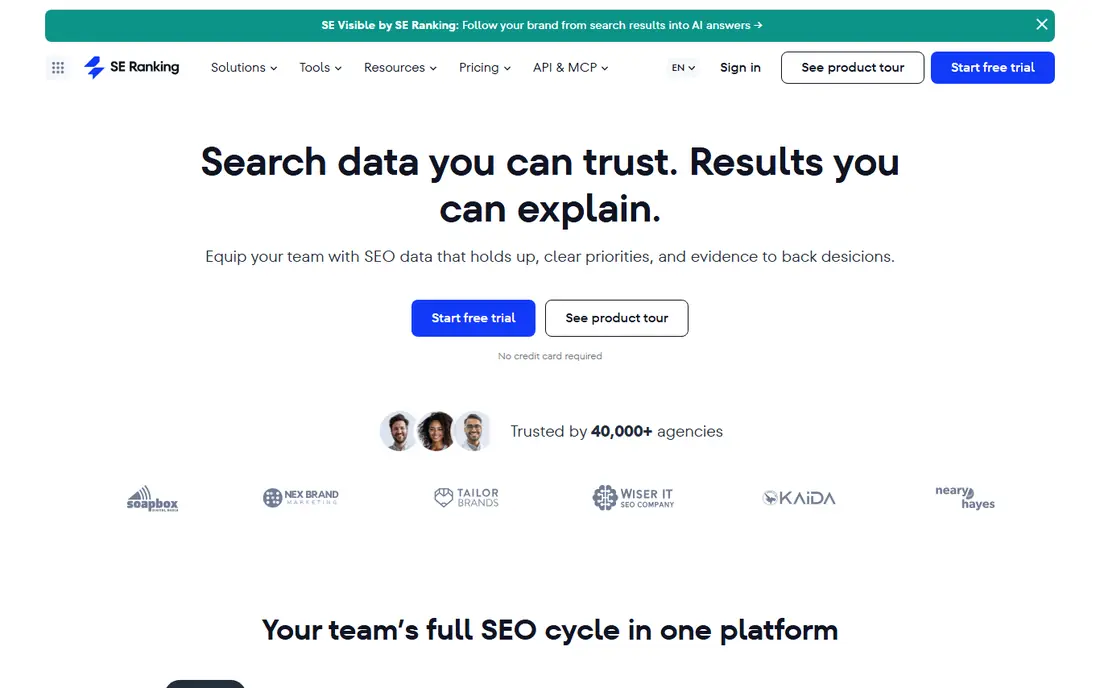
SE Ranking stands out for transparent pricing and agency-friendly reporting, including white-label options. The AI Search add-on tracks AI overviews and chat answers alongside classic rankings. Coverage is narrower than dedicated AI trackers, but for teams that need both classic and AI visibility in one bill, the value is strong.
For most readers, the deciding question with SE Ranking is fit rather than raw feature count. Check the plan limits that matter to you, such as seats, usage caps and what happens when a trial ends, before you commit to a paid tier. If the free tier or trial covers your core task, use it for a full week of real work before paying, and keep an eye on renewal terms and cancellation steps. That short test usually tells you more than any feature list, and it keeps the choice grounded in how you actually work day to day.
- Transparent pricing
- Rank tracking plus AI search add-on
- White-label reports
- AI coverage is narrower than specialist tools
- Interface takes learning
Moz Pro
Ideal for: Beginner-friendly SEO visibility
Moz Pro is the friendliest suite for teams new to SEO. Rank tracking is clear, metrics are explained well, and the learning resources help beginners interpret results. Keyword limits are modest next to Semrush, and AI visibility coverage is limited, so it suits classic search work more than AI-first tracking.
For most readers, the deciding question with Moz Pro is fit rather than raw feature count. Check the plan limits that matter to you, such as seats, usage caps and what happens when a trial ends, before you commit to a paid tier. If the free tier or trial covers your core task, use it for a full week of real work before paying, and keep an eye on renewal terms and cancellation steps. That short test usually tells you more than any feature list, and it keeps the choice grounded in how you actually work day to day.
- Clear rank tracking
- Domain authority metrics
- Helpful learning resources
- Keyword limits are modest
- AI visibility features are limited
BrightEdge
Ideal for: Enterprise content and search
BrightEdge serves large enterprises that need search visibility tied to content performance and forecasting. Reporting scales to many sites and stakeholders, and recommendations guide content teams. Pricing is quote-based and the platform is overkill for a small site, so it fits organisations with dedicated SEO teams.
For most readers, the deciding question with BrightEdge is fit rather than raw feature count. Check the plan limits that matter to you, such as seats, usage caps and what happens when a trial ends, before you commit to a paid tier. If the free tier or trial covers your core task, use it for a full week of real work before paying, and keep an eye on renewal terms and cancellation steps. That short test usually tells you more than any feature list, and it keeps the choice grounded in how you actually work day to day.
- Enterprise reporting
- Content recommendations
- Large-scale tracking
- Quote-based pricing
- Overkill for small sites
Conductor
Ideal for: Enterprise visibility and content
Conductor combines search visibility with content insights for large teams, so marketers can see which pages drive visibility and what to improve next. Integrations with analytics and content tools help larger organisations. Pricing is quote-based and onboarding takes time, so it suits teams with budget and patience for setup.
For most readers, the deciding question with Conductor is fit rather than raw feature count. Check the plan limits that matter to you, such as seats, usage caps and what happens when a trial ends, before you commit to a paid tier. If the free tier or trial covers your core task, use it for a full week of real work before paying, and keep an eye on renewal terms and cancellation steps. That short test usually tells you more than any feature list, and it keeps the choice grounded in how you actually work day to day.
- Strong reporting for large teams
- Content and search in one view
- Integrations
- Quote-based pricing
- Setup takes time
Similarweb
Ideal for: Traffic and competitor visibility
Similarweb answers a different question: how much traffic do you and your competitors actually get. Traffic estimates and benchmarking put your rankings in context, which is useful for strategy. It is not a dedicated rank tracker, so pair it with a tracking tool if daily rank data matters to you.
For most readers, the deciding question with Similarweb is fit rather than raw feature count. Check the plan limits that matter to you, such as seats, usage caps and what happens when a trial ends, before you commit to a paid tier. If the free tier or trial covers your core task, use it for a full week of real work before paying, and keep an eye on renewal terms and cancellation steps. That short test usually tells you more than any feature list, and it keeps the choice grounded in how you actually work day to day.
- Website traffic estimates
- Competitor benchmarking
- Market trends
- Free tier is limited
- Rank tracking is not the focus
SISTRIX
Ideal for: Visibility index and market tracking
SISTRIX is known for its Visibility Index, a single score that summarises how visible a domain is in search. That view helps teams track market position over time and compare competitors at a glance. The interface is technical and pricing targets professionals, so it suits experienced SEOs more than beginners.
For most readers, the deciding question with SISTRIX is fit rather than raw feature count. Check the plan limits that matter to you, such as seats, usage caps and what happens when a trial ends, before you commit to a paid tier. If the free tier or trial covers your core task, use it for a full week of real work before paying, and keep an eye on renewal terms and cancellation steps. That short test usually tells you more than any feature list, and it keeps the choice grounded in how you actually work day to day.
- Visibility index for whole domains
- Competitor comparisons
- Market data
- Interface is technical
- Pricing suits professionals
How we picked these
We compared official feature pages, pricing pages, app store listings, privacy policies and public reviews for each option below. We kept only products that exist and work now, that fit the topic directly, and whose official homepage we could confirm. Where a price was not published clearly, we wrote See website rather than guessing, and we favoured options with a free tier or trial where one exists.
Buying search visibility software in 2026
Decide whether you need AI visibility, classic rankings, or both. Specialist AI trackers cover chat answers deeply, while suites cover classic rankings deeply. If you need both, a suite with an AI add-on may be cheaper than two separate bills, but check prompt limits before you pay.
Test with your own keywords and competitors. Trials are only useful if you load real data, so import your top keywords, your main competitors and a few AI prompts on day one. A tool that looks good on demo data can disappoint on your market.
Watch the add-on trap. Base prices often exclude AI visibility, extra keywords or white-label reports, and those extras can double the bill. Ask for the total monthly cost for your keyword count and prompt count before signing an annual plan.
Frequently asked questions
What is the best search visibility software?
For most teams, Semrush offers the broadest mix of rankings, audits and AI visibility. Ahrefs leads for backlink and competitor depth, while SE Ranking offers strong value for agencies.
How much does search visibility software cost?
Prices range from budget trackers under 100 dollars a month to enterprise suites priced by quote. AI visibility add-ons can add substantially to the base price, so check the total cost for your keywords and prompts.
Do I need AI visibility tracking?
If customers find you through chat tools and AI overviews, yes, because classic rankings no longer show the full picture. If most of your traffic still comes from classic search, a traditional rank tracker may be enough for now.
Is there free search visibility software?
Google Search Console is free and shows real search performance for your own site, though it lacks competitor data. Paid suites add competitors, AI visibility and reporting, so many teams pair Search Console with one paid tool.
What is a visibility index?
A visibility index, such as the one from SISTRIX, summarises a domain's search presence as a single score over time. It is useful for tracking market position, though it should sit alongside rank and traffic data, not replace them.