Best Site Analytics Tools for Privacy and Growth

- 1
 Google Analytics 4Free, full-featured traffic analyticsVisit
- 2
 PlausiblePrivacy-first lightweight analyticsVisit
- 3
 Fathom AnalyticsSimple privacy analytics for agenciesVisit
- 4
 MatomoSelf-hosted full GA4 replacementVisit
- 5
 HotjarHeatmaps, replays, and surveysVisit
- Google Analytics 4 and Microsoft Clarity are both free, and Clarity adds heatmaps and session recordings that GA4 does not include.
- Plausible at $9 per month and Fathom at $15 per month are the cheapest privacy-first options, with no cookies and no consent banner needed.
- Matomo Cloud at $29 per month is the only tool here that can replace GA4, Hotjar, and an A/B testing tool in one interface, and its self-hosted edition is free.
- Mixpanel and Heap both offer generous free tiers for product analytics, with 1 million events and 10,000 sessions a month respectively.
- Hotjar now runs under Contentsquare pricing, with a free plan covering up to 200,000 sessions a month and Growth from $39 per month billed annually.
Quick comparison
| Product | Ideal for | Price from | Free version | |
|---|---|---|---|---|
| Google Analytics 4 | Free, full-featured traffic analytics | $0/month | Yes | Visit |
| Plausible | Privacy-first lightweight analytics | $9/month | Free trial (30 days) | Visit |
| Fathom Analytics | Simple privacy analytics for agencies | $15/month | Free trial (7 days) | Visit |
| Matomo | Self-hosted full GA4 replacement | $29/month | Yes | Visit |
| Hotjar | Heatmaps, replays, and surveys | $39/month (billed annually) | Yes | Visit |
 Mixpanel | Product funnels and retention | $0/month, usage-based | Yes | Visit |
 Heap | Autocapture analytics, minimal setup | $300/month | Yes | Visit |
 Microsoft Clarity | Free heatmaps and session replay | $0/month | Yes | Visit |
The best site analytics tools
A site analytics tool tells you where visitors come from, what they do on your site, and where they drop off. The choice comes down to three questions: do you need privacy-friendly tracking without cookies, do you need product analytics like funnels and retention, or do you need to watch how visitors behave on the page. Prices below come from vendor pricing pages and pricing reads in October and November 2026.
Google Analytics 4
Ideal for: Free, full-featured traffic analytics

Google Analytics 4, or GA4, is the default analytics tool for most websites, and it is free with no traffic limits. It tracks sessions, users, traffic sources, conversions, and ecommerce revenue, and it integrates with Google Ads and Search Console so you can see search and ad performance in one place. The free tier covers everything a small or mid-size site needs, and the 360 enterprise tier is quote only. The main drawbacks are privacy and complexity: GA4 uses cookies, so EU sites need a consent banner, and the interface is harder to learn than the privacy-first tools on this list. Data is also sampled on very large properties. GA4 fits any site that wants a free, full-featured analytics tool and does not need cookie-free tracking or session recordings.
- Free with no traffic limits
- Deep integration with Google Ads and Search Console
- Ecommerce and conversion reporting included
- Uses cookies and needs a consent banner in the EU
- The interface is complex and reports are sampled on large properties
Plausible
Ideal for: Privacy-first lightweight analytics

Plausible is a lightweight, open-source analytics tool made and hosted in the EU on European-owned infrastructure. It is the anti-GA4: a single dashboard with the numbers that matter, no cookies, no personal data collection, and a script so small it barely registers on page speed. Starter costs $9 per month for 10,000 monthly pageviews and one site, with three years of data retention, goals, custom events, and a Google Analytics import. Growth at $14 per month adds up to three sites and three team members, while Business at $19 per month adds up to ten sites, five years of retention, funnels, user journeys, and ecommerce revenue attribution. The trial lasts 30 days with no card required. Plausible fits blogs, content sites, and marketing sites that want clean, privacy-friendly stats without a consent banner.
- Cookieless tracking with no consent banner needed
- Tiny script that barely affects page speed
- Open source and hosted in the EU
- No free plan, only a 30-day trial
- Funnels and revenue attribution sit on the $19 Business plan, not the $9 Starter
Fathom Analytics
Ideal for: Simple privacy analytics for agencies
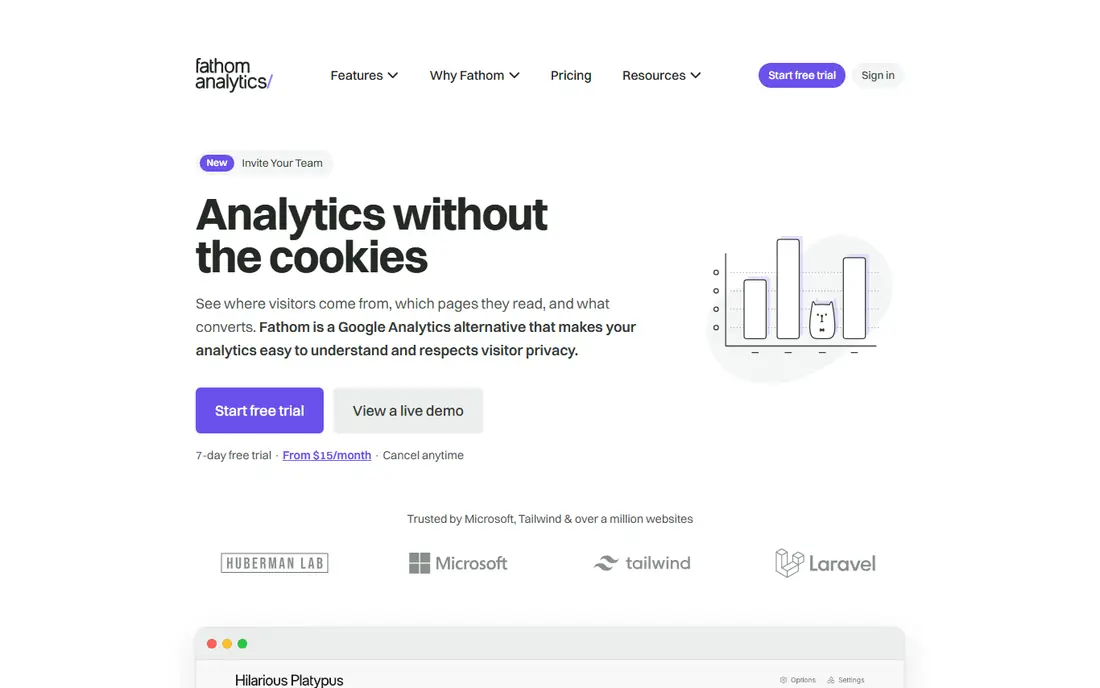
Fathom Analytics is a privacy-first analytics tool from a Canadian company, with EU traffic handled on European-owned infrastructure. Its pricing is the simplest on this list: $15 per month covers up to 100,000 monthly pageviews across 50 sites, with every feature included, and steps run $25 for 200,000 pageviews, $45 for 500,000, and $60 for 1 million. There is no free plan, only a 7-day trial that requires a card. Fathom tracks events, revenue, and shared dashboards, and it never uses cookies, so no consent banner is needed. At 100,000 pageviews it is cheaper than Plausible, and at 1 million it undercuts Plausible by a wide margin. Fathom fits agencies and owners running many small-to-medium sites who want one simple bill and no feature tiers to think about.
- One plan covers 50 sites sharing 100,000 pageviews
- Every feature included on every plan
- No cookies and no consent banner
- No free plan, only a 7-day trial that needs a card
- Less depth than GA4 or Matomo for large sites
Matomo
Ideal for: Self-hosted full GA4 replacement
Matomo is the everything alternative: the only tool on this list that can replace GA4, Hotjar, and an A/B testing tool in one interface, with no data sampling. Matomo Cloud starts at $29 per month for 50,000 hits, with data stored in Frankfurt, and premium features such as heatmaps, session recordings, and A/B testing cost extra. Some reads of the Matomo pricing page show $26 a month or 23 euros, so confirm the currency and figure at checkout. The On-Premise Community edition is free forever with unlimited users and hits, which makes Matomo the best choice for organizations with strict data residency rules or a team that can host it. Matomo fits privacy-regulated businesses and EU-market companies that want full analytics depth with data ownership.
- Only tool here that replaces GA4 plus Hotjar plus A/B testing in one interface
- Self-hosted Community edition is free forever
- Full data ownership
- Cloud entry at $29 per month is the priciest starting point here
- Heatmaps and A/B testing cost extra on Cloud
Hotjar
Ideal for: Heatmaps, replays, and surveys
Hotjar, now part of Contentsquare, helps UX researchers see how visitors behave and collect feedback in the same platform. The free plan covers up to 200,000 monthly sessions with one project and one month of data access, including heatmaps, recordings, funnels, and basic surveys, which is far more generous than the old standalone free tier. Growth starts at $49 per month, or $39 billed annually, for a 7,000-session entry tier, scaling up with traffic, with 13 months of data access, zone-based heatmaps, and AI summaries of replays. Pro and Enterprise are quote only. Note that the pricing page now routes through Contentsquare, and published figures vary slightly because the page shows euros while some third-party listings convert to dollars. Hotjar fits teams that need to watch sessions and find friction on the page, not just count visits.
- Free plan covers up to 200,000 sessions a month
- Heatmaps, recordings, funnels, and surveys in one place
- AI summaries on Growth
- Pricing now runs through Contentsquare after the merger
- The free plan keeps data for only one month
Mixpanel
Ideal for: Product funnels and retention
Mixpanel is a product analytics tool built for funnels, retention, and behavioral analysis across web and mobile apps. The free plan covers 1 million events a month plus 10,000 session replays, with unlimited seats, which is generous for a small product team. The Growth plan starts at $0 and scales with event volume, with additional events billed per event, so you only pay once you pass the free allowance. Mixpanel captures events automatically and through custom events, and it offers boards, flows, and experiments connected to product metrics. The catch is that event-based billing punishes chatty instrumentation: every extra event you track raises the bill, so you need a clean tracking plan. Mixpanel fits product-led teams that need to know where users drop off in a funnel, not just how many visited.
- Free plan covers 1 million events a month plus 10,000 session replays
- Strong funnels, cohorts, and retention analysis
- Unlimited seats on free
- Event-based billing punishes chatty instrumentation
- Needs a clean tracking plan to stay useful
- Session replay is limited on free
Heap
Ideal for: Autocapture analytics, minimal setup
Heap is an autocapture analytics tool: it records every click, pageview, and form interaction automatically, with no manual event setup, so you can define funnels and segments retroactively from data you already collected. The free plan covers 10,000 sessions a month, and Growth starts at $3,600 a year, about $300 a month, with higher session limits and advanced features. Heap suits teams that want analytics without writing tracking code for every button and page, and it pairs well with product teams that change their questions often. The main drawback is price: $3,600 a year is steep for a small site, and session-based billing means a high-engagement product can burn through its allowance fast. Heap fits mid-size product teams that value autocapture over a low entry price.
- Autocapture records every click and pageview with no manual event setup
- Free plan covers 10,000 sessions a month
- Retroactive analysis
- Growth starts at $3,600 a year, which is steep for small sites
- Session-based billing punishes high-engagement products
Microsoft Clarity
Ideal for: Free heatmaps and session replay
Microsoft Clarity is a free heatmap and session replay tool from Microsoft, and it has no priced tier at all. It records sessions, builds click and scroll heatmaps, and shows rage clicks and dead clicks, with no traffic limits and no sampling. It works on websites, web apps, and mobile apps through SDKs, and it integrates with Google Analytics so you can watch the sessions behind your GA4 numbers. The limits are clear: Clarity has no funnels, no goals, and no ecommerce reporting, so it cannot replace GA4 or a product analytics tool on its own. But as a free companion to GA4, it is hard to beat, and it is the best starting point for any team that wants to see how visitors actually use the page. Clarity fits every site that wants behavior data without spending anything.
- Completely free with no traffic limits and no priced tier at all
- Heatmaps and session recordings included
- Works on web and mobile apps
- No funnels, goals, or ecommerce reporting
- No support for custom events at the depth of Mixpanel or Heap
Cost at 100,000 monthly pageviews
| Tool | Monthly cost at 100,000 pageviews | What you get at that level | | Google Analytics 4 | $0 | Full traffic analytics, sampled on very large properties | | Microsoft Clarity | $0 | Heatmaps and session replay, no funnels | | Plausible | $19 (Business) | Funnels, revenue attribution, 10 sites | | Fathom Analytics | $15 | All features, 50 sites sharing the allowance | | Matomo Cloud | $29 | Full toolkit, premium plugins extra | | Hotjar Growth | $39 (billed annually) | 7,000 sessions, AI summaries, 13 months retention | | Mixpanel | $0 within free allowance | 1M events a month free, usage-based after | | Heap | $300 | Growth from $3,600 a year, autocapture included |
How we chose
We compared vendor pricing pages, plan documentation, and help centers for each tool, plus pricing reads from October and November 2026 where a vendor page did not render prices. We weighted the entry price, the free plan, whether tracking is cookieless, and what the tool measures, because those four factors decide whether a tool fits your site, your privacy rules, and your budget. We did not run hands-on tests, and we did not count review scores. Prices change often, so confirm the current tier and the pageview or event limit on the vendor pricing page before you sign.
What to check before you buy
Check what the tool counts before you compare prices: Plausible and Fathom charge by pageviews, Matomo Cloud by hits, and Mixpanel and Heap by events or sessions, so the same traffic can cost very different amounts. Ask whether the free plan is permanent or a trial, since Plausible and Fathom offer trials only. Confirm whether tracking needs cookies and a consent banner, which matters for EU traffic. Check the data retention period: Hotjar free keeps data for one month, while Plausible Starter keeps it for three years. Finally, ask whether the features you need, such as funnels, heatmaps, or revenue attribution, are on the entry tier or gated behind a higher plan.
Frequently asked questions
Which site analytics tool is best for a small blog?
Plausible is the best pick for a small blog, at $9 per month for 10,000 pageviews, with cookieless tracking and a clean single dashboard. Google Analytics 4 is free and more powerful, but it needs a consent banner in the EU and its interface is harder to learn. Microsoft Clarity is also free and adds heatmaps and session recordings. For most small blogs, Plausible plus Clarity covers traffic and behavior for $9 a month.
Is Google Analytics still the best free analytics tool?
Yes, for traffic analytics, Google Analytics 4 is still the best free tool, with no traffic limits and deep integration with Google Ads and Search Console. But it is not the best free tool for behavior: Microsoft Clarity is free and adds heatmaps and session recordings that GA4 does not include. Mixpanel is free up to 1 million events a month for product analytics. The best free setup is usually GA4 plus Clarity, which costs nothing and covers both jobs.
Do I need a consent banner with Plausible or Fathom?
No. Plausible and Fathom are cookieless by design and collect no personal data, so they do not need a consent banner under EU privacy rules. Matomo can also run in a cookieless mode, but you must switch it on. Google Analytics 4, Hotjar, Mixpanel, and Heap use cookies or similar identifiers by default, so they usually need consent. Check your own legal advice before removing a banner, since rules vary by country and by how you configure the tool.
What is the difference between Plausible and Fathom?
Both are privacy-first, cookieless analytics tools with simple dashboards, but they price differently. Plausible starts at $9 a month for 10,000 pageviews on one site, and features like funnels sit on the $19 Business plan. Fathom starts at $15 a month for 100,000 pageviews across 50 sites, with every feature included on every plan. Fathom is cheaper at higher traffic and for agencies, while Plausible is cheaper at low traffic and is open source.
Can Matomo replace Google Analytics completely?
Yes. Matomo is the closest full replacement for Google Analytics, with unsampled reporting, GA import, ecommerce reporting, multi-channel attribution, and optional heatmaps, session recordings, and A/B testing. The self-hosted Community edition is free, and Cloud starts at $29 a month. The trade-off is cost and setup: Cloud is the priciest entry point here, and self-hosting needs a server and maintenance. Matomo fits teams that need data ownership or strict residency rules.