Best Sleep Meditation Apps in 2026: 8 Options Compared

- Calm leads for sleep stories and soundscapes, while Headspace leads for structured learning.
- Insight Timer and Medito offer the most free content for listeners on a budget.
- Balance personalizes daily plans, and Waking Up suits listeners who want deeper teaching.
- Try the free content first, since sleep taste is personal and a trial week tells you more than a feature list.
Quick comparison
| Product | Ideal for | Price from | Free version | |
|---|---|---|---|---|
 Calm | Sleep stories and soundscapes | $14.99 per month | Yes | Visit |
 Headspace | Beginners who want structure | $12.99 per month | Free trial | Visit |
 Insight Timer | Free content and variety | Free | Yes | Visit |
 Balance | Personalized daily plans | $11.99 per month | Free trial | Visit |
 Waking Up | Deeper teaching and theory | $14.99 per month | Free trial | Visit |
 Medito | A fully free option | Free | Yes | Visit |
 Aura | Short personalized sessions | See website | Yes | Visit |
 Smiling Mind | Free evidence-based programs | Free | Yes | Visit |
The best best sleep meditation app
Sleep meditation apps work best when they remove decisions at bedtime. We compared guided sleep content, sleep stories, soundscapes, timers, free content and subscription prices, and we favored apps that offer a clear bedtime routine rather than a large library with no guidance.
In this guide, we list eight best sleep meditation app options and explain who each one suits best, what it costs to start, and where it falls short. We kept the list focused on products that are widely available in the United States and that a reader can actually sign up for today, rather than filling the list with niche tools that are hard to buy or that have stopped updating their product. Prices and free tiers are shown as we found them in October 2026, and we note where a price needs a check on the vendor site because it varies by plan, team size or region.
Calm
Ideal for: Sleep stories and soundscapes

Calm is the strongest bedtime choice in this list for listeners who fall asleep to stories rather than silent meditation. Its sleep stories, music and nature sounds are polished and easy to find, and the daily session gives returning users a simple place to start each evening.
The catch is price and paywall depth. Only a small amount of content is free, and the annual plan is the better value for regular users. If sleep is the main goal, Calm is our pick for most people, but try the free sessions first to check whether story narration helps you drift off.
- Large sleep story library
- Quality soundscapes
- Daily sessions
- Most content needs a subscription
- Library can feel crowded
Headspace
Ideal for: Beginners who want structure

Headspace teaches meditation step by step, which helps beginners who do not know where to start. Its sleepcasts and wind-down exercises pair guided narration with calming sound, and the structured courses carry over into daytime stress and focus practice.
Headspace suits listeners who want a course, not just a playlist. The free content is limited, so use the trial to complete the basics course and test the sleepcasts before paying. If you mainly want stories read by familiar voices, Calm will feel richer.
- Clear beginner courses
- Sleepcasts
- Short wind-down exercises
- Most content is paid
- Sleep library is smaller than Calm
Insight Timer
Ideal for: Free content and variety
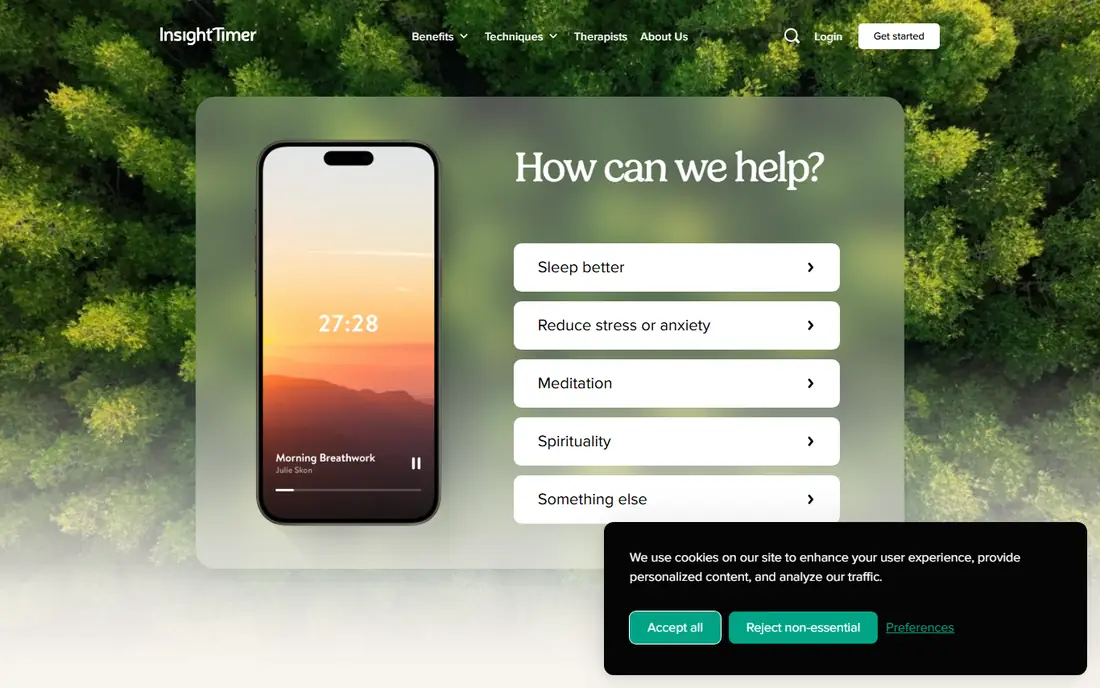
Insight Timer offers thousands of free guided meditations, sleep tracks, talks and a customizable timer, which makes it the best free starting point in this list. Teachers from many traditions contribute, so listeners can find styles that suit them without paying first.
The size of the library is also its weakness, since quality varies and searching takes patience. Save favorite teachers and build a small bedtime playlist to avoid scrolling at night. Paid Member Plus adds courses and offline listening, but the free tier alone supports a steady practice.
- Very large free library
- Live events
- Flexible timer
- Quality varies by teacher
- Choice can overwhelm beginners
Balance
Ideal for: Personalized daily plans
Balance builds a personal meditation plan from your experience, goals and feedback, then adjusts each day. That structure helps people who quit other apps because they never knew what to play next, and sessions stay short enough for a busy evening routine.
Balance is a good middle ground between Headspace structure and Insight Timer variety. Its sleep content is solid but less story-driven than Calm, so listeners who need narration to fall asleep should compare both during their trials.
- Plans adapt to experience and goals
- Short daily sessions
- Smaller sleep story library than Calm
- Paid after trial
Waking Up
Ideal for: Deeper teaching and theory
Waking Up pairs guided meditations with short lessons on attention, awareness and the mind, which appeals to listeners who want to understand the practice, not just follow a voice. It includes sleep meditations and a timer, and it offers free access to people who say they cannot afford it.
The teaching style is not for everyone. Listeners who want a simple story at bedtime may find the lessons too demanding late at night. For curious practitioners who want depth, it is one of the most rewarding apps in this list.
- Thoughtful lessons
- Theory alongside practice
- Sleep content included
- Higher price
- Less story-style sleep content
- Can feel intellectual
Medito
Ideal for: A fully free option
Medito is a nonprofit app with no paywall, offering guided meditations, courses, sleep sessions and a timer at no cost. It is an honest choice for anyone who wants to build a habit without a subscription decision hanging over the first month.
The library is smaller and the design is plainer than Calm or Headspace, but the core content is well organized for beginners. Medito is our pick for listeners on a tight budget, and it pairs well with Insight Timer for extra variety.
- Completely free
- Beginner courses
- Sleep content
- Smaller library
- Simpler design
- Fewer celebrity voices
Aura
Ideal for: Short personalized sessions
Aura focuses on short, personalized sessions matched to mood, stress or sleep, which suits listeners who only have a few minutes at bedtime. It includes sleep stories, music and courses, and the app learns from feedback to suggest what to play next.
The free tier gives a taste rather than a full library, and paid pricing varies, so check the current offer in the app store before subscribing. Aura is worth trying when long sessions feel like too much and a short wind-down is more likely to happen every night.
- Short daily sessions
- Mood-based picks
- Sleep stories
- Free tier is limited
- Pricing varies by offer
Smiling Mind
Ideal for: Free evidence-based programs
Smiling Mind is a free nonprofit app with structured mindfulness programs for adults, children and classrooms. It is a calm, no-pressure option for families and beginners who want a guided path without ads or subscription prompts.
It has less bedtime storytelling than Calm, so it suits listeners who prefer straightforward guided practice over stories. For a free, structured program with no paywall, Smiling Mind is one of the most trustworthy choices available.
- Free programs for adults and children
- Structured courses
- Less sleep-story content
- Australian nonprofit focus
How we picked these
We compared official feature pages, pricing pages, app store listings, privacy policies and public reviews for each option, and we checked that each product is still available and working in October 2026. We favored products that fit the topic directly, publish clear pricing or a clear free tier, and explain how they handle data and support. We left out products that looked discontinued, that did not match the topic, or whose official homepage we could not verify. Prices change often, so check the vendor page linked in each block before you pay.
We also paid attention to the details that decide daily satisfaction, not just headline features. That meant checking how a free plan actually limits use, whether a paid plan is priced per user, per device or per account, and what happens when you add team members or exceed a limit. Where a vendor only publishes quote-based pricing, we say so rather than guessing a number, and where a first-year discount differs from a renewal price, we flag that difference in the product write-up so the second year does not come as a surprise.
How to pick a sleep app you will actually use at night
Choose by how you fall asleep. Story listeners should lean toward Calm, structure seekers toward Headspace or Balance, and budget listeners toward Insight Timer or Medito. Download two apps, not eight, and test each for three nights with the same bedtime routine.
Keep the routine short and repeatable. Pick one sleep session, set a regular start time, and put the phone face down once it starts. A 10-minute session you use nightly beats a 45-minute session you skip, and a timer with soft sounds can work when narration keeps you awake.
Check the subscription before the trial ends. Note the annual price, whether offline listening is included, and whether family sharing applies. If sleep problems persist, talk to a clinician, since an app supports relaxation but does not diagnose sleep disorders.
Before you commit, run a short trial with the work you actually do, not with demo data. Set up one real project, booking, routine or workflow, invite the people who will use the tool every day, and check support response time when you hit a question. A product that feels good in a sales demo can still fail on a busy day, so a trial that mirrors real use is the most reliable test. If two options feel close after that trial, choose the one with clearer pricing, simpler cancellation and better support, since those factors matter long after the novelty of a new tool fades. Keep a note of the trial end date, the renewal price and the cancellation steps, so a decision made in a hurry does not turn into a subscription you forgot to review. That small record, kept in the same place as your other subscription dates, makes the yearly renewal check a five-minute job rather than a surprise bill.
Frequently asked questions
What is the best sleep meditation app?
For most sleep listeners, Calm is the strongest pick because of its sleep stories and soundscapes. Headspace is better for structured learning, and Insight Timer is better when a large free library matters most.
Are there free sleep meditation apps?
Yes. Insight Timer, Medito and Smiling Mind all offer substantial free content, including sleep sessions. Paid apps usually offer a trial, but the free apps in this list can support a nightly routine without a subscription.
Do sleep stories really help you fall asleep?
They help many listeners by giving the mind a gentle focus instead of looping thoughts, but taste matters. Try a story, a soundscape and a silent timer across different nights to learn which style helps you drift off fastest.
What is the best guided meditation app for beginners?
Headspace and Balance are the easiest starting points because they build a course around you. Insight Timer and Medito are also good for beginners who want free content and do not mind choosing their own sessions.
Can a meditation app replace treatment for insomnia?
No. Apps can support relaxation and routine, but ongoing insomnia, loud snoring, or daytime sleepiness deserve a clinician visit. Use the app as part of a steady bedtime routine, not as a diagnosis or treatment.