Best Smoking Cessation Apps in 2026: 7 Apps Compared

- 1
 Smoke FreeStructured quit programVisit
- 2
 QuitNowCommunity supportVisit
- 3
 Quit GeniusCoaching-based programVisit
- 4
 KwitGamified quittingVisit
- 5
 Quit TrackerSimple progress trackingVisit
- QuitNow and Smoke Free suit most quitters with progress tracking, cravings tools and community support.
- This is general information, not medical advice. Talk to a clinician about nicotine replacement, prescription options and a quit plan that fits you.
- Apps help most when combined with support, such as counseling, a quitline, or medication where appropriate.
- Free tiers cover core tracking well, so pay only if you need coaching or advanced programs.
- Our pick for most quitters is Smoke Free, with QuitNow as the pick for community support.
Quick comparison
| Product | Ideal for | Price from | Free version | |
|---|---|---|---|---|
| Smoke Free | Structured quit program | Free | Yes | Visit |
| QuitNow | Community support | Free | Yes | Visit |
| Quit Genius | Coaching-based program | See website | Free trial | Visit |
| Kwit | Gamified quitting | Free | Yes | Visit |
| Quit Tracker | Simple progress tracking | Free | Yes | Visit |
 SmokeFree.gov | Free government quit support | Free | Yes | Visit |
 Puff Count | Simple cigarette counting | Free | Yes | Visit |
The best smoking cessation apps
Quitting smoking is hard, and an app can help by tracking progress, showing money saved and health gains, and offering tools for cravings. The apps below differ in structure, community and coaching. We compared official feature pages, pricing, app store listings and public reviews. If you smoke, talk to a clinician about a quit plan, including nicotine replacement or prescription options where appropriate. For immediate support in the US, call 1-800-QUIT-NOW.
Smoke Free
Ideal for: Structured quit program
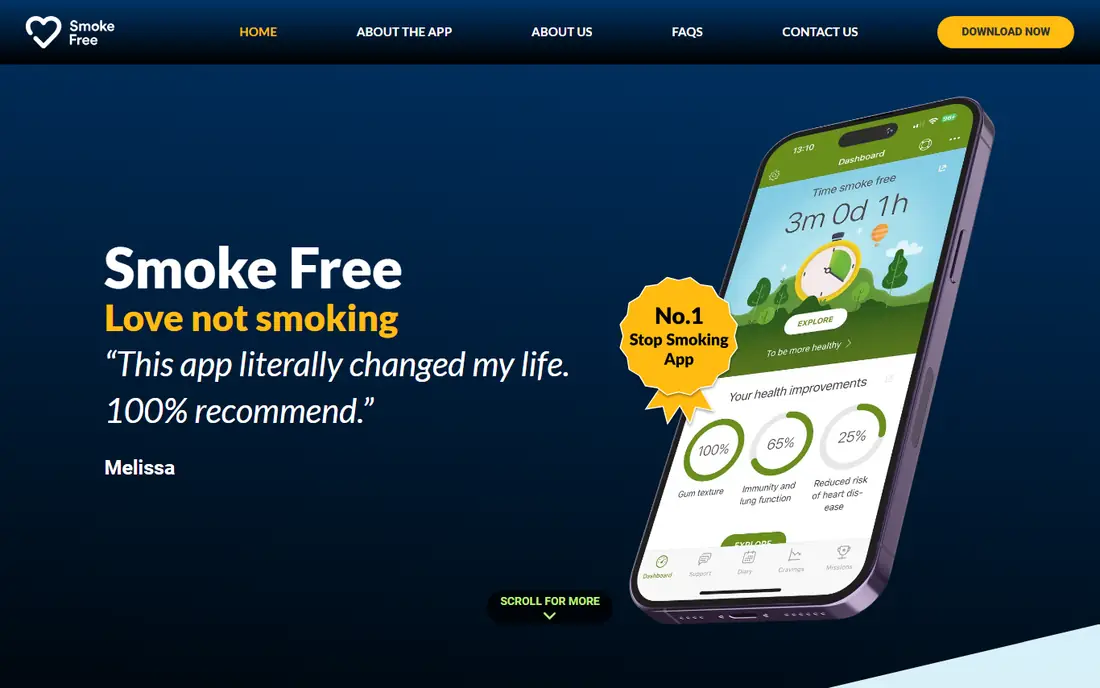
Smoke Free is our pick for most quitters because it combines a structured program with practical tools. Daily missions guide the first weeks, cravings tools offer coping strategies in the moment, and progress tracking shows days smoke-free, money saved and health milestones. The free tier covers core tracking, while Pro adds the full program and extra tools.
It is less community-heavy than QuitNow, so quitters who want peer chat may prefer that app alongside Smoke Free. For a clear, day-by-day quit structure, Smoke Free is the strongest single app in this list.
- Clear quit plan and daily missions
- Cravings tools
- Progress and savings tracking
- Full program features need Pro
- Some users want more community depth
QuitNow
Ideal for: Community support

QuitNow suits quitters who value peer support. Its community chat connects you with other people quitting, which helps on hard days, and milestones show health gains and money saved over time. The app tracks cigarettes avoided, time smoke-free and savings, giving a clear picture of progress.
The free tier includes ads, and Pro removes them and adds features. Community quality varies, as with any open chat, so use the community for encouragement and rely on a clinician or quitline for medical guidance. For social support during a quit, QuitNow is our pick.
- Large supportive community
- Chat with other quitters
- Health and savings milestones
- Ads in the free tier
- Pro needed for full features and ad removal
Quit Genius
Ideal for: Coaching-based program

Quit Genius offers a coaching-based program built on cognitive behavioral techniques, with a personal coach, structured lessons and tracking. It suits quitters who want guided support rather than just a tracker, and some employers and health plans cover it, so check benefits before paying.
Pricing is subscription-based or custom through employers, so check the official site for current consumer pricing. The program asks more time than a simple tracker, which is a strength for committed quitters and a barrier for casual users. If you want coaching, Quit Genius is the leading app-based option.
- Structured program with coaching
- Cognitive behavioral approach
- Employer coverage sometimes available
- Pricing is custom or subscription-based
- Program is more intensive than simple trackers
Kwit
Ideal for: Gamified quitting
Kwit turns quitting into a game, with levels, achievements and openables as you stay smoke-free. That structure motivates some quitters, especially those who respond to streaks and rewards, and cravings tools help in tough moments. Progress statistics show money saved and health gains alongside game progress.
Gamification does not suit everyone, and some users find the game elements distracting from the quit itself. Premium opens full features. If streaks and achievements keep you motivated, Kwit is a fun, effective tracker.
- Gamified levels and achievements
- Cravings tools
- Progress statistics
- Game elements may distract some users
- Full features need Premium
Quit Tracker
Ideal for: Simple progress tracking
Quit Tracker is a simple, focused app for users who want progress stats without extras. It tracks days smoke-free, money saved and health milestones, with a savings calculator that makes the financial benefit concrete. For a quitter who already has support elsewhere and just wants a counter, it is enough.
Coaching, community and cravings tools are limited, so pair it with a quitline, counseling or a community app if you need support. Its simplicity is its strength for users who want a clean tracker.
- Simple, focused tracking
- Health milestones
- Savings calculator
- Limited coaching or community
- Basic design
SmokeFree.gov
Ideal for: Free government quit support
SmokeFree.gov, from the US National Cancer Institute, offers free, evidence-based quit support, including the quitSTART app, text programs and quitline referrals. It is completely free, with no ads or upsells, and its tools are built on cessation research. For a quitter who wants trusted, free help, it is an excellent starting point.
The app experience is simpler than commercial apps, with less gamification and community. Use SmokeFree.gov for trusted guidance and a quit plan, and add a commercial tracker for daily motivation if you want it. In the US, calling 1-800-QUIT-NOW connects you to free quitline coaching.
- Completely free
- Evidence-based tools
- Quitline and text programs
- App experience is simpler than commercial apps
- Less gamification
Puff Count
Ideal for: Simple cigarette counting
Puff Count suits people cutting down before a quit date, or tracking cigarettes smoked per day as a first step. Its simple counter makes daily use easy, and seeing counts fall can motivate a full quit attempt. For a gradual reduction plan agreed with a clinician, it is a useful tool.
It is not a full quit program, with limited cravings, community or coaching support. Use it as a stepping stone toward quitting, not as the whole plan, and set a quit date with support in place.
- Very simple counting
- Useful for cutting down before quitting
- Clear daily counts
- Not a full quit program
- Limited support features
How we picked these
We compared official feature pages, pricing, app store listings and public reviews for smoking cessation apps available in the US in October 2026. We favored apps with clear tracking, cravings tools or support, no misleading health claims, and a working official homepage. We left out apps we could not verify as live products.
What to check before you choose
Pick an app that fits how you quit. A structured program suits quitters who want daily guidance, a community app suits those who want peer support, and a simple tracker suits those who already have support elsewhere. Try the free tier for a few days before paying, since daily use matters more than features.
Combine app support with real help
Apps work best alongside other support. Consider a quitline, counseling, or nicotine replacement or prescription medication discussed with a clinician. Set a quit date, tell people around you, and plan for cravings with strategies from the app and your clinician. If you slip, use it as information to adjust the plan, not as a reason to give up.
Try the free tier for a full week before paying
The free tier or trial for most apps in this list is enough to judge whether the app fits your routine, but only if you use it for a full week rather than an afternoon. Set it up properly on day one, including notifications, reminders, and any import from your current app, so the trial reflects real use instead of a half-finished setup. Use it at the same times you would normally use such an app, and note what annoys you by day three, since small annoyances grow into reasons to quit. Check whether your data exports cleanly, whether the app works offline when you need it, and whether support answers a real question promptly. If the app still earns its place after a week of honest use, the paid plan is an easy decision, and if it does not, you have saved a subscription you would have cancelled later.
Check the reminder and notification settings on day one, since a tracker only helps if you open it when a craving hits. Set a morning check in, a midday reminder, and an evening review for the first two weeks, then trim the alerts that you ignore. Also check whether the app lets you log a slip without resetting your whole history, because a single slip should not erase weeks of progress. A clear way to record the trigger, the time, and what helped you recover makes the next craving easier to handle. If the app makes logging feel like work, try a simpler tracker from this list for a week and compare which one you actually open each day.
Frequently asked questions
What is the best app to quit smoking?
Smoke Free is our pick for most quitters, thanks to its structured program and cravings tools. QuitNow suits quitters who want community support, and SmokeFree.gov offers free, evidence-based help for everyone.
Are quit smoking apps free?
Many offer free tiers covering core tracking, including Smoke Free, QuitNow and SmokeFree.gov. Paid plans add coaching, full programs or ad removal, so pay only if you use those extras.
Do smoking cessation apps really help?
Apps can help by tracking progress, showing savings and health gains, and offering cravings strategies, especially when combined with counseling, quitline support or medication. They are aids, not guarantees, and a clinician can help build a full quit plan.
Should I use nicotine replacement with an app?
Many quitters benefit from nicotine replacement or prescription options, but the right choice depends on your health and smoking history. Talk to a clinician or pharmacist about options, and use the app to track progress alongside that plan.
What should I do if I slip and smoke?
A slip does not erase progress. Note what triggered it, adjust your plan, and keep going rather than returning to regular smoking. If slips keep happening, talk to a clinician or quitline coach about changing the plan or support.