Best SMS for Healthcare Software

- 1
 OhMDEHR-connected practices that want two-way patient textingVisit
- 2
 SimpleTextingSmall teams that want simple credit pricingVisit
- 3
 Text-Em-AllLow cost reminders and staff alertsVisit
- 4
 WeaveDental and optometry practices that want phones plus textingVisit
- 5
 SolutionreachPractices that want reminders, recall, and check-in in one bundleVisit
- OhMD leads for practices that want two-way patient texting tied to the EHR, from $300 per month.
- Text-Em-All is the cheapest entry point at $19 per month, but the vendor states it is not HIPAA compliant, so keep it to staff alerts and reminders that carry no patient health details.
- Weave and Solutionreach bundle phones, reminders, and texting from $199 and $189 per month, which suits practices that want one vendor for the front desk.
- Twilio costs $0.0083 per text segment, the lowest per-message rate here, but your team builds the workflow, since it ships as a developer platform rather than a ready inbox.
Quick comparison
| Product | Ideal for | Price from | Free version | |
|---|---|---|---|---|
| OhMD | EHR-connected practices that want two-way patient texting | $300 per month | No | Visit |
| SimpleTexting | Small teams that want simple credit pricing | $29 per month | Free trial (14 days) | Visit |
| Text-Em-All | Low cost reminders and staff alerts | $19 per month | Yes | Visit |
| Weave | Dental and optometry practices that want phones plus texting | $199 per month | No | Visit |
| Solutionreach | Practices that want reminders, recall, and check-in in one bundle | $189 per month (billed annually) | No | Visit |
 Luma Health | Multi-location groups that want scheduling automation | quote only | No | Visit |
 Klara | Medical practices that want a shared messaging inbox | quote only | No | Visit |
 Twilio | Developer teams that want to build custom reminders | $0.0083 per SMS segment | Free trial | Visit |
Best SMS for Healthcare Software
OhMD
Ideal for: EHR-connected practices that want two-way patient texting
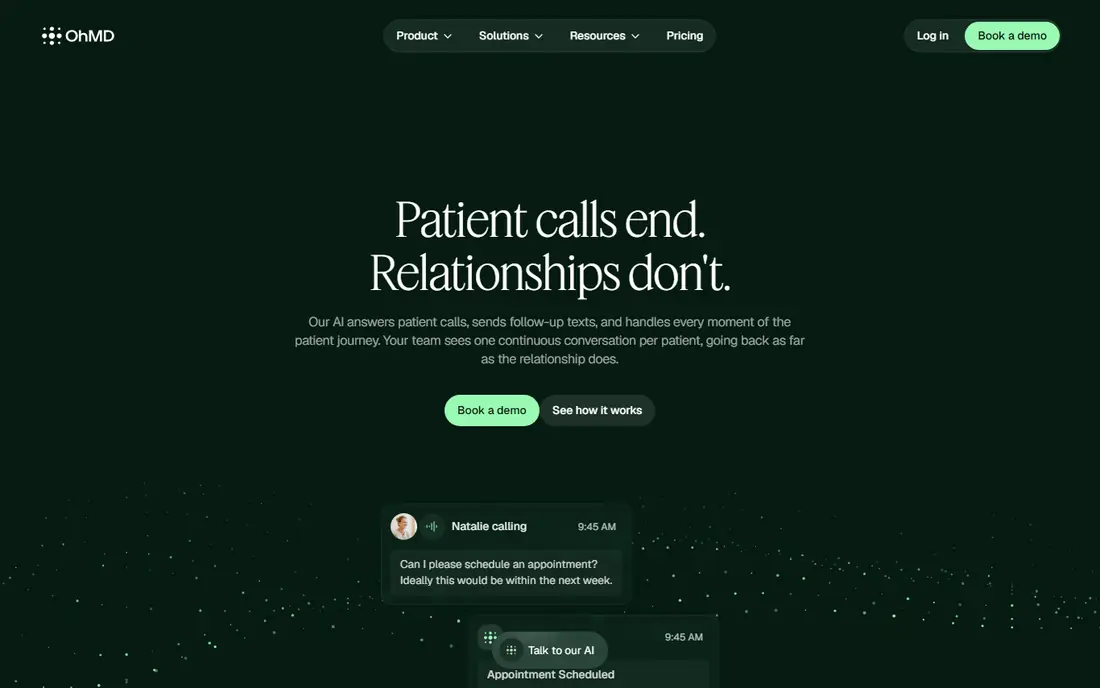
OhMD turns a practice phone number into a two-way texting hub, so patients can reply to reminders, ask questions, and complete forms by text without installing an app. The Core plan starts at $300 per month and covers two-way SMS, a text-enabled landline, voice and video calling, voicemail transcription, and call handoff to text. The vendor states that its platform supports HIPAA-compliant communication across its channels when the right patient consent is in place, which is the wording to confirm in writing before you send any message that carries health details.
The draw for busy front desks is the EHR connection. OhMD lists more than 85 EHR integrations, so appointment data can flow into reminders and replies without manual retyping. The AI and Automation tier starts at $500 per month and adds patient call automation, automatic message routing, and custom workflows. The main limits are cost and the absence of a free tier: a small practice pays $300 per month before a single call, and calling usage is billed separately from the plan price.
- Two-way SMS from your existing office number
- More than 85 EHR integrations
- No free plan or free trial
- Calling usage billed separately
SimpleTexting
Ideal for: Small teams that want simple credit pricing
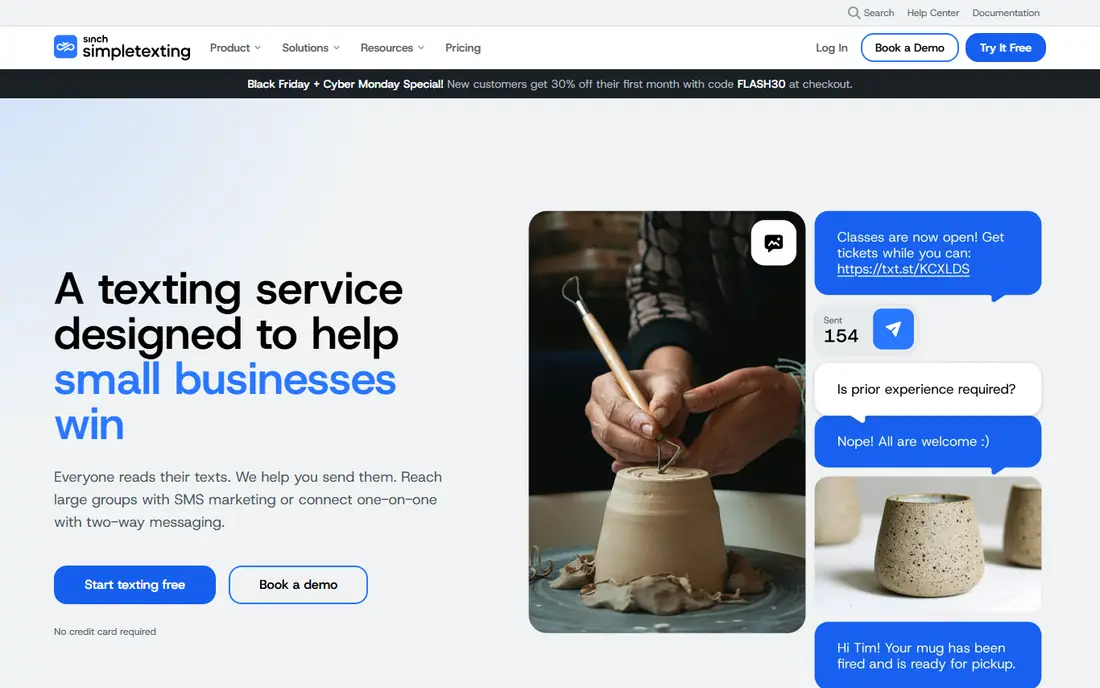
SimpleTexting sells one plan with every feature, priced by message credits. The entry tier is $29 per month for 500 credits, and annual billing takes 20 percent off the credit price. Incoming SMS replies are free, three user seats are included, and unused credits roll over until the end of the following month. A local number adds $10 per month plus a $4 one-time carrier registration fee, while a toll-free number carries no added fee. Extra seats cost $20 per month each, and extra credits at the entry tier cost 5.5 cents each.
This is a general business texting tool, not a healthcare platform, so it fits appointment reminders and broadcast notices better than clinical conversations. The vendor offers a 14-day free trial, live support seven days a week, and integrations with Mailchimp and Zapier. Before using it for patient messages, ask the vendor about a business associate agreement in writing and keep protected health information out of plain text messages, since standard SMS is not encrypted in transit.
- One plan with every feature
- Unused credits roll over to the next month
- US and Canada only
- A local number adds $10 per month plus a $4 one-time fee
Text-Em-All
Ideal for: Low cost reminders and staff alerts
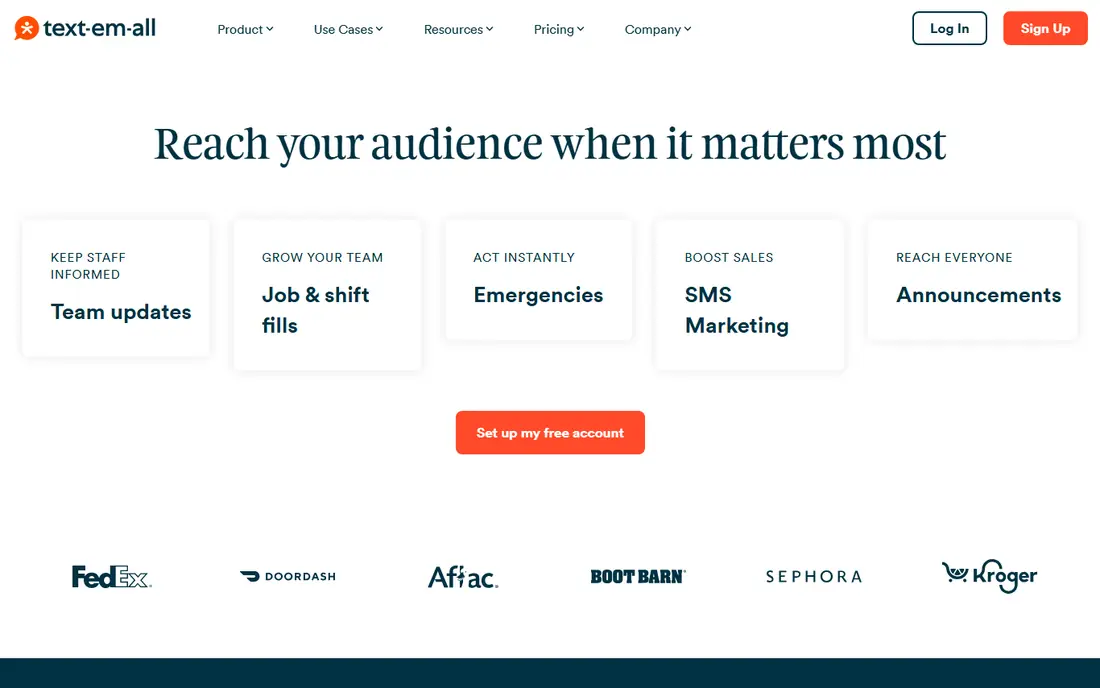
Text-Em-All offers two ways to buy: pay-as-you-go credits from 6 cents per credit, or a monthly plan from $19 per month. A free starter includes 25 credits with no credit card required, and the vendor charges no fees for users, phone numbers, or carrier registration. The platform covers text broadcasts, two-way texting, a shared team inbox, text surveys, auto-replies, and drip campaigns, plus voice broadcasts that can reach people a text cannot reach.
The limit that matters most is compliance. On its own comparison page, the vendor states plainly that the platform is not HIPAA compliant, because it does not encrypt messages at rest and standard SMS cannot be encrypted in transit. That makes Text-Em-All a sound pick for staff alerts, shift fills, and plain appointment reminders that carry no health details, and a poor pick for messages that include diagnoses, test results, or treatment details. Monthly plans cap message length at 320 characters unless you add enhanced texting.
- Free starter with 25 credits
- No per-seat fees and no carrier surcharges
- Vendor states the platform is not HIPAA compliant
Weave
Ideal for: Dental and optometry practices that want phones plus texting
Weave combines VoIP phones with two-way texting, appointment reminders, online scheduling, digital forms, review requests, and text-to-pay in one system built for healthcare practices. Pricing starts from $199 per month for the Base plan, which covers calling, two-way texting, missed call text, text-to-pay, call analytics, fax, a mobile app, and team chat. Bulk texting runs from 1,500 messages a month on the lower tier to 15,000 on the top tier, and the Coordinate and Attract bundles add $149 per month each for scheduling, forms, reviews, and bulk messaging.
Weave publishes a business associate addendum with its terms, which gives compliance-minded buyers a document to review rather than a sales promise. The platform is strongest in dental and optometry, where its phone system and recall workflows match daily routines. The main drawback is pricing opacity beyond the starting figure: per-plan prices come only on request, and the per-location charge compounds quickly for groups, since three locations cost $597 per month before any bundle.
- Phones, two-way texting, and payments from one vendor
- Published BAA addendum
- Per-plan prices only on request
- Price is charged per location
Solutionreach
Ideal for: Practices that want reminders, recall, and check-in in one bundle
Solutionreach is a long-standing patient engagement platform built around automated reminders, two-way texting, recall, online scheduling, and patient check-in. The Essentials package costs $189 per month on an annual plan or $249 month to month, a promotional rate available until December 31, and it includes up to 1,500 messages per month. The vendor states that the platform works with more than 400 practice management and EHR systems, so reminders and replies can sync with the schedule most practices already use.
Higher tiers add pro newsletters and surveys, digital intake, batch messaging, secure documents, insurance eligibility for dental practices, and larger SMS allowances of 3,500 and 4,500 messages per month. The vendor-supplied starting price on review sites is $329 per month for the standard platform, which shows how far the Essentials promo sits below the regular rate. The honest catch is that the promotional price is locked for the first year only, after which the price is subject to change, so get the renewal figure in writing before you sign.
- Works with more than 400 practice management and EHR systems
- Reminders, recall, and check-in included
- Essentials message cap of 1,500 per month
- Price can change after the first year
Luma Health
Ideal for: Multi-location groups that want scheduling automation
Luma Health is a patient engagement platform aimed at medical groups, health systems, and multi-location practices. Its core strengths are scheduling automation: self-scheduling widgets, a smart waitlist that texts waitlisted patients when a slot opens, referral outreach that contacts referred patients by text, and appointment reminders in more than 20 languages. The vendor describes its secure chat as HIPAA compliant and notes that actions write back to the EHR, which keeps the record current without duplicate entry.
The platform also covers digital intake, pre- and post-care messaging, and telehealth links sent by SMS, so patients can join a video visit without an extra download. The drawback is access: Luma Health publishes no price and offers no self-serve signup or trial, so every buyer goes through a sales conversation and a quote based on provider count and modules. That scope suits larger organizations, while a single-location practice may find the setup heavier than a simpler texting tool.
- Reminders in more than 20 languages
- Smart waitlist fills cancelled slots automatically
- No public price and no self-serve trial
- Sales-led buying only
Klara
Ideal for: Medical practices that want a shared messaging inbox
Klara is a patient communication platform built around a shared inbox where the whole team can see, assign, and answer patient messages. AI-powered routing directs incoming messages by urgency and topic, voicemail is transcribed to text so staff can scan it, and patients can message the practice without logins or downloads. The platform also covers appointment reminders, digital intake forms, and video visits that patients join from a text link, and it serves medical practices across more than 40 specialties.
Klara was acquired by ModMed in 2022, and its website now leads into ModMed patient engagement pages, which reflects its place inside a larger specialty practice ecosystem. The vendor publishes no price, so every quote is tailored to practice size, locations, and modules, and there is no free plan or self-serve trial. Klara also lacks native scheduling and billing, so practices that need those functions will pair it with another system or look at a broader bundle instead.
- AI message routing sends each inquiry to the right staff member
- Voicemail to text included
- No published price and no free trial
- No native scheduling or billing
Twilio
Ideal for: Developer teams that want to build custom reminders
Twilio is a developer platform for messaging, not a ready-made inbox, which makes it the most flexible and the most hands-on tool in this list. US SMS costs $0.0083 per 160-character segment to send or receive, across long codes, toll-free numbers, and short codes, and the vendor states that pricing is current as of October 2026. Carriers add their own fees on top, for example $0.0035 per outbound text to AT&T, $0.0045 to T-Mobile, and $0.005 to Verizon, while a local number costs $1.15 per month and a toll-free number costs $2.15.
A practice with developers can build exactly the reminder flow it wants, with two-way conversations, scheduling links, and EHR triggers, and pay only for the messages it sends. Twilio offers a free trial with no credit card required to start building, plus volume discounts for high-volume senders. The tradeoff is effort: there is no front-desk inbox out of the box, long messages split into segments that each bill separately, and plain SMS is not encrypted, so your team must design the workflow around consent, opt-outs, and a signed business associate agreement where patient data is involved.
- Pay-as-you-go pricing with no monthly platform fee
- Volume discounts as you scale
- No ready-made practice inbox
- Compliance setup is your team's job
How we chose
We opened each vendor homepage and pricing page on 12 November 2026 and recorded the starting price shown there, or marked the tool quote only when the vendor publishes no price. We compared two-way texting, appointment reminders, message limits, EHR integrations, and the compliance wording each vendor publishes, including whether it offers a business associate agreement. We favored tools with healthcare messaging features or a clear healthcare focus, and we kept one general SMS platform and one developer platform in the list so practices with different needs can compare them. We did not run hands-on tests, join demos, or interview users, so treat this as a pricing and feature comparison, not a trial report. Prices change, so confirm the current figure on the vendor pricing page before you budget.
What to check before you buy
Start with compliance, because it decides which messages you can send at all. Ask each vendor for a signed business associate agreement in writing, and confirm which plan it covers, since some vendors attach it only to certain tiers. Get patient consent and a clear opt-out path before the first text, and keep protected health information out of plain SMS unless the message travels through the vendor's encrypted, agreement-covered channel. Check message caps against your real volume: 1,500 messages a month covers a small practice, but a busy clinic with reminders, recalls, and confirmations can pass that quickly.
Then check the practical details. Confirm that your existing office number can be text-enabled and ported, and ask how long carrier registration takes, since new numbers need approval before the first campaign goes out. Confirm the EHR or practice management integration by name, not by a logo on a marketing page, and ask which fields sync in each direction. Read the contract term, the renewal notice window, and the cancellation process, and ask for the full monthly bill in writing, including number fees, carrier fees, overage rates, and setup charges.
| Practice size | Monthly budget signal | Best match | | Solo practice or 2 providers | Under $50 per month | Text-Em-All at $19, SimpleTexting at $29 | | Small practice, 3 to 10 providers | $189 to $300 per month | Solutionreach Essentials at $189, OhMD Core at $300 | | Dental or optometry, one location | From $199 per month | Weave Base at $199 | | Multi-location group or health system | Quote based | Luma Health, Klara | | Developer-led team or high volume | $0.0083 per segment | Twilio |
Frequently asked questions
Is plain SMS HIPAA compliant for patient messages?
Plain SMS on its own is not HIPAA compliant, because standard text messages are not encrypted and there is no agreement with the mobile carrier. A message stays compliant only when it carries no protected health information, such as a bare appointment time, or when it travels through a vendor channel covered by a signed business associate agreement. Ask each vendor which of those two paths its product uses.
What does SMS for healthcare cost per month?
Entry prices in this list run from $19 per month for Text-Em-All and $29 per month for SimpleTexting up to $300 per month for OhMD Core, while Weave starts at $199 and Solutionreach Essentials at $189 on an annual plan. Twilio charges $0.0083 per text segment with no monthly platform fee. Add number fees, carrier fees, and overage charges to the headline price before you compare totals.
Do I need a BAA before texting patients?
Yes, get a signed business associate agreement before you send any message that could carry patient health information. The agreement makes the vendor legally responsible for protecting that data. Ask which plan the agreement covers and get it in writing, since some vendors attach it only to certain tiers. A vendor that cannot produce one is a signal to keep its tool to staff messages and plain reminders.
Can patients reply to appointment reminders by text?
Yes, with the tools in this list that offer two-way texting. Patients can confirm, cancel, or reschedule from the reminder itself, and staff see the reply in a shared inbox. OhMD, Weave, Solutionreach, and Luma Health all support this flow, and SimpleTexting and Text-Em-All include two-way messaging on their entry plans. Confirm that replies sync back to your schedule before you rely on them.
Which tool is best for a small practice on a tight budget?
Text-Em-All at $19 per month is the cheapest entry point, with a free starter that includes 25 credits, but the vendor states it is not HIPAA compliant, so use it only for messages without health details. SimpleTexting at $29 per month adds a 14-day free trial and rollover credits. If the budget stretches to $189 per month, Solutionreach Essentials adds reminders, recall, and check-in in one bundle.