Best SMS Marketing Platforms in 2026: 8 Platforms Compared

- 1
 SimpleTextingSmall business two-way textingVisit
- 2
 KlaviyoEmail and SMS for online storesVisit
- 3
 AttentiveEnterprise personalizationVisit
- 4
 EZ TextingMass texting on a budgetVisit
- 5
 PostscriptShopify SMS marketingVisit
- SimpleTexting and EZ Texting offer the clearest low-cost entry points for small businesses, starting around $25 to $29 per month.
- Klaviyo and Omnisend suit online stores that want email and SMS in one system, while Attentive targets larger brands with custom pricing.
- Carrier registration and consent rules apply to every platform here, so compliance tools are not an optional extra.
- Message credits, phone number fees and carrier fees can change the real monthly cost, so compare the full bill, not the headline price.
- Our pick for most small businesses is SimpleTexting for simplicity, with Klaviyo as the pick for Shopify stores.
Quick comparison
| Product | Ideal for | Price from | Free version | |
|---|---|---|---|---|
| SimpleTexting | Small business two-way texting | $29 per month | Free trial | Visit |
| Klaviyo | Email and SMS for online stores | $20 per month | Yes | Visit |
| Attentive | Enterprise personalization | See website | Free trial | Visit |
| EZ Texting | Mass texting on a budget | $25 per month | Free trial | Visit |
| Postscript | Shopify SMS marketing | $49 per month | Free trial | Visit |
 Omnisend | Affordable email and SMS automation | $16 per month | Yes | Visit |
 SlickText | Rollover credits and simple campaigns | $29 per month | Free trial | Visit |
 Textmagic | Pay-as-you-go low-volume texting | See website | Free trial | Visit |
The best SMS marketing platforms
Text messages get read fast, which is why SMS marketing still works for sales, reminders and customer service. The platforms below differ mainly in who they serve: small local businesses, online stores, or large brands with complex automation. We compared official pricing pages, feature lists, compliance documentation and public reviews.
SimpleTexting
Ideal for: Small business two-way texting

SimpleTexting is our pick for most small businesses because it keeps the everyday jobs simple: send a campaign, answer replies in a shared inbox, and grow a list with keywords and web forms. A restaurant, gym or local shop can get running without a marketing team, and the two-way inbox means customers can reply rather than just receive blasts. That conversational side is where many small businesses see the best response.
The weakness is depth for online stores. If you need deep Shopify automation, revenue attribution and complex flows, Klaviyo or Postscript will do more. SimpleTexting also charges separately for a phone number on some plans, so check the total monthly cost before comparing it with an all-in price elsewhere.
- Easy shared inbox
- Keyword opt-ins
- Rollover credits on some plans
- Phone number fees can add to the monthly cost
- Advanced ecommerce features are thinner than Klaviyo
Klaviyo
Ideal for: Email and SMS for online stores
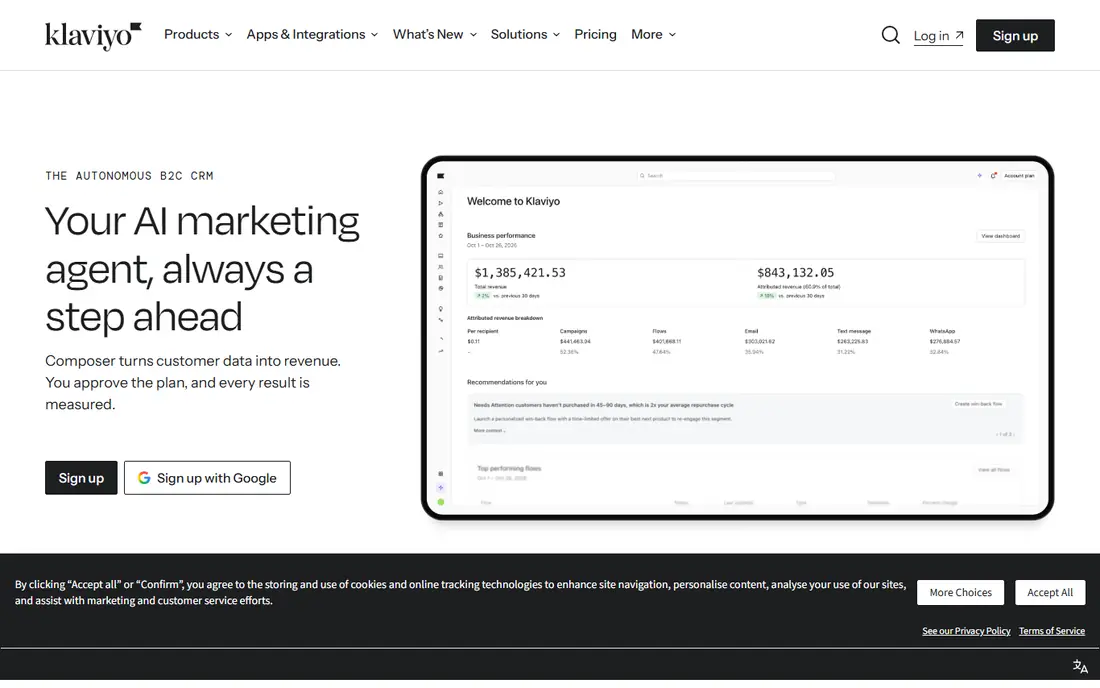
Klaviyo is the natural choice for a direct-to-consumer brand that already sends email and wants SMS in the same system. Customer profiles combine email and SMS behavior, so a flow can react to what a shopper did in either channel. Segmentation is detailed, and the Shopify integration is one of the strongest in this list, with purchase and browsing data feeding flows automatically.
Cost is the honest catch. The email plan and SMS credits are billed in a way that can surprise a new user, and the bill grows as the list grows. Small stores should start on the free tier, test one or two flows such as abandoned cart and post-purchase, and only scale SMS volume once those flows earn their keep.
- Unified email and SMS profiles
- Strong segmentation
- Deep Shopify integration
- SMS costs sit on top of the email plan
- Pricing grows with list size
Attentive
Ideal for: Enterprise personalization

Attentive serves larger ecommerce brands that want personalization at scale. Its strengths are behavioral triggers, AI-assisted send-time choices, and subscriber growth tools that are built for high-volume stores. Large brands also get managed strategy help, which matters when SMS is a major revenue channel rather than a side experiment.
For a small business, Attentive is usually the wrong fit. Pricing is custom and the effective minimum is far above the entry prices in this list, and contracts are common. If your monthly SMS budget is under a few hundred dollars, start elsewhere and revisit Attentive only when SMS revenue justifies it.
- Behavioral triggers and send-time optimization
- Managed services for large brands
- Strong subscriber growth tools
- Custom pricing with a high effective minimum
- Contracts are common
EZ Texting
Ideal for: Mass texting on a budget
EZ Texting is a solid budget pick for organizations that mainly send announcements to a large list: churches, schools, nonprofits, venues and local businesses. The campaign builder is straightforward, contacts are not the limiting factor on some plans, and the entry price is among the lowest here. For one-to-many messages, it does the job without a learning curve.
It is less suited to complex, behavior-driven flows. Automation exists, but it is simpler than what Klaviyo or Postscript offer, and extra fees for telecom and carrier costs need to be added to the headline price. Check the full fee breakdown for your volume before you judge it against a competitor.
- Low entry price
- Simple campaign builder
- Unlimited contacts on some plans
- Carrier and telecom fees apply
- Automation is simpler than Klaviyo or Attentive
Postscript
Ideal for: Shopify SMS marketing
Postscript is the SMS-first choice for Shopify stores. It is built around Shopify events, so cart abandonment, browse abandonment, post-purchase and win-back flows come ready-made rather than assembled from generic automation blocks. Two-way messaging and revenue attribution help store owners see which texts actually led to orders, not just clicks.
The limitation is scope. If you sell on WooCommerce, Squarespace or in person, Postscript loses its main advantage, and a general platform will serve you better. Minimum spend on some plans also means very small stores should confirm the floor before signing up.
- Native Shopify triggers
- Strong abandoned cart flows
- Revenue attribution
- Built for Shopify, so it is a poor fit elsewhere
- Minimum spend applies on some plans
Omnisend
Ideal for: Affordable email and SMS automation
Omnisend gives smaller online stores a cheaper route to combined email and SMS automation. Prebuilt workflows cover welcome series, cart recovery and post-purchase messages, and the free tier lets a new store test the basics before paying. For a store that finds Klaviyo too expensive at its list size, Omnisend is the first alternative we would check.
Read the plan details carefully, because SMS automation sits on the Pro plan rather than the cheapest tier. The headline price is for email, so a buyer comparing SMS costs should compare the Pro plan price with Klaviyo's combined cost, not with the entry price alone.
- Email, SMS and push in one plan
- Prebuilt automation workflows
- Free tier to start
- SMS is included on higher plans, so the cheapest plan alone is not an SMS plan
- Fewer enterprise features than Attentive
SlickText
Ideal for: Rollover credits and simple campaigns
SlickText suits businesses with uneven sending patterns, such as seasonal shops or event venues. Rollover credits mean unused messages are not wasted in a quiet month, which is a real saving for businesses that send in bursts. List growth tools, including popups and text-to-join keywords, are simple to set up.
It does not try to match Klaviyo on ecommerce automation, and teams that want deep store integrations will notice the gap. For a business whose main need is reliable campaigns and two-way replies, that gap rarely matters, and the rollover policy is a genuine advantage.
- Rollover credits
- Simple list-growth tools
- API access on paid plans
- Fewer ecommerce automation features than Klaviyo
- Interface feels dated to some users
Textmagic
Ideal for: Pay-as-you-go low-volume texting
Textmagic fits senders who text rarely and do not want a monthly subscription: a landlord sending reminders, a clinic sending appointment notes, or a small team sending occasional alerts. Pay-as-you-go pricing means you pay for what you send, and the email-to-SMS gateway is handy for systems that already send email.
At high volume, per-message pricing becomes expensive next to a monthly plan, and automation is basic compared with the marketing platforms above. Use Textmagic when volume is low and flexibility matters more than flows, and move to a monthly platform once sending becomes regular.
- Pay-as-you-go pricing
- No monthly contract needed
- Email-to-SMS gateway
- Limited automation compared with marketing platforms
- Costs rise steeply at high volume
How we picked these
We compared official pricing pages, feature lists, compliance and carrier registration guidance, and public reviews for SMS marketing platforms available in the US in October 2026. We favored platforms with clear entry pricing or a trial, real two-way messaging or automation, and documented consent and opt-out handling. We left out tools we could not verify as live products.
What to check before you choose
Start with consent and compliance, because this is where SMS differs most from email. Every platform here supports opt-in keywords and opt-out handling, but you still need a clear consent record for each subscriber and a working STOP reply. Carrier registration for business texting is now standard in the US, so ask the vendor what registration help is included and what it costs.
Count the full monthly cost
Compare the plan price plus message credits, phone number fees, carrier fees and any minimum spend. A $25 plan with separate fees can cost more than a $29 plan that includes them. Estimate your monthly message volume honestly, including replies and automated flows, and price the plan that covers that volume rather than the cheapest tier.
Match the platform to your store or system
Shopify stores get the most from Postscript or Klaviyo, while WooCommerce and general businesses are better served by Omnisend, SimpleTexting or SlickText. If you use a CRM, check the native integration before you buy, because a missing integration means manual imports and stale lists.
Frequently asked questions
What is the best SMS marketing platform for a small business?
SimpleTexting is our pick for most small businesses because of its simple shared inbox, keyword opt-ins and clear pricing. EZ Texting is a close alternative when mass announcements matter more than two-way conversations.
How much does SMS marketing cost per month?
Entry plans in this list start around $25 to $29 per month for a few hundred messages, while ecommerce platforms with SMS add-ons cost more as lists grow. Add phone number fees, carrier fees and extra message credits to get the real monthly total.
Is SMS marketing legal without consent?
No, in practice you need clear consent from each recipient before sending marketing texts, and you must honor opt-outs promptly. Use keyword opt-ins, web forms with clear wording, and keep a record of when and how each person opted in.
Can I use SMS marketing without a monthly plan?
Yes, Textmagic offers pay-as-you-go pricing that suits low-volume senders. It costs more per message at scale, so switch to a monthly plan once your sending becomes regular.
Does SMS work better than email for sales?
SMS messages are usually opened faster than email, which helps time-sensitive offers and reminders. Email still works better for long messages, catalogs and detailed content, so many stores use both channels together.