Best Software Development Firms in 2026: 7 Companies Compared

- 1
 ToptalHiring vetted freelance expertsVisit
- 2
 ThoughtworksLarge transformation programsVisit
- 3
 BairesDevNearshore engineering teamsVisit
- 4
 IntellectsoftAI-first product buildsVisit
- 5
 ScienceSoftLong-running enterprise softwareVisit
- Software development firms differ in model: some build a whole product for you, while others supply engineers who join your team.
- Consultancies such as Thoughtworks and ELEKS suit large, complex programs, while talent networks such as Toptal suit fast hiring for a defined role.
- Time zone overlap, seniority of the team, and who owns delivery risk matter more than a firm's client logo list.
- Our pick for most buyers is a firm that shows relevant past work, names senior staff for the project, and agrees clear milestones before coding starts.
Quick comparison
| Product | Ideal for | Price from | Free version | |
|---|---|---|---|---|
| Toptal | Hiring vetted freelance experts | See website | No | Visit |
| Thoughtworks | Large transformation programs | See website | No | Visit |
| BairesDev | Nearshore engineering teams | See website | No | Visit |
| Intellectsoft | AI-first product builds | See website | No | Visit |
| ScienceSoft | Long-running enterprise software | See website | No | Visit |
 ELEKS | Full-cycle custom software | See website | No | Visit |
 Andersen | Dedicated teams across industries | See website | No | Visit |
The best software development firms
Hiring a software development firm is a very different decision from buying software. You are buying people, process, and judgment, and the wrong partner can cost months even if the hourly rate looks attractive. Some firms take full ownership of a product from idea to launch. Others supply engineers, designers, or QA staff who work inside your team. The right model depends on how much internal technical leadership you already have.
We compared official service pages for firms that serve US clients, looking at service range, engagement models, industry focus, and how each firm describes delivery. The list below mixes consultancies, nearshore teams, and talent networks, so startups and large companies can both compare realistic options.
Toptal
Ideal for: Hiring vetted freelance experts
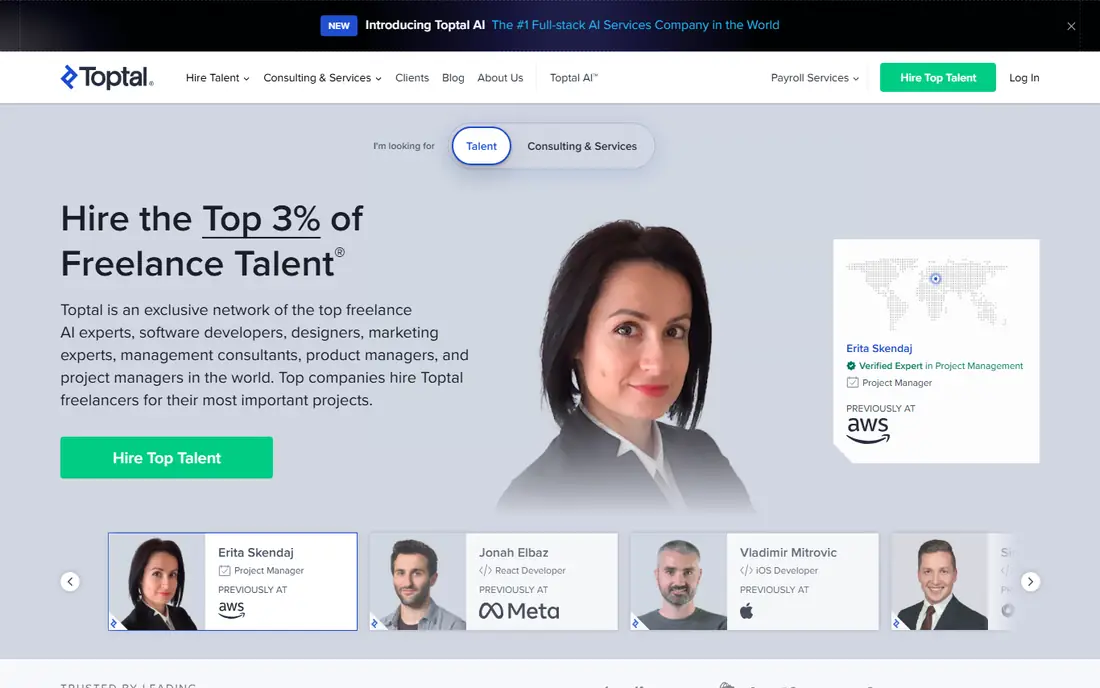
Toptal is a talent network rather than a traditional development firm, connecting companies with freelance developers, designers, product managers, and other specialists. The site presents a selective vetting process and fast matching, with trial engagements so a company can test fit before committing. That model suits a team that already knows what to build and needs one strong engineer, designer, or manager quickly.
The catch is ownership. With Toptal, your team still owns product decisions, roadmaps, and delivery, which is ideal for companies with internal leadership but less helpful for a non-technical founder who wants a firm to run the whole build. If you need a full product team with architecture, QA, and project management, a full-service firm on this list will fit better.
- Fast matching to vetted freelancers
- Flexible hourly to full-time engagements
- Broad skill coverage from developers to product managers
- You manage the work more than with a full-service firm
- Quality varies by individual match
- Costs can rise for senior specialists
Thoughtworks
Ideal for: Large transformation programs

Thoughtworks is a technology consultancy known for engineering-led transformation, modernization, and AI work for large organizations. Its current focus includes agentic development platforms and rebuilding systems for the AI era, with partnerships across major cloud and data providers. Companies hire Thoughtworks when a system is complex, legacy-bound, or central to the business, and when engineering quality matters as much as speed.
The trade-off is scale. Thoughtworks engagements are typically enterprise programs, not small fixed-price app builds, and pricing is by project scope. Smaller companies may find the process and cost heavy for a simple product. For a large company modernizing a core system or building a major platform, Thoughtworks is one of the most credible names to shortlist.
- Deep engineering and modernization experience
- Strong cloud and data partnerships
- Focus on AI-era transformation work
- Enterprise-level engagement and cost
- May be more than a small project needs
- Availability depends on practice capacity
BairesDev
Ideal for: Nearshore engineering teams
BairesDev provides nearshore software engineers and teams for US companies, with staff augmentation, dedicated teams, and managed projects. Its appeal for US buyers is time zone overlap: teams work during US business hours, which makes daily standups, reviews, and quick decisions easier than with far-offshore teams. The firm covers a wide range of technologies, from web and mobile to data and AI-assisted development.
The catch is the same as with any staff model: you still need internal product direction, and results depend on the specific engineers assigned. Companies should interview the actual team, not only the sales contact, and agree on seniority, ramp-up, and replacement terms. For US firms that want to scale engineering without hiring full-time, BairesDev is a practical nearshore option.
- Time zone aligned nearshore teams for US clients
- Wide technology coverage
- Staff augmentation and managed teams
- Team quality depends on the assigned engineers
- Communication needs active management
- Project pricing varies by scope
Intellectsoft
Ideal for: AI-first product builds
Intellectsoft describes itself as an AI-first software engineering firm, building digital products for enterprises and startups with AI woven through design, build, and testing. Its process starts with a senior architect setting technical direction before coding, which helps avoid the common problem of a product that works in a demo but fails to scale. The firm also offers dedicated teams and full product builds, with coverage across regions.
The trade-off is fit and proof. AI-first is a broad claim, and buyers should ask for case work close to their own problem, not only general AI examples. Pricing is by project, so a clear scope and milestone plan matters. For companies building a product where AI is central, rather than a side feature, Intellectsoft is worth a conversation.
- AI work across the delivery lifecycle
- Architecture-first approach
- Teams across several regions for coverage
- Midsize firm, so capacity for very large programs may be limited
- Pricing by project
- AI claims need checking against your use case
ScienceSoft
Ideal for: Long-running enterprise software
ScienceSoft is a long-established software and IT services firm, founded in 1989, covering custom software, AI, data analytics, testing, cybersecurity, and infrastructure services. Its breadth suits companies that want one partner for a product plus surrounding work, such as data pipelines, QA, and security review. The firm also highlights an in-house project management office, which helps on longer, multi-part programs.
The catch is that breadth can hide variation. A firm with many practices may be stronger in some areas than others, so buyers should check the specific team and past work for their industry and technology. Enterprise process can also feel slow for a startup that wants a fast MVP. For midsize and large companies with ongoing software needs, ScienceSoft offers depth and staying power.
- Long history since 1989
- Broad services from software to QA, data, and cybersecurity
- In-house project management office
- Large service range can mean varied team depth by practice
- Enterprise process may feel heavy for startups
- Pricing by project
ELEKS
Ideal for: Full-cycle custom software
ELEKS designs and builds custom software across the full cycle, from discovery and design to development, data, and AI services. Its industry pages cover health, finance, insurance, energy, and logistics, with case work ranging from consumer apps to complex enterprise systems. For a buyer who wants one firm to own a product end to end, ELEKS offers a complete service range rather than staff alone.
The trade-off is cost and fit for small projects. ELEKS engagements are typically scoped projects for companies with real budgets, and a tiny MVP may be better served by a smaller studio or a talent network. Buyers should also ask which delivery center and team will handle the work, and how senior staff stay involved after kickoff. For full-cycle builds with industry complexity, ELEKS is a strong contender.
- Full-cycle design and development
- Industry work in health, finance, and energy
- Data and AI services alongside product builds
- Enterprise focus and project pricing
- Smaller builds may not be the best fit
- Delivery teams vary by practice
Andersen
Ideal for: Dedicated teams across industries
Andersen is a software development company offering dedicated teams, staff augmentation, and full project delivery across many industries, from finance and health to logistics, retail, and telecom. Its service list covers mobile and web development, QA, DevOps, UI and UX design, and business analysis, which lets a buyer assemble a team with several roles from one vendor. That breadth is useful for companies that need more than developers alone.
The catch is diligence. With a large firm, the assigned team matters more than the brand, so buyers should interview team leads, check relevant case work, and agree on communication, reporting, and exit terms. Pricing is by scope, so a clear brief and milestone plan will protect both sides. For companies that want a flexible team across several skills, Andersen is a realistic option.
- Very broad industry coverage
- Dedicated teams and staff augmentation
- Mobile, web, QA, and DevOps services
- Large firm, so team quality can vary
- Project pricing by scope
- Buyers should verify the assigned team closely
How we picked these
We compared official service pages for firms that serve US clients and that describe clear engagement models, looking at custom development, staff augmentation, AI work, and industry focus. We favored firms with detailed service and case pages over firms with only a marketing homepage, because buyers need to judge real capability. We also mixed talent networks, nearshore teams, and consultancies, since the best model depends on internal leadership and budget.
We did not hire these firms, and we did not review private contracts or client references. Any shortlisted firm should be checked through reference calls, a paid discovery or trial phase, and a written statement of work covering scope, milestones, intellectual property, and support.
What to check before you hire a firm
Start with the actual team, not the pitch deck. Ask who will work on your project, what they built before, and how much time senior staff will spend on it. A firm that shows strong case work but assigns junior staff without senior review is a common source of disappointment.
Next, agree on ownership and milestones. The contract should state what is delivered at each stage, who owns the code and data, how changes are priced, and what happens if the project stops early. A paid discovery phase that produces architecture, scope, and a realistic estimate is often worth the cost before a full build.
Finally, test communication early. Daily or weekly demos, a shared backlog, and a single point of contact on each side will surface problems while they are still cheap to fix. If a firm is slow to respond during sales, expect the same pattern during delivery, and choose accordingly.
Frequently asked questions
What is the best software development firm?
There is no single best firm. Thoughtworks and ELEKS suit large, complex programs, BairesDev and Andersen suit team scaling, Toptal suits hiring individual experts, and Intellectsoft and ScienceSoft suit product builds with AI or enterprise depth. The best choice follows your scope, budget, and internal team.
How much does it cost to hire a software development firm?
Costs vary by team size, seniority, location, and project length, and most firms price by scope rather than publishing rates. Get a written estimate tied to milestones, and ask what is included for QA, project management, and post-launch support.
Should I choose staff augmentation or a full product team?
Choose staff augmentation if you have product and technical leadership and need extra hands. Choose a full product team if you need architecture, design, QA, and delivery managed by the firm, especially for a new product or a complex rebuild.
How do I check a software development firm before hiring?
Ask for relevant case work, speak with past clients, interview the actual team, and run a small paid trial or discovery phase. Check the contract for code ownership, change pricing, support terms, and exit options.
What is nearshore software development?
Nearshore development uses teams in nearby time zones, such as Latin America for US companies, so working hours overlap. That overlap can make daily communication easier than with teams many hours ahead or behind.