Best Software for Church Accounting in 2026: 7 Tools Compared

- 1
 AplosFund accounting for churchesVisit
- 2
 ChurchTracAll-in-one church managementVisit
- 3
 PowerChurchDesktop church managementVisit
- 4
 BreezeSimple church managementVisit
- 5
 QuickBooksGeneral accounting familiarityVisit
- Church accounting differs from business accounting, because gifts are often restricted to a fund, and boards need clear fund reports.
- Aplos and ACS Technologies focus most on fund accounting, while ChurchTrac, Tithely, and Breeze bundle accounting with wider church management.
- QuickBooks suits churches that already use it and want general accounting, but it needs care to track funds and donor giving well.
- Our pick for most churches is a fund-aware tool with giving and reporting together, tested with a real month of gifts and bills first.
Quick comparison
| Product | Ideal for | Price from | Free version | |
|---|---|---|---|---|
| Aplos | Fund accounting for churches | See website | Free trial | Visit |
| ChurchTrac | All-in-one church management | $29 per month | No | Visit |
| PowerChurch | Desktop church management | See website | No | Visit |
| Breeze | Simple church management | See website | No | Visit |
| QuickBooks | General accounting familiarity | See website | Free trial | Visit |
 Tithely | Giving plus church management | See website | No | Visit |
 ACS Technologies | Large church and diocese systems | See website | No | Visit |
The best software for church accounting
Church accounting has a job that general business software often misses: tracking gifts by fund, showing how restricted money was used, and producing reports a board and an auditor can trust. A building fund gift, a missions gift, and general operating income are not interchangeable, and a system that mixes them will create problems at year end. The best church tools keep funds, donors, giving, and bills in one clear record.
We compared official feature and pricing pages for tools that serve US churches, looking at fund accounting, giving, donor records, budgets, and reporting. The list below mixes focused accounting tools with all-in-one church platforms, because some churches want accounting alone and others want people, giving, and accounting together.
Aplos
Ideal for: Fund accounting for churches
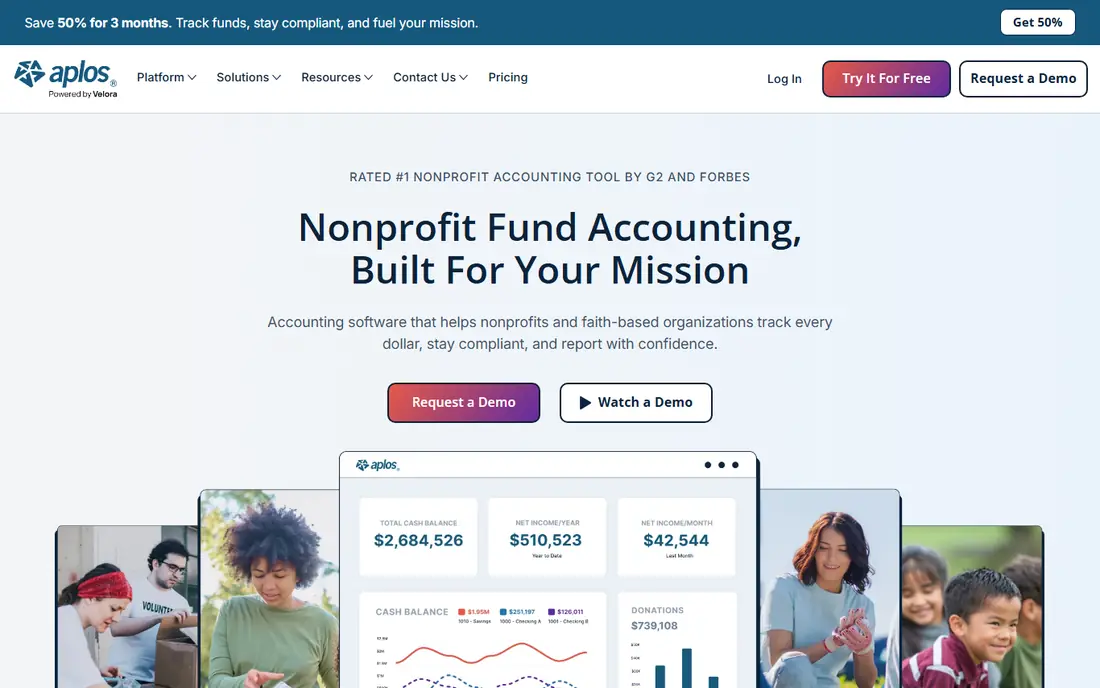
Aplos is nonprofit accounting software built around fund accounting, budgeting, and reporting for churches and nonprofits. Its homepage stresses tracking restricted funds and grants, building custom reports by fund, and sharing board-ready financial statements. That focus suits churches where fund clarity matters most, such as churches with building campaigns, missions funds, and grant income alongside weekly giving.
The trade-off is breadth. Aplos covers accounting, donations, and donor records well, but churches that want a full member database, check-in, worship planning, and a church app may need other tools alongside it. Aplos offers a 15-day trial, which is worth using with a real month of gifts and bills. For fund-first churches, Aplos is a strong first choice.
- Fund accounting built for nonprofits and churches
- Board-ready reports
- Donation and donor tools in the wider suite
- Full church management features are narrower than all-in-one platforms
- Pricing varies by plan
- Larger churches may need extra tools
ChurchTrac
Ideal for: All-in-one church management
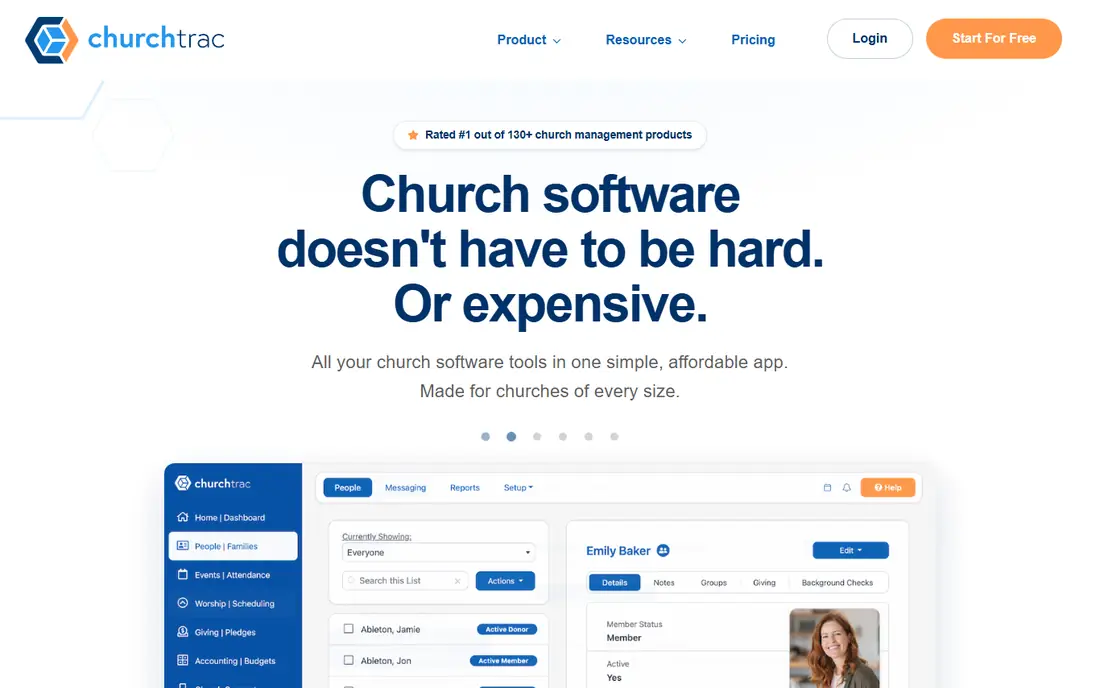
ChurchTrac bundles church management, giving, accounting, worship planning, messaging, and volunteer tools into one affordable platform. Its homepage lists plans starting at $29 per month, based on the number of people tracked, with fund accounting, budgeting, and reporting included in all-in-one plans. For small and midsize churches, that single price and single login can replace several separate tools.
The catch is depth in any one area. ChurchTrac covers a great deal, but a church with complex accounting, multiple campuses, or detailed audit needs should test its fund reports and exports carefully. Support is a stated strength, with US-based help, workshops, and training videos. For churches that want one simple system for people, giving, and money, ChurchTrac offers strong value.
- All-in-one plans starting at $29 per month on its site
- Fund accounting included
- People, giving, and messaging in one app
- All-in-one depth varies by area
- Larger churches may need deeper accounting reports
- Pricing scales with people tracked
PowerChurch
Ideal for: Desktop church management
PowerChurch Software offers church management products that cover membership, contributions, accounting, events, and more, with both desktop and online options. Its homepage presents PowerChurch Plus as an all-in-one desktop product and PowerChurch Online for Windows, Mac, and Linux users. For churches that prefer a traditional, installed product or that have used PowerChurch for years, that continuity matters.
The trade-off is modern cloud expectations. Churches that want fully cloud-based access, mobile apps, and online giving links should check how PowerChurch Online handles those workflows and what pricing applies. A free demo is offered for the desktop product, which helps teams test membership and accounting flows. For churches that value a long-running, church-specific system, PowerChurch remains a credible option.
- Long-running church management product
- Membership, contributions, and accounting together
- Desktop and online options
- Website gives less pricing detail
- Desktop habits may suit some teams less
- Setup and training need time
Breeze
Ideal for: Simple church management
Breeze, now part of the Tithely family, is church management software built for ease of use, covering people, groups, events, forms, giving, and service planning. Its homepage stresses simple design, no hidden fees, and support by email and phone, with free help moving data from an old system. That ease matters for churches run by volunteers or small staff teams who cannot spend weeks learning a complex system.
The catch is accounting depth. Breeze handles giving and church records well, but churches with strict fund accounting, detailed budgets, and audit-grade reports should compare its accounting features with Aplos or ACS Technologies before choosing. For churches that want a friendly all-in-one system and simple money tracking, Breeze is an easy tool to adopt.
- Simple, easy-to-use design
- People, giving, events, and forms in one place
- Free data import help and support
- Accounting depth is less than fund-focused tools
- Pricing needs a quote
- Larger churches may need more reporting
QuickBooks
Ideal for: General accounting familiarity
QuickBooks is general small-business accounting software, covering books, invoices, expenses, payroll, and reporting, and it is used by millions of businesses. For a church, the appeal is familiarity: many treasurers and outside accountants already know QuickBooks, and help is easy to find. It can handle bills, bank feeds, payroll, and standard financial reports without a church-specific learning curve.
The limit is fund logic. QuickBooks is not built around church funds, donor giving statements, and restricted gifts, so churches must set up classes, funds, or workarounds carefully to keep restricted money clear. That setup can work, but it needs discipline and an accountant who understands church accounting. Churches that already use QuickBooks and have simple fund needs may stay with it, while fund-heavy churches should consider a church-specific tool.
- Widely known and widely supported
- Strong invoicing, expenses, and reporting
- Many accountants already use it
- Not built for church fund accounting
- Giving and donor tracking need workarounds
- Church reports need careful setup
Tithely
Ideal for: Giving plus church management
Tithely covers church giving, management, and engagement, with online, mobile, and text donations, recurring giving, pledge campaigns, and tax statements. Its homepage presents an All Access bundle at $119 per month, covering giving, management, apps, sites, and worship tools, with giving itself carrying no monthly fee but transaction fees per donation. For churches that want giving and management together, that bundle is easy to understand.
The trade-off is accounting scope. Tithely is strongest on giving and engagement, and churches should check how its management and reporting tools handle fund accounting, budgets, and board reports for their needs. Transaction fees also matter at scale, so churches should compare card and bank rates. For giving-first churches that want a modern app and site alongside donations, Tithely is a strong pick.
- Strong giving tools with online, mobile, and text donations
- Church management and app in the wider suite
- Clear All Access bundle pricing on its site
- Giving fees apply per transaction
- Full suite pricing adds up
- Accounting depth depends on the bundle chosen
ACS Technologies
Ideal for: Large church and diocese systems
ACS Technologies, known as ACST, provides church management, giving, accounting, and engagement tools for churches, dioceses, schools, and ministries. Its homepage stresses fund accounting built for churches, tools to track funds and expenses, plan budgets, and gain insights, plus systems for multi-parish and diocese work. That scale suits large churches and denominational bodies that need consistent reporting across many sites.
The catch is size. ACS Technologies is an enterprise-style system with pricing by quote, and a small church may find it more than needed. Implementation, training, and data migration also need planning for a system of this scope. For large churches, multi-site ministries, and dioceses that need fund accounting across many locations, ACS Technologies is a serious option.
- Long history serving churches since 1978
- Fund accounting built for churches
- Tools for dioceses and multi-site ministries
- Enterprise scope and pricing by quote
- May be heavy for a small church
- Implementation needs planning
How we picked these
We compared official feature and pricing pages for church accounting and church management tools available in the US, looking at fund accounting, giving, donor records, budgets, and board reporting. We favored church-specific tools over general accounting software, while keeping QuickBooks because many churches already use it and ask how it compares. We also mixed small-church tools with large-church systems, since church size changes the right choice.
We did not test these tools with live church finances, and we did not review any church's audit position. Pricing can change, so check the vendor site, test fund reports with sample gifts, and speak with a church accountant before switching systems.
What to check before you choose
Start with funds, not with the dashboard. List every fund your church uses, including building, missions, benevolence, and general operating, and test how each tool records a gift, moves money between funds, and reports a fund balance. If a tool cannot show restricted balances clearly, it will fail at audit time, whatever else it offers.
Next, check giving end to end. Online, mobile, and text gifts should flow into donor records and fund reports without manual retyping, and year-end giving statements should be easy to produce. Confirm transaction fees, payout timing, and how refunds and failed gifts are handled, because those details affect both donors and treasurers.
Finally, match the system to the people who will run it. A powerful fund system that only one treasurer understands is a risk if that person leaves, while a simpler system that volunteers can use and back up may serve a small church better. Check training, support hours, data export, and who can access financial records, then trial the system with a real month of activity.
Frequently asked questions
What is the best software for church accounting?
Aplos suits fund-focused churches, ChurchTrac and Breeze suit small churches that want all-in-one simplicity, Tithely suits giving-first churches, and ACS Technologies suits large churches and dioceses. QuickBooks can work for churches with simple fund needs and an accountant who knows church setup.
What is fund accounting?
Fund accounting tracks money by purpose, such as general operating, building, or missions, so restricted gifts are used only for their stated purpose. Churches use fund reports to show boards and donors how each fund was received and spent.
Can QuickBooks handle church accounting?
Yes, for basic books, bills, and reports, but it needs careful setup to track funds and donor giving. Churches with many restricted funds often find a church-specific tool clearer for fund balances and audit reports.
How much does church accounting software cost?
ChurchTrac lists plans starting at $29 per month, Tithely lists an All Access bundle at $119 per month, and other tools price by plan or quote. Always ask for the total, including users, giving fees, and support.
Do church tools handle donor giving statements?
Most church platforms do, including Aplos, ChurchTrac, Tithely, and ACS Technologies, with year-end tax statements for donors. Check that statements group gifts by donor and fund correctly, and test a sample statement before year end.