7 Best Software for Data Extraction and Integration Options for 2026

- Top of the list is Skyvia, which targets no-code integration with a free level.
- The cheapest monthly starting price in the list is $265/month, offered by Hevo Data.
- For low-code pipelines with predictable pricing, Integrate.io is worth a look.
- Only 2 of the 7 tools have a free plan (Skyvia, Hevo Data), so check the caps.
- Before buying Fivetran, weigh this: usage-based pricing can surprise.
Direct answer
Start with Skyvia if you need no-code integration with a free level. Informatica is the stronger choice for large organizations with complex data estates, while Fivetran suits teams wanting managed pipelines at scale. Prices, free plans and limits for all 7 tools follow.
Quick comparison
| Product | Ideal for | Price from | Free version | |
|---|---|---|---|---|
 Skyvia | No-code integration with a free level | See website | Yes | Visit |
 Informatica | Large organizations with complicated data estates | See website | Free trial | Visit |
 Fivetran | Teams wanting managed pipelines at scale | See website | Free trial | Visit |
 Rivery | ELT with value-based, not row-based, pricing | See website | Free trial | Visit |
 Hevo Data | Transparent pricing for expanding teams | From $265/month | Yes | Visit |
 Qlik Talend | Enterprises needing integration plus governance | See website | Free trial | Visit |
 Integrate.io | Low-code pipelines with predictable pricing | See website | Free trial | Visit |
The best software for data extraction and integration
This Ainotely guide covers 7 options for software for data extraction and integration. Each profile lists a starting price, free plan details, strengths and drawbacks, so you can drop poor fits quickly.
Skyvia
Ideal for: No-code integration with a free level

Skyvia is built with no-code integration with a free tier in mind. Skyvia bundles data integration with backup, data access, and management tools in one no-code system, and it lets you start free. Complicated transformations are also thinner than the developer-oriented tools.
But for business users and small teams that want integration without engineering, the combination of a free start and no-code operation is compelling. With 200+ connectors spanning cloud apps, databases, and warehouses, a non-technical user can set up syncs and ETL flows without writing code. Pricing is usage-based and not published as a straightforward per-seat number, so heavier workloads need a careful look at the pricing page. Pricing for Skyvia is not stated here, so ask the vendor for current figures. You can start on Skyvia without paying.
Downsides: Usage-based pricing needs watching at scale.
- Backup and data management included
- No-code setup across 200+ connectors
- Less depth for complicated transformations
Informatica
Ideal for: Large organizations with complicated data estates
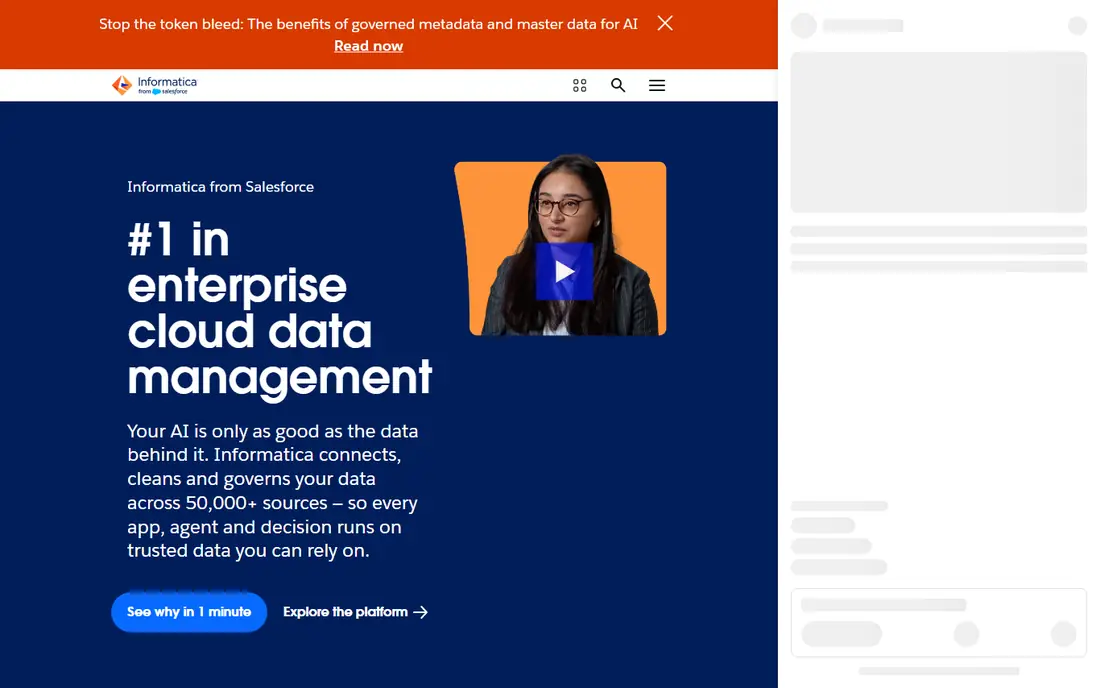
Informatica works best for large organizations with complicated data estates. The system includes data integration alongside data quality, master data management, governance, and cataloging, with 300+ connectors for moving data across clouds, apps, and databases. From a buyer's view, for a mid-sized company that just needs pipelines, this is too much software.
Where it falls short: Quote-based enterprise pricing.
The company now sits under Salesforce ownership, which has sharpened the AI-ready data pitch without changing the product's enterprise character. More specifically, nobody evaluates Informatica casually. Pricing is quote-based, sales cycles are real, and the product rewards organizations with dedicated data teams. Pricing for Informatica is not stated here, so ask the vendor for current figures. As for free access: Free trial.
- Broadest enterprise data management system
- 300+ connectors
- Complexity exceeds what small teams need
Fivetran
Ideal for: Teams wanting managed pipelines at scale

Fivetran was built for teams wanting managed pipelines at scale. Schema changes in the source get handled automatically rather than breaking your warehouse loads. In practice, you also provide up the control that includes running your own infrastructure.
Also, everyone else gets the most boring, in the best sense, pipelines in the business. Also, for a data team that would rather analyze data than maintain plumbing, that offloading is the product. More specifically, pricing is usage-based, tied to the volume your pipelines move, so bills grow with data growth in ways that require monitoring. Check the vendor site for Fivetran pricing; none is listed in this comparison. Free options: Free trial.
Points against: Usage-based pricing can surprise.
- Hundreds of completely managed connectors
- Automatic schema migration handling
- Less control than self-hosted choices
Rivery
Ideal for: ELT with value-based, not row-based, pricing
Rivery was built for ELT with value-based, not row-based, pricing. Rivery positions itself against the row-metered pricing of the big managed products, charging on value-based consumption rather than counting every record. Beyond that, as with multiple tools here, actual prices live behind a sales conversation.
Rivery is also a smaller brand than Fivetran or Informatica, which matters to buyers who want the safety of an incumbent. But the product is complete, the managed experience is genuine, and the pricing model straight answers the most typical complaint about this category. Check the vendor site for Rivery pricing; none is listed in this comparison. As for free access: Free trial.
Honest limits: Smaller brand than the category leaders.
- Reverse ETL included
- Completely managed SaaS
- Pricing not published
Hevo Data
Ideal for: Transparent pricing for expanding teams
Hevo Data is aimed squarely at transparent pricing for expanding teams. Hevo Data prints its pricing on the website, which already distinguishes it in a category fond of "contact sales." The free plan costs $0 and covers light use with up to 5 users. Also, the platform spans the standard ELT loop across 150+ sources with schema drift handling and failure recovery built in.
Trade-offs to know: Streaming features need the upper levels.
But for an expanding team that wants managed pipelines with predictable, published pricing, Hevo is one of the easiest evaluations to run. In practice, event-based pricing means you can forecast costs from your data volume rather than guessing. Premium plans start at $265 per month for Starter and $750 for Professional, with a 14-day trial that does not need a credit card. On cost, Hevo Data starts like this: From $265/month. Free access exists with Hevo Data.
- 14-day free trial with no card
- 150+ connectors
- Premium entry is higher than some rivals
Qlik Talend
Ideal for: Enterprises needing integration plus governance
Think of Qlik Talend for enterprises needing integration plus governance. Teams that just need pipelines will find it heavy. Teams that require governance alongside integration will find the breadth worth it.
What users get: hybrid deployment.
Honest limits: Enterprise sales process.
For everyday use, deployment stays adaptable across cloud, on-premises, and hybrid, which matters to enterprises that cannot move everything at once. This is enterprise software in the full sense: quote-based pricing, a sales-led evaluation, and implementation that rewards planning. Also, the old standalone Stitch product is being absorbed into this platform, so new buyers should evaluate Qlik Talend Cloud straight instead of hunting for the legacy tools. Qlik Talend does not show a starting price in this comparison, so check the vendor site for current pricing. Free access: Free trial.
- Unified integration, quality, governance
- Cloud, on-premises
- Heavier than pure-play ELT tools
Integrate.io
Ideal for: Low-code pipelines with predictable pricing
Integrate.io is aimed squarely at low-code pipelines with predictable pricing. Integrate.io's headline differentiator is fixed-fee pricing in a category that largely meters usage.
Trade-offs to know: Smaller connector mindshare than the giants.
As for the details, teams can scale data volume, client count, and connectors without the bill scaling in lockstep, which makes budgeting refreshingly straightforward. No starting price is listed for Integrate.io here; confirm pricing on the vendor site. Free options: Free trial. Upsides: Practical support.
- ETL, ELT, CDC
- Reverse ETL in one product
- Pricing details need a sales conversation
How we built this list
Ainotely used vendor pricing pages and product documentation as the base, then compared plans, free access and documented limits for 7 tools. Figures are shown as the vendors publish them. Billing terms, seat minimums and add-ons can change the real cost. The sequence is a judgement call: typical use case first, then pricing transparency, then free access. Use the profiles to check fit.
Questions to settle before buying
- Get a written quote from Skyvia, Informatica, Fivetran and others; the list shows no starting price for them.
- Look at free plan limits closely: Skyvia and Hevo Data have one, and the caps decide whether it is usable for real work.
- Run a trial of Informatica, Fivetran, Rivery and others with real work before paying for a year; your own workflow is the best test.
- Before choosing Skyvia, weigh its main limit: usage-based pricing needs watching at scale.
- List the apps you already depend on and check that Rivery supports each one on the plan you would buy.
- Let daily users try Informatica on real work; their feedback beats any feature checklist.
Frequently asked questions
How are the tools for software for data extraction and integration ordered?
The order follows typical fit for software for data extraction and integration, with Skyvia first and Integrate.io last, then price clarity and free access. It is editorial judgement, not a score, so another team could rank the tools differently.
Can these tools deal with live data?
Change data capture gets you near-real-time database replication on multiple products here, and Hevo provides streaming pipelines on upper levels. True sub-second streaming is a different product category; these tools target analytic freshness measured in minutes, not milliseconds.
Can I try these tools before paying?
Often, yes. Skyvia and Hevo Data have a free plan and Informatica, Fivetran, Rivery and others offer a free trial. Use your own data and a real task during the test, and check what the free tier or trial limits before you rely on it.
Do these tools publish their prices?
Not all of them. Skyvia, Informatica, Fivetran and others publish no starting price, so expect a quote request for those. The rest, Hevo Data included, show a starting price, though seats and billing terms still change the final cost.
What is the difference between ETL and ELT?
In ETL, data is extracted, transformed, then loaded into the destination. ELT dominates modern cloud setups since warehouses are now feature-rich enough to transform at scale, and it preserves raw data for reprocessing.
What is the cheapest option for software for data extraction and integration in this list?
On published monthly entry prices, Hevo Data is the lowest here at $265/month. Entry price is only part of the cost, because seats, add-ons and billing terms can change the total.