Best Test Data Management Tools in 2026: 7 Options Compared

- Test data management tools create, mask, subset, and deliver realistic data for development, testing, and QA without copying full production databases.
- Delphix, DATPROF, and Curiosity Software suit teams that need masking, subsetting, virtualization, and automated provisioning in one platform.
- GenRocket and Tonic.ai suit teams that want synthetic data generated from rules or models rather than masked copies of production data.
- Informatica and K2view suit enterprises that need test data as part of a wider data management or data product platform.
- Our pick for most teams is a tool that masks or generates data well, refreshes environments on demand, and fits the databases the team already runs.
Quick comparison
| Product | Ideal for | Price from | Free version | |
|---|---|---|---|---|
 Delphix | Data virtualization and masking | See website | Free trial | Visit |
 GenRocket | Design-driven synthetic data | See website | Free trial | Visit |
 Tonic.ai | Synthetic data for testing and AI | See website | Free trial | Visit |
 Informatica | Enterprise test data management | See website | Free trial | Visit |
 DATPROF | Modular test data platform | See website | No | Visit |
 K2view | Entity-based test data products | See website | Free trial | Visit |
 Curiosity Software | AI-powered enterprise test data | See website | No | Visit |
The best test data management tools
Testing needs data that looks real, behaves real, and does not expose real customers. Copying a full production database into every test environment is slow, costly, and risky: it spreads personal data into systems that may lack production controls. Test data management tools solve this by masking sensitive values, generating synthetic records, cutting databases down to smaller subsets, or virtualizing data so teams can spin up fresh environments on demand.
We compared official feature pages, pricing pages, and product documentation for tools used in October 2026, looking at masking, synthetic generation, subsetting, virtualization, automation, database coverage, and compliance support. The seven tools below cover both dedicated test data platforms and wider data platforms with strong test data features, so teams can compare focused depth against enterprise breadth.
Delphix
Ideal for: Data virtualization and masking

Delphix offers a DevOps Data Platform built around virtualization, masking, synthetic data, and test data management. Instead of copying whole databases, teams can create virtual copies that provision in minutes, refresh on demand, and reset after a test run. Masking replaces sensitive values with realistic substitutes, and synthetic data fills gaps where production data cannot be used at all.
The strength of Delphix is speed at scale. Teams running many environments, from development to performance testing, can give each developer or pipeline a fresh, compliant copy without waiting on full restores. The trade-off is enterprise weight: pricing is by quote, and getting the most from virtualization takes database and infrastructure planning. For large teams with heavy database estates, Delphix is a leading choice.
- Virtualization plus masking and synthetic data
- Fast environment provisioning
- Strong enterprise database coverage
- Enterprise pricing by quote
- Setup needs database expertise
- Smaller teams may find it heavy
GenRocket
Ideal for: Design-driven synthetic data

GenRocket takes a design-driven approach to synthetic data. Teams model the data they need, including relationships between tables and realistic value patterns, and GenRocket generates synthetic records that follow the model. Its homepage points to more than 750 generators covering common data types, which helps teams build varied, believable datasets for functional, performance, and edge-case testing.
The advantage is independence from production data. When no production copy is available, or when privacy rules bar its use, GenRocket can still produce test data that matches the shape of real data. The trade-off is design effort: complex schemas need careful modeling before generation pays off. For teams that want synthetic-first test data, GenRocket is a strong pick.
- 750 plus data generators
- Model-based synthetic data
- No production data needed
- Design effort for complex models
- Enterprise pricing by quote
- Less focus on masking existing data
Tonic.ai
Ideal for: Synthetic data for testing and AI
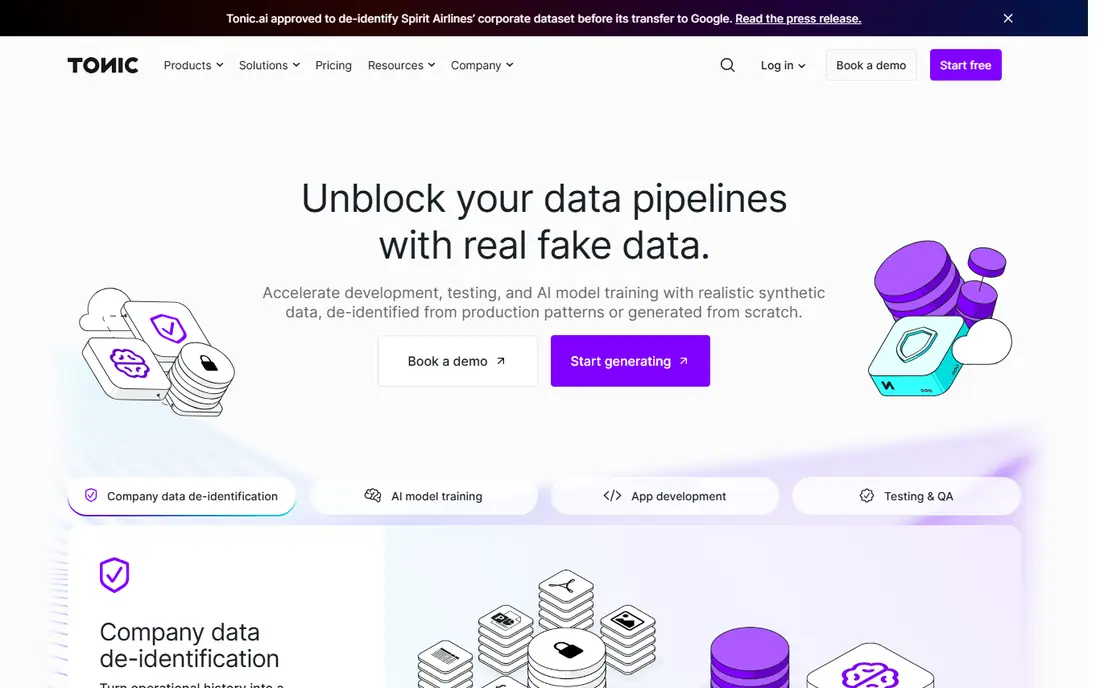
Tonic.ai focuses on synthetic data for testing, QA, and AI training. It generates realistic, relationally consistent data that preserves the structure of source data while removing real personal information. That makes it useful both for application testing and for training or fine-tuning models where real customer data cannot be used.
The appeal of Tonic.ai is its developer-friendly approach: teams can generate data that fits their schemas and pipelines without managing production copies. The trade-off is scope: Tonic.ai is strongest on synthetic generation rather than the full masking, subsetting, and virtualization range of a dedicated test data platform. For teams whose main need is high-quality synthetic data, Tonic.ai is a strong option.
- Synthetic data for testing, QA, and AI training
- Realistic relational data
- Modern developer workflow
- Pricing by quote for larger use
- Setup needs schema understanding
- Smaller scope than full TDM suites
Informatica
Ideal for: Enterprise test data management
Informatica is a wide data management platform that includes test data management among its data integration, governance, and quality capabilities. Teams already using Informatica for integration or governance can add test data provisioning, masking, and subsetting without adopting a separate vendor, and they can reuse existing connectors and governance policies.
The strength of Informatica is breadth and governance. Test data inherits the same controls, lineage, and policy handling as the rest of the data platform, which matters in regulated settings. The trade-off is enterprise scope: pricing is by quote and the platform rewards planning and skilled administration. For enterprises already invested in Informatica, its test data features are a natural fit.
- Test data management inside a wide data platform
- Strong data governance links
- Broad connector coverage
- Enterprise pricing by quote
- Platform breadth needs planning
- Smaller teams may find it heavy
DATPROF
Ideal for: Modular test data platform
DATPROF is a test data management platform built from modules that work together: Privacy for masking and synthetic generation, Subset for smaller referentially intact datasets, Analyze for finding sensitive data, Virtualize for virtualized database environments, and Runtime as the automation and self-service layer. Teams can run, schedule, and monitor test data processes, including through CI/CD pipelines.
The modular design is the main draw. A team can start with masking and subsetting, then add automation and self-service as needs grow, rather than buying everything at once. DATPROF also stresses compliance support for regulated industries such as banking, insurance, healthcare, and government. The trade-off is that pricing is by quote and the platform needs data expertise to set up well. For enterprise teams that want a purpose-built, modular test data platform, DATPROF is a strong pick.
- Masking, synthetic data, subsetting, and virtualization in modules
- Automation and CI/CD links
- Compliance focus
- No free plan listed
- Modular pricing needs scoping
- Setup needs data expertise
K2view
Ideal for: Entity-based test data products
K2view builds governed data products around business entities such as customers, accounts, orders, and claims. Each entity-level Micro-Database holds fresh, governed data for one entity, which lets teams provision masked, synthetic, or tokenized data for testing, development, analytics, and AI without slowing work. Its homepage stresses protected data access and fast, isolated access to trusted context at scale.
The advantage is a business-entity view of test data. Instead of provisioning whole databases, teams can deliver exactly the customer or order data a test needs, with governance intact. The trade-off is breadth: K2view is a wider data product platform, so teams that only need test data should compare it against focused tools such as DATPROF or Delphix. For enterprises that want governed, entity-level test data, K2view is a strong choice.
- Entity-level data products
- Masked, synthetic, and tokenized data
- Fast governed access
- Platform breadth beyond testing
- Enterprise pricing by quote
- Setup needs data modeling
Curiosity Software
Ideal for: AI-powered enterprise test data
Curiosity Software offers AI-powered enterprise test data management, with masking and data generation capabilities that deliver compliant and secure data to teams when and where they need it. Its homepage stresses building a complete picture of an application estate, bringing many data sources into a single view so teams can plan test data strategies across connected systems.
The draw is coverage across complex applications. Teams testing systems that span many databases and services can use Curiosity to understand data structures and deliver trusted data for each part. The trade-off is vendor size and pricing: Curiosity is smaller than Informatica or Delphix, and pricing is by quote. For teams with tangled, multi-system test data needs, Curiosity Software is worth a close look.
- Masking and data generation
- Application-wide data view
- AI-assisted test data delivery
- No free plan listed
- Enterprise pricing by quote
- Smaller vendor than Informatica or Delphix
How we picked these
We compared official feature pages, pricing pages, and product documentation for test data management tools available in October 2026. We favored tools that clearly support masking, synthetic generation, subsetting, or virtualization, that explain how they handle sensitive data, and that offer automation or self-service provisioning rather than manual copies. We excluded tools whose homepages no longer presented them as test data vendors, and we kept pricing as "See website" where the vendor prices by quote or the price was not shown on the homepage. We did not claim hands-on testing; this comparison rests on vendor documentation, pricing pages, and public reviews.
What to check before you buy test data software
Start with the data you must protect. List the databases, personal data types, and regulations that apply, then check whether each tool masks, generates, or tokenizes those values well, and whether it keeps referential integrity across related tables. A tool that masks names but breaks foreign keys will produce data that looks fine and tests badly.
Next, check provisioning speed and automation. Ask how long it takes to refresh an environment, whether developers can self-serve data without waiting on a database team, and whether the tool plugs into CI/CD pipelines. Test data that arrives late slows every release, so automation matters as much as masking quality.
Then check database and application coverage. Confirm support for the databases, clouds, and legacy systems your team actually runs, and test with a realistic schema before committing. Finally, compare total cost, including setup, training, and ongoing administration, and run a pilot on one project so the team can judge data quality and refresh speed on real work.
Frequently asked questions
What is test data management?
Test data management is the practice of creating, protecting, and delivering data for development and testing. It covers masking sensitive values, generating synthetic records, subsetting large databases, and provisioning fresh environments on demand.
Should we mask production data or generate synthetic data?
Masking suits teams that need production-like data with real patterns, while synthetic data suits teams that cannot use production data at all or need edge cases that production data lacks. Many teams use both: masked data for regression testing and synthetic data for new features and AI training.
How does test data management help with privacy rules?
Masking, tokenization, and synthetic generation remove or replace personal data before it reaches test environments, which lowers the risk of exposing customer records in systems with weaker controls. Teams should still review masked output against their privacy rules, since masking quality varies by data type.
Can test data tools work with CI/CD pipelines?
Yes, several tools on this list, including DATPROF and Delphix, offer automation and pipeline integration so test data can refresh as part of a build or test run. Check whether the integration fits your pipeline tooling before buying.
How much does test data management software cost?
Most enterprise tools price by quote based on data volume, environments, and modules, so we list pricing as "See website" where no public price was shown. Ask vendors for a scoped quote tied to your databases and environment count.
Is synthetic data as good as real data for testing?
Synthetic data can match the structure and patterns of real data, and it can cover edge cases real data misses, but it may miss rare real-world patterns. The best approach is to validate synthetic data against real test outcomes and combine it with masked data where realism matters most.