Best Tools for Monitoring AI Overviews in 2026: 7 Options Compared

- OtterlyAI is our pick for most marketers because it tracks AI Overviews alongside ChatGPT, Perplexity, and other engines.
- Profound suits large brands that want deeper analysis and agent-led fixes, not just dashboards.
- ZipTie and Peec AI are strong choices for smaller teams that need prompt tracking without enterprise cost.
- AI answers change often, so weekly prompt tracking matters more than a one-time audit.
Quick comparison
| Product | Ideal for | Price from | Free version | |
|---|---|---|---|---|
 ZipTie | simple AI search tracking | See website | No | Visit |
 OtterlyAI | all-round AI search monitoring | See website | Free trial | Visit |
 Peec AI | prompt and sentiment tracking | See website | No | Visit |
 Profound | enterprise AI search analysis | See website | No | Visit |
 Scrunch AI | AI visibility and content delivery | See website | No | Visit |
 Writesonic | AI visibility plus content fixes | See website | Free trial | Visit |
 Brandlight | brand visibility in AI answers | See website | No | Visit |
The best tools for monitoring ai overviews
We compared official feature pages, pricing pages, and public reviews for tools that monitor Google AI Overviews and other AI answers in October 2026. Our pick for most teams is OtterlyAI, because it covers the major engines in one dashboard and explains citation changes clearly, but smaller and larger teams have good options below.
ZipTie
Ideal for: simple AI search tracking
ZipTie tracks how your brand appears across AI search engines from a focused dashboard. Its strength is clarity: you see visibility trends without wading through unrelated SEO metrics. Support quality matters when something breaks, so read the help pages and the refund or cancellation terms before paying. Note which features sit behind higher tiers, because the headline plan rarely includes everything shown on the marketing page.
The catch is breadth, since larger teams may want more engines, prompts, or reporting options. Read the privacy policy for any product that holds personal or business data, and confirm who can see that data and how long it is kept.
Our view: if simple AI search tracking is your main need, this option deserves a trial, with the trade-offs above kept in mind. Set a reminder to review the plan after the first month, when real usage shows whether the tier you picked still fits. A clean export path matters, so confirm you can take your data out in a usable format if you later switch.
- Tracks brand visibility across AI engines
- Clear trend dashboards
- Focused feature set
- Smaller engine list than some rivals
- Newer platform with fewer integrations
OtterlyAI
Ideal for: all-round AI search monitoring
OtterlyAI monitors brand mentions and citations across the major AI search platforms. Its strength is coverage of AI Overviews alongside chat engines, which matches how buyers now search. Watch for limits that only appear at scale, such as seats, projects, scans, or exports, since those decide the real monthly cost. If your team will use it daily, get one or two colleagues to try the same task in it and compare notes before you choose.
The catch is plan choice: check prompt limits and engine coverage before committing to a tier. A clean export path matters, so confirm you can take your data out in a usable format if you later switch.
Our view: this option is a strong candidate when all-round AI search monitoring matters most, provided the limits above fit your budget. If you rely on it for work, confirm uptime, backup, and account recovery options before moving anything important into it. Check the pricing page before you commit, since plans and limits change and the page you see at signup is the one that counts.
- Covers Google AI Overviews, ChatGPT, Perplexity, and more
- Citation tracking
- Competitor views
- Trial length and plan limits vary
- Pricing is not fully public on the homepage
Peec AI
Ideal for: prompt and sentiment tracking
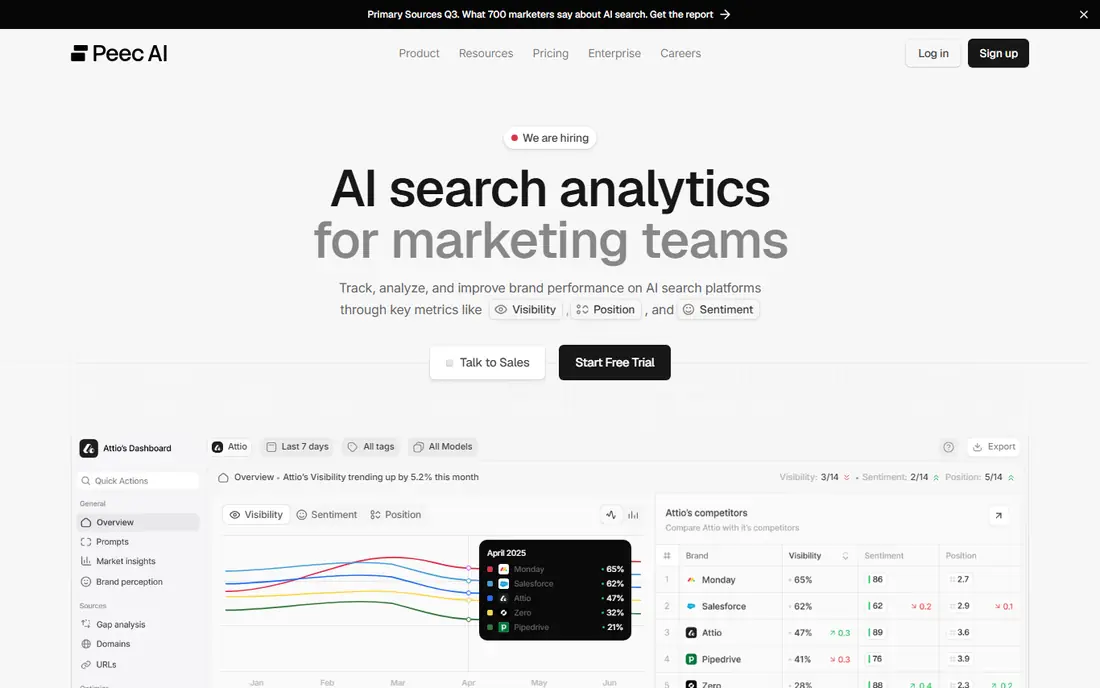
Peec AI tracks the prompts that define your brand and scores visibility, position, and sentiment. Its strength is prompt-level detail, which shows exactly which questions you win or lose. Compare at least two options on the same task, using the same sample project or data, so the comparison stays honest. Check the pricing page before you commit, since plans and limits change and the page you see at signup is the one that counts.
The catch is maturity: ask about data history and support before moving a large prompt set over. Note which features sit behind higher tiers, because the headline plan rarely includes everything shown on the marketing page.
Our view: shortlist this option if prompt and sentiment tracking is what you are buying for, and compare it head to head with one other option here. Look at how it handles your existing tools, because a product that fits your current setup saves more time than one with a longer feature list. If your team will use it daily, get one or two colleagues to try the same task in it and compare notes before you choose.
- Prompt-level tracking
- Visibility, position, and sentiment metrics
- Shareable reports
- Newer vendor, so long-term track record is shorter
- Pricing needs a sales page check
Profound
Ideal for: enterprise AI search analysis
Profound analyses billions of real user conversations to show how answer engines describe your category. Its strength is depth for large brands that need to act on findings, not just read dashboards. Check the pricing page before you commit, since plans and limits change and the page you see at signup is the one that counts. A clean export path matters, so confirm you can take your data out in a usable format if you later switch.
The catch is cost and complexity, since smaller teams may not need its full platform. A short trial or a free tier, where one exists, tells you more in a week than any feature list can.
Our view: this option earns its place here for buyers who put enterprise AI search analysis first, and it is worth a close look before you decide. If your team will use it daily, get one or two colleagues to try the same task in it and compare notes before you choose. Note which features sit behind higher tiers, because the headline plan rarely includes everything shown on the marketing page.
- Deep answer-engine analysis
- Conversation data
- Agent-led content actions
- Enterprise pricing and positioning
- Likely costly for small sites
Scrunch AI
Ideal for: AI visibility and content delivery
Scrunch AI helps brands measure visibility in AI search and prepare content for AI crawlers. Its strength is pairing measurement with content delivery, so fixes and tracking sit together. Support quality matters when something breaks, so read the help pages and the refund or cancellation terms before paying. Look at how it handles your existing tools, because a product that fits your current setup saves more time than one with a longer feature list.
The catch is clarity on pricing and starter plans, which are not obvious from the homepage. Read the privacy policy for any product that holds personal or business data, and confirm who can see that data and how long it is kept.
Our view: if AI visibility and content delivery is your main need, this option deserves a trial, with the trade-offs above kept in mind. Set a reminder to review the plan after the first month, when real usage shows whether the tier you picked still fits. Support quality matters when something breaks, so read the help pages and the refund or cancellation terms before paying.
- AI search visibility tracking
- Content optimisation for AI crawlers
- Enterprise features
- Homepage focuses on platform breadth, so plan details need a demo
Writesonic
Ideal for: AI visibility plus content fixes
Writesonic tracks AI visibility and then runs content and citation work to improve it. Its strength is the loop from insight to action, with reporting on traffic and pipeline effects. Watch for limits that only appear at scale, such as seats, projects, scans, or exports, since those decide the real monthly cost. Compare at least two options on the same task, using the same sample project or data, so the comparison stays honest.
The catch is scope creep: buyers who only want tracking may pay for features they never use. A clean export path matters, so confirm you can take your data out in a usable format if you later switch.
Our view: this option is a strong candidate when AI visibility plus content fixes matters most, provided the limits above fit your budget. If you rely on it for work, confirm uptime, backup, and account recovery options before moving anything important into it. Set a reminder to review the plan after the first month, when real usage shows whether the tier you picked still fits.
- Tracks AI platforms
- Content and outreach actions
- Traffic and pipeline reporting
- Broad platform can feel busy if you only want monitoring
- Pricing varies by plan
Brandlight
Ideal for: brand visibility in AI answers
Brandlight monitors how AI answers present your brand against competitors. Its strength is a focused brand view, which suits marketing teams reporting on share of voice. Compare at least two options on the same task, using the same sample project or data, so the comparison stays honest. Read the privacy policy for any product that holds personal or business data, and confirm who can see that data and how long it is kept.
The catch is public proof: fewer independent reviews exist, so use a trial to judge it yourself. Note which features sit behind higher tiers, because the headline plan rarely includes everything shown on the marketing page.
Our view: shortlist this option if brand visibility in AI answers is what you are buying for, and compare it head to head with one other option here. Look at how it handles your existing tools, because a product that fits your current setup saves more time than one with a longer feature list. A short trial or a free tier, where one exists, tells you more in a week than any feature list can.
- AI answer monitoring
- Brand and competitor tracking
- Reporting dashboards
- Less widely reviewed than larger rivals
- Pricing needs a direct check
How we picked these
We compared official feature pages, pricing pages, and public reviews for each tool. We looked for coverage of Google AI Overviews specifically, plus ChatGPT and Perplexity, for prompt tracking, citation sources, competitor comparison, and reporting. We did not run hands-on tests.
How to choose an AI overview monitoring tool
Start with the engines your buyers use. If Google AI Overviews drive your traffic, confirm the tool tracks them directly, not just general chatbot answers.
Build a prompt list from real customer questions, not just brand terms, since category questions reveal where competitors get cited and you do not.
Check reporting before you buy. You need trends over time, citation sources, and competitor views you can share with clients or managers without manual work.
Frequently asked questions
What does an AI overview monitoring tool track?
It runs your chosen prompts through AI search engines and records whether your brand appears, how it is described, and which sources get cited. Over time it shows trends, gains, and losses.
Why do AI overview results change so often?
AI engines update models, sources, and ranking signals frequently, and answers can vary by location and phrasing. That is why regular tracking beats a single snapshot.
Can these tools improve my visibility in AI answers?
They show where you are cited and which sources shape answers, which helps you fix content gaps. Most tools also suggest content changes, but they cannot guarantee a citation.
Do I need a separate tool if I already use an SEO tool?
Traditional SEO tools track blue-link rankings, while these tools track AI-generated answers and citations. Teams that care about AI traffic usually need both views.