Best Trip Planning App in 2026: 8 Apps Compared

- TripIt remains the best itinerary organizer, turning forwarded confirmations into a single trip timeline.
- Wanderlog is the best collaborative planner for group trips, with maps, budgets and shared lists.
- Roadtrippers suits road trips specifically, with route planning and stops along the way.
- Rome2Rio, Tripsy and PackPoint cover transport search, beautiful itineraries and packing respectively.
Quick comparison
| Product | Ideal for | Price from | Free version | |
|---|---|---|---|---|
 TripIt | Automatic itinerary organizing | Free | Yes | Visit |
 Wanderlog | Group trip planning | Free | Yes | Visit |
 Tripsy | Beautiful personal itineraries | Free | Yes | Visit |
 Roadtrippers | Road trip routes and stops | See website | Free trial | Visit |
 Rome2Rio | Transport between places | Free | Yes | Visit |
 PackPoint | Packing lists | Free | Yes | Visit |
 Google Travel | Free flight and hotel planning | Free | Yes | Visit |
 Kayak Trips | Bookings and price alerts | Free | Yes | Visit |
The best trip planning apps
A trip planning app turns scattered bookings, ideas and reservations into one itinerary you can actually follow on the road. The eight apps below cover flights, road trips, group planning and packing, and they differ in automation, collaboration and price. We compared official product pages, pricing pages and app listings.
TripIt
Ideal for: Automatic itinerary organizing
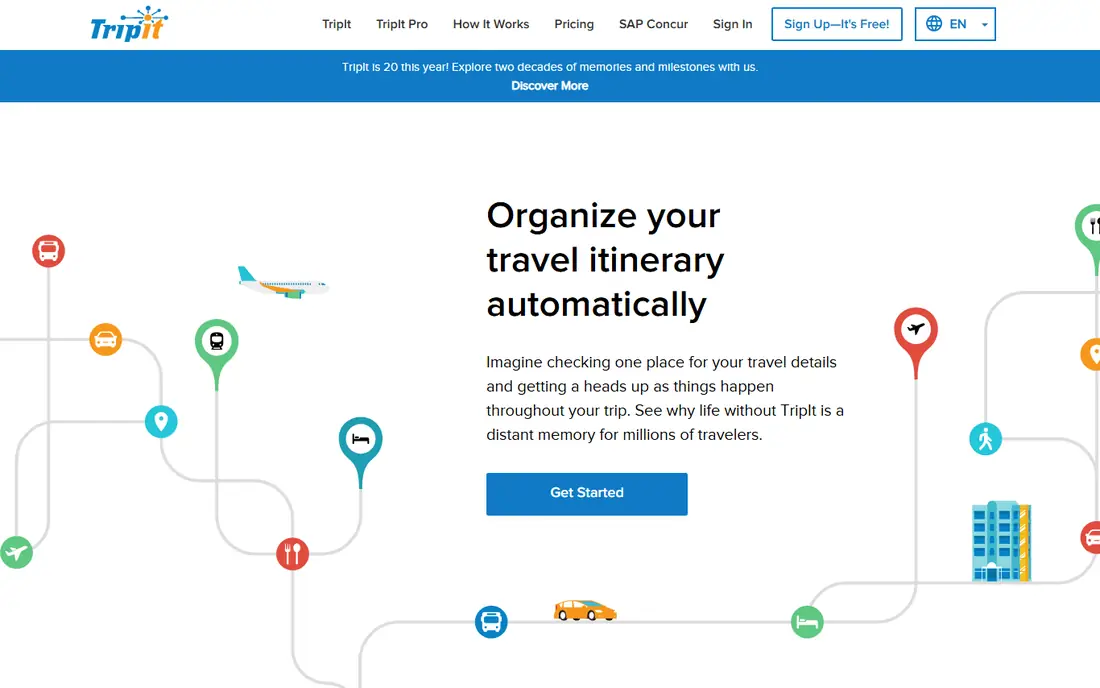
TripIt is the classic itinerary app: forward booking confirmations to it, and it builds a single timeline of flights, hotels, cars and activities, with maps, directions and sharing for travel companions. That automation saves the manual work of copying bookings into a document.
The free plan covers core itineraries, with Pro adding alerts, seat tracking and more. For a traveler whose bookings already exist and need organizing, TripIt is the easiest and most reliable choice.
- Auto-builds itineraries from forwarded confirmations
- One timeline for flights, hotels and cars
- Good sharing options
- Full features need Pro
- Less of a discovery or planning tool
Wanderlog
Ideal for: Group trip planning

Wanderlog is built for planning together: friends add places to a shared map, build day-by-day itineraries, split budgets and vote on ideas, all in one free workspace. Its map-first design suits road trips and city breaks where place order matters.
Booking organization is lighter than TripIt, so many travelers use both: Wanderlog for planning, TripIt for the final itinerary. For a group trip, Wanderlog is the best collaborative planner here.
- Collaborative maps, lists and budgets
- Free for core planning
- Good for road trips and city trips
- Booking management is lighter than TripIt
- Some features need Pro
Tripsy
Ideal for: Beautiful personal itineraries

Tripsy builds beautiful, timeline-based itineraries from bookings and manual entries, with flight tracking, weather, documents and offline access for travel days without signal. Its design makes a trip feel organized and pleasant to follow.
It is smaller than TripIt, and some features need Premium. For a traveler who wants a beautiful personal itinerary app, Tripsy is a polished alternative.
- Beautiful timeline itineraries
- Flight and hotel tracking
- Offline access
- Smaller community than TripIt
- Some features need Premium
Roadtrippers
Ideal for: Road trip routes and stops
Roadtrippers is the road trip specialist: enter start and end points, and it plans a route with interesting stops, attractions, restaurants and campgrounds along the way, estimating fuel and time. Its place database makes a drive feel like a journey, not just a commute.
It is strongest for US routes, and full features need a paid plan. For a road trip, no general itinerary app matches Roadtrippers for route discovery.
- Route planning with interesting stops
- Millions of places along routes
- Good for US road trips
- Best for US routes
- Full features need a paid plan
Rome2Rio
Ideal for: Transport between places
Rome2Rio answers the core travel question, how do I get from here to there, by searching flights, trains, buses, ferries and driving together, with prices and times compared side by side. Its global coverage suits complex multi-leg journeys.
Booking happens through partners rather than inside Rome2Rio, and it is not a full itinerary manager. As a transport planning companion, it is indispensable for many travelers.
- Searches flights, trains, buses, ferries and driving in one place
- Clear price and time comparisons
- Global coverage
- Booking happens with partners, not in-app
- Less of an itinerary tool
PackPoint
Ideal for: Packing lists
PackPoint builds a packing list from your destination, travel dates, weather forecast and planned activities, so you pack for the trip you are actually taking, not a generic list. Its checklist interface makes packing faster and less forgetful.
It covers packing only, so pair it with TripIt or Wanderlog for the full trip. For a traveler who always forgets something, PackPoint is a simple and effective fix.
- Smart packing lists from destination, weather and activities
- Easy checklist use
- Free core features
- Packing only, not full trip planning
- Premium needed for custom lists
Google Travel
Ideal for: Free flight and hotel planning
Google Travel bundles free flight search, hotel search, price tracking and trip itineraries, drawing on Gmail bookings to build timelines automatically. Its price tracking and explore tools help travelers find good fares and destinations.
Planning features are spread across Google services rather than one dedicated planner, and collaboration is lighter than Wanderlog. For a free, powerful planning companion, Google Travel is hard to beat.
- Free flight, hotel and trip tools
- Uses your Gmail bookings for itineraries
- Strong price tracking
- Planning features are spread across Google services
- Less collaboration than Wanderlog
Kayak Trips
Ideal for: Bookings and price alerts
Kayak Trips manages bookings and price alerts in one free place, drawing on Kayak's flight and hotel search strength. Travelers can track trips, watch prices and manage plans without a separate app for search and storage.
Itinerary design is lighter than TripIt or Wanderlog, so it suits travelers who mainly need booking tracking and alerts. For a free, search-linked trip manager, Kayak Trips is a practical choice.
A further preparation step is saving emergency information offline. Store passport copies, insurance details, embassy contacts and accommodation addresses in your trip app or a secure offline note, so a lost phone or dead battery does not leave you stranded. That preparation takes ten minutes and matters most exactly when other plans fail.
- Free trip management from bookings
- Price alerts for flights and hotels
- Good search heritage
- Less itinerary design than TripIt
- Features vary by region
How we picked these
We compared official product pages, pricing pages and app listings, focusing on itinerary building, collaboration, maps, offline access and price. We favored apps that are actively maintained today and solve a real travel job, from booking organization to route discovery.
We also tested the planning reality: an app that looks good with a demo trip but fails with real, messy bookings is not useful. Automation, sharing and offline access weighed heavily in our picks.
How to plan a trip with apps without losing the fun
Use one planner, one itinerary and one packing tool, not five overlapping apps. Wanderlog or Tripsy for planning, TripIt for the final itinerary, and PackPoint for packing covers most trips cleanly. Extra apps add copying work and version confusion.
Plan days loosely, not hourly
A trip planned hour by hour breaks at the first delay and stresses everyone. Plan one or two anchors per day, like a morning sight and an evening meal, and leave gaps for wandering, rest and discoveries. The best travel memories rarely come from a spreadsheet.
Share one source of truth for group trips
For group travel, agree on one shared planner, like Wanderlog, and keep bookings, budgets and decisions there. Group chats lose details, while a shared map and itinerary keep everyone aligned without constant re-explaining.
Download offline before you leave
Save itineraries, maps, tickets and packing lists offline before departure, since signal fails at airports, borders and rural roads. TripIt, Tripsy and Google Travel all support offline access for key details, and that preparation prevents travel-day panic. Also confirm cancellation and change policies for every booking before paying, since flexible fares cost more upfront but save far more when plans change unexpectedly. Also share your itinerary with a trusted person at home, including accommodation addresses and return dates, so someone can help if you lose your phone or miss a connection. That single habit has saved many trips from small disasters. Do it before every trip, without exception.
If you are still unsure, start with a free plan and move to a paid plan only when you hit its limits.
Frequently asked questions
What is the best trip planning app?
TripIt is best for organizing bookings into itineraries, Wanderlog for group planning, Roadtrippers for road trips, and Rome2Rio for transport search. Most travelers use two: one for planning, one for the final itinerary.
What is the best free trip planning app?
TripIt, Wanderlog, Tripsy, Rome2Rio, Google Travel and Kayak Trips all offer free plans that cover core planning. Wanderlog is the best free group planner, and TripIt is the best free itinerary organizer.
What is the best app for group travel planning?
Wanderlog is the best group planner, with shared maps, lists, budgets and voting. TripIt also shares itineraries well, but Wanderlog is built for collaborative planning from the start.
Can trip planning apps track flights?
Yes. TripIt Pro, Tripsy and Kayak Trips track flights with alerts, and Google Travel tracks bookings from Gmail. Free plans cover basic tracking, while Pro plans add delay and gate alerts.
Do trip planning apps work offline?
Many do for saved itineraries, maps and documents, including TripIt and Tripsy. Download everything before departure, since roaming and rural coverage can fail when you need details most.
What should I do if my flight is cancelled while traveling?
Check the airline app first for rebooking options, then contact the airline by phone or desk, and keep receipts for meals and hotels if the airline owes care. A trip app with your booking details handy speeds every step of rebooking.