Best Used Car App in 2026: 8 Apps Compared

- CarGurus and Autotrader offer the widest used-car listings with price ratings that flag good deals.
- Cars.com and Edmunds add strong research, reviews and pricing tools alongside listings.
- Carvana suits buyers who want delivery and a return window without visiting a dealer.
- TrueCar and Kelley Blue Book help with pricing transparency, while Facebook Marketplace suits local private deals.
Quick comparison
| Product | Ideal for | Price from | Free version | |
|---|---|---|---|---|
 CarGurus | Deal ratings and wide listings | Free | Yes | Visit |
 Autotrader | Largest listing selection | Free | Yes | Visit |
 Cars.com | Research plus listings | Free | Yes | Visit |
 Carvana | Buying online with delivery | Free | Yes | Visit |
 TrueCar | Transparent pricing | Free | Yes | Visit |
 Edmunds | Expert reviews and values | Free | Yes | Visit |
 Kelley Blue Book | Car values and pricing | Free | Yes | Visit |
 Facebook Marketplace | Local private deals | Free | Yes | Visit |
The best used car apps
A good used-car app does more than list cars: it shows fair prices, vehicle history, dealer ratings and financing options, so you can spot a good deal and avoid a bad one. The eight apps below are the most useful for US buyers in 2026, compared from official app pages, pricing tools and store listings.
CarGurus
Ideal for: Deal ratings and wide listings
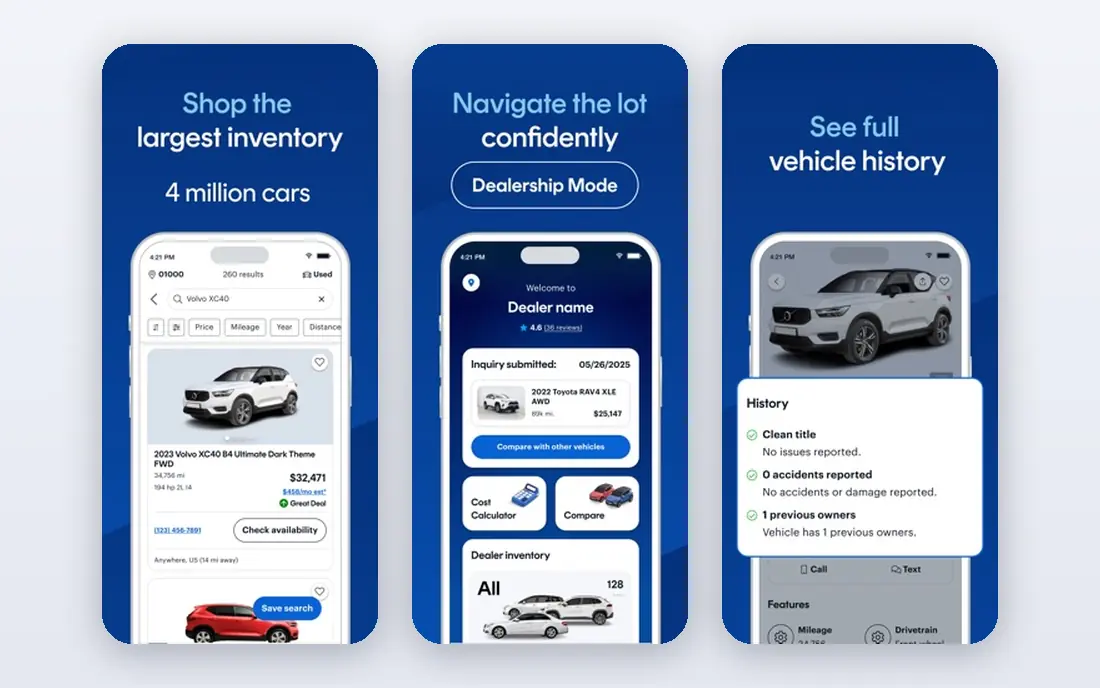
CarGurus is the first app many buyers open, thanks to its deal ratings: each listing is rated from overpriced to great deal against market data, which helps a buyer judge a price at a glance. Its listings cover dealers and private sellers nationwide, with price history and alerts for drops.
Listings can occasionally be outdated, so confirm availability before traveling. For a buyer who wants price confidence first, CarGurus is the strongest starting point.
- Deal ratings flag overpriced and good deals
- Very wide dealer and private listings
- Price history and alerts
- Some listings may be outdated
- Financing options vary by dealer
Autotrader
Ideal for: Largest listing selection
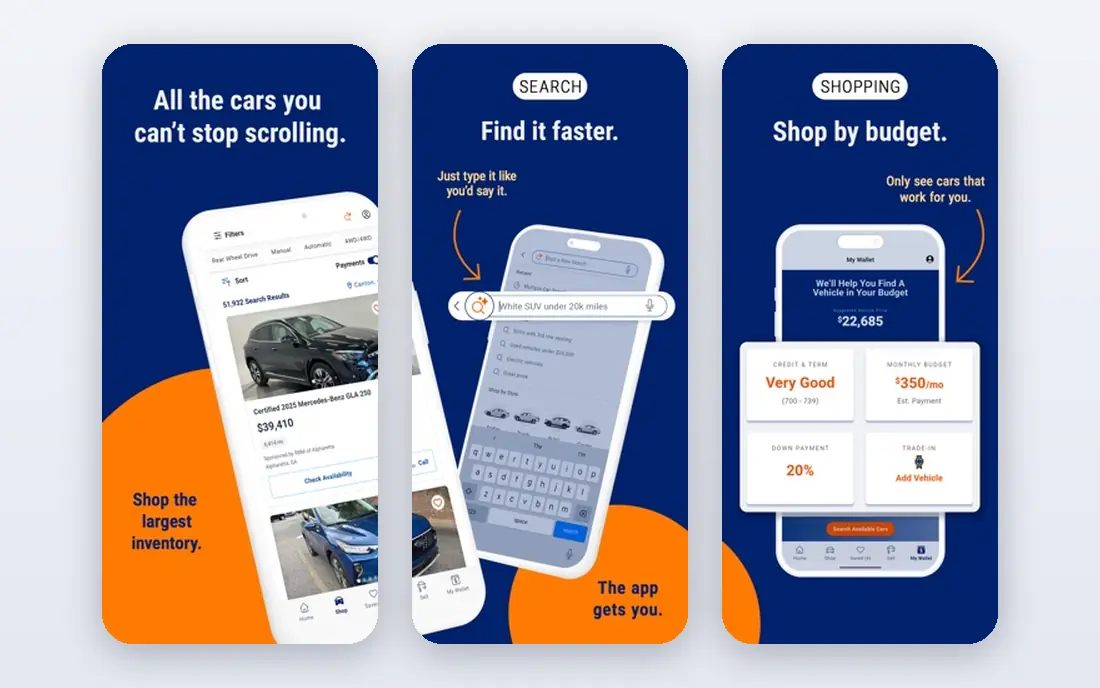
Autotrader offers one of the largest used-car inventories in the US, with detailed filters for price, mileage, features and location, plus research tools and vehicle history options on many listings. Its scale means rare models and trims appear here more often than on smaller apps.
The interface packs a lot in, which can feel busy on a phone. For a buyer who wants the widest choice and does not mind filtering, Autotrader is essential.
- Very large inventory from dealers and private sellers
- Detailed filters and research
- Vehicle history options
- Interface can feel busy
- Some features vary by listing
Cars.com
Ideal for: Research plus listings
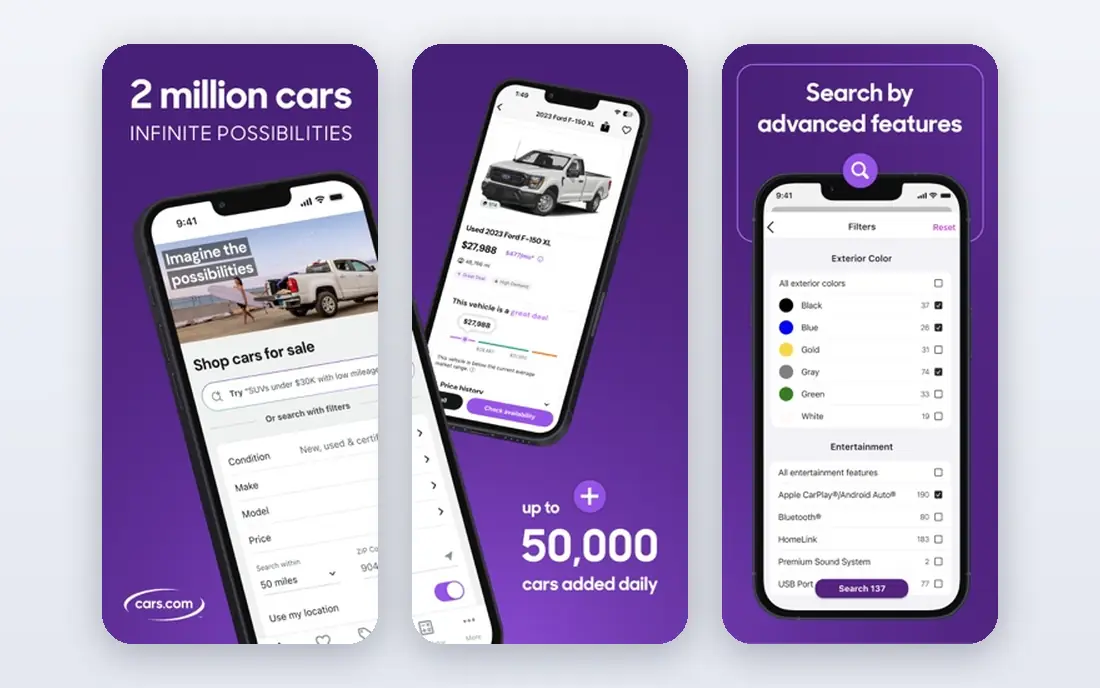
Cars.com pairs listings with research: expert and owner reviews, price comparisons and dealer ratings help a buyer judge both the car and the seller. Its search is clean, and its tools for comparing models side by side are genuinely useful.
Inventory can be slightly smaller than Autotrader in some regions, so cross-check both for rare cars. For a buyer who researches before visiting a dealer, Cars.com is a top choice.
- Strong reviews and research alongside listings
- Price comparisons
- Dealer ratings
- Inventory slightly smaller than Autotrader in some areas
- Some tools need an account
Carvana
Ideal for: Buying online with delivery
Carvana lets you buy a used car fully online, with delivery to your door or pickup from a vending machine location, plus a return window if the car does not suit you. Its no-haggle pricing removes negotiation stress, and its inventory is inspected and reconditioned before sale.
Prices can run higher than a private deal, and you cannot test drive before buying in the traditional sense. For a buyer who values convenience and a return option over the lowest price, Carvana is the leading online choice.
- Buy fully online with delivery or pickup
- Return window on purchases
- No-haggle pricing
- Prices can be higher than private deals
- Inspection is online, not in person
TrueCar
Ideal for: Transparent pricing
TrueCar focuses on price transparency, showing market average prices and price curves for models so buyers can see what others actually pay. Its certified dealer network adds a layer of accountability, and its tools help with trade-in values too.
Inventory leans dealer rather than private, so bargain hunters should also check Marketplace. For a buyer who wants to know a fair price before negotiating, TrueCar is a valuable tool.
- Shows market average prices
- Certified dealer network
- Price curve for models
- Inventory is dealer focused
- Fewer private listings
Edmunds
Ideal for: Expert reviews and values
Edmunds is best known for expert reviews, true market values and ownership cost estimates, which help a buyer judge a car's real worth and running costs. Its listings let you search cars alongside that research, keeping buying and learning in one place.
Listings are secondary to research here, so inventory depth trails Autotrader. For a buyer who wants trusted values and reviews before choosing, Edmunds is an essential research companion.
- Trusted expert reviews and true market values
- Listings plus research
- Ownership cost tools
- Listings are a secondary feature
- App experience varies
Kelley Blue Book
Ideal for: Car values and pricing
Kelley Blue Book, or KBB, is the name most Americans associate with car values, and its app gives trade-in, private party and retail values that buyers and sellers both reference in negotiation. Its listings and research tools round out the buying picture.
Values are guides based on market data, not guarantees for a specific car's condition, so inspect any car in person. For pricing confidence in a negotiation, KBB is the standard reference.
- Trusted KBB values for trade-in and retail
- Easy valuation tools
- Listings and research
- Values are guides, not guarantees
- App is research-first
Facebook Marketplace
Ideal for: Local private deals
Facebook Marketplace offers the largest local private inventory, often at lower prices than dealers, with direct messaging to sellers and filters for location and price. For a bargain hunter willing to inspect cars carefully, it is unmatched for local choice.
There is no dealer warranty or buyer protection, and scams exist, so meet in safe places, inspect thoroughly, check the title and history, and never pay before seeing the car. Used carefully, Marketplace is a powerful buying tool.
A further check before buying is insurance and running costs. Get an insurance quote for the exact model and year, check fuel economy, tire sizes and common repair costs, and add those figures to the purchase price over a year. A car that looks cheap can cost more monthly than a slightly pricier model with lower insurance and maintenance.
- Huge local private inventory
- Direct seller messaging
- Often the lowest prices
- No buyer protection like a dealer
- Scams and misrepresented cars need care
How we picked these
We compared official app pages, store listings and pricing tools, focusing on inventory size, price transparency, history and research features, and buying convenience. We favored apps that are actively maintained today and widely used by US buyers.
We also weighed safety: private deals carry risks that dealer platforms reduce, and we flag those differences wherever they matter for buyers.
How to buy a used car with an app without regret
Start with price, not with a car you love. Check CarGurus deal ratings, TrueCar market averages, Edmunds values and KBB values for the same model, and set a budget that includes tax, insurance and a pre-purchase inspection. Falling for a car before checking its price is how buyers overpay.
Always check history and inspect
Get a vehicle history report, check for accidents, title issues and recalls, and pay for an independent mechanic inspection before buying, especially for private deals. A clean-looking car can hide flood, frame or odometer problems that only an inspection reveals.
Test drive and compare at least three cars
Drive at least three examples of the model you want, including one you do not plan to buy, so you learn what normal feels like. Compare condition, tires, brakes and electronics across cars, not just price, since a cheaper car needing repairs costs more in the end.
Negotiate with data, not emotion
Bring printed values and comparable listings to the negotiation, and be willing to walk away. Dealers and sellers respect a buyer with data, and the best deal often comes from the second conversation, not the first. For online purchases, use the return window to inspect thoroughly on arrival.
Frequently asked questions
What is the best app to find used cars?
CarGurus and Autotrader offer the widest listings with price tools, Cars.com and Edmunds add research, and Facebook Marketplace offers the most local private deals. Use two apps together for the fullest picture.
What is the best app to check used car prices?
CarGurus deal ratings, TrueCar market prices, Edmunds true market values and Kelley Blue Book values together give a reliable price range. Check at least two sources before negotiating.
Is Carvana worth it for used cars?
Carvana suits buyers who value online convenience, delivery and a return window, though prices can be higher than private deals. Inspect the car thoroughly during the return window and compare its price with dealer listings.
Is Facebook Marketplace safe for buying cars?
It can be, with care: meet in safe public places, inspect the car and title, check history, and never pay before seeing the car. Avoid deals that pressure quick payment, hide the VIN, or offer prices far below market.
Should I get a used car inspected before buying?
Yes, always for private deals and usually for dealer cars too. An independent mechanic inspection costs far less than a hidden repair, and it gives strength in negotiation if issues are found.
Should I buy a used car from a dealer or privately?
Dealers offer more protection, warranties and financing, while private sellers often offer lower prices. Private deals suit buyers who inspect carefully and check history, while dealer purchases suit buyers who want recourse if problems appear.