8 Best Value AI Model Orchestration Platforms

- 1
 LiteLLMFree self-hosted gateway across 100 plus providersVisit
- 2
 LangfuseOpen source tracing and evals with no seat feesVisit
- 3
 LangSmithLangChain and LangGraph teams that want tracing plus deploymentVisit
- 4
 PortkeyGateway routing, guardrails and cost controlsVisit
- 5
 PromptLayerNon-technical teams versioning promptsVisit
- LiteLLM is free to self-host, and Langfuse Cloud starts at $29 a month with a free Hobby tier.
- LangSmith Plus costs $39 per seat a month, so count every invited teammate, while Langfuse charges no seat fees at all.
- Portkey and PromptLayer both start at $49 a month, each with a free tier.
- Helicone and Traceloop are open source options with free tiers, but both changed owners or roadmaps in 2026, so check their current status first.
- Every tool here works with your own model provider keys, so your model token bill stays separate from the platform fee.
Quick comparison
| Product | Ideal for | Price from | Free version | |
|---|---|---|---|---|
| LiteLLM | Free self-hosted gateway across 100 plus providers | $0 per month | Yes | Visit |
| Langfuse | Open source tracing and evals with no seat fees | $29 per month | Yes | Visit |
| LangSmith | LangChain and LangGraph teams that want tracing plus deployment | $39 per seat per month | Yes | Visit |
| Portkey | Gateway routing, guardrails and cost controls | $49 per month | Yes | Visit |
| PromptLayer | Non-technical teams versioning prompts | $49 per month | Yes | Visit |
 W&B Weave | Tracing and evals inside the Weights and Biases platform | $60 per month | Yes | Visit |
 Helicone | Request logging and cost tracking, self-hosted | $79 per month | Yes | Visit |
 Traceloop | OpenTelemetry tracing with OpenLLMetry | quote only | Yes | Visit |
The best value AI model orchestration platforms
LiteLLM
Ideal for: Free self-hosted gateway across 100 plus providers
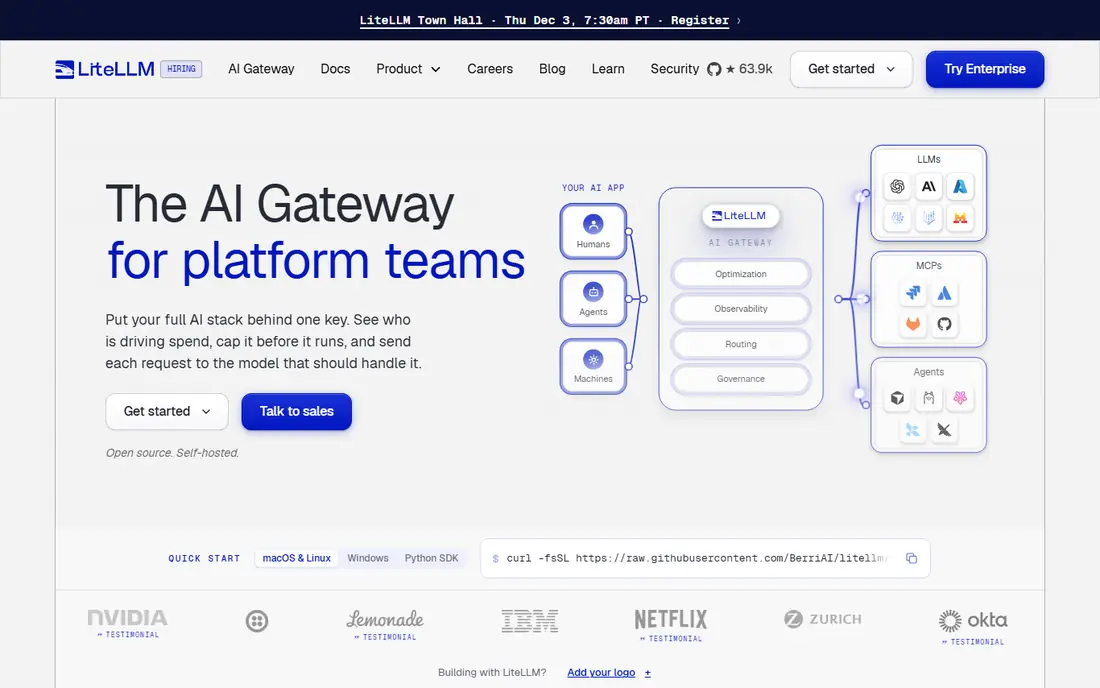
LiteLLM is the cheapest way to put one gateway in front of many model providers. The open source proxy is free forever when you self-host it, with virtual keys, users and teams, spend tracking, budgets, rate limits, LLM fallbacks, request logging and Prometheus metrics. You bring your own provider keys and pay each provider directly, with no per-token platform fee. That makes LiteLLM a strong pick for a solo developer or a small team that wants routing and spend control without a monthly platform charge.
The tradeoff is operational work. LiteLLM is free to run, but your team owns deployment, upgrades, backups and uptime. The vendor pricing page states that the open source version is really free for production, with no license fee, forever. Enterprise adds SSO and SCIM, audit logs, secret managers, org admins, a multi-region control plane, 24/7 support and air-gap deployment, priced annually by request capacity. A 30-day Enterprise trial key is available.
- Open source gateway with no license fee
- One OpenAI-compatible API for more than 100 providers
- Enterprise features such as SSO and audit logs need a custom contract
- You run, patch and monitor the gateway yourself
Langfuse
Ideal for: Open source tracing and evals with no seat fees
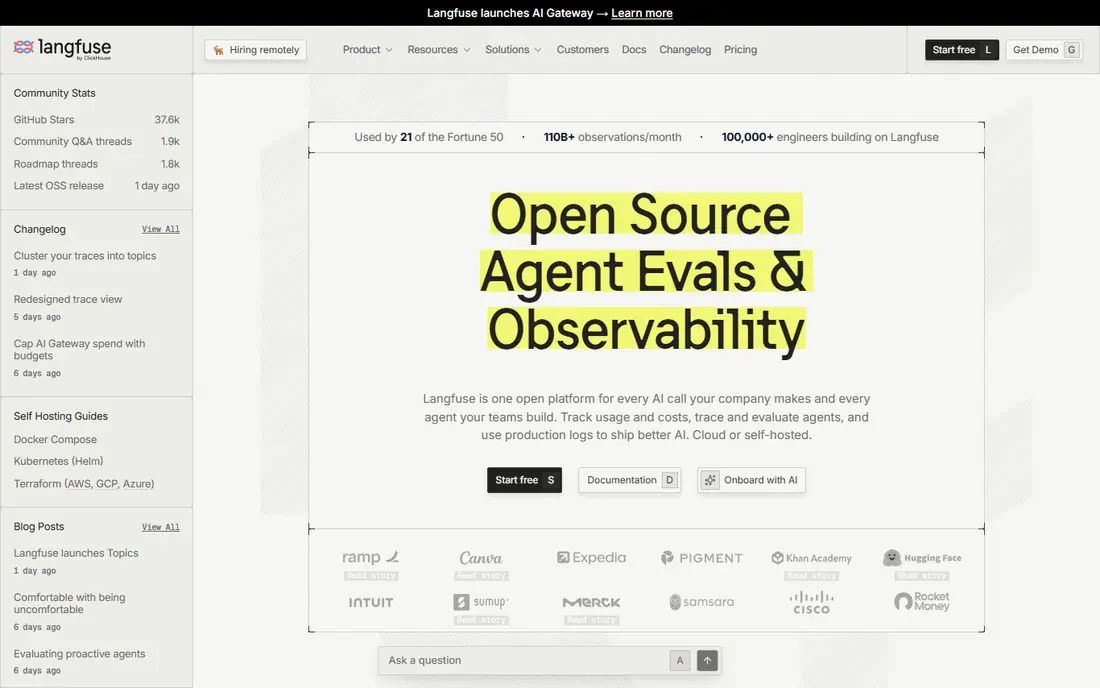
Langfuse is an open source platform for tracing, prompt management, evaluation, datasets, experiments and metrics. The Hobby plan is free with 50,000 units a month, 30 days of data access and 2 users, and Core costs $29 a month with 100,000 units, 90 days of data access and unlimited users. Pro costs $199 a month and Enterprise costs $2,499 a month. Usage beyond the included units costs $8 per 100,000 units, falling to $6 at very high volume. Because there are no seat fees, a whole team can look at traces without each viewer adding to the bill.
Langfuse works with more than 100 frameworks and providers, and stores traces in ClickHouse, which you can query with standard SQL when you self-host. The vendor states that the self-hosted core is MIT licensed and that Enterprise SSO and organisation-level access control ship in the free distribution. ClickHouse acquired Langfuse in January 2026, and the vendor states that licensing is not changing. Watch the unit meter closely: a unit is one trace, one observation or one score, so a busy agent run can use far more units than the trace count alone suggests.
- No seat fees on any plan, so reviewers cost nothing to add
- Self-hosted core is MIT licensed
- Every trace, observation and score counts as a billable unit, so one agent run can consume dozens of units
- Self-hosting needs a sizeable ClickHouse footprint
LangSmith
Ideal for: LangChain and LangGraph teams that want tracing plus deployment
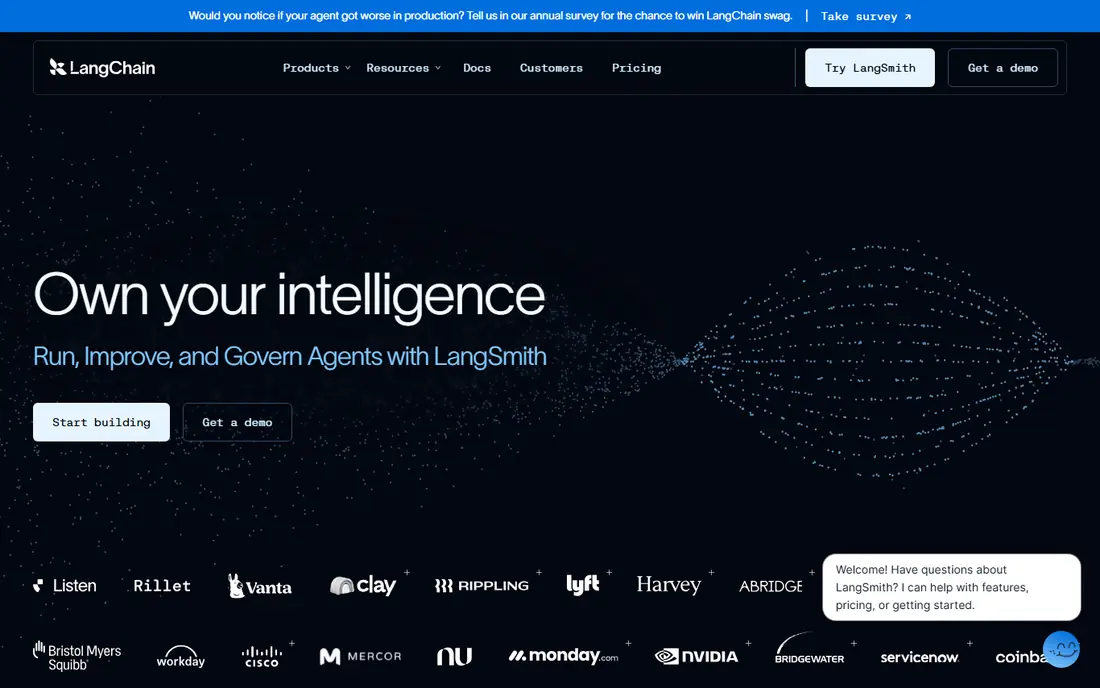
LangSmith is LangChain's platform for tracing, evaluation and deployment of agents. The Developer plan is free for one seat with up to 5,000 base traces a month, then usage charges apply. Plus costs $39 per seat a month with up to 10,000 base traces a month, unlimited seats, access to Deployment, Engine and Fleet, and one free small serverless deployment. Enterprise is custom priced with self-hosted and hybrid options, custom SSO and a support SLA. Usage beyond the included traces and compute is metered in LangChain Standard Units, where 1 LSU costs $1.
LangSmith is the natural pick if your agents already run on LangChain or LangGraph, because tracing starts with a single environment variable and the same platform can host the agent, run evaluators and watch production traces for failures. The cost to watch is the seat meter: the vendor bills seats on invitations, so every reviewer and teammate you invite adds $39 a month. Base traces are kept 14 days, and keeping them for 180 days is a per-trace upgrade. Model token costs are billed by your provider and are not included, except inside Fleet.
- Deep integration with LangChain and LangGraph through one environment variable
- Includes a free small serverless deployment on Plus
- Every invited user adds a $39 monthly seat fee, so a 10-person team is $390 a month before usage
- Base traces are kept only 14 days
Portkey
Ideal for: Gateway routing, guardrails and cost controls
Portkey is an AI gateway that routes requests across more than 1,600 models from providers such as OpenAI, Anthropic, Google, AWS Bedrock and Azure OpenAI, behind one unified API. The Dev plan is free forever with 10,000 recorded logs a month, 3-day log retention and up to 3 prompt templates. Pro costs $49 a month with 100,000 recorded logs, 30-day retention, role-based access, LLM guardrails and semantic caching. Overage costs $9 a month for every extra 100,000 requests, up to 3 million. Enterprise is custom priced with SSO, VPC hosting, audit logs and compliance certificates.
Portkey adds automatic fallbacks, load balancing, conditional routing, automatic retries, request timeouts, key management and spend tracking at the gateway layer, so governance applies to every request by default. The gateway core is open source under the MIT license, and Palo Alto Networks acquired Portkey in 2026, folding it into Prisma AIRS as the AI gateway. The free Dev tier is generous for testing, but the 3-day retention and the hard 10,000 log cap mean production teams will need Pro.
- Free Dev tier with 10,000 requests a month
- Semantic caching and LLM guardrails on the Pro plan
- Dev tier allows no overage and keeps logs only 3 days
- Pro overage costs $9 for every extra 100,000 requests
PromptLayer
Ideal for: Non-technical teams versioning prompts
PromptLayer is a prompt management platform with a visual editor, a prompt registry, evaluations, request logging and agent tracing. The free plan covers 5 users, 2,500 requests a month, 250 evaluation cell executions a month, 10 MB datasets and 10 prompts. Pro costs $49 a month with unlimited prompts, workspaces and playgrounds, 150 MB datasets and usage charges of $0.003 per transaction. Team costs $500 a month for 25 users, 100,000 or more requests a month and usage charges of $0.002 per transaction. Enterprise is custom priced with role-based access, deployment approvals and HIPAA with a BAA.
PromptLayer suits product teams where the people who know the right answer are not the people writing code, because domain experts can edit and version prompts, run evaluations and review logs without touching a repository. It is bring-your-own-key, so your model calls never route through PromptLayer servers. The pricing gap is the weak point: a team that outgrows Pro faces a jump to $500 a month with nothing between the two tiers.
- Visual prompt editor that non-engineers can use without code
- Prompt registry with versions, diffs and release labels
- Team plan jumps to $500 a month, a 10x step from Pro with no tier between
- Free tier caps at 10 prompts and 2,500 requests a month
W&B Weave
Ideal for: Tracing and evals inside the Weights and Biases platform
W&B Weave is the tracing and evaluation surface of Weights and Biases, now part of CoreWeave Forge. The free tier includes 5 seats, 5 GB of storage a month and 1 GB of Weave ingestion a month. Pro starts at $60 a month flat for up to 10 seats, with 100 GB of storage and 1.5 GB of Weave ingestion, then $0.10 per MB of extra ingestion. Enterprise is custom priced with single-tenant deployment, HIPAA compliance, customer-managed encryption keys, SSO and audit logs. Pro is limited to early-stage teams with fewer than 50 employees.
Weave traces LLM calls and agent steps, scores responses with LLM-as-a-judge and code evaluators, and tracks experiments and datasets in the same workspace. That combination suits teams that already track model training in Weights and Biases and want their LLM work in the same place. The cost driver is ingestion volume: traces carry full prompts and tool outputs, so a team logging 10 GB a month would face a large overage bill on Pro. Measure your monthly ingestion in megabytes on the free tier first.
- Free tier includes 1 GB of Weave ingestion a month
- Eval leaderboards and guardrail scorers included
- Ingestion overage costs $0.10 per MB beyond the included 1.5 GB on Pro, so heavy tracing gets costly fast
- Weave has no standalone plan
Helicone
Ideal for: Request logging and cost tracking, self-hosted
Helicone is an open source LLM observability platform and AI gateway that logs requests, tracks cost and latency, manages prompts and runs evaluations. The Hobby plan is free with 10,000 requests a month, 1 GB of storage, 1 seat and 7-day data retention. Pro costs $79 a month with unlimited seats, alerts, reports, HQL query access, 1-month retention and 1,000 logs per minute of ingestion. Team costs $799 a month with 5 organisations, SOC 2 and HIPAA compliance. Usage beyond the included 10,000 requests is billed on top of the plan fee.
Helicone is still a sound choice for self-hosting, because the Apache 2.0 code has no request cap and you can run it on your own infrastructure. The hosted service is a different story: Mintlify acquired Helicone in March 2026 and moved the hosted product into maintenance mode, with security fixes and new-model support continuing but no new features planned, and new hosted signups are disabled.
- Open source under Apache 2.0 with no request cap when self-hosted
- One-line proxy setup for logging
- Hosted product is in maintenance mode and new hosted signups are disabled
- Free tier keeps data only 7 days
Traceloop
Ideal for: OpenTelemetry tracing with OpenLLMetry
Traceloop is an LLM observability platform built on OpenTelemetry, and OpenLLMetry is its open source instrumentation library. The free tier is free forever with 50,000 spans, monitoring and evaluation dashboards, CI/CD integration and prompt management, with 24-hour data retention. Enterprise is custom priced with unlimited seats, custom retention, SOC 2 and on-premise deployment. There is no published list price for a hosted plan between the free tier and Enterprise, so teams should request pricing early.
OpenLLMetry is the part most teams will value: it instruments LLM calls, vector databases and frameworks such as LangChain and CrewAI, and it can send traces to Traceloop or to Datadog, Grafana, Honeycomb or any other OpenTelemetry backend. That makes it a low-risk way to start tracing, because your instrumentation survives a change of backend. The vendor site states that Traceloop is joining ServiceNow, with OpenLLMetry staying open source, so check the current ownership and roadmap before you commit to the hosted platform.
- OpenLLMetry is free Apache 2.0 instrumentation for more than 20 providers and frameworks
- Traces can go to any OpenTelemetry backend
- No published price for the hosted platform beyond the free tier, so Enterprise is custom
- Free tier keeps data only 24 hours
How we chose
We compared vendor pricing pages, documentation and feature lists for each tool, and we checked each homepage to confirm the product is live. We favoured tools with a free tier or a low entry price, because this list is about value. We recorded the entry monthly price from the vendor pricing page, noted what the free tier includes, and checked self-hosting options. We did not run hands-on tests. Prices change often, so confirm the current figure on the vendor pricing page before you buy.
What to check before you buy
Check four things before you commit. First, work out your real monthly volume in the unit the vendor bills: traces, logs, requests, spans and ingested megabytes are not the same event. Second, count seats, because a per-seat fee multiplies fast when reviewers join. Third, check retention, because a 7-day or 14-day window may be too short for debugging last month's incident. Fourth, confirm the exit path: open source code and OpenTelemetry export keep your traces portable.
| Team size and budget | Best pick | Why it fits | Monthly cost to expect | | Solo developer, $0 budget | LiteLLM self-hosted | Full gateway with no license fee | $0 plus your server and model bills | | Solo developer, small budget | Langfuse Hobby or Core | Free 50,000 units, then $29 a month | $0 to $29 | | Small team, under $50 a month | Langfuse Core | Unlimited users, no seat fees | $29 plus unit overage | | LangChain team, 2 to 5 seats | LangSmith Plus | Deep LangGraph integration and deployment | $78 to $195 in seat fees plus usage | | Product team editing prompts | PromptLayer Pro | Visual editor for non-engineers | $49 plus $0.003 per transaction overage | | Team already on Weights and Biases | W&B Weave Pro | Tracing and evals in the same workspace | $60 plus $0.10 per MB overage | | Team that self-hosts everything | Helicone or Traceloop open source | No platform fee, full control | $0 plus your infrastructure |
Frequently asked questions
What is an AI model orchestration platform?
An AI model orchestration platform sits between your application and your model providers and manages routing, prompts, tracing, evaluation and cost control in one place. It lets you switch models, retry failed calls, cache repeated prompts, version prompts, score outputs and see what each request cost. Most tools here work with your own provider keys.
Which tool on this list is cheapest to start with?
LiteLLM is cheapest to start with, because the open source gateway is free forever when you self-host it, with no license fee and no per-token platform fee. Langfuse Hobby is the cheapest hosted start, with 50,000 units a month free and no card required. Pick LiteLLM if you can run a server, and Langfuse if you want hosted tracing with no setup.
How much should a small team budget each month?
A small team can start at $0 on a free tier and should budget $29 to $60 a month once traffic grows. Langfuse Core at $29 covers unlimited users, Portkey Pro and PromptLayer Pro both cost $49, and W&B Weave Pro starts at $60. Add your model token bill on top. Measure one month of real traffic first.
Do I need to self-host to get good value?
No, self-hosting is not required. Langfuse, LangSmith, Portkey, PromptLayer and W&B Weave all offer hosted free tiers, with entry plans from $29 to $60 a month. Self-hosting saves the platform fee but adds server, upgrade and monitoring work, so it only wins when someone on your team owns that work. Start hosted, and move to self-hosting only if the hosted bill grows past the cost of running it yourself.
What is the difference between traces, logs and spans?
A trace records one full run of your application. A log is a single recorded request or event, often one model call. A span is one step inside a trace. Vendors bill different units, so compare carefully: Langfuse bills every trace, observation and score, while LangSmith bills whole traces and Portkey bills recorded logs.
Which tool is best for prompt versioning?
PromptLayer is the best pick for prompt versioning on this list, because the prompt registry is its core product, with versions, diffs, release labels and a visual editor that non-engineers can use. Langfuse and LangSmith also version prompts and link each version to traces and scores. Choose PromptLayer when product managers or domain experts own prompt wording, and Langfuse when prompts sit inside a wider tracing workflow.