Best Value ETL Software for Startups Compared

- Airbyte has the cheapest managed start at $20 a month, and Meltano costs $0 in licence fees if you self-host it.
- Fivetran and Hevo Data both offer real free tiers, up to 500,000 monthly active rows on Fivetran and up to 1 million events a month on Hevo.
- Row, event, and credit meters all punish chatty sources, so count changed rows and events before you pick a plan.
- Portable at $1,800 a month and Integrate.io at $1,999 a month only make sense once volume is high enough that a flat fee beats a meter.
- Talend is quote only and built for large estates, so shortlist it for later, not at seed stage.
Quick comparison
| Product | Ideal for | Price from | Free version | |
|---|---|---|---|---|
 Airbyte | Cheapest managed start with 700+ connectors | $20 per month | Yes | Visit |
 Meltano | Technical teams that want $0 licence fees | $0 per month | Yes | Visit |
 Fivetran | A generous free tier on a managed platform | $5 per connection/month | Yes | Visit |
 Hevo Data | No-code pipelines with a free tier | $299 per month | Yes | Visit |
 Stitch | Simple row-based pricing for small teams | $100 per month | Free trial (14 days) | Visit |
 Portable | Niche and long-tail SaaS connectors | $1,800 per month | Free trial (14 days) | Visit |
 Integrate.io | Flat-fee pricing at high volume | $1,999 per month | Free trial (14 days) | Visit |
 Talend | Large estates that need governance | quote only | Free trial (14 days) | Visit |
The best value ETL software for startups
Airbyte
Ideal for: Cheapest managed start with 700+ connectors
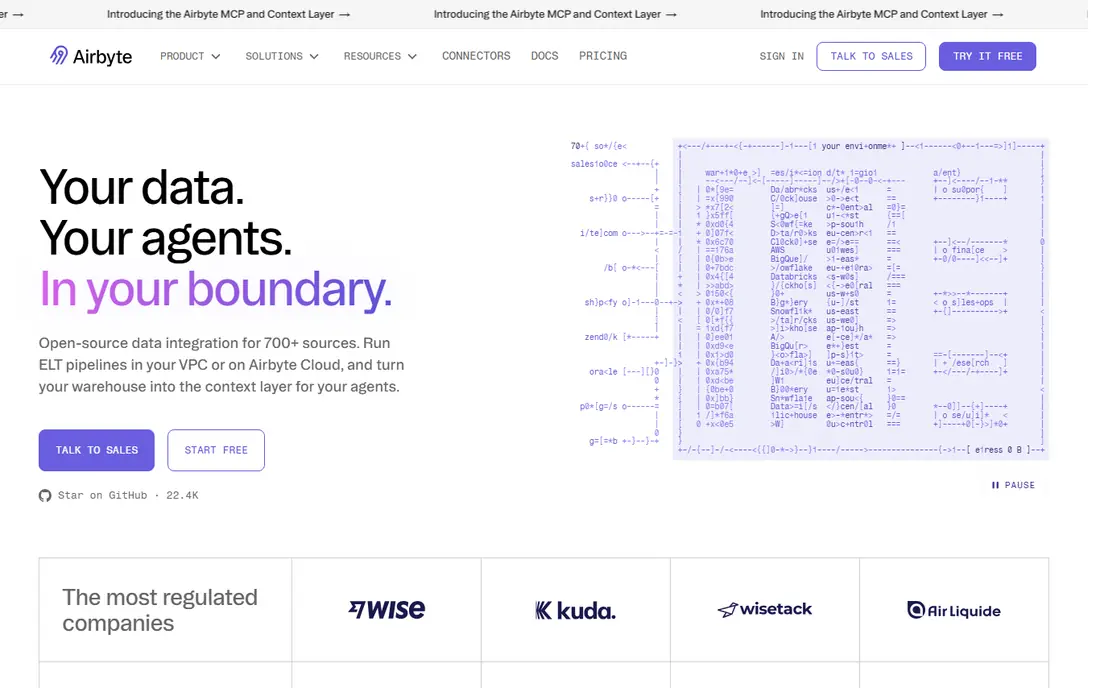
Airbyte is an open source data integration platform with more than 700 connectors, and it gives a startup two cheap ways in. Airbyte Core is free to self-host under the Elastic License 2.0, so a technical team can run pipelines on its own servers with no licence fee. Airbyte Cloud Standard starts at $20 a month, including 5 credits, with extra credits at $5 each, and new accounts get a 14-day trial with 400 credits.
The value case rests on the credit model, so read it before you commit. Credits are metered by source type, and the pricing page says teams using 40 or more credits a month usually find the Plus plan cheaper, starting with credit packages from $189 a month. The limit is predictability: a source that updates many rows can burn credits fast, Standard syncs only once an hour, and portal support runs 7am to 7pm EST with no first-response promise.
- Free self-hosted Core with 700+ connectors
- Managed Cloud starts at $20 a month with a 14-day trial
- Credit metering makes the bill hard to predict as volume grows
- Standard syncs only once an hour and support has no response-time promise
Meltano
Ideal for: Technical teams that want $0 licence fees
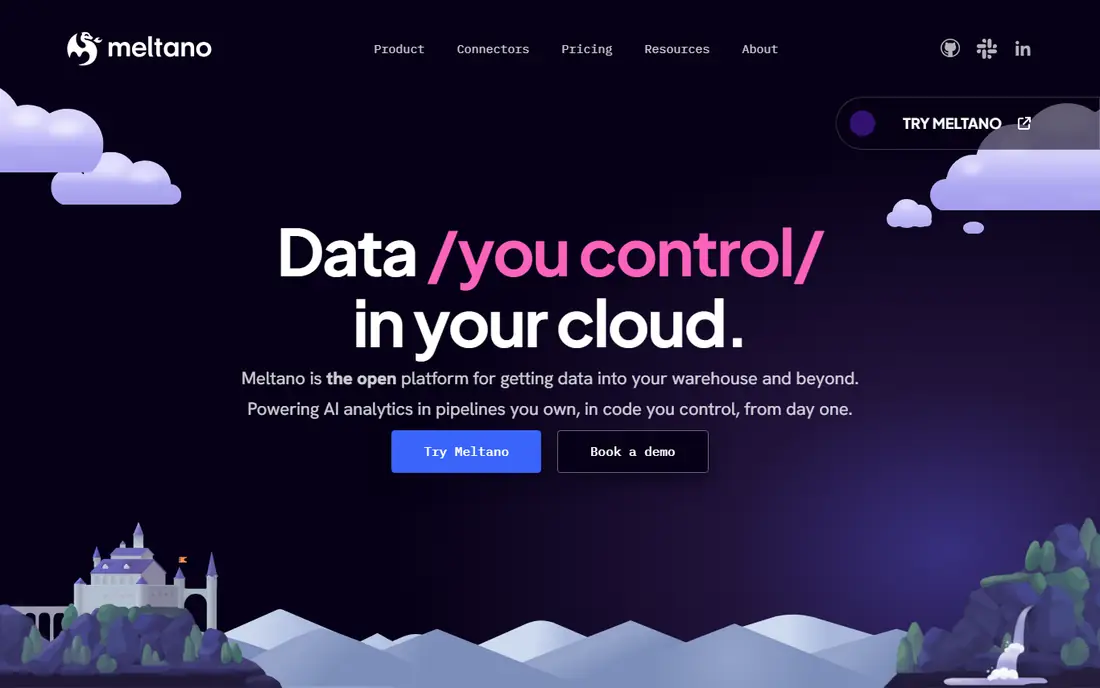
Meltano is the open platform for getting data into a warehouse, and its price is the simplest in this guide: $0. There is no licence fee and no vendor pricing page, because the software is open source and you run it in your own cloud. The homepage lists 600+ pre-built connectors across SaaS applications, REST APIs, files, and relational databases, with full, incremental, or log-based replication, and dbt is integrated for transformation.
The value case is strongest for a startup with an engineer who is comfortable with the command line and YAML. You pay only for the hosting you run, and costs stay tied to the workloads you actually run rather than to rows or events. The trade-off is that Meltano is batch only, with no streaming and no managed free tier, and you own upgrades, monitoring, and fixes. If no one on the team will own the pipeline code, a managed tool costs less in time.
- Open source with 600+ connectors and no licence fee
- Pipelines defined as code with dbt built in
- Batch pipelines only, with no streaming
- You host, run, and fix everything yourself
Fivetran
Ideal for: A generous free tier on a managed platform
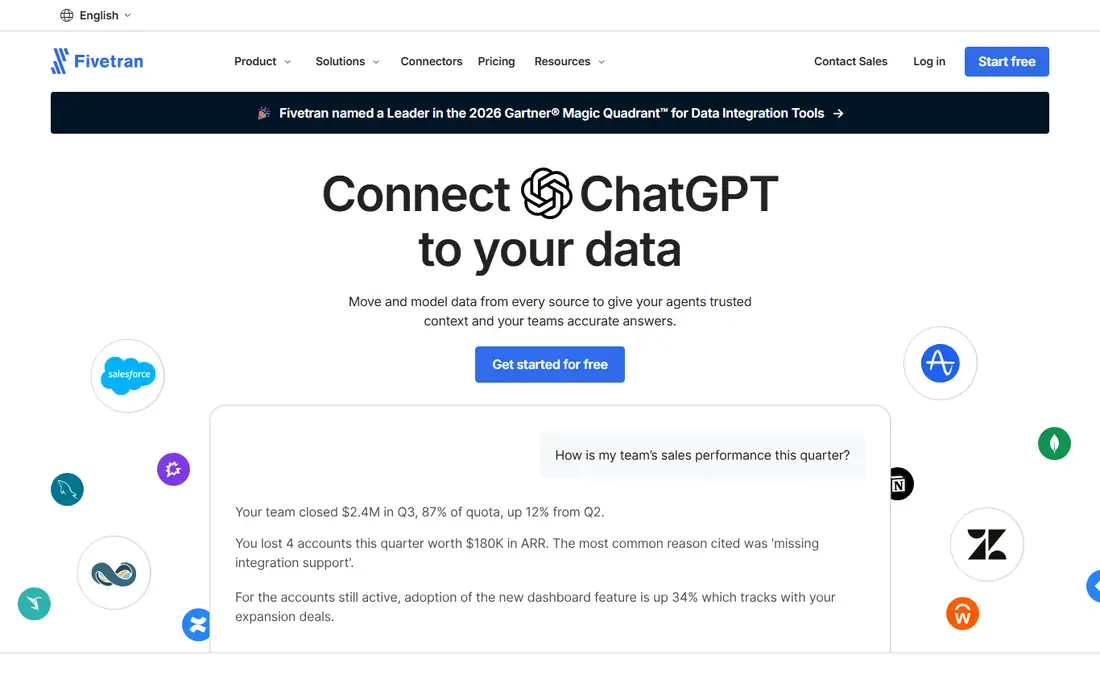
Fivetran is the managed ELT platform most startups meet first, and its free tier is the most generous managed offer in this guide. The Free plan includes all Standard features up to 500,000 connector monthly active rows, 3,500 activation monthly active rows, and 5,000 transformation model runs per month. The homepage lists 750+ fully managed connectors, and new accounts get a 14-day trial.
Once you outgrow the free tier, the meter matters. Fivetran bills by monthly active rows, counted per connection, with a $5 minimum charge per standard connection in the 1 to 1 million row band, while annual contracts start at a $12,000 minimum. Enterprise database connectors and hybrid deployment need Enterprise or Business Critical plans, and 1-minute syncs need Enterprise. Model the bill per connection, not per account.
- Free plan covers up to 500,000 monthly active rows with Standard features
- 750+ fully managed connectors
- Annual contracts carry a $12,000 minimum
- Enterprise database connectors and hybrid deployment need higher tiers
Hevo Data
Ideal for: No-code pipelines with a free tier
Hevo Data is a no-code, fully managed pipeline platform, and its free tier suits a startup that wants pipelines without writing code. The Free plan costs $0 and covers up to 1 million events a month for limited connectors, with up to 5 users, unlimited pipelines, and 1-hour scheduling. The Starter plan starts at $299 a month, opens all 190+ connectors, adds dbt Core integration and SSH and SSL support, and allows up to 10 users.
The main risk is the event meter. Every record inserted, updated, or deleted in the destination counts as one event, and usage above the plan quota is charged on demand on top of the plan. A source with frequent small updates can burn through a quota faster than its row count suggests. The free plan also limits connectors and syncs to once an hour, and streaming pipelines need the Professional plan, which starts at $549 a month.
- Free plan covers up to 1 million events a month
- No-code setup with 190+ connectors on Starter
- Event-based billing adds on-demand overage charges
- Streaming pipelines need the Professional plan
Stitch
Ideal for: Simple row-based pricing for small teams
Stitch is a cloud ELT service that replicates data from SaaS applications and databases into warehouses and lakes, and its pricing is the easiest to read in this guide. The Standard plan starts at $100 a month for 5 to 300 million rows a month, with 1 destination, 10 Standard sources, 5 users, a 7-day historical sync, and 7-day extraction log retention. Advanced is $1,500 a month billed annually, and Premium is $3,000 a month billed annually.
The value case is the low floor and the simple meter: the price only rises when row volume rises, and every new account gets a 14-day free trial with unlimited rows and no card required. The limits are the caps. One destination and 10 sources fit an early stack, but an eleventh source forces a tier change, and the 7-day historical sync limits backfills. Stitch is now part of Qlik, and its homepage steers new users toward Qlik Talend Cloud, so ask about the standalone roadmap first.
- Standard starts at $100 a month with a clear row scale
- 14-day trial with unlimited rows and no card required
- Standard allows only 1 destination and 10 sources
- Historical sync is limited to 7 days on Standard
Portable
Ideal for: Niche and long-tail SaaS connectors
Portable is an ELT platform built for the long tail of business applications, and its connector library is its main claim. The homepage lists 1,800+ prebuilt connectors, and the team builds custom connectors for sources it does not already cover. Pricing is flat per data flow with unlimited data volumes, so the bill never moves with row counts. Standard is $1,800 a month for 6 enabled flows with hourly syncs, Pro is $2,800 a month for 15 flows, and Advanced is $4,200 a month for 25 flows.
The value case only works when your startup depends on niche sources that mainstream tools do not cover. If your stack includes a vertical CRM or a specialist billing tool, Portable can connect it where a cheaper tool would need custom code. The entry price is the problem: at $1,800 a month for 6 flows, each flow costs about $300. Portable also sells only to companies based in the United States, and it does no transformation, so you still need dbt for modelling.
- 1,800+ connectors including niche sources other tools skip
- Flat per-flow pricing with unlimited data volume
- $1,800 a month entry price is far above a startup budget
- Sales are limited to companies based in the United States
Integrate.io
Ideal for: Flat-fee pricing at high volume
Integrate.io is a low-code data pipeline platform that covers ETL, ELT, change data capture, and reverse ETL in one product, with 200+ sources and destinations. The pricing page states a flat $1,999 a month, with unlimited data volume, unlimited pipelines, unlimited connectors, and unlimited users. There is a 14-day free trial with full access and no card required, and every account gets a dedicated Solution Engineer plus 24/7 support.
The value case is predictability at scale, and the vendor says so directly: at low volumes, usage-based pricing can cost less, while a fixed fee keeps the bill flat as sources, volume, and use cases grow. The fee covers ingestion, transformations, and reverse ETL together, where usage-based rivals bill each separately. For a seed-stage team, though, $1,999 a month is about 100 times the entry price of Airbyte Standard, and there is no free tier to grow into gradually.
- One flat $1,999 a month covers unlimited data, pipelines, connectors, and users
- ETL, ELT, CDC, and reverse ETL in one platform
- $1,999 a month is far above a startup budget
- No free plan, only a 14-day trial
Talend
Ideal for: Large estates that need governance
Talend is now sold as Qlik Talend Cloud, after Qlik acquired Talend, and the homepage presents it as a unified platform for integration, quality, and governance. It covers cloud, on-premises, and hybrid deployment, with tools for data integration, data quality, stewardship, lineage, and AI pipelines. The vendor site offers a trial of Qlik Talend Cloud, and the product is aimed at organisations that need trusted, governed data across many systems.
The problem for a startup is price transparency. Qlik publishes no price list for Talend, so the platform is quote only, and a buyer cannot model the cost without a sales conversation. The editions run from Starter for SaaS ingestion up to Enterprise for SAP and mainframe connectivity, so the platform is packaged for large estates rather than for a team with five sources. Know the name for later, but do not start here.
- Enterprise integration, data quality, and governance in one platform
- Cloud, on-premises, and hybrid deployment
- No published price, so a startup cannot budget without a sales conversation
- Enterprise scope is more platform than most startups need
How we chose
We compared vendor pricing pages, product documentation, and homepages for all eight platforms on 11 November 2026. We checked which vendors publish a price and which ask for a quote, and we marked every unpublished price as quote only rather than repeating third-party estimates as fact. We compared the free tier, the entry price, how the meter works, connector counts, and sync frequency. We did not run hands-on tests or negotiate quotes, so feature claims here come from vendor documentation.
What to check before you buy
Check the meter before the feature list. Count how many rows, events, or credits your sources will generate in a normal month, and include deletes and updates, not just new rows. Then check the caps: how many sources, destinations, and users the entry plan allows, how far back a historical sync reaches, and how often pipelines can run. Confirm which features sit behind a higher tier, and whether transformation is built in or needs dbt. Finally, run the free tier or trial on your two most active sources for two weeks, watch the meter daily, and only commit when the projected monthly cost fits your budget.
| Team size and budget | Best fit | Why | Watch out | | Solo founder, $0 to $50 a month | Meltano, Airbyte Core | No licence fee, you run it yourself | You own hosting, upgrades, and fixes | | 2 to 10 people, $20 to $150 a month | Airbyte Standard, Stitch Standard | Low entry prices and simple setup | Credit and row meters rise with volume | | 2 to 10 people, $0 while you validate | Fivetran Free, Hevo Free | Real free tiers with usable limits | Free caps end fast once syncs grow | | 10 to 30 people, $300 to $1,000 a month | Hevo Starter, Stitch Advanced | More connectors, faster syncs, more users | Event and row overages add up | | 30 or more people, over $1,800 a month | Portable, Integrate.io, Talend | Flat fees, niche connectors, or enterprise governance | High floors, get a written quote first |
Frequently asked questions
What is the cheapest ETL software for a startup?
Meltano is the cheapest, because it is open source with a $0 licence fee and you pay only for hosting. Airbyte is the cheapest managed option, with Cloud Standard at $20 a month and a free self-hosted Core. Fivetran and Hevo Data also cost $0 at first through free tiers, but their meters start charging once volume passes the free limits.
Is there really a free ETL tool for startups?
Yes. Meltano and Airbyte Core are free to self-host, with no licence fee. Fivetran Free covers up to 500,000 monthly active rows, and Hevo Free covers up to 1 million events a month. Each option has limits on connectors, sync frequency, or users, so check the caps and plan the upgrade path for the month your volume passes them.
How do ETL vendors charge, and which model suits a startup?
Vendors charge by rows, events, credits, or a flat monthly fee. Fivetran bills monthly active rows per connection, Hevo bills events, Airbyte bills credits, and Stitch bills rows. Portable and Integrate.io charge flat monthly fees of $1,800 and $1,999. A startup with low, steady volume usually spends least on a metered plan with a free tier.
How many connectors does a startup actually need?
Most startups need between 5 and 15 connectors: a CRM, a billing tool, a product database, one or two ad platforms, and a spreadsheet or file source. Count your sources before you compare connector libraries, because a library of 1,800 connectors adds no value if your five sources are covered by every tool.
When should a startup move from a free tier to a monthly plan?
Move when you hit a cap that blocks real work, such as the free row or event limit, the 1-hour sync floor, or the source limit on the free plan. Move sooner if you need faster syncs, single sign-on, or support with a response-time promise. Before you upgrade, test the trial on your busiest sources and check the projected monthly cost.